



Collectors' Checklist: 5 Majapahit Sculpture Types and Provenance
Collectors' Checklist: 5 Majapahit Sculpture Types and Provenance
Majapahit sculpture refers to the stone and terracotta artworks produced in East Java between the 13th and 15th centuries, during the Majapahit kingdom. Two materials define the tradition: hard volcanic stone, carved into attenuated guardian figures and deities, and low-fired terracotta, modeled into small, strikingly expressive heads and figurines.
Together they mark a turning point where Javanese art broke from Indian sculptural conventions toward something distinctly local.
Key Features:
- Most surviving terracotta fragments are small heads and figurines found mainly in Trowulan, with a majority broken at the neck due to their attachment points.
- Monolithic stone guardian figures are large, angular, and typically located near temples, serving protective and symbolic roles in architecture.
- Genuine Majapahit sculptures often display hand-modeling marks, seam lines, and a clay patina consistent with low-fired earthenware, with provenance records vital for authentication.
- The material sources include local volcanic stone for monumental figures and alluvial clay for terracotta, with limited evidence of imported finished sculptures.
- Majapahit style persisted in later Indonesian art, particularly in relief carving, storytelling, and performance traditions like wayang puppet theater.
Table of Contents
- What Is Majapahit Sculpture? Historical and Archaeological Context
- Stone Versus Terracotta: Materials, Sizes, and Techniques
- What Types of Majapahit Sculptures Exist?
- Iconography: Cap-Figures, Panji Tales, and Local Storytelling
- Where to See Majapahit Sculpture in Museum Collections
- Expert Insights and HD Asian Art’s Curatorial Perspective
- Authentication, Conservation, and Ethical Collecting
- Material Sourcing and Trade Influences on Majapahit Sculpture
- Carving and Finishing Techniques: Tools and Workshop Practices
- Symbolic Meanings Beyond the Obvious Iconography
- Preservation Challenges Facing Majapahit Sculptures Today
- How Majapahit Sculpture Shaped Later Indonesian Art
- Why Majapahit Sculpture Matters to Collectors and Scholars
- How HDAsianArt Helps You Collect With Confidence
- Sources
- FAQ
What Is Majapahit Sculpture? Historical and Archaeological Context
Majapahit rose in the late 13th century and reached its territorial peak under Hayam Wuruk in the mid 14th century, before fading by the early 1500s. Sculpture from this era sits at a hinge point in Indonesian sculpture history: it inherited technical vocabulary from Central Javanese and East Javanese predecessors, then pushed toward flatter, more angular, and more narrative forms.
Almost everything scholars know about the period’s smaller works traces back to one place.
- Trowulan, the presumed capital region, has produced the overwhelming majority of terracotta finds recovered from Majapahit-era house sites and temple compounds.
- Excavated material has scattered widely since the colonial era, ending up in the Trowulan Museum, Indonesian national collections, and Western museums.
- Stone sculpture, being harder to remove intact often stayed near temple sites or entered collections through more formal channels.
This dispersal explains why so much of what you can study today sits in museum databases rather than in situ. It also means an object’s findspot, when documented, carries real evidentiary weight, not just decorative interest.
Stone Versus Terracotta: Materials, Sizes, and Techniques
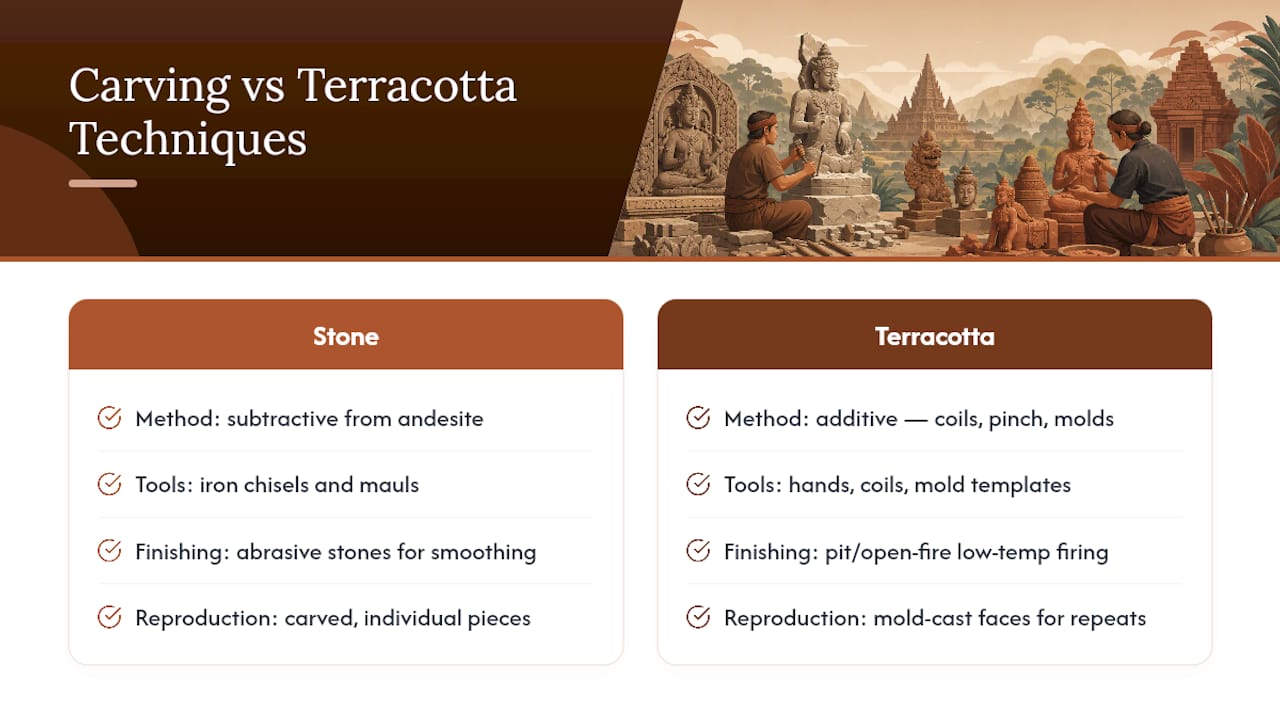
The two Majapahit media demanded almost opposite skills. Stone carving, worked in volcanic andesite, is subtractive: sculptors chiseled monumental guardian figures and deities down from a block, producing the elongated, angular silhouette that defines Majapahit stone carvings. Terracotta work is additive and far more intimate in scale.
- Sculptors built terracotta pieces through coil and pinch modeling, mold-casting for repeated forms like faces, or a combination of both, then dried and fired them at low temperatures.
- Hand-modeling leaves visible finger marks and asymmetry; mold-cast pieces show seam lines and more uniform mirrored features.
- Notably, no kilns have turned up in the archaeological record at Trowulan, which suggests firing happened in simple pit or bonfire conditions rather than dedicated workshops.
Terracotta heads typically measure a few centimeters, often under 10 centimeters, while larger architectural elements, like column surrounds and figural attachments, reach roughly 50 centimeters. That size gap matters for the archaeological record. Small terracotta pieces were often functional attachments, fixed to roof lines, columns, or vessels, rather than freestanding statues. When a building collapsed or was dismantled, those attachments snapped at their weakest point, the neck. That is why detached heads dominate what survives, far outnumbering complete figures.
What Types of Majapahit Sculptures Exist?
Majapahit cultural artifacts fall into a handful of recurring categories, each tied to a different use.
- Figurine and head fragments. Small terracotta heads, often broken at the neck, form the largest single category in museum holdings. Scholars debate whether some breakage was intentional, a form of ritual decommissioning, though most damage looks consistent with ordinary structural collapse.
- Animal forms. Piggy bank vessels, water buffalo, and Nandi-style bulls appear in terracotta and occasionally stone, often doubling as functional containers.
- Vessels and kendi. These spouted water containers combined ceramic function with decorative modeling, including human or animal-shaped spouts.
- Architectural surrounds and reliefs. Column surrounds, roof ornaments, and figures like Hariti, known locally as Men Brajut, decorated buildings while also serving structural roles.
- Monumental stone figures. Guardian statues, deified queens, and temple deities carved from andesite represent the tradition’s formal, public face, typically standing far larger than any terracotta piece and meant for lasting display rather than daily handling.
The contrast between the intimate terracotta pieces and the monumental stone guardians tells you something about Majapahit society itself: art operated at both the household and the state level, often at the same time.
Iconography: Cap-Figures, Panji Tales, and Local Storytelling
One detail separates Majapahit reliefs from earlier Javanese sculpture more reliably than almost anything else: the cap-figure. Characters wearing this distinctive headgear, rather than the crowns and diadems of Indian-derived deities, signal that a scene belongs to local narrative traditions rather than imported religious iconography, according to research on cap-figure motifs in Majapahit temple reliefs.
- Cap-figures anchor the Panji cycle, a set of East Javanese romance tales that appear across relief carving, standalone sculpture, and later wayang shadow puppetry, linking sculpture to a living performance tradition.
- Deity figures, by contrast, retain more Indian-influenced attributes, reflecting the religious syncretism of a kingdom that blended Hindu, Buddhist, and indigenous belief.
- Daily-life scenes, farmers, musicians, foreign traders, appear alongside sacred subjects, which is unusual for earlier Central Javanese temple art and points to a broadening of who and what counted as worth depicting.
This shift toward local storytelling is widely read as indigenization, a move away from earlier reliance on Indian sculptural models toward home-grown narrative and visual language.
Pro Tip: If you’re trying to date or place a Majapahit relief fragment, check the headgear first. A cap rather than a crown or diadem is one of the fastest ways to tell a Panji-cycle scene from an imported deity type.
Where to See Majapahit Sculpture in Museum Collections
Several public collections hold well-documented Majapahit pieces worth studying firsthand or online.
- The Metropolitan Museum of Art’s Column Surround with Pensive Woman shows a terracotta architectural attachment with a lightly modeled seated figure, a good example of how devotional and structural function overlapped.
- The Victoria and Albert Museum holds a monolithic stone guardian figure carved in the characteristic attenuated, angular Majapahit style, useful for seeing the stone tradition at full scale.
- The Smithsonian’s National Museum of Asian Art catalogs multiple 14th and 15th century terracotta heads, letting you compare mold-cast and hand-modeled examples side by side.
- LACMA’s catalog entry for a deified queen figure illustrates the funerary and commemorative role stone sculpture played for Majapahit royalty.
Each record typically lists dimensions, findspot when known, and acquisition history, details worth cross-referencing before drawing conclusions about any single piece.
Expert Insights and HD Asian Art’s Curatorial Perspective
The gallery researches, photographs, and describes each piece individually, a practice that matters more with Majapahit terracotta than with almost any other category, given how easily fragments get mislabeled or overdated.
A functional void where a piece once attached to a column or roofline, a mold seam running through a face, a patina consistent with low-fired earthenware fired centuries ago, these details separate a documented Majapahit fragment from a modern reproduction. Provenance records matter as much as the object itself.
Collectors examining Javanese Buddhist and Hindu sculpture should look for these condition markers before anything else. Pieces referenced elsewhere in this article, terracotta heads, column surrounds, monolithic guardians, serve as useful benchmarks for what genuine period work looks like.
Authentication, Conservation, and Ethical Collecting
Authenticating a Majapahit piece starts with the same details museum catalogers rely on.
- Check for hand-modeling marks (finger ridges, asymmetry) versus mechanical mold seams.
- Look for functional voids or attachment points suggesting architectural use rather than a purely devotional figure.
- Assess clay body and patina consistency with low-fired earthenware, since a mismatch is a red flag.
- Request documented provenance, ideally referencing prior museum or catalog citations, and avoid pieces with no export history.
Pro Tip: Never attempt to clean or repair a terracotta fragment yourself. Low-fired clay is porous and fragile, and amateur restoration can permanently obscure the tool marks and surface details specialists rely on for dating.
When in doubt, consult a specialist before buying or restoring anything.
Material Sourcing and Trade Influences on Majapahit Sculpture
Majapahit sculptors worked with what East Java’s geology offered. Volcanic andesite, abundant near mountains like Kelud and Arjuno, became the default stone for monumental guardian figures and temple reliefs, prized for its density and workability under chisel. Terracotta relied on local alluvial clay, plentiful in the lowland areas around Trowulan, which explains why terracotta production clustered so heavily around the capital region rather than spreading evenly across the kingdom.
Trade shaped the tradition in less obvious ways. Majapahit sat at the center of a maritime network stretching toward India, China, and the broader archipelago, and that exposure shows up in subtle stylistic borrowings rather than raw material imports. Chinese ceramic trade goods, recovered alongside terracotta figurines at Trowulan house sites, suggest artisans and merchants operated in close physical proximity, and some scholars read cross-pollination in decorative motifs on kendi vessels as a result. Indian religious sculpture supplied the initial iconographic vocabulary, crowns, mudras, deity attributes, that Majapahit stone carvers gradually reworked into flatter, more angular local forms.
What is notable is how little evidence exists for imported finished sculpture. Unlike ceramics, which traveled well and turn up in archaeological layers far from their kilns, Majapahit sculpture reads as fundamentally a local industry: local stone, local clay, local labor, with trade contributing ideas and trade goods rather than finished art objects. That self-sufficiency is part of why the tradition developed such a distinct visual identity so quickly.
Carving and Finishing Techniques: Tools and Workshop Practices
Stone carving in Majapahit Java followed a subtractive process built around progressively finer tools. Rough shaping likely used iron chisels and mauls to remove bulk material from an andesite block, roughing out the elongated, angular silhouette before finer chisels defined facial features, drapery folds, and ornamental detail. Final surfaces were smoothed with abrasive stones, a slow process that explains why monumental guardian figures represent significant labor investment, not casual craft.
Terracotta work followed a different rhythm entirely. Artisans built forms from local clay using coil construction for larger vessels, pinch modeling for small figures, and mold-casting for repeated elements like faces or decorative bands. Mold-cast faces let a workshop reproduce a popular design efficiently, which is likely why so many surviving terracotta heads share near-identical features, evidence of standardized production rather than one sculptor working alone on every piece.
Firing appears to have happened without dedicated kiln structures. The absence of kiln remains at excavated Trowulan sites points toward simpler pit-firing or open-bonfire methods, a lower-temperature process that produced the soft, slightly friable body typical of Majapahit terracotta today. That low firing temperature is also why so much surviving terracotta shows wear, chipping, and surface erosion; the material was never built for the kind of durability stone offers.
Workshop organization likely mixed both trades. Sites near Trowulan yielding both stone-working debris and terracotta fragments suggest some level of shared production space, even if the two crafts required entirely different skill sets and tools.
Symbolic Meanings Beyond the Obvious Iconography
Majapahit sculpture carried meaning that went beyond simply depicting a god or a scene. Terracotta figurines, in particular, functioned less as devotional objects and more as social documents, recording occupations, status markers, and even the presence of foreign traders within Majapahit society, according to field research on Majapahit terracotta figurines. A figurine dressed in particular clothing or holding a specific tool was not decoration; it was a record of who mattered enough to be depicted.
This social-document reading extends to religious syncretism as well. Majapahit blended Hindu, Buddhist, and indigenous ancestor traditions, and sculpture reflects that blend rather than picking one system cleanly. A single temple complex might house Hindu deities, Buddhist figures, and locally rooted spirits side by side, which tells you Majapahit religious life was not a matter of strict denominational lines.
Stone guardian figures carried a protective symbolic function tied to real architectural placement, positioned at gateways and thresholds to mark boundaries between sacred and ordinary space. Their exaggerated, angular ferocity was not simply an artistic choice; it served the practical religious purpose of warding off harmful forces at exactly the points where a temple compound was most vulnerable.
Even the piggy-bank and vessel forms carried meaning past their obvious function, potentially tied to ideas of household prosperity and ritual offering rather than pure practicality. Reading Majapahit sculpture only as devotional art or only as craft misses how thoroughly these categories overlapped in practice.
Preservation Challenges Facing Majapahit Sculptures Today
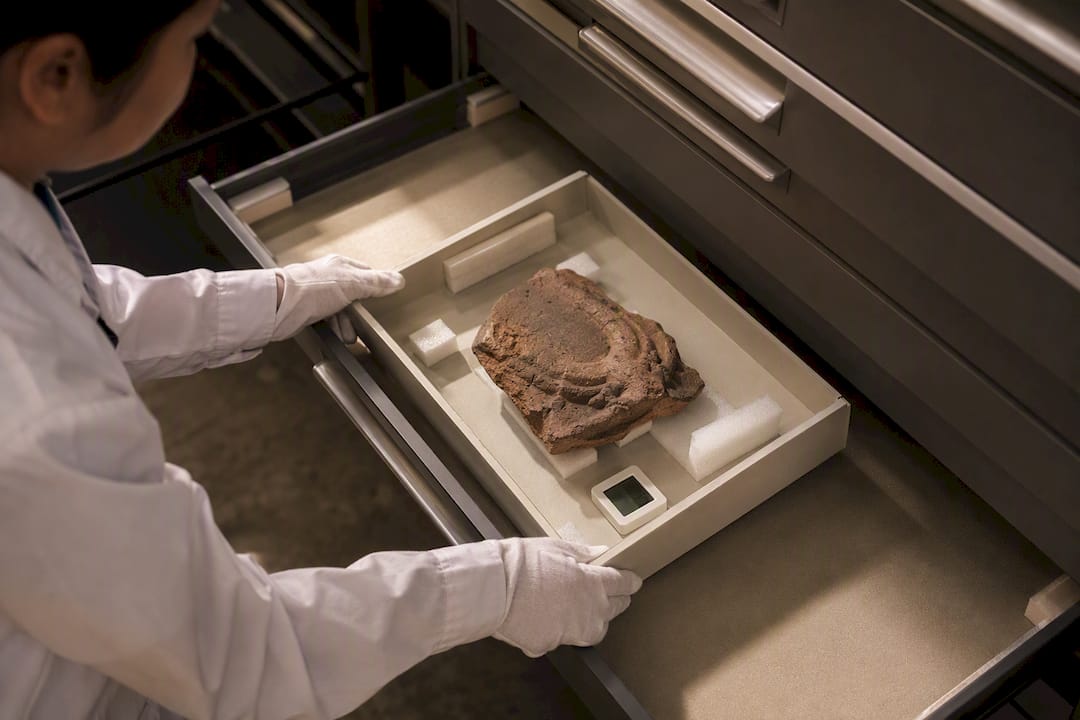
Terracotta’s fragility creates the single biggest preservation headache. Low-fired clay is porous, structurally weak, and prone to surface erosion, chipping, and salt damage, especially in pieces that spent centuries buried in East Java’s humid, mineral-rich soil. Once excavated, that same porosity makes terracotta highly sensitive to humidity swings, which is why museum storage protocols emphasize stable environmental conditions over aggressive cleaning.
Stone sculpture fares better structurally but faces its own threats. Andesite guardian figures and reliefs left exposed at temple sites endure weathering, moss growth, and, in some cases, deliberate damage or theft, since monumental pieces are harder to secure than small museum-held fragments.
Conservation practice for both materials leans conservative. Specialists generally avoid aggressive cleaning or reconstruction, since low-fired terracotta in particular can lose surface detail permanently under improper handling. Where restoration is necessary, reversible methods and clear documentation of what was original versus repaired are considered standard practice.
Archaeological context adds another layer of difficulty. Because so much Majapahit terracotta was recovered without careful stratigraphic recording, especially material excavated or sold decades ago, a meaningful share of surviving pieces lack reliable findspot data entirely. That gap is precisely why provenance documentation on any piece entering a private or museum collection carries so much weight: it may be the only surviving link between an object and its original context.
How Majapahit Sculpture Shaped Later Indonesian Art
Majapahit’s stylistic choices did not disappear when the kingdom declined in the early 1500s. The flatter, more angular figure style and the shift toward local narrative content carried forward into later Javanese and Balinese sculptural traditions, particularly in relief carving that continued to favor indigenous stories over imported Indian iconography.
The clearest continuity runs through performance culture. Panji-cycle stories, first solidified in Majapahit-era reliefs and cap-figure imagery, fed directly into wayang shadow puppetry traditions that remain active in Java today. That link between static sculpture and living performance art is one of the more remarkable through-lines in Indonesian sculpture history, connecting a 14th century temple relief to a puppet show still performed centuries later.
Balinese sculpture and temple architecture also absorbed Majapahit visual conventions, partly through the historical migration of Majapahit court culture to Bali as the kingdom weakened. Guardian figure placement, ornamental motifs, and certain proportional choices in Balinese temple carving trace recognizably back to Majapahit precedent.
Modern Indonesian cultural heritage institutions treat Majapahit material as foundational rather than transitional. Trowulan’s ongoing archaeological status and the steady museum interest in Majapahit terracotta and stone carving both reflect a broader recognition: this period marks the moment Javanese sculpture found a visual language distinctly its own, separate from the Indian-derived conventions that came before it.
Why Majapahit Sculpture Matters to Collectors and Scholars
Scholarship and collecting are not separate pursuits here. Every well-documented terracotta head or provenance-verified guardian figure adds to a fragile, incomplete archaeological record, which means treating these objects as historical evidence matters as much as appreciating their craftsmanship. Responsible collectors and careful museum documentation both push in the same direction: keeping context attached to objects that have already lost so much of it.
— James, HDAsianArt.com
How HDAsianArt Helps You Collect With Confidence
Sourcing genuine Southeast Asian sculpture without reliable documentation is where most collectors run into trouble, and it’s the single biggest risk in this category. The gallery researches, photographs, and describes each piece individually rather than relying on generic listings, which gives buyers the context a Majapahit-era object needs to be evaluated properly rather than guessed at.

The gallery’s curated Southeast Asian holdings include Majapahit-style bronze work, such as this antique Java-style standing bronze statue, alongside broader Indonesian and Javanese religious sculpture like this seated bronze preaching Buddha figure. Every listing ships worldwide with DHL insurance, so a piece arrives protected regardless of distance. If you want deeper background before buying, the gallery’s write-up on Indonesian Hindu sculpture is a useful next stop. Browse the full collection or reach out directly for condition and provenance details on any piece that catches your eye.
Sources
For readers who want to verify details or dig deeper, these are strong starting points.
- Column Surround with Pensive Woman | The Metropolitan Museum of Art
- Sculpture (V&A collection) — Monolithic guardian figure
- Terracotta — National Museum of Asian Art (Smithsonian)
- Majapahit Terracotta Figurines: Social environment and life (Neliti)
- Terracotta acquisitions (Asian Art Archive entry)
FAQ
What Were the Majapahit Known For?
Majapahit was a major East Javanese kingdom known for its wide trade influence and for producing a distinctive sculptural tradition in stone and terracotta marked by attenuated forms and local narrative subjects like the Panji cycle.
What Are Some Famous Sculptures From Indonesia?
Notable examples include monolithic Majapahit stone guardian figures held by the Victoria and Albert Museum, terracotta architectural pieces like the Met’s Column Surround with Pensive Woman, and Borobudur’s earlier relief carvings from Central Java.
Why Was It Called Majapahit?
Local tradition traces the name to a bitter-tasting fruit, the maja, that early settlers reportedly found in the area where the kingdom’s capital took root, giving rise to the name “Majapahit.”
What Are the Three Main Types of Majapahit Sculpture?
Most collections group the material into monumental stone figures, small terracotta heads and figurines, and terracotta architectural elements like column surrounds and reliefs, each serving a different social or religious function.
How Can You Tell if a Majapahit Terracotta Piece Is Authentic?
Look for hand-modeling marks or consistent mold seams, functional voids suggesting architectural attachment, and a clay body and patina consistent with low-fired earthenware, ideally backed by documented provenance.
