





Lokeshvara Iconography: How to Identify the Bodhisattva
Lokeshvara Iconography: How to Identify the Bodhisattva
Lokeshvara is a name for Avalokiteshvara, the bodhisattva of compassion. In sculpture the figure is identified by a cluster of attributes: a lotus, a small seated Amitabha Buddha on the crown, an antelope skin, a water vessel or rosary, and specific hand gestures. No single attribute settles the question. The combination does. This guide sets out those markers, what each signifies, how the major multi-armed forms differ, and how Khmer, Javanese, Nepalese and Tibetan examples vary. It is written for collectors and for buyers placing a statue in a home, spa, studio or hotel.
Key Features
- Lokeshvara (“Lord of the World”) is a common title for Avalokiteshvara. In art the two names usually refer to the same bodhisattva.
- The most reliable identifier is a small Amitabha Buddha in the crown or hair, read together with a lotus held by the stem.
- Gestures carry meaning: varada mudra signals boons and deliverance, and anjali mudra can enclose a jewel.
- Four-armed Shadakshari, eleven-faced and thousand-armed forms are recognized by arm count, face count and held objects.
- Style differs by region, so the same identifiers must be read through the local tradition: Gandharan, Gupta, Pala, Khmer, Javanese or Himalayan.
Table of Contents
- The name: Lokeshvara and Avalokiteshvara
- The core identifiers
- What the gestures and objects signify
- The major forms
- Regional variation
- Telling Lokeshvara from other figures
- Applying this to a statue or print
- Collecting Lokeshvara at HD Asian Art
- Our perspective
- FAQ
- Sources
The name: Lokeshvara and Avalokiteshvara
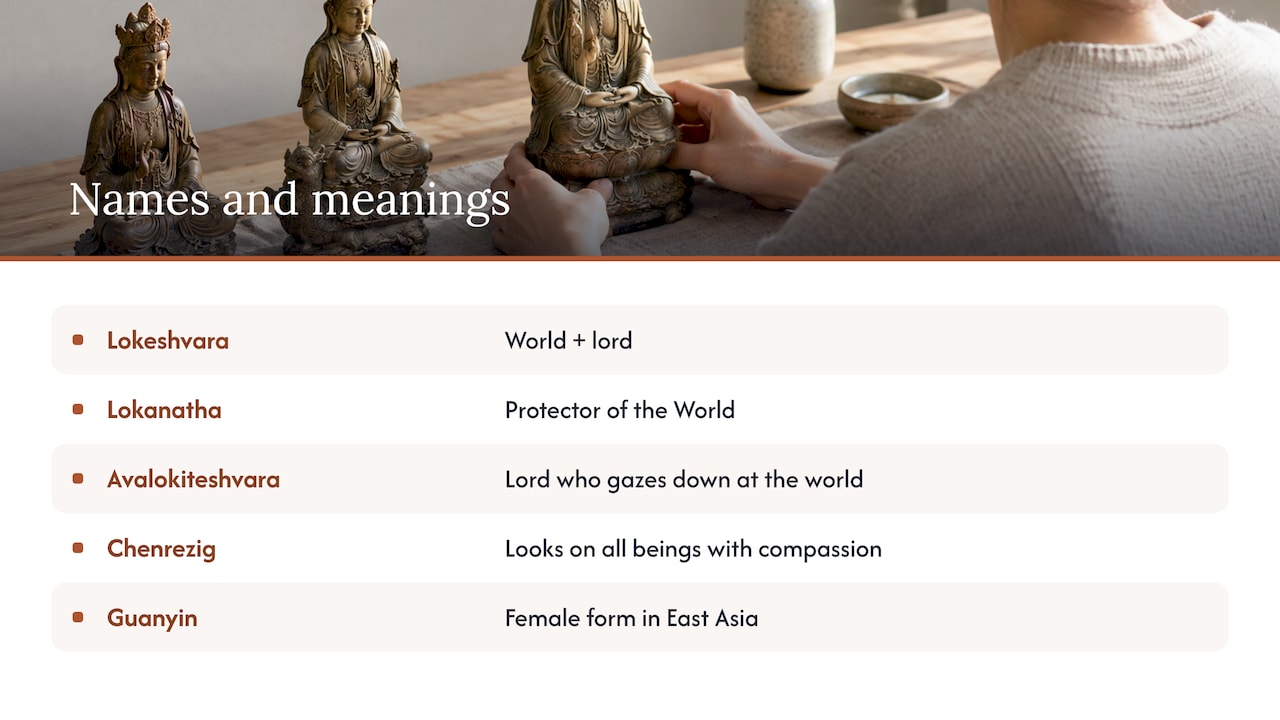
Lokeshvara (Lokeśvara) combines loka, “world,” and īśvara, “lord.” Encyclopedia of Buddhism lists it as a common title for Avalokiteshvara, with Lokanatha, “Protector of the World,” as a synonym. The Getty’s iconography record for Lokeshvara defines it as a male form of Avalokiteshvara.
The longer name Avalokiteshvara is usually translated as the lord who gazes down at the world. The Tibetan form is Chenrezig, one who looks on all beings with the eye of compassion, as summarized in Wikipedia’s entry on Avalokiteshvara.
The Getty’s Avalokiteshvara record describes the figure as the embodiment of the compassion of all Buddhas. It notes that the figure can be shown as male or female and that he vows to postpone his own Buddhahood until every being is liberated. In East Asia the figure became the female Guanyin, according to the Encyclopedia of Art.
One caution on terminology. The Tibetan Buddhist Encyclopedia notes that Lokeshvara can also be a respectful title for a buddha, and that Lokeshvararaja is a different figure: the buddha who predicted the future Buddhahood of Dharmakara. In a catalogue entry, “Lokeshvara” should therefore be read in context, with the iconography confirming the identity.
The core identifiers
Iconographic identification works from criteria set out in authoritative texts: colour, number of arms, eyes and held objects. Tuladhar-Douglas, in a 2005 study of the figure’s many names, observes that the small Amitabha in the crown confirms the identity even where Nepalese and Khmer images differ greatly in style.
Amitabha in the crown
A small seated Buddha, Amitabha, appears in the headdress or matted hair. The Vassar exhibition catalogue Embodying Compassion states that by the 5th century a buddha in meditation posture began to appear on the crown. This is the first thing to look for on a bronze, and it can be small or worn.
The lotus
Himalayan Art Resources, in its Avalokiteshvara identification set, lists a large lotus held by the stem and opening over the left shoulder as a key element. The Vassar catalogue adds that the white lotus separates Avalokiteshvara from other lotus-holding bodhisattvas such as Tara, Maitreya and Manjushri, who hold the blue utpala.
Antelope skin, water vessel, rosary
The same Himalayan Art page lists krishnasara deerskin across the left shoulder, and notes that a water pot or mala may also appear but that neither is conclusive alone. Vassar explains the symbolism:
- The kundika water jar connects the figure to renunciant mendicants and signifies purity.
- The black antelope skin associates him with yogic practice and with extreme gentleness and compassion.
- The mala is counted bead by bead, one for each repetition of the mantra om mani padme hum.
Dress and ornament
The Smithsonian’s Freer|Sackler publication Paths to Perfection explains that bodhisattvas are distinguished from robed buddhas by rich garments and jewels. A crowned, jeweled figure with a lotus or flask and a small buddha in the headdress is Avalokiteshvara rather than a buddha.
What the gestures and objects signify
Hand positions are as diagnostic as held objects. Smarthistory’s guide to mudras in Buddhist art gives two that matter most here.
| Gesture | Appearance | Meaning |
|---|---|---|
| Varada mudra | Open hand, palm outward, lowered | Boon-granting, linked to salvation and deliverance. Earliest in India on 4th to 5th century Avalokiteshvara images. |
| Anjali mudra | Palms joined at the chest | Worshipful greeting. Particularly associated with Avalokiteshvara, who in four-, eight- and thousand-armed forms holds a gem between the palms. |
The gem inside the joined hands represents love and enlightenment, and it conveys that enlightenment is personal. The Vassar catalogue calls it the wish-fulfilling jewel, chintamani, and ties it to the Mahayana aspiration that all beings be free from suffering.
A useful habit when examining a piece: note the right hand first, then the left. Indian standardized images, per the Encyclopedia of Art, typically show varada mudra on the right and a lotus in the left. Departures from that pattern point to a regional or later variant.
The major forms
The standing, two-armed figure is the base form. Multiple arms and faces express the same compassion in extended form.
| Form | Identifiers | Notes |
|---|---|---|
| Padmapani (lotus-holder) | Two arms, lotus in one hand | Often standing; the basic form. |
| Shadakshari Lokeshvara | Four arms: two hands in anjali, one with a lotus, one with a mala | Embodies the six-syllable mantra om mani padme hum. |
| Ekadasamukha (eleven-faced) | Eleven faces in three vertical tiers, many arms | Worshipped in Nepal and Tibet. Conveys an all-seeing nature and generosity. |
| Thousand-armed, thousand-eyed | Very many arms, eyes in the palms | Described in Wikipedia’s Lokesvara entry. |
| Rakta-padmapani-lokeshvara | Red body, crowned, two hands, lotus held in abhayamudra | Identification given by Tuladhar-Douglas, confirmed by the Amitabha in the crown. |
The Vassar catalogue describes Shadakshari in detail: a white, youthful figure in lotus position with matted ascetic locks. The front hands are in anjali with a jewel between cupped palms, a white lotus is in the upper left hand and prayer beads are in the upper right. He sits on a lotus throne with adoring attendants.
The Encyclopedia of Art attributes the many-limbed, many-headed forms to Vajrayana influence under Pala patronage in the late first millennium. The eleven-faced image arranges its faces in tiers to convey an all-seeing nature.
Regional variation
The same bodhisattva looks different in each tradition. Following the Encyclopedia of Art’s outline:
- Gandhara. Figures with a moustache and uttariya (upper) robes. The lotus and Amitabha-in-hair features are speculated to have emerged at this stage.
- Vakataka and Gupta India (2nd to 6th centuries). Standardized images with varada mudra on the right, a lotus in the left, jewels, a rosary and Amitabha in the matted hair. The 5th-century painting in Ajanta Cave 1 is the most recognizable depiction.
- Pala period. Many-limbed, many-headed Vajrayana forms.
- East Asia. The figure becomes Guanyin, frequently female.
Khmer
The Angkor Database notes that Khmer freestanding sculptures show Avalokiteshvara with two, four, six or eight arms, while temple bas-reliefs such as Banteay Chhmar show ten arms. The massive faces of the Bayon are believed to represent Lokeshvara. A wisdomlib essay on Cambodian sculpture adds that the king identified himself with Lokeshvara as protector of his subjects.
For deeper reading on the Khmer tradition, HD Asian Art has published guides on Lokeshvara in Khmer culture from pre-Angkor to Angkor times, on key Khmer iconographic features and on the four faces of Avalokitesvara. A related question is the visual overlap with Vishnu, covered in Khmer Vishnu and Lokeshvara.
Himalayan postures
Himalayan Art Resources describes four principal non-iconic posture types: standing Padmapani, seated with a raised knee, a thinking posture with the right hand at the face, and an assorted group of seated figures. These postures are not prescribed by the iconographic texts, so a sculptor had freedom in pose while the attributes stayed fixed.
Telling Lokeshvara from other figures
Many bodhisattvas share jewels and a lotus. These checks separate them:
- Small buddha in the headdress. Marks Avalokiteshvara, and separates him from Manjushri, Kshitigarbha and Samantabhadra, per Paths to Perfection.
- White lotus. Tara, Maitreya and Manjushri hold the blue utpala instead, per Vassar.
- Crown ornament. A stupa on the crown points to Maitreya. A manuscript on a lotus points to Manjushri.
- Colour, arms, eyes, objects. Compare all four against the textual description for the form in question.
The practical rule: one attribute is a clue, and two or three together are an identification. A figure with a lotus but no crown buddha may be another bodhisattva, or a Lokeshvara whose crown has worn away.
Applying this to a statue or print
The same reading works on any depiction, including printed work such as a Buddha meditation canvas print, where the Amitabha image, the lotus and the hand gestures remain the points to check.
For a sculpture, a short examination sequence helps:
- Locate the crown and look for the small seated buddha.
- Identify the object in each hand and the gesture of each hand.
- Count arms and faces and compare with the named form.
- Check the lower garment, ornaments and base against the region claimed.
- Read the provenance and the description against what the object shows.
An example from the gallery: the antique Indonesian style Java Majapahit standing bronze Lokeshvara statue, 44 cm, is a standing bronze figure, which makes the crown, hands and held objects the first points to study. A broader primer on attributes is in the guide to Buddhist symbol meanings, and the role of the bodhisattva is outlined in The Role of the Bodhisattva Avalokiteshvara in Buddhist Art.
Collecting Lokeshvara at HD Asian Art
HD Asian Art is an online gallery of antique and traditional Buddhist and Hindu statues and temple art from Cambodia, Thailand, Indonesia, Sri Lanka, Vietnam and other regions. Each piece is individually researched, photographed and described by experts, and orders ship worldwide by insured DHL. Bodhisattva figures are found in the Buddha Statues collection, and the most significant works are grouped under Masterpieces.
For gifting to a collector, the gallery also offers a gift card redeemable on gallery purchases.
Our perspective
Iconography is the first test of a Lokeshvara. Before style, patina or size, we look at what the figure holds, how the hands are placed and what sits in the crown. A piece that reads correctly on those points is a piece that can be studied for years.
This is why each work in our gallery is researched, photographed and described individually. Close photography of the crown, hands and base lets a collector check the attributes described in this guide against the object itself.
For interior designers and homeowners, the same knowledge gives a statue meaning beyond decoration. A bodhisattva of compassion placed in a spa, studio or entrance hall carries a specific symbolism, and knowing it makes the placement deliberate.
Long-term collectability rests on identification, provenance and craftsmanship together. We select pieces with those three in mind.
James, HDAsianArt.com
Frequently Asked Questions
Is Lokeshvara the same as Avalokiteshvara?
In most cases, yes. Lokeshvara is a common variant name and title of Avalokiteshvara, and the Getty defines it as a male form of the bodhisattva. The term can also be a general title of respect, and Lokeshvararaja is a separate buddha, so context decides.
What is the single best identifier of Lokeshvara in a statue?
A small seated Amitabha Buddha in the crown or hair. Scholars note it confirms the identity across very different styles. It is read together with the lotus, since a lotus alone also appears on other bodhisattvas.
What does om mani padme hum have to do with the statue?
The four-armed Shadakshari form personifies the six-syllable mantra. Its joined hands enclose a jewel, and the mala marks each repetition, according to the Vassar catalogue and the National Museum of Asian Art’s description of a Shadakshari thangka.
Why do Khmer and Himalayan figures look so different?
Each tradition developed its own style from the shared textual criteria. Khmer sculpture favors a regal bodhisattva with multiple arms in freestanding works, while Himalayan work includes eleven-faced and thousand-armed forms shaped by Vajrayana practice. The crown Amitabha and the lotus remain the common thread.
Where can authenticated Lokeshvara statues be found?
HD Asian Art lists antique and traditional bronze, stone and wood Buddhist statues with expert descriptions and provenance in its Buddha Statues collection.
Sources
- Lokeśvara, Encyclopedia of Buddhism
- Getty CONA: Lokeshvara iconography record
- Getty CONA: Avalokiteshvara iconography record
- Avalokiteśvara, Wikipedia
- Lokesvara, Wikipedia
- Lokeshvara, Tibetan Buddhist Encyclopedia
- Embodying Compassion, Vassar College exhibition catalogue (2015)
- Buddhist Deity: Avalokiteshvara (Non-Iconic Forms), Himalayan Art Resources
- Mudras in Buddhist art, Smarthistory
- Avalokiteshvara, Encyclopedia of Art
- Tuladhar-Douglas (2005), On why it is good to have many names
- Paths to Perfection, Freer|Sackler
- Avalokitesvara, Lokeshvara, Angkor Database
- Sculptures in Cambodia, wisdomlib
