



How to Choose a Large Buddha Head Statue
How to Choose a Large Buddha Head Statue
The usual advice is to choose a serene face and put it somewhere peaceful. That skips the harder questions. A large Buddha head statue may be a manageable contemporary casting, a surprisingly heavy stone carving, or a historic fragment whose ownership and export history matter as much as its appearance.
Start with the space you can safely offer, then establish what the object is. Respectful display, sound buying judgement and practical housecraft belong together, especially when a head wasn't originally made to stand apart from a complete figure.
Table of Contents
- Sizes That Count as a Large Buddha Head
- How to Check Material and Provenance
- Where a Large Head Belongs at Home
- Install and Care for the Head at Home
- Buy or Walk Away
Sizes That Count as a Large Buddha Head
A museum sculpture needn't tower over you to demand careful handling. The British Museum's Gandharan Head of the Fasting Buddha, museum number 1907,1228.1, measures 22.3 centimetres high, 18.5 centimetres in diameter and 12.7 centimetres wide, yet has an estimated weight of 7 kilograms. The catalogue dates it to the 2nd–3rd centuries CE.
That distinction matters in a UK home. An object that looks modest beside a table lamp may still overload a poorly fixed shelf or be awkward to carry because its weight sits above a narrow neck. Height describes visual scale; weight and structure determine handling.
A Central Asian Buddha head in the British Museum stands 23.5 centimetres high. Neither example establishes a universal definition of large. They show why a shop category isn't a substitute for measurements.
Buddha head size bands for UK rooms
These are practical buying bands, not historical classifications. The recommended settings assume that the furniture or mount has been checked for the actual object.
| Size band | Height | Weight or market cue | Best setting |
|---|---|---|---|
| Shelf or altar head | Approximately 20 to 30 cm as a planning band | The museum stone example above is substantial despite its modest height | Sideboard, pooja shelf, desk altar |
| Mid display head | About 42 cm | Wayfair UK listed a grey head at £48.99 in 2024, measuring 42 cm | Hall console or meditation corner |
| Tall interior head | From about 50 cm as a planning band | Dense stone or hollow cast, establish the weight and handling method | Entrance or dedicated shrine wall |
| Architectural fragment | Over 1 m | A thin-cast Chinese bronze head in the V&A illustrates architectural scale | Gallery, large room or institution |
| Shop title that still means small | About 25 cm | Root & Still's 2026 collection listed its largest heads at 25 cm, with a top price of £42.99 | Gift or shelf, not a floor piece |
The retail prices are dated examples, not current quotations or evidence of material. A grey surface might be stone, painted resin or a mineral-filled composite. Don't infer substance from colour, and don't compare a decorative casting with a documented historic carving on price alone.
Measure the whole display
Ask for height, width, depth and weight, including whether the measurements include a mount. Request a photograph with a ruler beside the head and another showing it near a recognisable chair or doorway. Wide ears and a projecting nose can make a piece much harder to accommodate than its height suggests.
Use a cardboard silhouette at the intended location. Check it from the doorway, your usual chair and the nearest walking route, then include the proposed plinth beneath it. Our Buddha statue size guide helps you compare sculpture dimensions with the surrounding space.
Practical rule: Choose the smallest scale that gives the face a clear presence without making the room or the handling arrangements work around it.
A floor plinth becomes a sensible starting point for taller pieces, but height alone doesn't decide whether you need specialist movers. A compact stone head may need more help than a much taller hollow casting.
How to Check Material and Provenance
Decide what the head is made of before you decide what it means. Begin with good photographs of the underside, back, neck and any existing losses. These often reveal more about construction than a carefully lit frontal image.
Don't scratch a surface, scrape a patina or knock a potentially historic object to test it. A dull or hollow sound can be a preliminary cue on contemporary work, with permission, but it cannot establish material, age or authenticity.
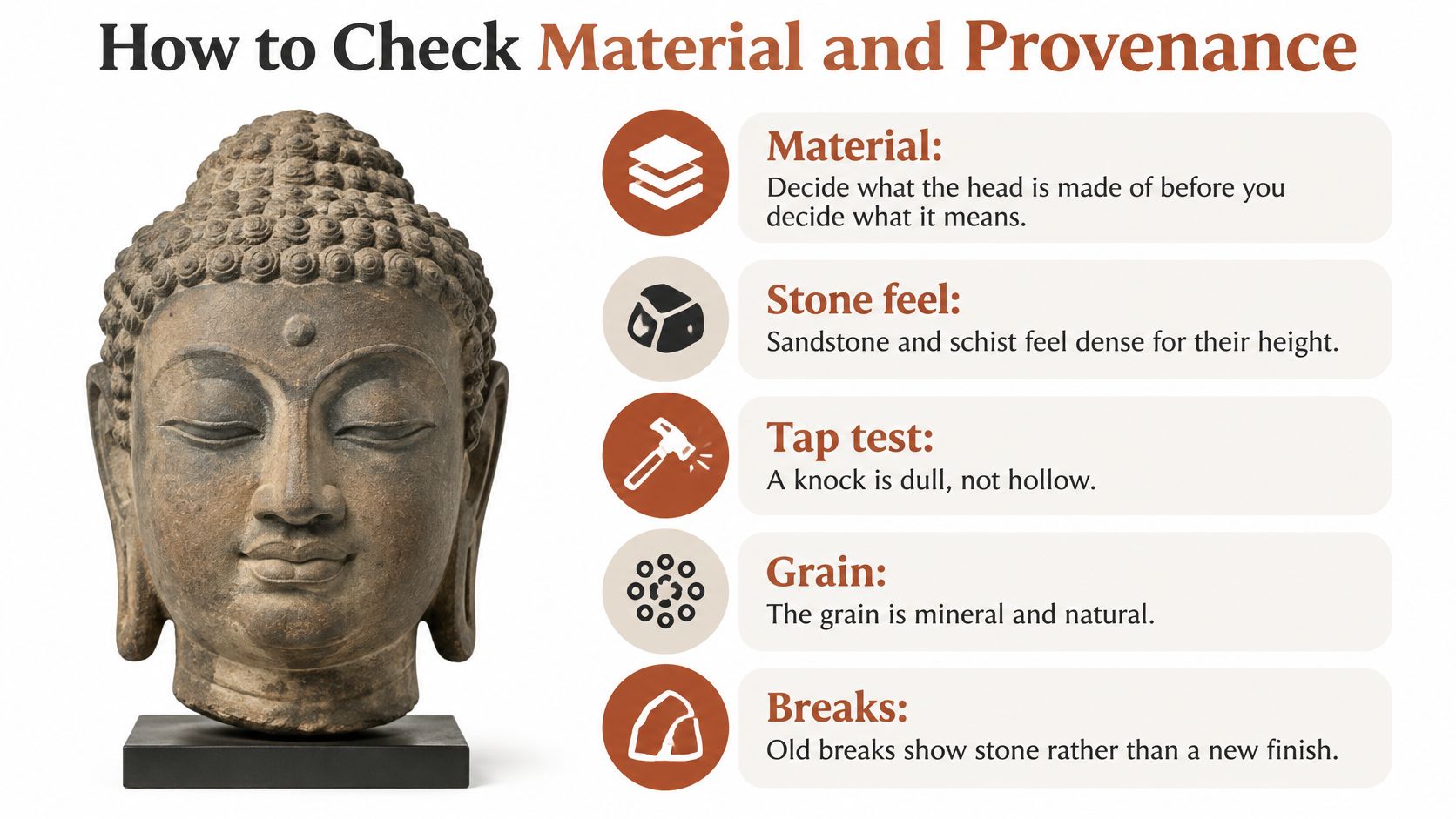
Material cues for a Buddha head
| Material | How it presents | Main risk | Authenticity cue |
|---|---|---|---|
| Sandstone or schist | Heavy for its height; mineral grain; potentially dull sound | Chips, salts and humidity swings | Existing breaks expose stone rather than a painted skin |
| Bronze | May be thin-cast and hollow rather than solid | Active corrosion and concealed repairs | Casting seams, interior construction and surviving pigment help explain manufacture |
| Wood | Weight follows species and construction; grain remains visible at worn edges | Cracks, insects and swelling | Continuous grain is more informative than a dark stain |
| Resin or composite | Often comparatively light; may have mould lines or a hollow body | Sunlight damage, fading and brittle projections | Mould seams and uniform finishes indicate a casting process, not antiquity |
These are identification clues, not certificates. A mould line doesn't make a contemporary sculpture dishonest, and a mineral grain doesn't make stone ancient. Painted finishes can conceal both modern construction and genuine earlier surfaces.
The V&A's Chinese bronze Buddha head is over one metre high, was cast in thin sections, and has later paper repairs and repainting; conservation revealed surviving original pigment. It demonstrates why a surface that looks uniform may contain very different materials and periods of work.
Establish whether it was made as a head
Ask directly: Was this sculpture manufactured as a standalone head, or is it a fragment from a complete figure? A contemporary head can deliberately echo a fragment without having suffered historical damage. A detached historic head requires a different level of investigation.
For an antique claim, request a written record covering:
- Identity and measurements: The material, dimensions, weight and basis for the proposed attribution.
- Condition and treatment: Known breaks, fills, repainting, stabilisation and replacement components.
- Ownership history: Dated invoices, collection records and earlier photographs where available.
- Movement between countries: Export documentation and a clear account of where the object was previously held.
Our guide to provenance research for Asian antique sculpture explains how to organise those enquiries.
Weathering, a serene expression and a temple-style description don't prove age. Nor should missing paperwork automatically turn a potentially historic object into harmless contemporary décor. If the seller cannot explain its ownership or lawful movement, pause the purchase rather than merely negotiate a lower price.
Where a Large Head Belongs at Home
A meditation room, a collector's interior and a shop reception are different settings. Decide whether the head will serve as devotional imagery, heritage art or decorative sculpture before choosing its position. Those purposes can overlap, but they aren't interchangeable.
The overview of Buddhism in the United Kingdom records 272,508 people identifying as Buddhist in England and Wales in the 2021 Census, approximately 0.5% of the population. That context is a reminder that Buddhist imagery belongs to living communities, not just an interior-design vocabulary.
Rooms that suit a Buddha head
| Room | What works | Limit |
|---|---|---|
| Meditation corner | Face near seated eye level in a clean, quiet spot | Ask a relevant Buddhist community whether a head alone is appropriate for worship |
| Entrance hall | Face readable on arrival; plinth clear of the door swing | Use a stable raised base, not the bare floor |
| Bedroom | A calmer, smaller piece on properly supported furniture | Don't put a heavy head above the bed |
| Garden | Confirmed frost-tolerant material on a drained plinth | Don't assume absorbent sandstone is suitable outdoors |
| Shop or studio | Respectful sculpture with room for people to pass | Keep it away from bins, bathrooms and casual leaning |
For devotion, consult the community whose practice you intend to follow. A head alone may not be appropriate for their altar arrangements, and a complete Buddha image may better serve the purpose. Avoid presenting any compass direction or placement formula as a rule shared by all Buddhist traditions.
For a collector, the priority may be seeing the carving clearly and preserving its condition. That still calls for a considered setting rather than treating the head as a stand for jewellery, seasonal accessories or promotional props.
Test the room from everyday viewpoints
Sit where you normally meditate or read. The face should remain legible without forcing you to crane your neck, and your route to the seat shouldn't bring your shoulder close to the ears or the ushnisha, the raised feature at the crown.
In a hall, open the door fully and carry a bulky coat or shopping bag past the proposed position. If you have to turn sideways, the display is too close to circulation space. A visually empty corner isn't necessarily a safe corner.
Respectful placement includes ordinary domestic behaviour. People shouldn't have to brush past, lean on or step over a sacred image.
Light the face gently from the front or side. A bright window behind it can leave the expression in silhouette, while a harsh overhead spotlight may exaggerate every surface loss. Use an adjustable lamp to test the effect before committing to fixed lighting.
Our guide to placing a Buddha statue at home offers further context for balancing household use with respectful display. The useful question isn't just whether a head fits the room, but whether the room lets people live comfortably and behave thoughtfully around it.
Install and Care for the Head at Home
Plan the installation before dispatch. A delivery driver arriving with a crate isn't the moment to discover that the staircase turns tightly or that the intended console has a loose top.
The British Museum's conservation policy prioritises preventive conservation, suitable conditions and condition assessment. For a private owner, that means preventing an avoidable break rather than assuming a restorer can make everything right afterwards.
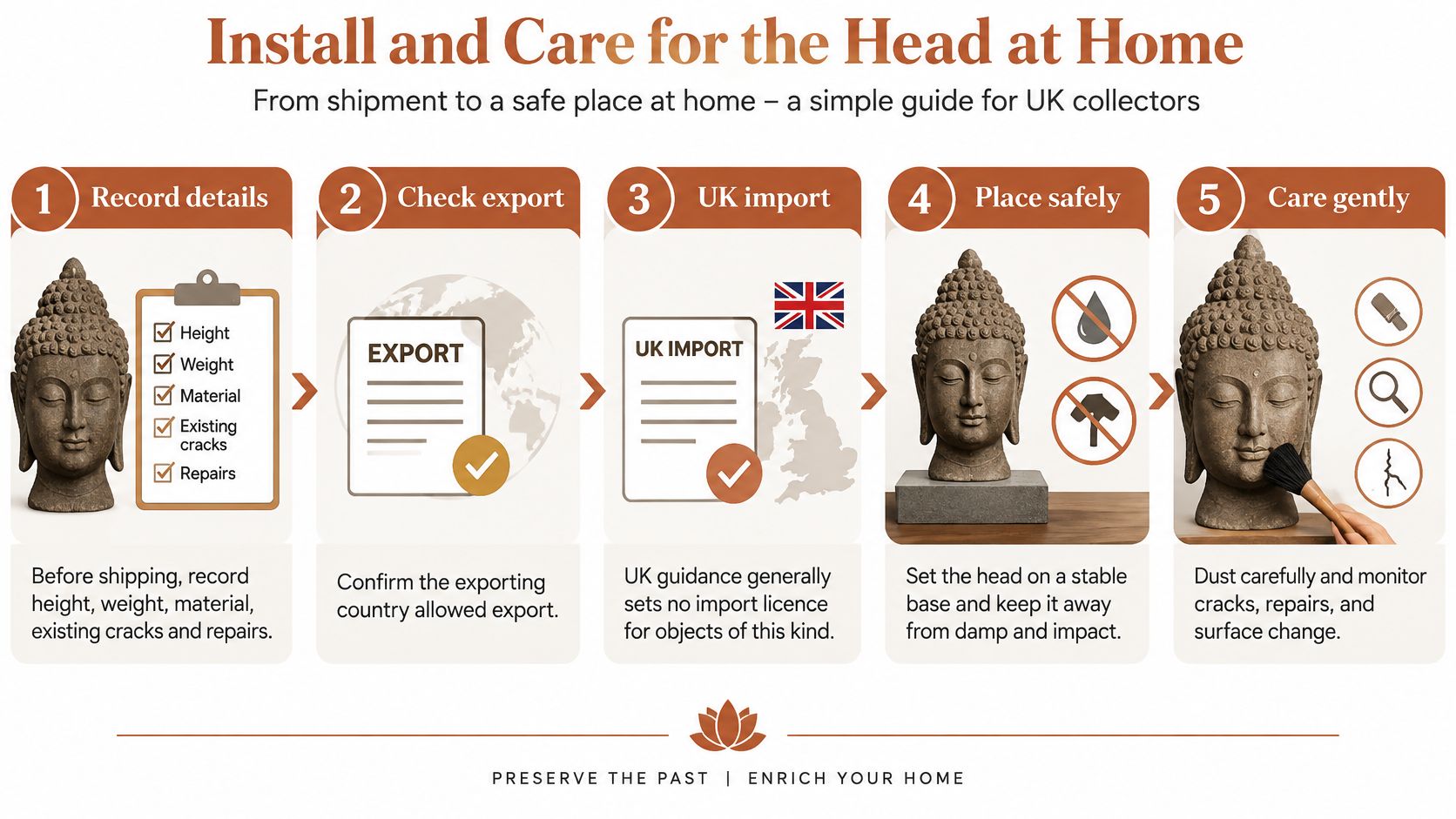
Prepare the journey and arrival
- Create a condition record before shipping. Record dimensions, measured weight, materials, repairs and visible cracks. Ask for clear photographs of the face, rear, underside and vulnerable projections, with close-ups of existing damage.
- Confirm lawful export before payment and dispatch. UK government guidance on objects of cultural interest states that Great Britain generally has no UK import-licensing requirements for these objects, but the exporting country's rules still apply; Northern Ireland has additional restrictions concerning unlawfully removed cultural goods. UK entry isn't proof that the object was lawfully exported.
- Plan the route from the delivery vehicle to the display position. Check thresholds, stairs, door clearances and the strength of the receiving furniture or floor. Keep children, pets and unnecessary helpers away from the handling route.
- Inspect the packaging on arrival. Photograph damage, displaced blocking or signs of impact before disturbing them. Document each accessible side of the object as the protective layers are removed, without turning an unstable head merely to obtain a photograph.
- Let the packaging and object acclimatise in a secure indoor location before completing unpacking. The appropriate period depends on material, journey conditions and the difference between transport and room environments, so obtain conservation advice for vulnerable historic work.
For organising boxes, protective layers and the wider household move, TLC Moving & Storage's guide to packing artwork for a move is a useful companion. A heavy sculptural fragment still needs object-specific support rather than a packing method borrowed unchanged from framed pictures.
Lift the structure, not the ornament
- Agree the lift before anyone touches the head. Identify structurally sound support points beneath the base or neck, allowing for repaired joints and hidden cavities. Never lift by ears, nose, hair curls or the crown feature; a neck is only a lifting point if its condition supports that choice.
- Use sufficient trained help and suitable equipment. An extra person is sensible beyond manageable shelf-scale work, but adding people doesn't compensate for poor access or an uncertain structure. Ask a conservator and competent art-handling or rigging specialist to review heavy, cracked or awkward pieces.
- Lower onto the prepared support without dragging. Keep fingers clear of pinch points and confirm that the load rests on the intended bearing areas. Stop if the object rocks, a repair opens or the mount touches a fragile projection.
Don't assume that a solid-looking head is structurally uniform. A sound outer surface can conceal an old join or a cavity, and a repaired ear may be attached much less securely than it appears.
Engineer the plinth and restraint
- Use a plinth designed for the actual object. The mount should resist tipping, sliding and rotation, ideally through a concealed, reversible restraint. Don't drill historic material or apply adhesive to it without a conservator's approval.
- Have the installer assess the centre of gravity, floor level and foreseeable accidental contact. Secure the plinth to the building where appropriate. Don't improvise a sideways push against a historic head as a stability test; controlled testing belongs in the installer's agreed method.
- Complete a final condition note. Compare arrival photographs with the installed object, record mount contact points and retain the handling plan. Any new loss, crack or movement needs investigation before the display is accepted.
UK museum-accreditation guidance requires secure mounting and warns that woods, adhesives and finishes can emit harmful gases. Specify suitable low-emission materials, such as zero-formaldehyde MDF, acid-free separating materials and non-reactive finishes, rather than assuming any painted pedestal is suitable.
A good mount should be removable without sacrificing the object. Concealed doesn't mean irreversible.
Control the immediate environment
UK collections-care requirements give starting parameters of approximately 40–60% relative humidity, changes limited to ±5% in 24 hours, and temperatures around 18–25°C for many hygroscopic collections. These aren't universal limits for every stone, wood, lacquer or mixed-media head; its materials, previous environment and condition must determine the final specification.
Place a temperature and humidity logger near the object, not elsewhere in the house. Keep the display away from radiators, air-conditioning outlets, damp walls and direct sunlight. Review readings during heating changes and spells of wet weather rather than relying on how comfortable the room feels.
Dust only stable, unpainted surfaces with a soft dry brush, directing dust away without catching projections. Leave flaking pigment, powdery corrosion and loose repairs untouched. Don't soak sandstone, casually wax bronze or oil historic wood.
Build a written inspection schedule around the object's vulnerability, with additional checks after moving, building work or an environmental upset. Look for fresh cracks, loose grains, bronze powder, new insect debris and restraint pressure. Photograph changes before seeking a conservator's advice, and don't attempt to disguise them with polish or filler.
Buy or Walk Away
A convincing purchase should survive practical questions without relying on the charm of the face. Buy the object you can explain, accommodate and care for, not the description you hope will prove accurate.
Start with the listing and the proposed room together. If the dimensions exclude the mount, the weight is missing or the material is described only as stone effect, you're not ready to order. Resolve the uncertainty in writing rather than filling it with assumptions.
The purchase decision
- Fit: Can you state the complete dimensions and weight, and identify a suitable position without narrowing a walking route?
- Purpose: Is the object appropriate for the way you intend to use it, particularly if it will become part of devotional practice?
- Evidence: Does any antique attribution come with a credible ownership and restoration record, plus the necessary export documentation?
- Material: Does the construction make sense of the stated weight and finish? An unexpectedly light head warrants clarification, not an automatic accusation or an automatic bargain.
- Responsibility: Can you arrange safe delivery, installation and continuing care? If not, decline or choose another piece.
An undocumented contemporary casting can be an entirely reasonable purchase when it is described as contemporary. An undocumented object offered as an antiquity presents a different problem. Don't solve uncertainty about lawful ownership by paying a decorative price.
Use feedback for the question it answers
Customer comments can help you assess presentation and delivery, but they don't authenticate another object. One of our customers said a sandstone Buddha head arrived safely and praised its serene expression and craftsmanship. That is useful testimony about that customer's purchase, not a substitute for examining the head you're considering.
A customer in London said a walking Buddha statue was very well moulded and finely detailed, and looked beautiful in the hall facing visitors. Karl from Seattle, Washington, USA said each statue he received worked well and blended with his home; he preferred the pieces because they felt unique and more real than common gilded Buddhas.
These responses describe personal satisfaction, not a universal placement rule. Your room, intended use and tolerance for conservation responsibility may be different.
At HD Asian Art, we offer Buddhist sculpture from Burmese, Thai, Khmer, Chinese, Indian and Sri Lankan traditions. Compare the stated centimetres, material and available weight information against your chosen setting, then resolve any missing detail before ordering. Walk away when the explanation remains weaker than the sales description.
HD Asian Art offers antique and contemporary Asian sculpture for collectors, institutions and private interiors, with descriptions that help you understand form and symbolism. Visit HD Asian Art to compare Buddha heads with your room measurements and intended use, and contact us about any detail you need clarified before choosing.
