



How to Buy an Antique Buddha Statue Online with Confidence
How to Buy an Antique Buddha Statue Online with Confidence
You've found the statue. The patinated bronze figure looks convincing, the seller's photographs are atmospheric, and the asking price feels just low enough to tempt you. Yet you're wondering whether the object is genuinely old, whether the seller owns it legally, and what happens if it arrives damaged or can't clear UK customs.
That uncertainty is sensible. How to buy an antique Buddha statue online with confidence isn't mainly a question of recognising a serene expression or attractive patina. It's a process built around provenance, import evidence, protected payment and documented condition. A beautiful listing photo can't compensate for missing paperwork.
Table of Contents
- Starting with Confidence Rather Than Instinct
- What Counts as an Antique Buddha Statue
- Reading a Listing Like a Specialist
- Provenance and Authentication Documents to Demand
- UK Import VAT, Customs and Cultural Goods
- Safe Payments and Your Consumer Rights
- Shipping, Inspection and Long-Term Care
- Your Pre-Purchase Confidence Checklist
Starting with Confidence Rather Than Instinct
A specialist dealer doesn't begin with “Do I like it?” They begin with “What can this object prove?” Style, colour and atmosphere matter, but they come after the basic controls that establish what the statue is, where it came from and whether the transaction is recoverable if something goes wrong.
The fraud risk is real. The Crime Survey for England and Wales estimated around 4.2 million fraud incidents in the year ending March 2025, up from 3.2 million the previous year, while UK Finance reported more than 2.09 million confirmed fraud cases in the first half of 2025. Those figures don't prove that a particular antiques seller is dishonest, but they do justify treating an unfamiliar online purchase as fraud-sensitive. See the Office for National Statistics fraud analysis for the wider context.
Practical rule: Confidence is earned by evidence, not by a persuasive photograph.
Use a repeatable sequence:
- Identify the object. Establish the figure, region, material, construction and claimed period.
- Test the listing. Ask for neutral, high-resolution images and precise condition information.
- Demand provenance. Request export and ownership records before payment.
- Calculate the landed cost. Include shipping, insurance, import treatment and any possible customs charges.
- Protect the transaction. Choose a traceable payment method and written returns terms.
- Inspect immediately. Record the parcel and statue before removing every layer of packaging.
Caution isn't indecision. It's normal buying behaviour for a fragile cultural object whose value depends on history as much as appearance.
What Counts as an Antique Buddha Statue
Online listings combine old sculpture, later devotional pieces, studio reproductions and decorative objects with antique-looking finishes. You need to separate those categories before comparing prices. A South Asian gilt-bronze figure, a Burmese lacquered wood image and a Chinese temple carving may all be described loosely as antique Buddha statues, but their materials, construction methods and expected documentation differ sharply.
Himalayan and Pala-influenced gilt bronzes often attract collectors because fine casting, gilding and regional iconography can support strong historical interest. Tibetan repoussé metalwork requires close examination of sheet construction, repoussé modelling, joins and any ritual attributes. Burmese and Shan lacquered wood pieces can show layered lacquer, pigment loss, timber movement and insect activity, all of which need a specialist condition assessment.
Thai bronze and stone figures range from restrained devotional forms to later formal images. Chinese temple wood carvings may have polychromy, replacement sections or evidence of worship use. Later decorative pieces can still be attractive, but terms such as “antique finish” don't establish age.
| Category | Typical Period | Common Materials | Value Implication |
|---|---|---|---|
| Himalayan or Pala-influenced gilt bronze | Earlier historic traditions through later workshop production | Gilt bronze, copper alloy, stone | Scarcity and technical quality can matter greatly, but iconography and provenance must align |
| Burmese or Shan Buddha | Historic and later devotional production | Wood, lacquer, gilding, bronze | Surface depth, regional style and condition of lacquer are central to assessment |
| Thai Buddha | Historic traditions through later temple and workshop production | Bronze, stone, stucco | Regional attribution, proportions and casting quality influence collectability |
| Chinese temple carving | Historic and later devotional production | Carved wood, polychromy, lacquer | Original surface, structural integrity and documented history are particularly important |
| Tibetan repoussé work | Historic and later ritual production | Hammered sheet metal, copper alloy, gilding | Construction, ritual correctness, workmanship and legal export history carry substantial weight |
| Later decorative reproduction | Modern production | Resin, cast metal, wood, composite materials | It can be worthwhile as décor when honestly described, but shouldn't be priced or represented as an antique |
For a visual introduction to the physical clues collectors study, compare the guidance on signs of authentic antique Buddha statues for collectors. Don't treat a checklist of visual features as authentication. It's only the first filter.
The word antique also has a customs meaning in the UK. A statue's visual age doesn't decide its import treatment by itself, and that legal question deserves separate attention.
Reading a Listing Like a Specialist
Read the description as a chain of claims. “Buddha statue” identifies almost nothing. A useful listing should state the figure's identity, regional attribution, material, dimensions, weight, construction method, estimated age and condition. If the seller can't distinguish a seated Buddha's mudra from a generic hand position, you shouldn't accept a confident period attribution from the same seller.
Look for internal consistency. A listing might describe dry lacquer, lost-wax bronze, carved wood, stone or repoussé metalwork. Those terms imply different construction evidence. Dry lacquer should lead you to ask about the core and layered surface. Lost-wax bronze should prompt questions about casting seams, the underside, wall thickness and finishing. “Bronze finish” isn't the same as bronze, and “metallic” says nothing reliable about the alloy.
Regional language needs equal scrutiny. “Tibetan-style”, “old style” and “antique finish” are deliberately broad. They may describe an honest modern reproduction, but they don't establish origin or age. A credible seller should explain why the piece is attributed to a particular region, using features such as the robe treatment, head form, lotus base, ornaments and hand gesture.
The photographs that should be non-negotiable
Request photographs of:
- Every side: Front, back, both profiles, the base and any halo or detachable attribute.
- Critical details: Face, hands, feet, inscriptions, casting seams, joins and areas of wear.
- Condition evidence: Chips, cracks, lifting lacquer, repainting, regilding, replaced sections and old repairs.
- Scale and neutrality: Consistent lighting, no heavy filters, stated measurements and ideally a scale reference.
“Wear consistent with age” is not a condition report. It's a conclusion without the observations needed to test it. Ask which areas are worn, whether the surface has been chemically treated, and whether restoration has altered the original patina.
A statue's display environment also affects how its surface is judged and preserved. Practical display and care tips can help you think about light, placement and presentation, although they can't verify an object's age.
Provenance and Authentication Documents to Demand
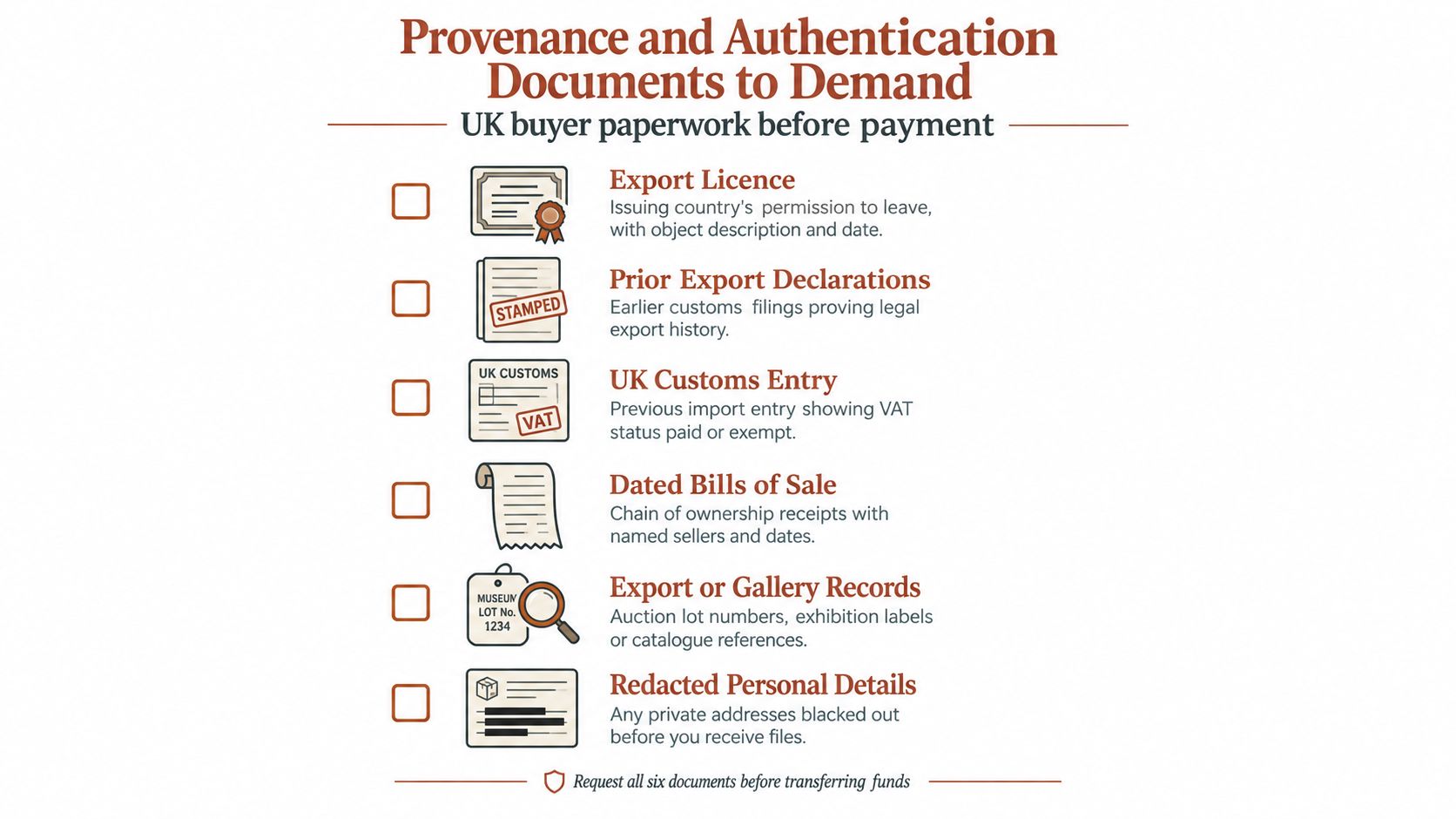
Treat provenance as documented or undocumented. A dealer invoice and the phrase “from a private collection” aren't enough for an object claimed to be more than a century old. Before paying, request copies that allow you to reconstruct the statue's movement and legal status.
Ask for:
- An export licence from the country of origin, where that country requires one, identifying the object and date.
- Prior export declarations or customs filings that show how the piece previously left another country.
- A prior UK customs entry, where available, showing the import declaration and VAT status.
- Dated bills of sale tracing ownership, preferably back at least three decades and naming sellers, buyers and dates.
- Technical reports, such as thermoluminescence for suitable ceramic pieces or XRF analysis for relevant metal objects.
- Auction, gallery or exhibition records, including lot numbers, catalogue references and labels.
The UK may not require an export licence for every antique, but the country of origin usually controls its own export requirements. A seller who says “the UK doesn't need an export licence” has not answered whether the statue was lawfully exported from its source country.
Warning signs in the paperwork
Be wary if the seller refuses to share documents, sends photographs of stock rather than the actual statue, or offers certificates without identifying the object clearly. Restoration can also obscure evidence. Chemical cleaning, repainting or aggressive patination may conceal original surfaces, so ask what was done, by whom and when.
Asian religious art described as under 50 years old may still need export documentation, depending on the source country and the type of object. Don't confuse a young age estimate with freedom from cultural-property controls.
For a deeper research process, use this guide to provenance research for Asian antique sculpture. The practical standard is simple: if the seller can't explain the paper trail before you transfer funds, price the risk as unacceptable.
UK Import VAT, Customs and Cultural Goods
Import treatment depends on evidence, not on the seller's casual description. HMRC guidance and the British Antique Dealers' Association explain that an item manufactured in its current form more than 100 years before import can qualify for antique relief, but the importer may need documentary proof of age. For antiques imported into Great Britain, BADA states that import VAT can be 5%, with no customs tariff duties on works of art, collectors' items and antiques regardless of origin. Review BADA's guidance on importing antiques into the UK before committing to a cross-border purchase.
Ask the seller to provide an accurate customs description, tariff classification and age statement. The parcel should carry the relevant customs declaration, such as a CN22 or CN23 where applicable, and the documents should match the invoice, photographs and provenance file. If customs queries the shipment, the courier may ask you for evidence and may collect charges before delivery.
The important qualification is “in its current form”. Major restoration, repainting or replacement parts can complicate the age assessment. Don't assume an old core automatically gives the complete, altered object antique treatment. Get written advice for an unusual or substantially restored piece rather than relying on a seller's promise.
| Statue Category | Age Threshold | VAT Treatment | Documentation Needed |
|---|---|---|---|
| Object qualifying as an antique | Manufactured in its current form more than 100 years before import | Import VAT may be 5% where the relief conditions and evidence are met | Age statement, provenance, invoice and correct customs declaration |
| Later devotional sculpture | Doesn't meet the antique threshold | The applicable import treatment may differ | Material, age, origin, value and customs description |
| Restored or altered object | Depends on the current form and extent of alteration | Don't assume antique relief applies | Restoration report, age evidence and clear description of replacement parts |
| Cultural good subject to source-country controls | Depends on characteristics, age, origin and legal category | UK customs treatment doesn't replace export compliance | Export licence or proof that none was required, plus lawful provenance evidence |
Cultural-property rules create a separate compliance layer. UK guidance on importing or exporting objects of cultural interest explains that some cultural goods require an import licence or importer statement and evidence of lawful provenance, including an export licence or proof that none was required at export.
Keep the invoice, provenance file, customs entry, payment record and correspondence together. If a seller won't provide a clear country of origin or lawful export history, don't let a favourable-looking VAT calculation persuade you to proceed.
Safe Payments and Your Consumer Rights
Don't pay an unfamiliar seller by bank transfer, cryptocurrency or Western Union for a high-value statue. Those methods can leave you with little practical recourse if the object never arrives, arrives damaged or differs materially from the description.
A credit card can offer stronger protection for qualifying purchases, while PayPal Goods and Services may provide a dispute route when the transaction meets its rules. For a particularly valuable piece, consider an established escrow arrangement, but verify the escrow provider independently and confirm exactly when funds are released.
What UK online buyers can enforce
For a UK-based retailer, the Consumer Contracts Regulations generally provide a 14-day cancellation window. The period starts the day after receipt, and after notifying the seller you normally have a further 14 days to return the goods. Government guidance also says the seller must refund within 14 days of receiving the returned item. The Which? guide to online returns summarises the process.
The cancellation right isn't a licence to ignore the listing. Disclosed cracks, restoration and missing components remain part of the agreed description. Photograph the unopened parcel, the packaging, the statue before removing its wrapping and every surface after unpacking. Keep the crate, labels and packing materials until you've completed your inspection.
If the item fails to meet the required standard, UK guidance says buyers may reject goods within the first 30 days and seek a refund. The government advice on savvy online shopping also confirms that your contract is with the retailer, not the manufacturer, and that online shoppers retain core rights comparable to high-street buyers.
For a useful reminder of the tactics that can arise in marketplace disputes, review this guide to how sellers avoid eBay buyer scams. Your own protection starts before payment, with a written description, returns policy and named contracting seller.
Shipping, Inspection and Long-Term Care
Fragile sculpture often fails in transit because the packing was designed for convenience rather than conservation. Require a custom-cut foam cradle or suspended mount, a rigid outer crate and a signed condition report inside the package. Reject loose packing in polystyrene peanuts. They shift, abrade surfaces and provide poor protection for projecting fingers, halos and lotus petals.
Before delivery, ask who insures the shipment and who carries the risk until arrival. On delivery, photograph the unopened crate and any dents, punctures or water marks. Unpack over a padded surface in strong, even light, then compare the object with the listing photographs and written report.
Inspection sequence
- Photograph the external packaging before opening it.
- Photograph the internal packing and the statue before removing every wrap.
- Check the face, hands, base, halo, joins and rear surfaces.
- Record chips, cracks, lifting lacquer, insect boreholes and loose parts.
- Contact the seller and carrier immediately if the condition differs from the agreed report.
Don't clean an antique before documenting it. A soft brush is safer than chemical polish, and water can damage painted, lacquered or gilded surfaces.
| Material | Ideal Humidity | Cleaning Method | Main Risk |
|---|---|---|---|
| Bronze or copper alloy | Stable indoor conditions | Soft dry brush or clean dry cloth | Tarnish, abrasive cleaning and impact damage |
| Gilt bronze | Stable indoor conditions | Very gentle dry dusting | Loss of gilding through rubbing or chemicals |
| Lacquered wood | Stable indoor conditions | Soft brush, no liquid cleaners | Lifting lacquer, humidity movement and abrasion |
| Painted or polychrome wood | Stable indoor conditions | Minimal dry dusting | Pigment fade, flaking and direct sunlight |
| Stone | Stable indoor conditions | Dry brush unless a conservator advises otherwise | Chipping, staining and unsuitable outdoor exposure |
Keep bronze and gilt pieces away from radiators. Protect wooden statues from direct sun, and maintain a stable environment rather than exposing them to rapid changes. For more detailed guidance, consult this collector's guide to displaying, caring for and shipping Buddha statues.
Your Pre-Purchase Confidence Checklist
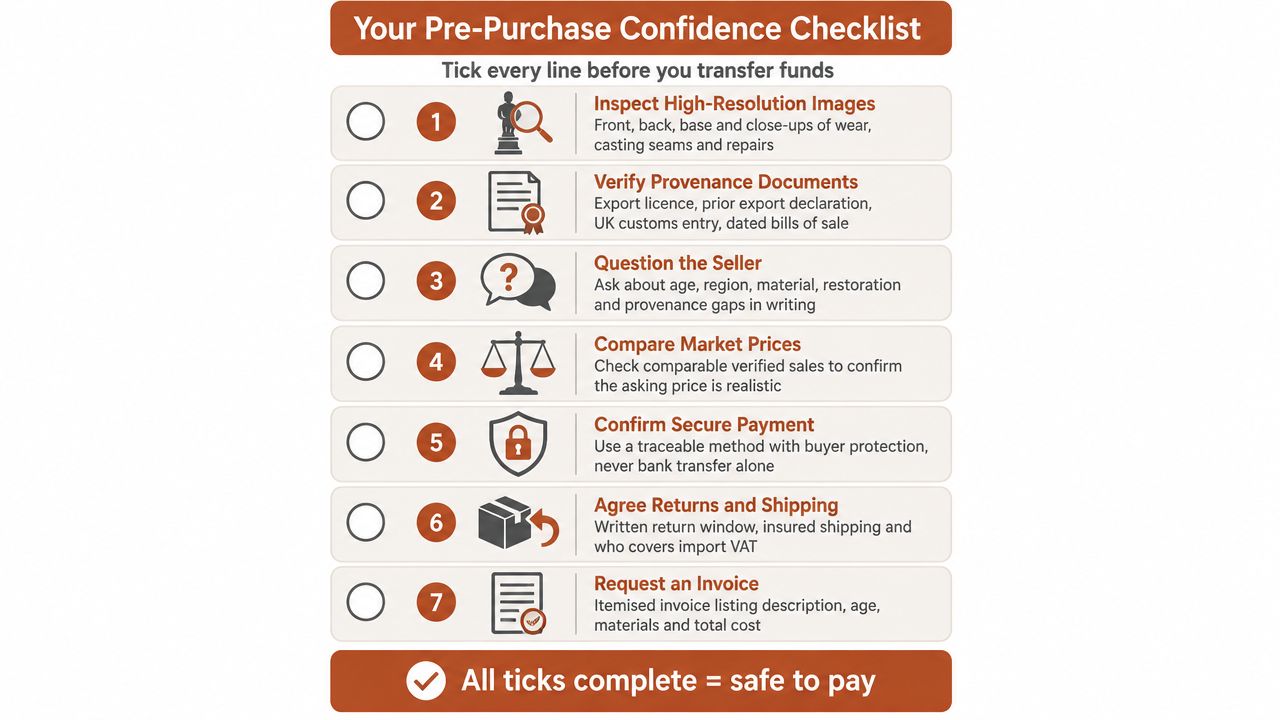
Before transferring funds, run the purchase in order. Don't allow an attractive dusk photograph or a deadline set by the seller to push you past an unanswered question.
Confirm the object
- Inspect the images: Require high-resolution views of the front, back, profiles, base, inscriptions, joins and repairs.
- Confirm the description: Get the figure, region, material, dimensions, weight, age estimate and construction method in writing.
- Read the condition report: Check for cracks, chips, restoration, repainting, regilding, replacement parts and unstable lacquer.
Confirm the history
- Request provenance: Ask for an export licence or proof none was required, prior export declarations, any UK customs entry, dated bills of sale and relevant technical reports.
- Check lawful origin: Obtain a clear country-of-origin statement and ask whether the piece may fall within cultural-goods controls.
- Match every record: The invoice, photographs, customs description and provenance documents must refer to the same object.
Confirm the transaction
- Calculate the landed price: Include the statue, insured shipping, import VAT treatment and any possible courier charges.
- Use protected payment: Choose a traceable card, a suitable buyer-protected service or independently verified escrow.
- Agree returns: Make sure the written returns window works with the Consumer Contracts Regulations and states who pays return shipping.
- Keep the file: Save the listing, messages, invoice, payment confirmation, condition report and customs paperwork.
A seller who can't evidence one of these points may still possess an attractive object, but you can't assess the risk properly. Walk away when the documentation is weak, the photographs are incomplete or the payment route leaves you exposed. Confidence comes from a file you can defend, not from how convincing the statue looks online.
HD Asian Art offers region-organised Buddhist and Southeast Asian sculpture, with descriptions covering a statue's style and known provenance available on request, alongside shipping and returns information. If you're comparing a candidate purchase against the paperwork standards above, visit HD Asian Art and ask for the object documentation before committing funds.
