



Hindu Worship Statue Lamps: Lighting and Caring for Diyas
Hindu Worship Statue Lamps: Lighting and Caring for Diyas
The tray is already out on the shelf, the ghee has gone grainy in the cold, and the wick is a little too long because you cut it in a hurry. You light it, the flame jumps, settles, and you notice the curtain moving near the edge of the shelf. Nothing has gone wrong yet. That's usually the point at which a household fixes something about its lamp, rather than before.
A Hindu worship statue takes all the attention in a home shrine. The lamp beside it does the daily work. It gets lit first, watched most closely and cleaned most often, and yet most writing about diyas stops at symbolism and never says which metal survives ten years of nightly use, how much fuel to pour, or why the flame keeps smoking halfway through a prayer.
The audience for this isn't small. The 2021 Census recorded 1,020,533 Hindus in England and Wales, up from 816,199 in 2011 and 546,982 in 2001, an increase of about 86.6% across two decades, according to British Religion in Numbers. A growing number of those households are lighting something on a shelf in a flat with a smoke alarm four feet away.
Table of Contents
- Diyas, Deepams and Materials at a Glance
- When and Why Lamps Are Lit in Worship
- Buying and Setting Up Your First Lamp
- How to Light a Lamp Safely, Step by Step
- Placing Lamps on a Home Altar Without Fire Risk
- Cleaning and Storing Brass and Bronze Lamps
- Fixing Sooty, Guttering and Tarnished Lamps
Diyas, Deepams and Materials at a Glance
For a lamp you light every day, buy brass. For a festival where dozens of small flames line a windowsill, clay is correct and cheap enough to replace each year. Everything else is a variation on those two decisions.
| Lamp type | Material | Usual fuel | Best use |
|---|---|---|---|
| Clay diya (mati diya) | Terracotta | Ghee or mustard oil with cotton wick | Festivals such as Diwali; usually single use |
| Brass diya | Brass | Ghee, sesame or mustard oil | Daily puja; reusable for years |
| Brass deepam (multi-wick) | Brass | Ghee or oil, several wicks | Aarti and altar display in larger shrines |
| Panchmukhi deepam (five-wick) | Brass or copper | Ghee | Festival and aarti use in larger rooms |
| Electric or LED diya | Ceramic, plastic or brass shell | Battery or mains | Where a flame is not allowed; check custom before ritual use |
Clay diyas are porous, so they soak oil into the wall as well as the bowl, and they crack when they dry too quickly or get knocked on a doorstep. Most families treat them as seasonal stock rather than testing whether last year's survived the cupboard.
Brass is the workhorse. It takes a knock, holds its shape and cleans back to a warm finish after years of soot, which is why it's the usual choice for daily puja rather than festival display. Copper behaves much the same with a warmer reddish tone, and silver-plated pieces belong on a shelf where they won't meet a flame every evening.
Ghee, sesame oil and mustard oil all work, though ghee sets solid in a cold kitchen and needs a moment of warmth before the wick will draw. Paraffin is a false economy: it burns hotter, smells and throws more soot onto the statue above it. An electric or LED diya covers the case where a naked flame isn't allowed at all, and whether it belongs in ritual is a family or temple question, not a materials one.
The simple rule: brass for daily lighting, clay for festival lighting, and an LED diya for the weeks when neither is practical.
When and Why Lamps Are Lit in Worship
At dusk in a Leicester flat, one brass diya goes onto the tray before anything else: before the incense, before the bell, often before the murti has been wiped down for the evening. The lamp goes first because it stands for the removal of darkness and ignorance, and because there isn't much point doing anything else in a dim room.
Hindu households aren't spread evenly across the country, which shapes how practice looks street by street. The 2021 Census recorded Harrow as the local authority with the highest proportion of Hindu residents at 25.8%, with Leicester second at 17.9%, up from 15.2% in 2011, according to the Office for National Statistics.
Those numbers count identity, not activity. The ONS is explicit that its religion question records the religion a person connects with or identifies with, not beliefs or active practice, and 94.0% of the population answered it in 2021 (ONS religion analysis). So census data tells you how many households might keep a shrine. It says nothing about how many lamps are lit tonight.
The lamp also moves during aarti, when a deepam is carried in a circle before the murti and the flame is offered to the deity. The wider sequence of offerings around that moment is set out in this guide to aarti and divine invocation.
Festivals bring the biggest lighting of the year. Diwali means rows of diyas along windowsills and doorsteps, and in Tamil households Karthigai Deepam fills the house with larger lamps. The order of lighting, the fuel chosen and whether a lamp stays alight all day are family and regional matters. Ask an elder or a temple priest rather than copying a stranger's sequence.
A lamp isn't only a light source. It's an offering, and it deserves the same care as the murti standing beside it.
Buying and Setting Up Your First Lamp
The daily kit is short: one brass diya, a metal tray with a small lip, a packet of cotton wicks, and a jar of ghee or a pure vegetable oil you'd also cook with. That covers an evening puja for years. Festivals are where the shopping multiplies, so buy a batch of clay diyas, light them once and store them dry between years. A brass deepam earns its shelf space only if your household performs aarti; without the circling, it's decoration with a cleaning routine attached.
Size the lamp to the statue rather than to the shelf. A diya set at the base or to one side keeps the flame below the murti's face, so heat and soot rise past the image instead of onto it. A lamp that reaches the statue's shoulder puts the flame in the wrong place both visually and practically.
Check four things in the shop or on the listing:
- Base. Flat and heavy enough that a knock won't tip it.
- Inner bowl. Smooth, with no rough casting pits that trap old ghee.
- Wick holder. The slot or pinch should fit the wicks you can buy locally.
- Finish. Even, with no flaking plating around the rim where the flame licks.
Painted shells and anything with a decorative coating inside the cup are best left alone, because heat lifts coatings and you don't want that in the fuel.
If you rent, read the tenancy for naked-flame conditions before you buy anything. Where a flame is restricted, an LED diya covers daily use and the brass comes out for festivals. If you're choosing the murti the lamp will sit beside, our statues are made for home shrines, meditation rooms and puja spaces as well as for display, and we'll help you match one to your altar if you send photos, measurements of the space and your preference on deity, material or style. Start with HD Asian Art and choose a piece sized to the surface you have.
How to Light a Lamp Safely, Step by Step
Light the lamp the same way every evening and most accidents, and most of the soot, never happen. The order below is what I'd teach someone setting up a first altar.
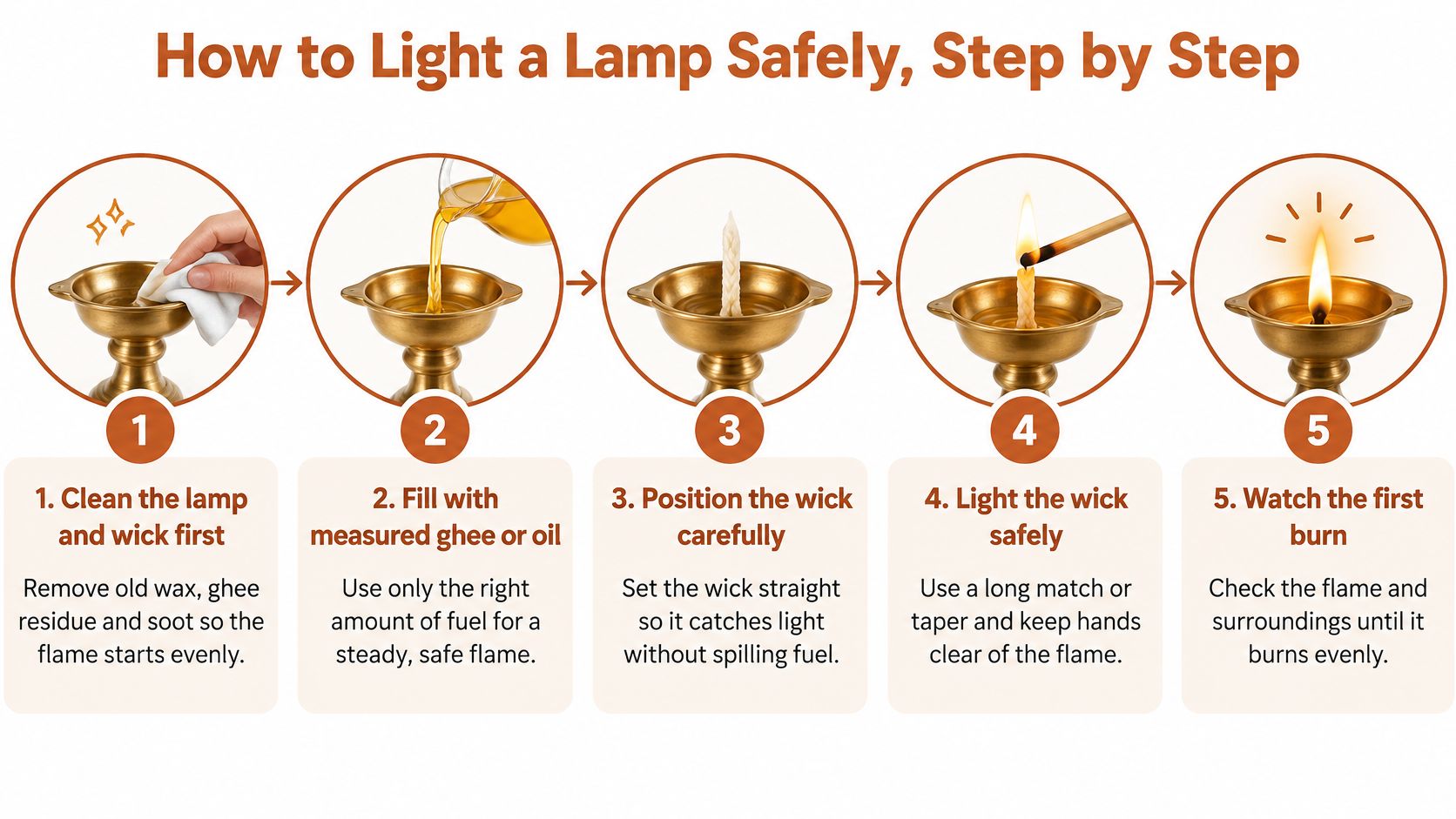
- Clean the lamp and the wick first. Old ghee, wax and soot at the rim make the flame start unevenly and smoke. Wipe the cup dry before any fuel goes in.
- Fill to about a third to half. A brim-full lamp spills when it's moved and drips fuel down the outside. Measured fuel also keeps the flame a predictable size.
- Set the wick so the tip just clears the fuel. It should sit straight, not flop over the rim. A wick lying against the edge burns the metal and stains it.
- Stand the lamp on a metal tray on a level, non-flammable surface. The tray catches spills and holds the lamp steady if someone brushes past it.
- Light with a long match or a taper. Keep sleeves, dupattas and hair well clear. The reach of a long match is the entire point of using one.
- Watch the first minute. A steady, upright tip means the wick is drawing properly. Smoke or a tall ragged flame means trim the wick or take some fuel out.
- Stay in the room. Never leave a lit lamp unattended, and keep matches and children out of reach. Children are a live factor here: 20.3% of Hindus in England and Wales were under 16 at the 2021 Census (ONS age and sex analysis), and a lamp within a toddler's reach is a burn waiting to happen.
- Put it out without blowing. Use a metal snuffer, or press the wick gently into the fuel with the back of a spoon. Blowing scatters soot across the altar and can send sparks past the tray.
Keep a damp cloth or a fire blanket within reach of the altar. Check that the smoke alarm in the room where you light a lamp daily works, because in a small flat that alarm is part of the practice, not part of the building's paperwork.
Placing Lamps on a Home Altar Without Fire Risk
The most common mistake isn't a dangerous lamp. It's a dangerous place to put one: a windowsill behind a curtain, a shelf directly above a radiator, or the floor, where a foot or a cat finds it. Move the lamp before you buy a different one.
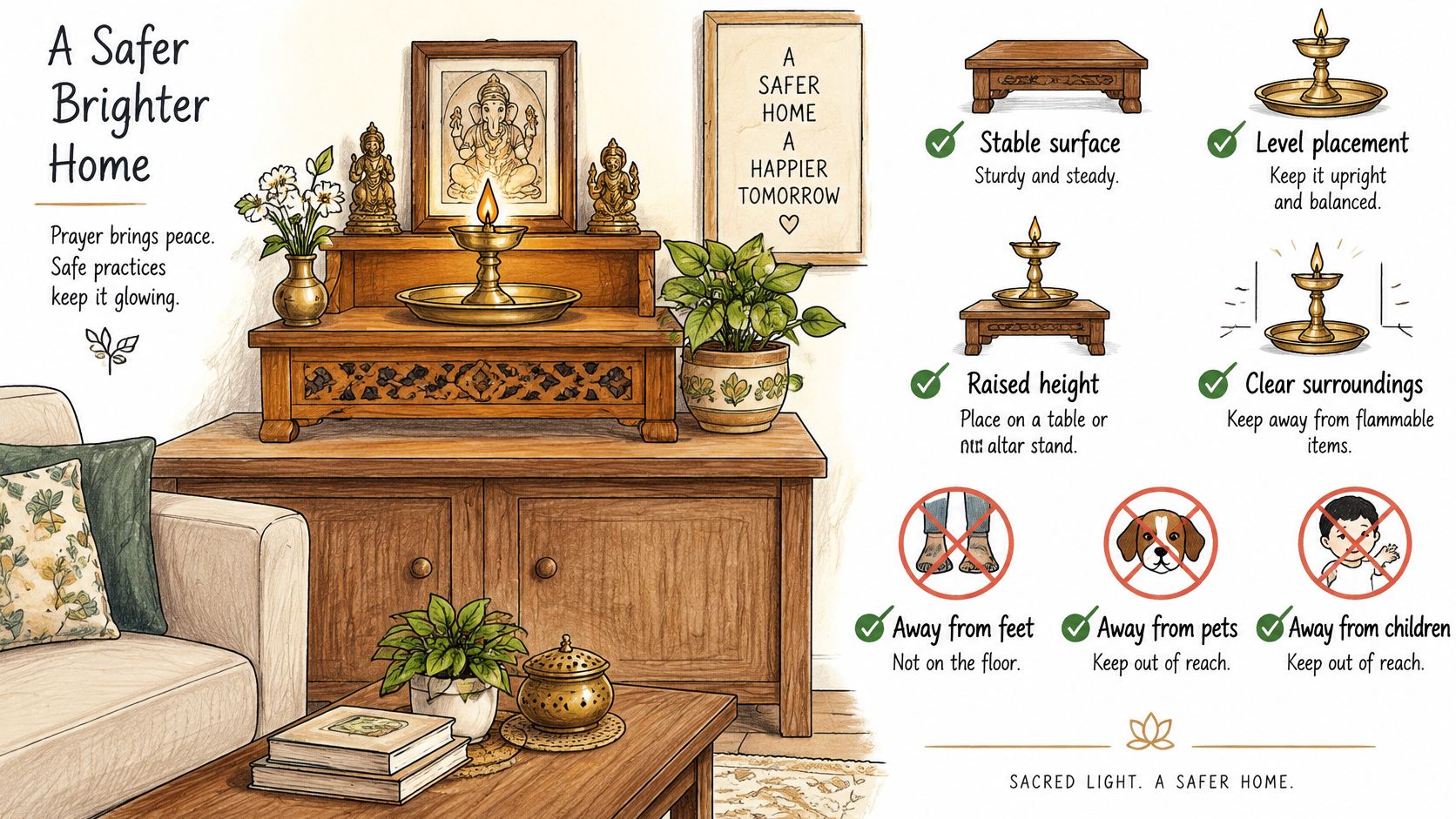
A shrine doesn't need its own room to be treated properly. Comment on UK religious change puts Hindus at about 1.7% of the population in 2021, up from 1.5% in 2011, and much of that practice happens at home, in whatever space a household can give it (Hinduism Today). The practical question is where the flame can stand safely, not how grand the setting is.
The Checklist Before You Strike a Match
- Raised and level. A shelf, altar stand or tray, never the floor.
- Clearance. At least 30cm from curtains, fabric, paper and garlands, and nothing directly above the flame.
- Out of through-draughts. Open windows and radiators both push a flame around.
- Away from bathrooms, bins, shoe racks and cooking hobs. These are the spots that make a shrine feel careless as well as unsafe.
- Beside or in front of the statue, not touching it. Heat and soot mark a murti's base over months.
- Reachable but not in a walkway. Everyone should be able to pass respectfully without stepping over the lamp.
Say you have a one-bed flat with a small alcove and a windowsill that seemed like the obvious spot. A curtain crosses that sill whenever the window is open, so the diya moves to a brass tray on a wall-mounted shelf in the alcove, at chest height, clear of the door swing. Same lamp, same practice, one less thing to think about.
If you're arranging the whole space rather than shifting one lamp, this step-by-step guide to building a sacred space covers the wider layout. Open flames deserve a wider look too, and this piece on how to avoid candle fire hazards is a sensible cross-check for curtains, shelving and draughts. In a shared or mixed-faith household, put the lamp where people can pass without stepping over it and where a flame at head height won't surprise anyone.
Cleaning and Storing Brass and Bronze Lamps
Brass and bronze lamps fail slowly and then suddenly. One cleaned after every use outlasts one scrubbed hard twice a year, so the routine matters more than the polish.
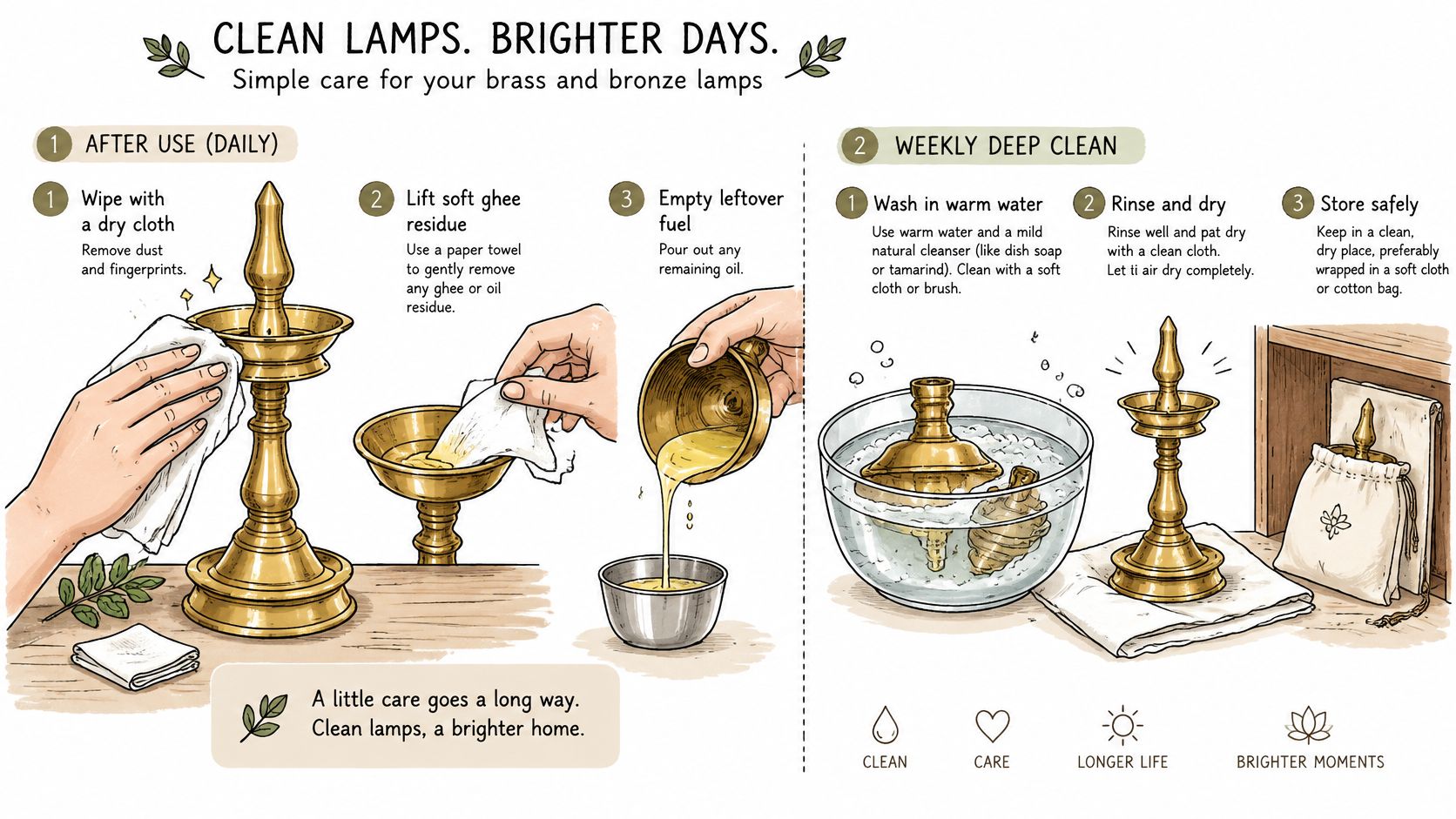
After Every Use
Let the lamp cool, wipe it with a dry cloth, lift soft ghee residue with a paper towel and empty any fuel left in the cup. Fuel left standing collects dust and thickens, and tomorrow's flame burns worse for it. Soot on the rim lifts with a soft brush; steel wool leaves scratches that gather dirt for years. In a small kitchen the whole job takes about as long as filling the lamp did, which is exactly why it gets done.
Once a Week
Wash in warm water with a drop of mild washing-up liquid, scrub the crevices with a soft brush, rinse and dry immediately with a cloth. Water trapped in a casting pit shows up as a spot within a day, and a lamp put away damp comes out marked.
That's the household version of what museums do, and the reasoning is the same. The British Museum's conservation policy puts reducing deterioration and damage ahead of interventive treatment. Conservators consistently rank display and storage conditions, dust and dirt, handling and humidity among the main risks to collections, which is why the same habits work at home.
What to Avoid
Skip abrasive creams, metal polishes and household sprays. They strip the patina, expose reactive metal underneath and leave a finish that dulls unevenly. If you test a mild acidic paste on a stain, try it on the hidden underside first and rinse thoroughly afterwards.
You don't have to fight the darkening. An even brown tone is a healthy brass surface and part of the lamp's character; the problem is a patchy, half-polished finish that neither shines nor looks aged. Store lamps dry, wrapped in cloth, away from damp cupboards and away from other metal pieces that can scratch them. A shallow box on a wardrobe shelf or under the bed suits a rented flat where cupboard space runs short. Clay diyas live in a separate dry box and get checked for cracks before a festival, not on the night itself. For statues rather than lamps, the same principles scale up, and this guide to cleaning bronze statues covers the softer and older surfaces.
Fixing Sooty, Guttering and Tarnished Lamps
Black soot on the wall above the altar, a flame that refuses to sit still, oil creeping down the outside of the cup: nearly every lamp fault traces back to the wick, the fuel level or a draught, and almost none of them mean the lamp itself is finished. Start with the symptom you can see, then work through the causes that are easy to skip.
| Symptom | Likely cause | Fix |
|---|---|---|
| Thick black soot on the flame | Wick too thick, fuel too high or a draught | Trim the wick, use a thinner cotton wick, lower the fuel and move the lamp out of the draught |
| Flame flickers or gutters | Wick not drawing fuel, end blocked by ash or wax | Re-trim the wick, press it down into the fuel and clear the channel |
| Fuel drips down the side | Lamp overfilled or tilted | Fill to about half, stand the lamp level and keep a tray underneath |
| Wax or ghee sets around the rim | Residue left from earlier use | Warm the lamp in hot water, wipe clean and wash after each use |
| Brass dull, green or black | Oxidation and humidity | Wash in warm soapy water, dry at once and store in a dry place |
| Clay diya cracks or leaks | Heat stress, damp or a dropped lamp | Stop using it with a flame and replace it |
Two causes hide better than the rest. A wick channel packed with ash stops fuel rising even with a fresh wick, and an overfilled lamp standing on an unlevel surface weeps fuel down one side in a way that mimics a leak. Residue rings around the rim are old ghee that has set hard. Standing the lamp in hot water for a few minutes loosens them without any scraping.
Tarnish comes from humidity. A lamp stored in a bathroom cupboard or put away damp goes green at the crevices first, so drying it thoroughly after every wash removes the cause. In a rented flat where storage space is limited, wrap the lamp in a dry cloth and keep it in a room that stays dry rather than under the sink. Clay diyas are the one item to retire rather than repair: a hairline crack holds heat unevenly and lets fuel seep onto the tray, which matters on a wooden shelf or a narrow windowsill.
A misbehaving lamp usually tells you three things: the wick is too thick, the cup is too full, or the room is too draughty. Sort those and you'll rarely need to change anything else.
HD Asian Art curates museum-quality Buddhist and Hindu sculpture for home shrines, meditation rooms and collections, including bronze pieces that share the altar comfortably with a lit diya. If you're building an altar in a small flat, share photos and measurements of the space along with the deity and material you're drawn to, and we can help narrow the options. Browse the collection at HD Asian Art and choose the piece your lamp will sit beside.
