



Ganesh Saraswati Lakshmi
Ganesh Saraswati Lakshmi
You're choosing a statue for a new home, arranging a quiet study corner, or searching for a meaningful Diwali gift. Three figures keep appearing together: Ganesh, Saraswati and Lakshmi. They may look like a coordinated decorative set, but their relationship is more thoughtful than a generic “wealth and success” motif.
In a UK setting, that distinction matters. England and Wales recorded 1,032,775 people identifying as Hindu in the 2021 Census, representing 1.7% of the population, while London recorded 5.1% and Leicester 6% identifying as Hindu in the same reporting (RE:ONLINE's Hindu worldview overview). A statue may therefore sit in a practising family's shrine, a culturally significant collection, an educational environment, or a private interior where the owner's relationship with the image is primarily aesthetic. Those contexts shouldn't be treated as interchangeable.
Table of Contents
- Why Ganesh, Saraswati and Lakshmi Are Often Grouped Together
- What Ganesh, Saraswati and Lakshmi Represent
- Reading Iconography on Ganesh, Saraswati and Lakshmi Statues
- The Symbolic Sequence Behind the Triad
- Altar Placement, Festival Use and Gift Contexts
- Choosing Combined or Separate Representations
- Building a Respectful and Practical Display
Why Ganesh, Saraswati and Lakshmi Are Often Grouped Together
A family preparing to move house might place Ganesh, Saraswati and Lakshmi on a clean shelf before unpacking the rest of the room. A designer creating a study may choose the trio to express a calm progression from starting well, to learning, to flourishing. A gift buyer may encounter the same three figures and wonder whether they represent one fixed religious arrangement or just a popular combination.
The more useful answer is that the trio brings together three complementary areas of life. Ganesh, also known as Ganesha, is commonly associated with auspicious beginnings and the removal of obstacles. Saraswati is connected with learning, music, eloquence and the arts. Lakshmi represents prosperity and good fortune. Together, they can be read as a sequence rather than a row of interchangeable symbols.
A practical reading: clear the path, cultivate knowledge and creativity, then support lasting prosperity.
This interpretation helps explain why the group appears in domestic shrines, studies, creative workspaces, shops and reception areas. Someone beginning a course may feel a particular connection with Saraswati, while a family marking a new venture may turn first to Ganesh. During Diwali, Lakshmi becomes especially prominent because the festival includes worship associated with wealth, prosperity and good fortune.
The sequence is meaningful, but it isn't a universal altar law. Hindu worship varies according to sampradaya, family tradition, regional custom and occasion. A household observing Ganesh Chaturthi may focus on Ganesh alone. A family preparing for Diwali may honour Lakshmi and Ganesh. Another may include Saraswati because learning, music or creative practice forms an important part of its devotional life.
The British Museum's exhibition Ancient India: Living Traditions placed this living context alongside historical objects. Its display included more than 180 objects, with some dating back approximately 2,000 years, and connected ancient South Asian art with contemporary Hindu, Jain and Buddhist communities in Britain (Eastern Eye's exhibition coverage). The three deities belong to a continuing visual and religious history, not a modern interior trend.
What Ganesh, Saraswati and Lakshmi Represent
Before choosing a combined image, identify what each figure contributes. The trio becomes easier to understand once you stop treating every crowned or seated deity as a general sign of abundance.
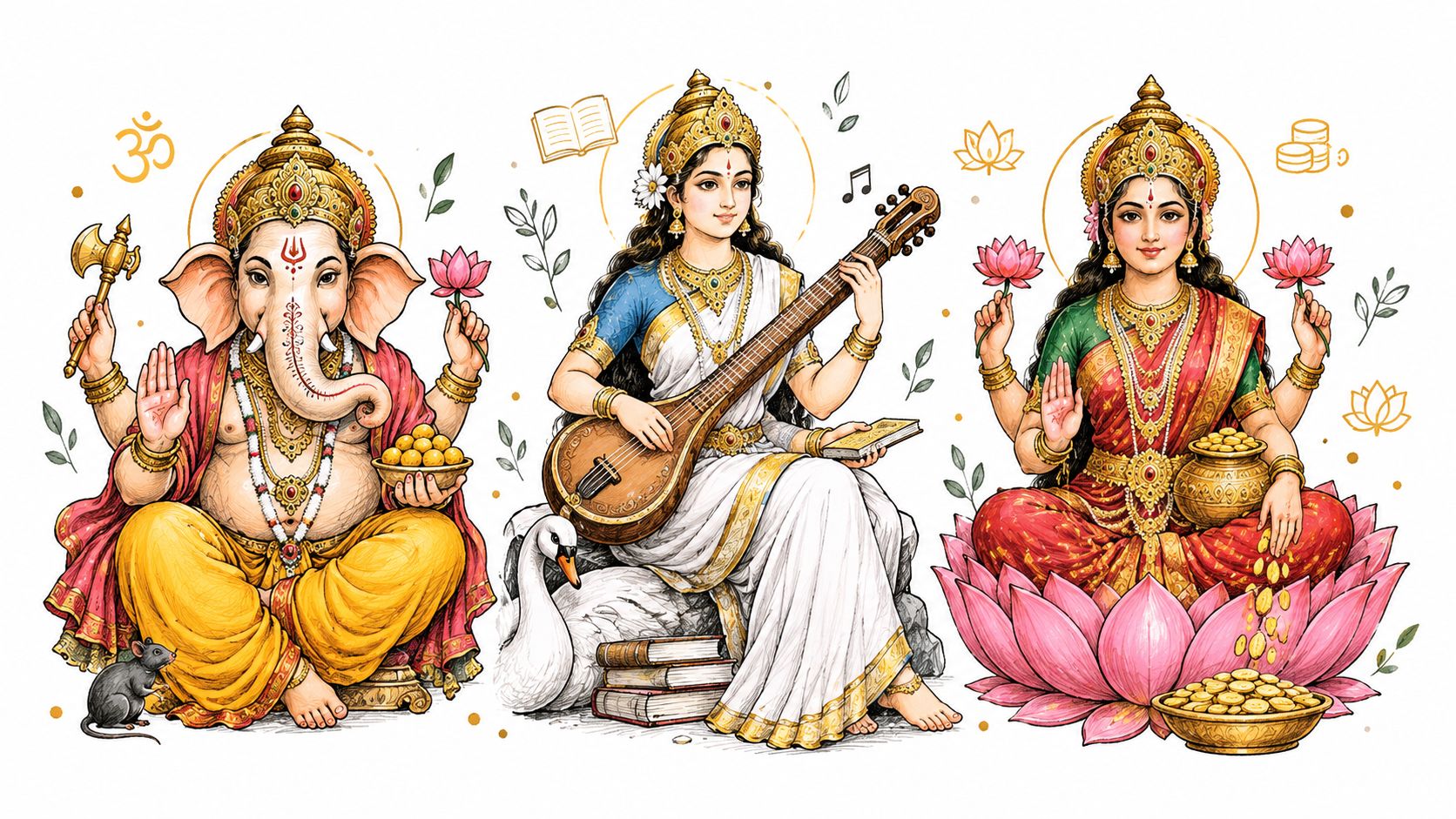
Ganesh and auspicious beginnings
Ganesh is the elephant-headed deity associated with good fortune, new beginnings and the removal of obstacles. UK interfaith materials describe Ganesh Chaturthi as a festival dedicated specifically to him, commonly understood as celebrating his birthday (Interfaith Network festival resources). That festival focus is different from Diwali, even though Ganesh may also be worshipped during Diwali in some traditions.
His presence in a home or workplace can therefore express a wish for a clear and auspicious beginning. This doesn't mean that a statue guarantees a particular practical result. It means the image provides a devotional and symbolic focus for intentions such as starting a business, beginning study, entering a new home or undertaking an important task.
Saraswati and cultivated knowledge
Saraswati is associated with learning, music, eloquence and the arts. A veena, manuscript or other learning-related attribute can help identify her in a sculpture, although attributes vary across forms and regional styles. Her presence suits a study, music room, teaching space or creative studio, but a household's devotional tradition should guide whether and how she's worshipped there.
For a fuller account of Lakshmi's place in Hindu religious imagery, readers can consult this guide to Lakshmi and prosperity. The important distinction is that Saraswati shouldn't be reduced to a decorative “success” figure. Her symbolic field concerns the knowledge and creativity through which people learn, communicate and make.
Lakshmi and prosperity
Lakshmi is associated with wealth, prosperity and good fortune. UK religious guidance describes Diwali as an annual five-day celebration held in October or November according to the Hindu lunar calendar, with Lakshmi Puja taking place on the third night (Religion Media Centre's Hinduism factsheet). Many families clean and decorate their homes, light lamps and offer prayers as part of welcoming Lakshmi.
That festival context explains why Lakshmi often occupies a prominent place in Diwali imagery. It doesn't erase the distinct roles of Ganesh or Saraswati. Instead, it shows why families may bring the figures together while still giving each one a separate identity.
Reading Iconography on Ganesh, Saraswati and Lakshmi Statues
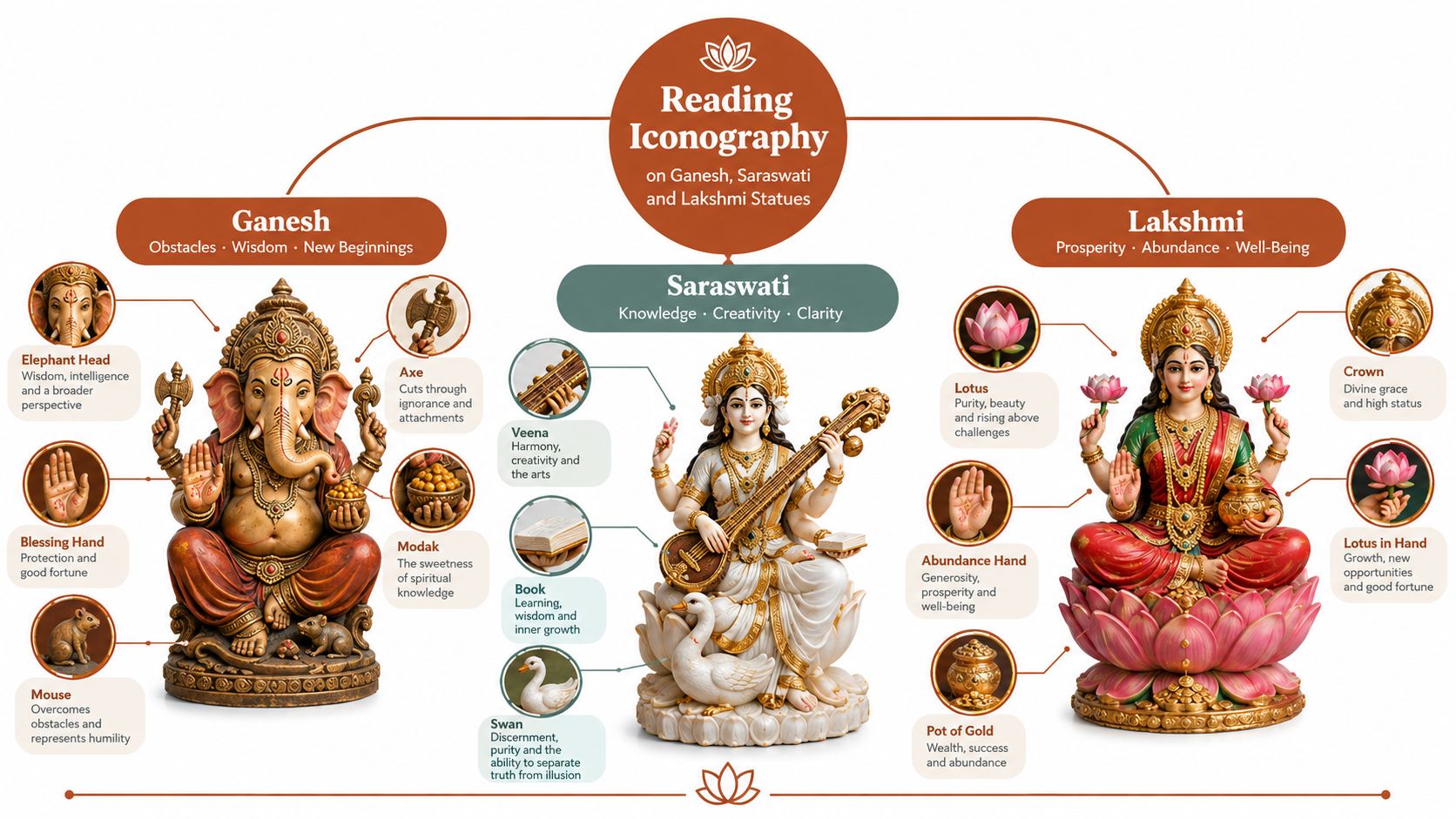
A collector comparing three statues in a showroom may find similar materials, colours or auspicious motifs. Identification should begin with the figure's attributes, posture, vehicle, material and regional style, not with a seller's label. These clues can confirm or question a description, especially when a combined image was made for gifting or general display.
Start with recognisable attributes
On a Ganesh figure, begin with the elephant head, trunk and rat vehicle. More elaborate forms may add several arms and a group of objects whose meanings depend on the specific form. A British Museum guide records a five-headed, ten-armed Ganesh carrying weapons, a lotus, fruit, a water pot and the rat vehicle (British Museum large-print guide).
Saraswati can often be recognised through the veena, manuscript, lotus and associations with music or learning. Lakshmi may be shown with the lotus, pot of abundance or other prosperity-related symbols. These features function like labels in a gallery. They help distinguish the deities and clarify the intended form, while variation remains common.
For a closer examination of Ganesh's attributes, consult this iconography guide to Ganesha. Compare its explanations with the object in front of you rather than treating a single feature as conclusive.
Consider style alongside identity
A deity's name does not describe the whole object. Regional style, material, dating, workmanship and cross-cultural influence can alter the appearance of a figure. A Kashmir Lakshmi in the British Museum, dated approximately to the 2nd to 4th centuries, combines an Indianised cornucopia, a full-bellied abundance pot, a lotus, pleated clothing reminiscent of Roman dress and a crown influenced by Sassanian models (British Museum collection record).
Use several forms of evidence together: iconographic completeness, regional attribution, material, condition and stylistic consistency. A lotus alone does not establish that a figure is Lakshmi, and a crown alone does not prove a particular period or region.
For transport and installation: inspect thin hands, veena necks, trunks, crowns and lotus stems before moving the piece. Projecting elements are often the most vulnerable parts of a sculpture.
Request photographs of the front, sides, base and any repaired areas. For worship, ask whether the object's condition and handling history fit the owner's tradition. For study or display, record its attributes and provenance clearly.
The Symbolic Sequence Behind the Triad
The strongest way to understand the trio is as a functional sequence. Ganesh addresses the difficulty of beginning. Saraswati represents the knowledge and creativity needed to proceed well. Lakshmi expresses the prosperity and good fortune that may sustain the work.
This sequence is not a mechanical promise. An image of Lakshmi doesn't guarantee financial results, and a Ganesh sculpture doesn't remove every practical difficulty. “Auspicious” describes a positive religious and cultural association, not a contractual outcome.
A sequence for different spaces
In a home entrance or new office, Ganesh may carry the strongest emphasis because the space marks a transition. In a study, Saraswati may be the most relevant figure because the room centres on reading, music, teaching or creative work. In a Diwali setting, Lakshmi may become the visual and devotional focus, with Ganesh included according to family practice.
The same three figures can therefore support different intentions without becoming inconsistent. Their relationship depends on what the space is for, who uses it and which tradition guides the household.
| Space or occasion | Emphasis that may feel most relevant | Question to ask |
|---|---|---|
| New home or venture | Ganesh and auspicious beginnings | What obstacle or transition is being acknowledged? |
| Study or creative room | Saraswati and cultivated knowledge | Is the space used for learning, music or artistic work? |
| Diwali observance | Lakshmi, often with Ganesh | What does the family's festival practice include? |
| General shrine | The balanced triad | Which family or community custom takes precedence? |
The British Museum's interpretation of these figures supports this kind of reading. Ganesh is associated with overcoming obstacles and auspicious beginnings, Saraswati with the arts and music, and Lakshmi with wealth and good fortune (British Museum Living Traditions guide). The framework is coherent without requiring every household to arrange the figures identically.
The order can communicate a way of living, not merely a decorative arrangement.
For an institution, that distinction is especially important. A museum, school or cultural venue may present the triad educationally, while a Hindu family may approach the same imagery devotionally. Accurate labels and sensitive interpretation should leave room for both without treating either as the only valid relationship.
Altar Placement, Festival Use and Gift Contexts
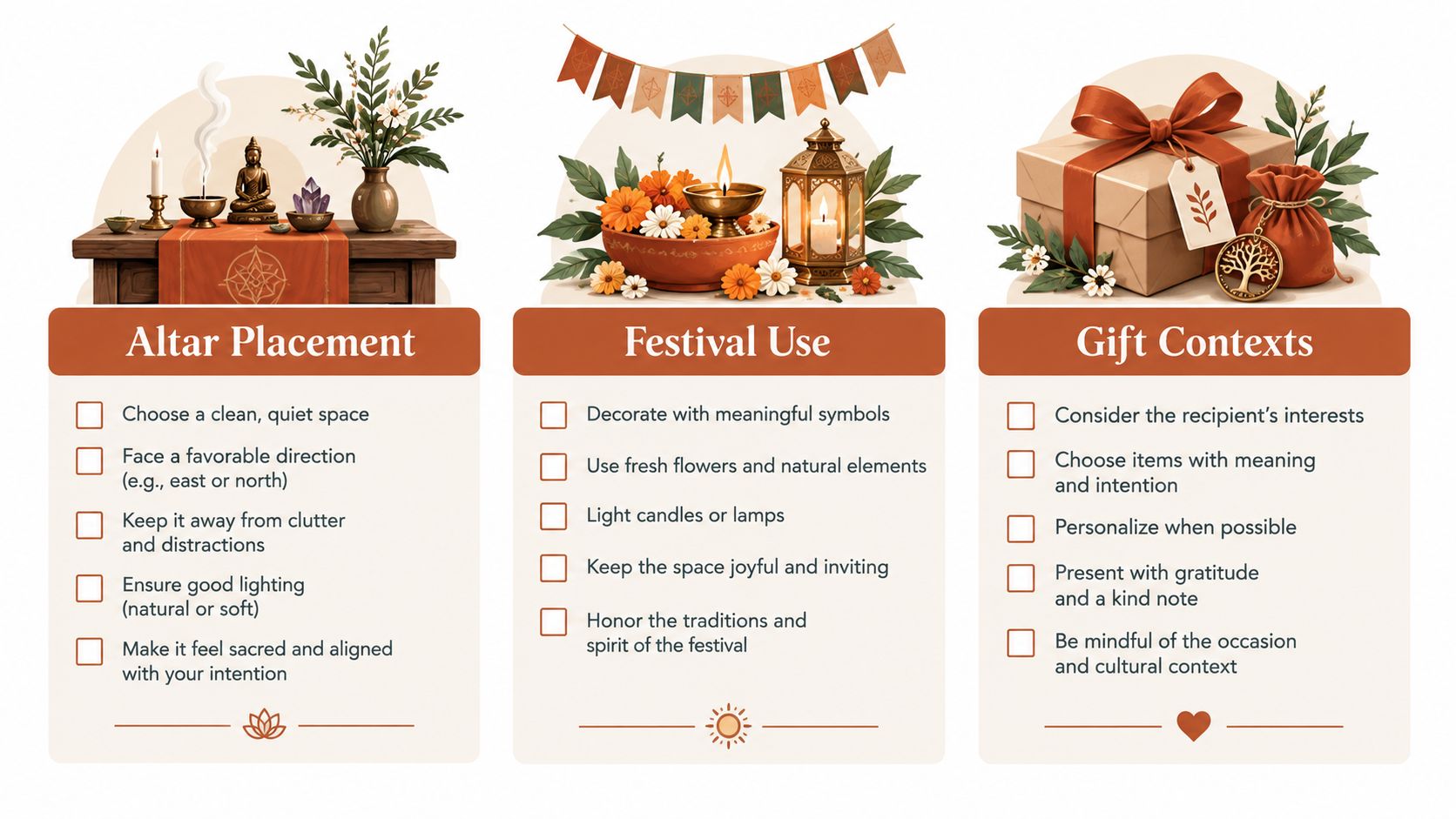
A three-deity image can serve several purposes, and each purpose changes the practical decision. A home altar needs a clean, respectful and usable location. A study display needs to fit the room without turning worship into a design accessory. A gift needs to acknowledge the recipient's own practice rather than impose the buyer's assumptions.
Home altars and limited space
A dedicated shrine offers the clearest setting for a combined representation. A rented flat may offer only a shelf, cupboard top or quiet corner. That limitation doesn't invalidate the practice. It calls for a clean surface, safe handling and an arrangement that the household can maintain.
There's no single UK-wide altar protocol that dictates which deity must occupy the centre or whether all three must appear together. A family's sampradaya, regional custom or inherited household practice should take priority over an online placement chart. Practical considerations also matter, including child safety, pets, heating, moisture and the risk of knocking projecting attributes.
For further practical reading, see this guide to a multi-deity Hindu home altar. Treat placement advice as guidance rather than religious law, particularly where the advice comes from interior design or Vastu summaries rather than the family's own tradition.
Festivals are not interchangeable
Ganesh Chaturthi focuses specifically on Ganesh. Diwali is broader, and UK guidance commonly connects its third-night Lakshmi Puja with Lakshmi, while the Royal Mint notes that prayers may be offered to both Lakshmi and Ganesh on Diwali night (Religion Media Centre's Hinduism factsheet). Saraswati may be included in some family or regional practices, but she shouldn't be added on the assumption that every Hindu household follows the same festival arrangement.
This distinction helps a buyer choose a suitable object. A Ganesh statue may be appropriate for a new beginning or Ganesh Chaturthi. A Lakshmi and Ganesh pairing may suit a Diwali gift where the recipient already follows that custom. A three-deity image may be meaningful for a family that wants to represent obstacle removal, learning and prosperity together.
Gifting with care
Ask the recipient, when possible, whether they prefer a devotional statue, a teaching object, a festival image or a decorative sculpture. Check scale, material, stability and packaging before buying. A smaller object may work in a limited home, while a more substantial sculpture may suit a collection or institutional display.
Don't describe auspiciousness as a promise of wealth. Explain the symbolic associations accurately, and let the recipient decide how the object should be placed and used.
Choosing Combined or Separate Representations
A combined Ganesh, Saraswati and Lakshmi image presents the three-part sequence in a single object: first clearing obstacles, then supporting knowledge and creativity, then representing prosperity. Shared scale, material and base can make it easier to place, especially where a room or altar has limited space. Separate statues let a household adjust emphasis for a festival, period of study or particular devotional practice.
Both formats can serve a respectful purpose. Begin with intended use, then consider the available space, the recipient's family tradition and the way the figures will be handled.
Use this decision framework
Choose a combined representation when one object should express the full sequence, when space is limited or when a matched visual style suits the setting. It may work in a study, reception area, gift setting or general home display. The owner should still recognise Ganesh, Saraswati and Lakshmi as distinct deities, rather than treating the group as interchangeable auspicious décor.
Choose separate representations when worship changes by occasion, when one deity has particular devotional importance or when the owner wants to study each figure's iconography independently. Separate pieces can also simplify future placement and conservation. They require closer attention to scale, material and visual relationship so that the group feels considered rather than assembled at random.
Use the following checks when comparing pieces:
- Iconography: Are the attributes identifiable, and does the arrangement distinguish Ganesh, Saraswati and Lakshmi clearly?
- Scale: Do the figures sit comfortably together without one appearing unintentionally dominant?
- Material: Is the surface suited to the intended handling, cleaning and environment?
- Provenance: Does the seller provide information about origin, date or collection history where available?
- Condition: Are trunks, hands, instruments, crowns, lotus stems and other projections secure?
- Photography: Do the images show more than one angle, including the base and rear?
- Purpose: Is the object intended for puja, teaching, gifting or decorative display?
Which deity should occupy the centre?
A single UK-wide placement rule does not govern every household. One family may follow a customary arrangement; another may centre the deity associated with the occasion. Equal height, clear presentation and the family's own practice can matter more than copying an online diagram whose source and context are unclear.
Ask before you prescribe: the recipient's family or community preference is usually more reliable than a placement chart detached from context.
The Office for National Statistics Census reporting distinguishes religious affiliation from active practice. The variety of Hindu practice in British households is exactly why this framework asks about the recipient's tradition first and the room's layout second.
Building a Respectful and Practical Display
A good display begins with a clear decision about the object's role. A practising household may need a place for regular worship. A Hindu-identifying family may want an image that carries cultural and familial meaning. A non-Hindu owner may value the sculpture as art or as part of a collection. These relationships can overlap, but they shouldn't be assumed to be identical.

Start with the room
Choose a location that's clean, stable and proportionate to the object. A quiet shelf or dedicated platform may suit a home shrine. A study can accommodate a smaller figure near books or musical instruments, provided the placement doesn't crowd the object with unrelated items. An institutional setting should provide enough space for interpretation, safe viewing and accurate labelling.
Avoid placing fragile projections where people frequently brush past them. Keep the sculpture away from direct sunlight, damp conditions, unstable shelves and heat sources. These are conservation considerations as much as matters of respect.
Handle the sculpture as an artwork
Lift a statue from its strongest body section, not by its trunk, instrument, crown or lotus stem. Support the base with both hands when possible. Before installation, inspect joints, repairs and any loose components, then record the object's condition with photographs.
A catalogue entry should name the deity, note visible attributes, and describe uncertainty with transparency. If the image combines all three figures, identify each one rather than labelling the whole object as a prosperity statue. That precision helps future owners, curators, and family members understand what they are looking at.
Keep tradition and practicality together
The triad works because it connects beginnings, knowledge and prosperity. It remains meaningful when the owner allows family practice and community guidance to shape the display, rather than treating symbolic associations as rigid interior rules. A compact rented-home shrine, a school collection and a museum gallery may all present these figures responsibly, but their labels, handling procedures and devotional expectations will differ.
For collectors and gift buyers, HD Asian Art offers Hindu deity sculptures including Ganesha and Lakshmi, alongside Buddhist and Southeast Asian works, with online collection information for people researching meanings, forms and display contexts. Explore the available selection at HD Asian Art, compare iconography and materials carefully, and choose a representation that suits the recipient, room and intended use.
