



Buddhist and Hindu Artwork with Meaning: A UK Buyer's Guide
Buddhist and Hindu Artwork with Meaning: A UK Buyer's Guide
You're standing in a shop, a market stall, or scrolling through listings at home, looking at a calm seated figure and thinking it would suit your hallway or meditation corner. It looks peaceful. That's a fair first impression, but it doesn't yet tell you who the figure is, what its hands are saying, or whether it's meant for a shrine, a teaching scene, or protection at a doorway. That's where most buyers get stuck, and it's exactly where Buddhist and Hindu artwork with meaning becomes readable once you stop judging by the face alone.
Table of Contents
- Why Meaning Lives in the Whole Statue
- Common Symbols Across Buddhist and Hindu Art
- Reading the Deities Buyers Ask About
- Reading Mudras and Postures in Buddhist Statues
- Reading a Shiva Nataraja Piece Element by Element
- Choosing Between Antique, Vintage and Contemporary Pieces
- Matching Meaning to Your Space and Intent
- Confirm the Meaning and Placement Before You Buy
Why Meaning Lives in the Whole Statue
A visitor in front of a bronze Buddha often sees calm first. The face is still, the eyes are lowered, and the whole piece feels quiet. That feeling is real, but it isn't an identification. You can't name the figure or its purpose from serenity alone.
These statues communicate through combined evidence. Posture tells you what the body is doing. A hand gesture adds a specific message. Objects held in the hands, clothing, surrounding figures, an inscription, and the setting the piece was made for each add another link. No single feature settles identity on its own, and that's the single-feature trap to avoid.
Why similar styles can mislead
A face or body type can be shared across traditions. Workshops in places such as Mathura served several faiths, so Hindu, Buddhist, and Jain pieces from the same centre can look alike in carving style. Similar style doesn't mean interchangeable meaning. The shared look reflects a common workshop culture, while specific attributes identify the deity or teacher.
The V&A frames Buddhist icons as embodiments of the religion's spiritual goal and path, grouping Mahayana bodhisattva images around compassion and Tantric sculptures around a yogic path toward enlightenment. In that framing, a Shakyamuni image isn't a portrait. It's a visual statement of the awakened state.
Practical rule: Read the statue, don't guess from its look.
That gives you three questions to use throughout this guide. What is the figure doing? What is it holding? Where was it meant to sit? If you can answer those, you're reading evidence. If you can only say it looks peaceful, the chain hasn't started yet.
Common Symbols Across Buddhist and Hindu Art
A buyer scanning a catalogue wants to decode one object at a glance. This table is the right place to start, provided you treat each row as a clue rather than an answer.
| Symbol | Where it appears | Core meaning | Tradition |
|---|---|---|---|
| Lotus | Seated Buddhas, pedestals, Lakshmi, Brahma | Purity rising from mud, spiritual transcendence | Buddhist and Hindu |
| Elephant | Ganesha, Indra's mount, temple guardians | Strength, wisdom, royal authority | Buddhist and Hindu |
| Naga cobra | Canopy over a Buddha, Vishnu | Protection and watchful power | Buddhist and Hindu |
| Chakra | Vishnu's hand, Buddhist wheel motifs | Cosmic order, teaching of dharma | Buddhist and Hindu |
| Conch (shankha) | Vishnu's hand | Auspicious sound and victory | Hindu |
| Fly whisk (chamara) | Goddesses, bodhisattvas, Purneshvari | Royal rank and honour | Buddhist and Hindu |
| Modak sweet | Ganesha's hand | Reward for wisdom, sweetness of attainment | Hindu |
| Mouse (mushaka) | Ganesha's mount | Desire humbled and held in check | Hindu |
| Bodhi tree | Scenes of the Buddha's awakening | Enlightenment under the tree | Buddhist |
| Trishula (trident) | Shiva | Three functions or qualities of existence | Hindu |
Shared symbols need a second clue
A shared symbol works like a word that exists in two languages. It can point in the right direction without finishing the sentence. A lotus under a seated figure signals purity and spiritual rising in either tradition, so by itself it cannot tell you whether you are looking at a Buddha, a bodhisattva, Lakshmi, or Brahma. Identity has to come from other attributes: what the figure holds, who stands beside it, or how the hands are arranged.
The naga cobra behaves the same way, sheltering a Buddha in one tradition and accompanying Vishnu in another, carrying protection in both cases. The fly whisk is an even cleaner example of where the evidence chain breaks. It marks royal rank and honour in Hindu and Buddhist art alike, which is why it turns up beside goddesses and bodhisattvas without belonging exclusively to either. Held alone, it tells you the figure has status. It tells you nothing about which tradition produced the piece. You need a second attribute, such as a mount, a held object, or an inscription, before the whisk's evidence adds up to a name.
If you enjoy this kind of close reading, the symbolism of the never-ending knot shows how one interlaced motif can carry a layered message rather than a one-word answer.
Count repeated elements
Numbers work as clues too. A panel in the V&A's collection depicts the Buddha's descent from Trayastrimsa Heaven, the heaven of the Thirty-Three Gods, where he is said to have preached to the gods and his mother before returning to earth. Hindu iconography counts the same way, with Vishnu's three strides measuring out the cosmos. Scenes like these are built on counted elements: groups of three, paired figures, repeated arms. When a statue shows the same element again and again, count it before you dismiss it as decoration.
Match at least two symbols before you name the figure.
That cross-check will not make you certain every time, and it is honest to say so. What it does is stop the commonest mistake, which is naming a statue from a lotus, an elephant, or a cobra seen in isolation.
Reading the Deities Buyers Ask About
Most buyers arrive with a name in mind. Use this quick identity check, and confirm at least two matching attributes before you settle on any name.
- Buddha: Seated or standing, identified mainly by mudra and bodily marks rather than by one fixed object.
- Ganesha: Elephant head, a modak sweet in one hand, and a mouse mount nearby, linking wisdom with the removal of obstacles.
- Lakshmi: Seated or standing on a lotus, sometimes with coins or a gold pot, associated with abundance.
- Vishnu: Conch and chakra in the hands, often with a naga canopy, carrying protection and cosmic order.
- Shiva: Trident, and in dance form the Nataraja composition, linked to transformation.
Ganesha suits new beginnings and entrances, while Lakshmi is often chosen for a home shrine or office reception. If you want the hand-by-hand detail, our guide to what Ganesha holds in his hands breaks down each object. Once the name is settled, the next question is what the hands are doing, especially on a Buddha.
Reading Mudras and Postures in Buddhist Statues
A mudra is a codified hand position with a conventional meaning. It's closer to a sign in sign language than to a natural gesture a sculptor invented for one piece. Posture works in a similar way. Seated often points to meditation, while standing can suggest teaching or a more formal, royal presence.
| Mudra | Hand position | Meaning |
|---|---|---|
| Abhayamudra | Right hand raised, palm outward | Fear not, protection and reassurance |
| Dharmachakramudra | Both hands at chest, thumb and index forming a wheel | Turning the wheel of teaching |
| Bhumisparshamudra | Right hand touching ground, fingers down | Calling the earth to witness the awakening |
| Dhyanamudra | Hands in lap, palms up, one over the other | Meditation and equanimity |
| Varadamudra | Right hand lowered, palm outward | Generosity and granting wishes |
| Vitarkamudra | Right hand at chest, thumb and index forming a circle | Teaching and discussion |
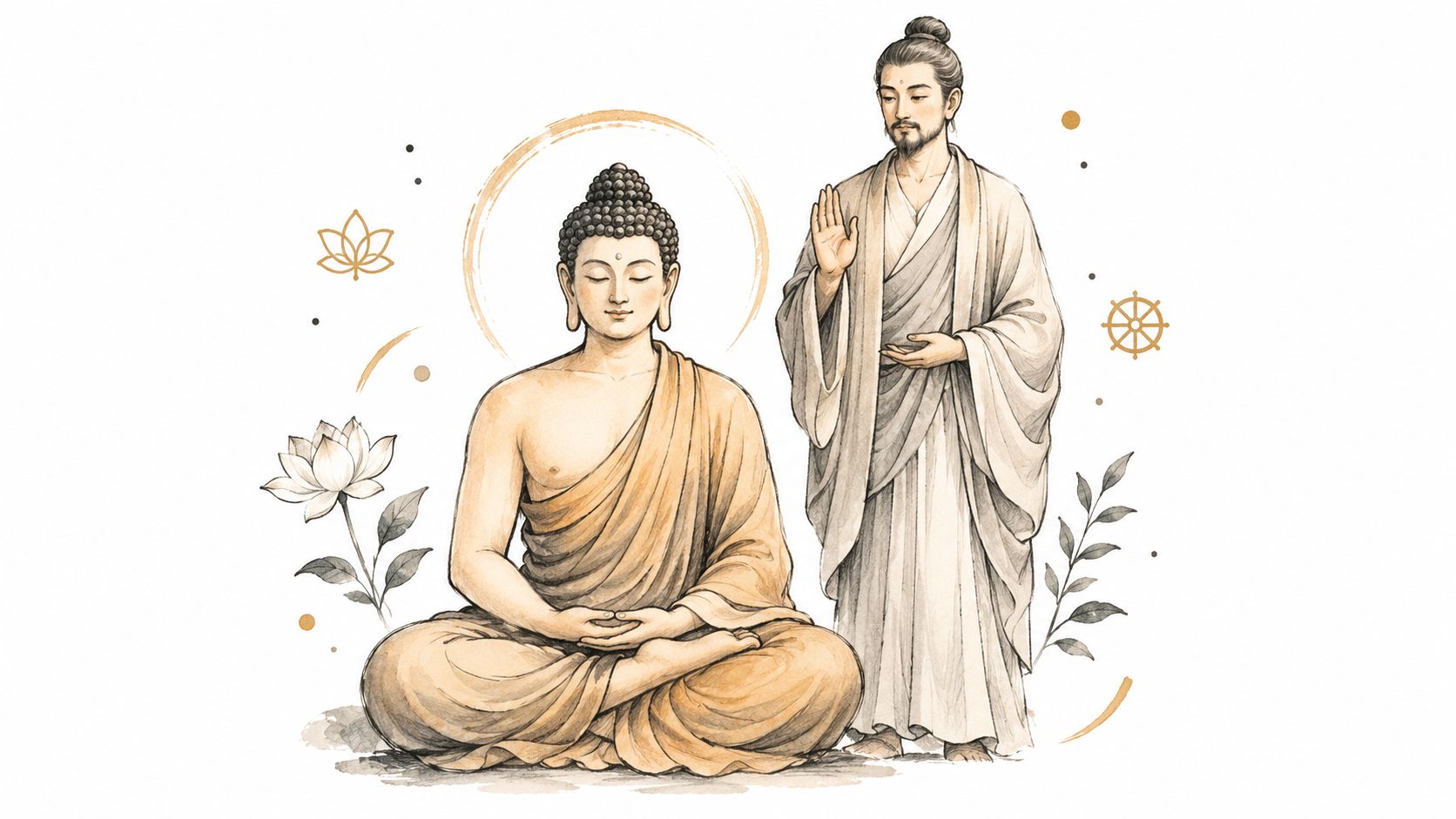
The image below pairs a meditating Buddha with a standing teacher, a useful reminder that posture changes the message even before you read the hands.
What one Shakyamuni teaches you
A V&A Shakyamuni uses a raised right hand in abhayamudra, signifying the allaying of fear, while lowered eyes and head indicate the image was meant to be viewed from below. That points to a processional or temple setting, not eye-level shelf display. The same sculpture includes several of the traditional 32 auspicious bodily marks, including curled hair, a cranial protuberance, and webbed fingers.
Those marks signal Buddhahood rather than naturalistic anatomy. So a stylised hand or an unusual head shape isn't necessarily a sculptor's error. It's part of the code, and a buyer who expects realistic anatomy can misread a correct piece as a flawed one.
The display rule follows from the evidence. Keep the viewing height and sightline the piece was made for, with space around it, instead of treating it as neutral décor. Our product guides also explain Buddha postures and mudras such as meditation, teaching, protection, or blessing, which helps when a listing names a gesture without explaining it.
Watch one edge case. Dharmachakra and vitarka can look similar in a small photograph. Check whether both hands sit at the chest and whether thumb and index finger form a circle. One hand at the chest usually points toward vitarka, while two hands forming the wheel point toward dharmachakra. If the photograph is unclear, ask for a close-up rather than guessing.
Reading a Shiva Nataraja Piece Element by Element
A Nataraja can look overwhelming at first because everything is moving at once. Slow it down by reading from the feet upward. You're learning a method here, not memorising a list.
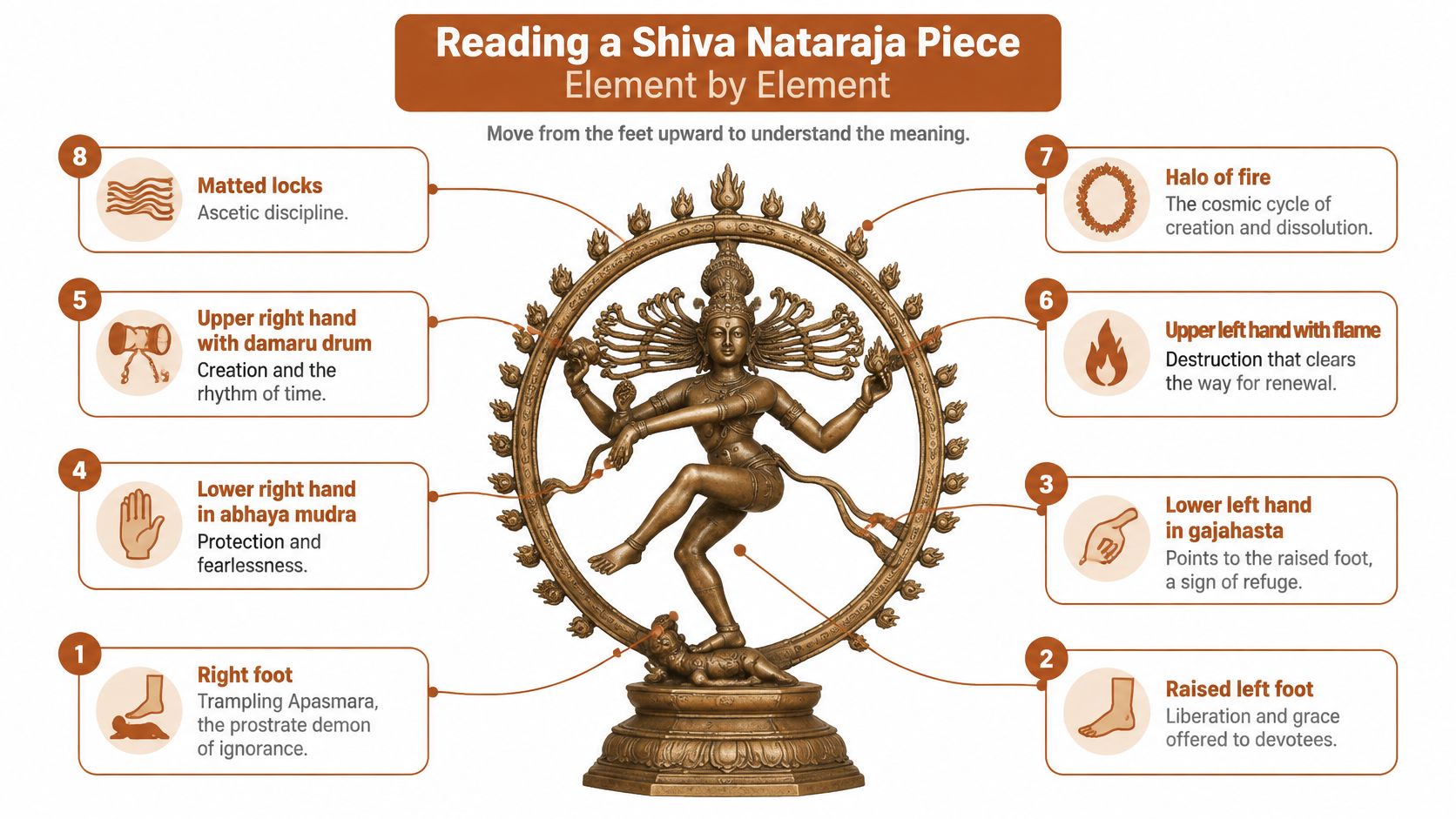
Start at the base. Shiva dances with his right foot on Apasmara, a prostrate demon who signifies ignorance. The principle is clear when you state it plainly. Ignorance is pressed down, and its destruction brings enlightenment. Compare it to clearing a blocked path. The point isn't cruelty toward a small figure. It's removing what stops understanding.
The ring and the four arms
Around the dancer is a ring of flames, the jvala mala, symbolising the life of the universe. The V&A's bronze shows Shiva with four arms and three eyes, combining destruction of ignorance, protection, creation, and final dissolution in one composition. Each hand carries a separate part of that message, so read them one at a time.
- Front right hand: Forms abhaya mudra, conveying assurance, with a cobra around the forearm signifying protection.
- Rear right hand: Holds the damaru drum, associated with creation.
- Rear left hand: Holds agni, the flame through which the universe will ultimately be destroyed.
Now group them into two pairs. Creation sits opposite destruction, so the drum and the flame describe a cycle rather than a single event. Assurance pairs with protection, so the open hand and the cobra tell the devotee not to fear that cycle. The ring of flames holds both pairs together as cosmic continuity.
Destruction here means clearing ignorance and ego, not simple annihilation.
That's the edge case readers often miss. A Nataraja isn't a statue about ruin for its own sake, and placing it as a dramatic ornament without that context flattens its meaning. It presents a universe that's created, sustained, dissolved, and renewed, with ignorance pressed underfoot throughout.
Try the exercise museums use in miniature. Write a three-line label in your own words. Line one names the figure. Line two states the main action, such as dancing on ignorance within a ring of flames. Line three lists the concepts the attributes carry, such as assurance, protection, creation, and dissolution. If you can't write line three for a piece you're considering, you don't yet have enough evidence to judge whether it suits your intent.
Choosing Between Antique, Vintage and Contemporary Pieces
The label changes what you're buying and what you should check before paying. It's like the difference between an original print, a later edition, and a modern poster of the same image. The picture may be similar, but age, value, and evidence aren't.
| Type | What the label means | Best for | Check before buying |
|---|---|---|---|
| Antique | Made in an earlier period, age and origin are the main claim | Collectors, museum-style displays | Documented age and provenance |
| Vintage | Older than modern production, not classed as antique | Décor with a period feel | Condition and place of origin |
| Antique-inspired reproduction | Modern piece based on an older design | Shrines and gifts on a budget | Whether the listing says it isn't antique |
| Faithful temple-style reproduction | Modern casting following a historic temple form | Meditation rooms, puja spaces | Accuracy of iconography against the label |
| Contemporary interpretation | Modern artist's version of a traditional figure | Modern interiors, personal gifts | Whether attributes still match the deity |
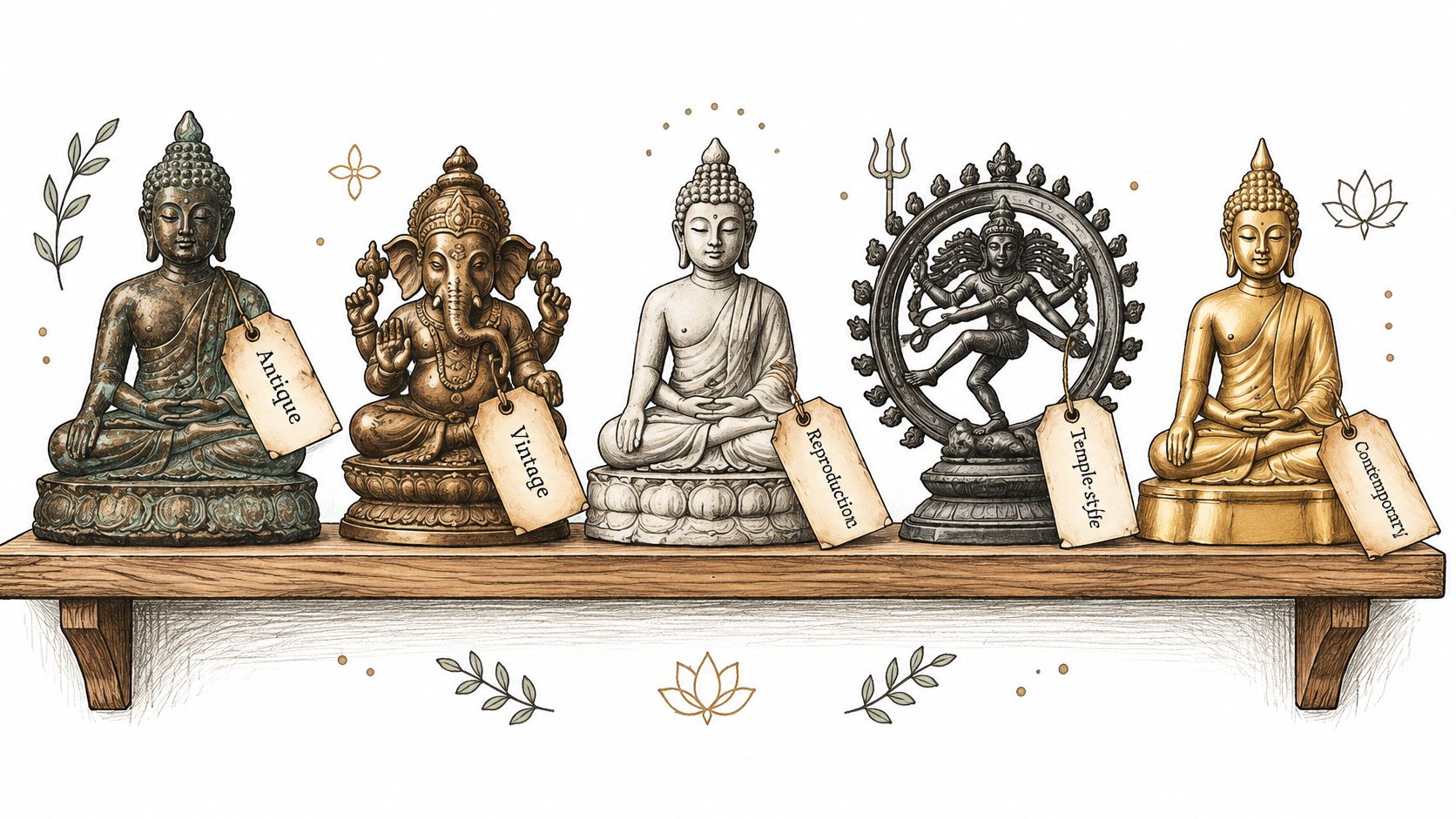
Our listings state whether a piece is antique, vintage, or modern and name the stylistic school, such as Khmer, Thai, or Indian. Our collection includes antique, antique-inspired, faithful temple-style reproductions, and contemporary interpretations. You can compare that approach with our guidance on antique versus reproduction Buddhist art before you shortlist anything.
Read any label in three parts. The school gives the visual tradition. The age shapes the provenance question. The reproduction type shows whether you're buying a faithful copy or a new interpretation. Then check the attributes against the listing. A contemporary Vishnu should still show the conch or chakra, and an antique should come with documented age rather than a vague claim.
Provenance matters in Britain because collecting has a long institutional history, including more than 1,200 South Asian objects cared for by Leeds Museums and Galleries. For gifts under £150, contemporary and reproduction pieces often fit the budget while keeping the meaning intact. An antique raises provenance questions a gift giver may not want to handle. Ask for measurements and material either way, because you'll need both for placement.
Matching Meaning to Your Space and Intent
The figure's meaning decides where it sits, and the room decides how it's seen. Those are two separate decisions, and buyers often merge them into one question about whether a statue looks nice in a corner. Keep them apart.
| Setting | Suggested figure | Placement | Avoid |
|---|---|---|---|
| Meditation corner | Meditation Buddha in dhyanamudra | Raised surface at seated eye level, clear space around it | Clutter, bright clashing objects |
| Home shrine or puja room | Shiva, Ganesha, Lakshmi, or Vishnu | Clean shelf or dedicated altar, raised from floor | Bathrooms, bins, the floor |
| Entrance hall | Ganesha | Inside threshold, facing the door, at raised height | Outside the door, on the floor |
| Living room | Buddha in blessing or teaching pose | Eye level, visible, treated with respect | Placed where guests use it as a prop |
| Office reception | Ganesha or Lakshmi | Reception shelf, visible to arrivals | Blocking exits, stacked among décor |
We suggest a meditation Buddha for a calm room or altar, Ganesha for new beginnings and wisdom, Shiva for transformation, Vishnu for protection, and Lakshmi for abundance. Treat those as starting points, not rules that override the evidence chain. A Shiva chosen for transformation still needs the right attributes, and a Lakshmi chosen for abundance still needs a respectful setting.
Rules that apply in every room
Keep the piece clean, raised from the floor, and away from bathrooms, bins, or cluttered corners where it may be treated casually. That's our standard recommendation for a Buddha statue, and it's a sensible baseline for Hindu figures too. A raised shelf also protects a piece from kicks, vacuum cleaners, and pets, so respect and practicality point the same way.
Many Hindu and Buddhist objects now in British collections were first kept in temples or household shrines for daily devotion. A home piece can carry the same weight for its owner, which is why placement isn't just interior styling. You're deciding how an object of devotion or meditation will be treated day after day.
Edge cases are normal in UK homes. If your living room doubles as a meditation space, use a dedicated raised shelf and clear space rather than a separate room you don't have. In a small flat with no shrine, a clean, uncluttered shelf is better than a crowded altar squeezed beside a bin. At an entrance, place Ganesha inside the threshold and raised, facing inward toward the home rather than sitting on the floor by the shoes. If you can't meet the basic conditions in that spot, choose a different spot instead of forcing the pairing.
Confirm the Meaning and Placement Before You Buy
You're now making one decision. Does this specific piece fit its meaning, your space, and your intent? Work through the chain in order, and stop if a link breaks.
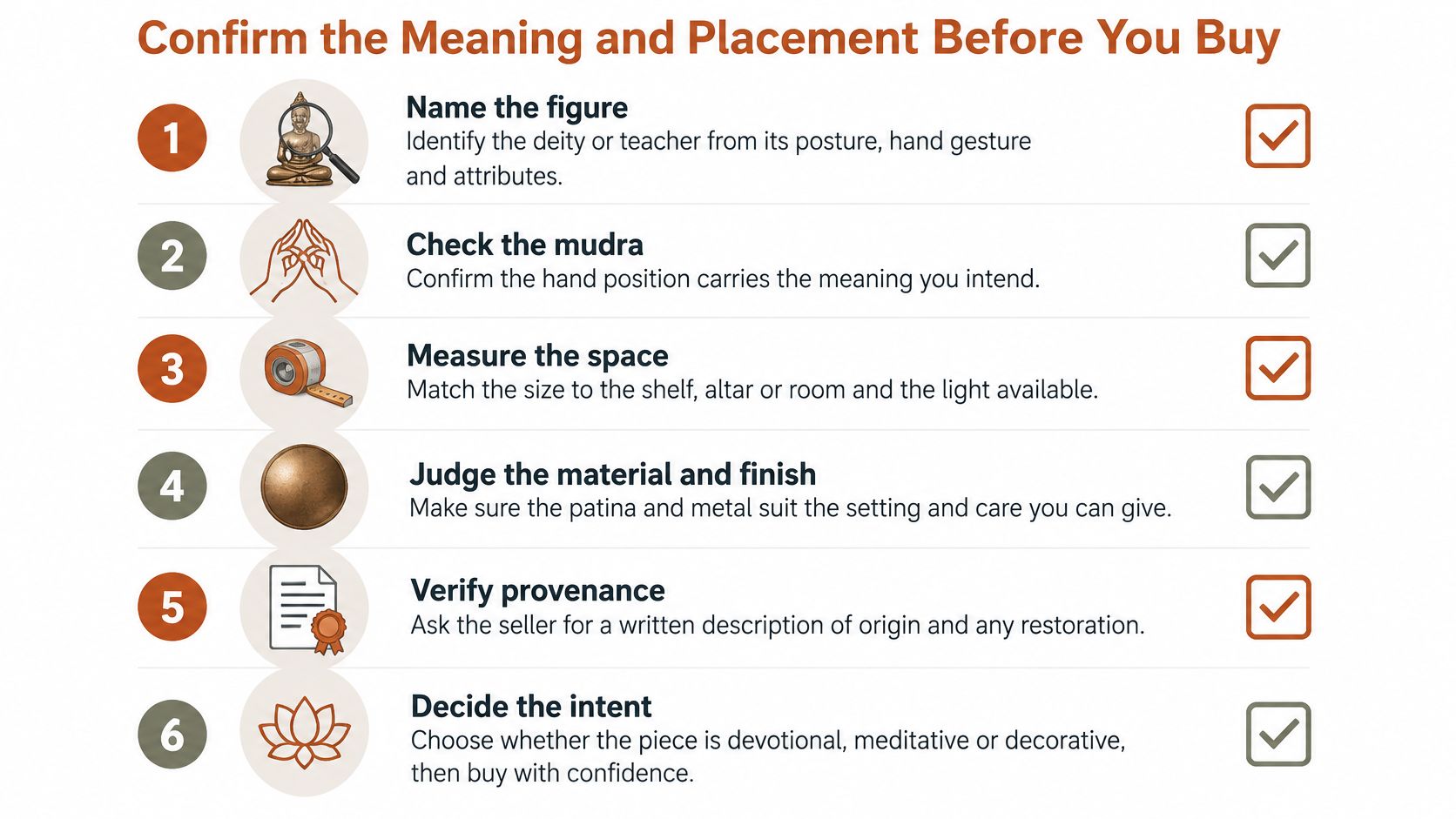
- Name the figure: Use posture, hand gesture, and attributes, with at least two matching clues.
- Confirm the mudra or key symbol: Check it carries the meaning you intend, not just a meaning you like.
- Read the origin and age label: Note the school and whether the piece is antique, vintage, or modern.
- Match the figure to the setting: Use the placement table above rather than available shelf space alone.
- Measure the space: Check shelf or altar height and width before choosing a size.
- For a gift, check the use: Find out whether the recipient will use it as a shrine piece or as décor.
A statue can tell you a lot when its posture, gesture, attributes, and label agree. It can't tell you its full history from a photograph, and it can't confirm age or origin without documentation. Be direct with yourself about that limit. If the seller can't explain an attribute or the label contradicts the figure, that's useful information, not a minor detail.
We help customers choose the right statue when they share photos, measurements of their space, and preferences such as deity, material, or style. Our range covers Buddha and Hindu figures suited to home shrines, meditation rooms, puja spaces, décor, and collections. That support is most useful when you arrive with your three answers half formed, because we can test them against specific pieces.
If the evidence chain breaks, don't buy on the face alone.
Finish with one action. Write the three-line label from the Nataraja example for the piece you're considering, naming the figure, its main action, and the concepts its attributes carry, then use that label to shortlist two options.
Browse Buddhist and Hindu artwork with meaning at HD Asian Art, where Buddha, Ganesha, Shiva, Vishnu, and Lakshmi pieces are listed with their school, age category, and iconography explained. Send us photos and measurements of your shrine, meditation corner, or entrance hall, and we'll help you match a figure's mudra and attributes to the space before you buy.
