



How to Spot and Fix an Over-Cleaned Antique Bronze Surface
How to Spot and Fix an Over-Cleaned Antique Bronze Surface
If you’ve found a bright, stripped patch on an antique bronze piece, stop all cleaning immediately, photograph the area, and isolate the object in a dry, stable environment. Do not apply any household cleaner, acid, or polish. For any spot showing pitting, powdery green deposits, or exposed yellow-pink metal, contact a professional conservator before doing anything else.
Immediate do/don’t list:
- Do photograph the damaged area from multiple angles before touching it
- Do move the object to a dry room away from humidity and direct sunlight
- Do wrap it loosely in acid-free tissue and place it in a padded, ventilated box
- Do label the images with date, location on the object, and any prior treatments you know of
- Don’t apply vinegar, lemon juice, ketchup, baking soda paste, or any commercial metal polish
- Don’t keep the object in a damp basement, bathroom, or near a sink
- Don’t rub the bright spot again, even with a soft cloth
Immediate action checklist:
- Photograph (multiple angles, macro if possible)
- Label and date images
- Isolate the object in a dry, stable space
- Wrap in acid-free tissue
- Avoid all moisture contact on the affected area
- Contact a conservator if the metal is bright, pitted, or shows any powdery green residue
Pro Tip: Write the date and a brief description directly on the tissue wrapping. If you later consult a conservator, that record of when the damage was first noticed is genuinely useful for treatment planning.
Key Takeaways
Stopping all cleaning immediately and documenting the damage before any further intervention is the single most protective action you can take after spotting an over-cleaned area on antique bronze.
| Point | Details |
|---|---|
| Stop and document first | Photograph the spot from multiple angles before touching it; label images with date and location. |
| Classify severity before treating | Cosmetic brightness only allows careful DIY stabilization; pitting or green deposits require a conservator. |
| Use only conservation-grade materials | Distilled water, non-ionic detergent, soft brushes, and microcrystalline wax are the approved toolkit. |
| Wax protects and integrates | A thin microcrystalline wax coat reduces visual contrast and provides a reversible moisture barrier. |
| Professional referral is non-negotiable for active corrosion | Bronze disease, pitting, or structural damage must be assessed and treated by a qualified conservator. |
Table of Contents
Why patina is worth protecting: chemistry, value, and provenance
Patina on antique bronze is not dirt. It is a chemically stable surface layer, typically composed of copper oxides, carbonates, and sulfides, that forms over decades or centuries of controlled oxidation. This layer bonds to the metal itself. Removing it is not like wiping dust from glass; it is closer to sanding away the top layer of the object.
Smithsonian conservators treat stable patina as part of an object’s historic integrity, not a surface contaminant. That position reflects a broader conservation consensus: patina carries evidence of age, workshop finishing, burial environment, and handling history. Strip it, and you erase information that cannot be reconstructed.
The market consequence is direct. A bronze statue with original, unbroken patina commands significantly higher prices at auction and in specialist galleries than a comparable piece that has been polished or chemically stripped. Collectors and appraisers read surface continuity as a primary authenticity signal. An over-cleaned spot, even a small one, can raise questions about whether the piece has been altered elsewhere and can affect authentication assessments that rely on surface evidence.
Stable patina also functions as a physical barrier. It slows further oxidation of the underlying copper alloy. Remove it, and the exposed metal is more reactive, not less.
How to assess the over-cleaned area accurately
Before choosing any treatment, classify the damage. The severity determines whether conservative DIY stabilization is appropriate or whether a conservator must be called immediately.
Severity classification checklist:
- Cosmetic brightness only: The spot looks lighter or shinier than surrounding areas, but the surface is smooth and intact. No pitting, no green deposits, no texture change. This is the mildest category and the only one where careful DIY stabilization may be appropriate.
- Surface abrasion or burnishing: Raised details appear flattened or polished. The surface may show fine directional scratches under raking light. Conservation guidance notes that burnishing of raised details typically precedes visible scratching and represents genuine surface loss.
- Shallow pitting: Small depressions are visible in the metal, often where patina has been removed mechanically. No active green deposits. Requires professional assessment.
- Metal loss with active corrosion: Pitting combined with powdery, fuzzy, or flaky green deposits. This is active corrosion (bronze disease) and requires immediate professional referral.
Photo-documentation protocol:
- Shoot in natural daylight and under a single raking light source to reveal texture
- Include a ruler or coin for scale in at least one frame
- Capture the whole object, then the affected area at medium range, then macro
- Label each image: date, object name or catalog number, location of damage, and any treatments previously applied
- Store images in a dedicated folder and back them up before any treatment begins
Diagnostic prompts to run before touching the surface:
- Does rubbing the spot with a dry cotton swab transfer any color? If yes, active material is present and cleaning must stop.
- Is any green deposit powdery or fuzzy when viewed under a loupe? If yes, treat as active corrosion.
- Is the exposed metal yellow or pink rather than brown or black? That color indicates bare copper alloy, meaning the patina has been fully removed in that zone.
Surface texture changes that are invisible to the naked eye become clear at that magnification.*
Emergency stabilization after over-cleaning
Once you have documented the damage, the priority is preventing further change while you plan next steps. No chemical intervention is needed at this stage.
Remove the object from any humid environment. Bathrooms, kitchens, basements, and outdoor spaces all introduce moisture that accelerates oxidation on exposed metal. A dry interior room with stable temperature is the correct storage location.
Avoid handling the damaged area directly. Skin oils and salts transfer easily to bare metal and can initiate or accelerate corrosion. If you must move the object, wear clean cotton or nitrile gloves and support it from areas away from the affected spot.
For temporary storage, wrap the object loosely in acid-free tissue. Do not use newspaper, bubble wrap in direct contact with the metal, or standard plastic bags, all of which can trap moisture or transfer acids. Place the wrapped piece in a padded box with ventilation. Silica gel packets placed near (not touching) the object help maintain low relative humidity.
A small digital hygrometer costs very little and removes the guesswork. Fluctuating humidity is more damaging than a consistently moderate level.*
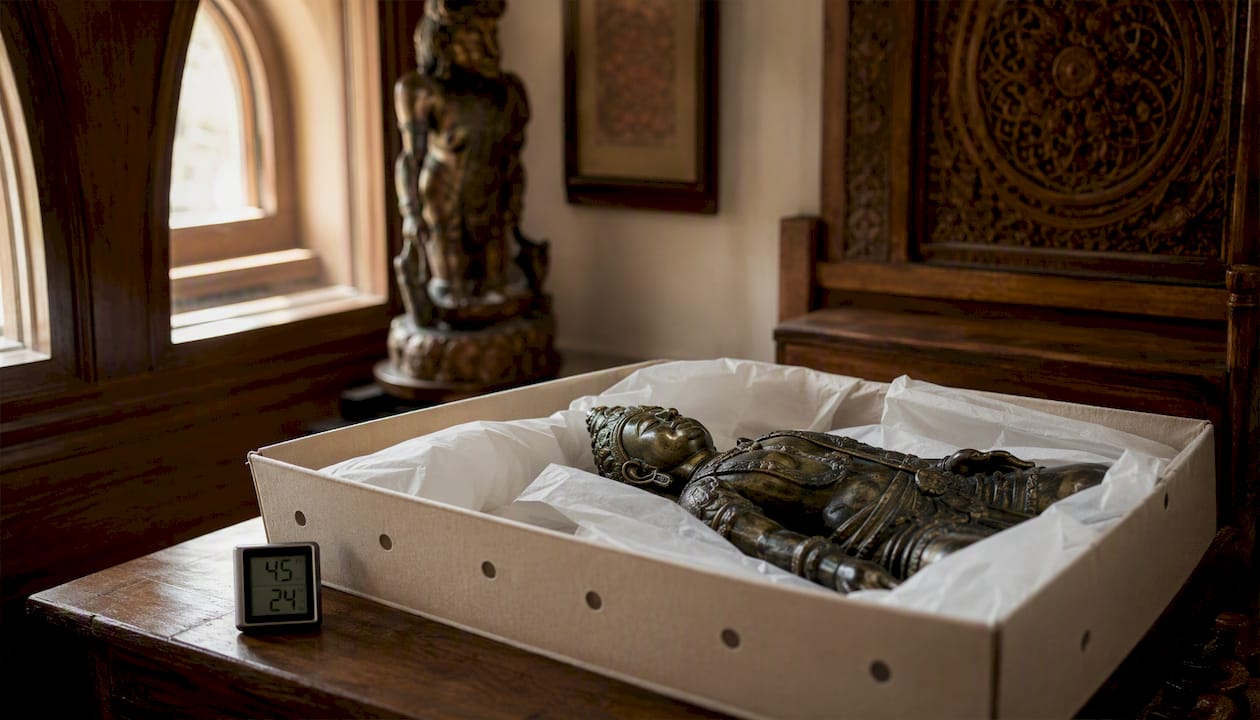
Contact a conservator immediately if you observe any of the following: pitting in the metal surface, powdery or fuzzy green deposits, loose or flaking surface material, or any structural instability. These signs indicate active processes that stabilization alone cannot stop.
Conservator-approved treatment steps for minor, cosmetically brightened spots
The following steps apply only to spots classified as cosmetic brightness with no pitting, no active corrosion, and no texture change. If the damage is more severe, skip to the professional referral section.
Materials required:
- Distilled water (not tap water, which contains minerals and chlorides)
- pH-neutral, non-ionic detergent (such as a conservation-grade soap or a very dilute solution of a non-ionic surfactant)
- Cotton swabs and lint-free cloths
- Soft natural-bristle brush (watercolor brush, size 2–4)
- Microcrystalline wax (Renaissance Wax is the most widely used conservation-grade product)
- Clean nitrile or cotton gloves
Step-by-step minimal intervention routine:
- Dry dust first. Use a soft natural-bristle brush to remove loose surface dust. Work from the top of the object downward. Do not press into the surface.
- Spot-test before any wet cleaning. Choose a small, hidden area, not the damaged spot itself. Apply a barely damp cotton swab with distilled water only. Wait 30 seconds. If any color transfers to the swab, stop all wet cleaning.
- Damp swab the affected area. If the spot test is clear, dampen a fresh cotton swab with distilled water and a trace of non-ionic detergent. Work in small circular motions with minimal pressure. Use a fresh swab every few passes. GSA conservation guidance confirms that pH-neutral detergents and soft tools are the correct choice, and that all cleaning removes some patina, so restraint is the governing principle.
- Rinse immediately. Follow with a swab dampened in plain distilled water to remove any detergent residue.
- Dry thoroughly. Use a lint-free cloth and allow the area to air-dry completely before any further treatment. Do not use heat.
- Apply microcrystalline wax. Warm a small amount of wax on your fingertip (body heat is sufficient) and apply a very thin, even coat over the treated spot and a slightly larger surrounding area to blend the tone. Buff gently with a soft cloth after a few minutes.
The Metropolitan Museum of Art supports microcrystalline wax as the standard protective finish for bronze after careful cleaning. It provides a moisture barrier, integrates tonal variation, and is fully reversible with mineral spirits.
What to avoid, without exception:
- Vinegar, lemon juice, ketchup, or any acidic household substance
- Baking soda or abrasive pastes
- Steel wool, scouring pads, or abrasive cloths
- Commercial metal polishes or silver polishes
- Household oils (olive oil, baby oil, WD-40)
- Ammonia-based cleaners
U.S. government conservation guidance explicitly discourages abrasives and steel wool because they cause discoloration and permanent pitting. Acidic household substances are equally destructive and can initiate active corrosion on freshly exposed metal.
Pro Tip: Renaissance Wax, applied in a thin coat and buffed after a few minutes, does more to visually integrate a bright spot than any toning agent. The wax slightly deepens the apparent color of bare metal and unifies sheen across the surface.
Safely removing failed wax or old lacquer
Sometimes the visual problem is not the over-cleaned metal itself but a degraded coating that is pooling, yellowing, or peeling over the affected area. Identifying this correctly changes the treatment path.
Signs that a coating is the problem:
- Tacky or sticky feel in recesses or on flat surfaces
- Uneven sheen: some areas are matte, others are glossy with no apparent reason
- Visible pooling or drips in carved detail
- Yellowing or milky appearance in certain light
- Peeling or lifting edges at the boundary of the bright spot
If a coating is present and degraded, removing it may reveal that the underlying patina is more intact than it appeared. However, lacquer removal on historic bronzes carries real risk. Solvents that dissolve lacquer can also affect fragile patina layers, particularly on pieces with thin or chemically complex surfaces.
Conservative solvent-testing protocol:
- Test on the least visible area of the object, not the damaged spot
- Use a cotton swab dampened with mineral spirits as the first, mildest solvent
- Work in a small area (5mm diameter) and observe for 60 seconds
- If the swab picks up color or the surface changes, stop and call a conservator
- If mineral spirits show no effect and the coating remains, do not escalate to stronger solvents without professional guidance
Decision flow:
- Coating is intact and stable, just slightly uneven: leave it. A cosmetic mismatch is preferable to an irreversible intervention.
- Coating is actively peeling or lifting: isolate the object and consult a conservator. Peeling lacquer can take patina with it.
- Coating is clearly the source of the visual problem and mineral spirits testing is safe: proceed with careful, localized removal, then apply microcrystalline wax to protect the exposed surface.
Removing lacquer from a historic bronze is a specialist procedure in most cases. The risk of removing original patina along with the coating is real, and the decision should be made conservatively.
Recognizing and stabilizing active corrosion (bronze disease)
Bronze disease is not the same as stable patina. It is an active, self-sustaining electrochemical process driven by chloride ions reacting with the copper in the alloy. Left untreated, it continues to consume the metal beneath the surface.
Identification checklist for active corrosion:
- Bright, powdery, or fuzzy green deposits (not smooth or integrated into the surface)
- Flaking or leafy green material that can be disturbed with a fingertip
- Spreading pits beneath or around the green deposits
- A white or pale residue at the edges of green areas (chloride salts)
- Deposits that reappear after being wiped away
Stable patina, by contrast, is smooth, firmly bonded, and does not transfer to a swab or fingertip. Many collectors misread stable green patina as a problem and over-clean it, which is precisely how over-cleaned spots occur in the first place.
Immediate stabilization steps for suspected bronze disease:
- Isolate the object immediately and photograph all affected areas
- Move to a dry environment; humidity accelerates the corrosion cycle
- Do not attempt to scrape, pick, or wash the deposits away
- Do not apply any household chemical treatment
Professional treatment for confirmed bronze disease typically involves mechanical removal of active deposits under magnification, chemical stabilization (benzotriazole is a widely used inhibitor in conservation practice), and controlled desalination in some cases. These are specialist procedures. Attempting them without training risks spreading the corrosion and causing irreversible metal loss.
Wikipedia’s overview of bronze disease describes the process as a chloride-driven electrochemical cycle that produces powdery green corrosion distinct from stable patina. The key practical implication: once active, it does not stop on its own without intervention.
Repair options: blending, cold patinas, and professional repatination
Three broad options exist for addressing the visual impact of an over-cleaned spot, ranging from minimal DIY intervention to full professional repatination.
Option 1: DIY gentle blending with microcrystalline wax Appropriate for cosmetic brightness only, no pitting or active corrosion. Apply a thin coat of microcrystalline wax over the bright spot and the surrounding area to unify sheen and slightly deepen the apparent tone. Plowden & Smith’s restoration casework confirms that microcrystalline waxing is a standard conservation finish used after cleaning. Cost: materials only. Reversible. Does not restore lost patina color but reduces visual contrast.
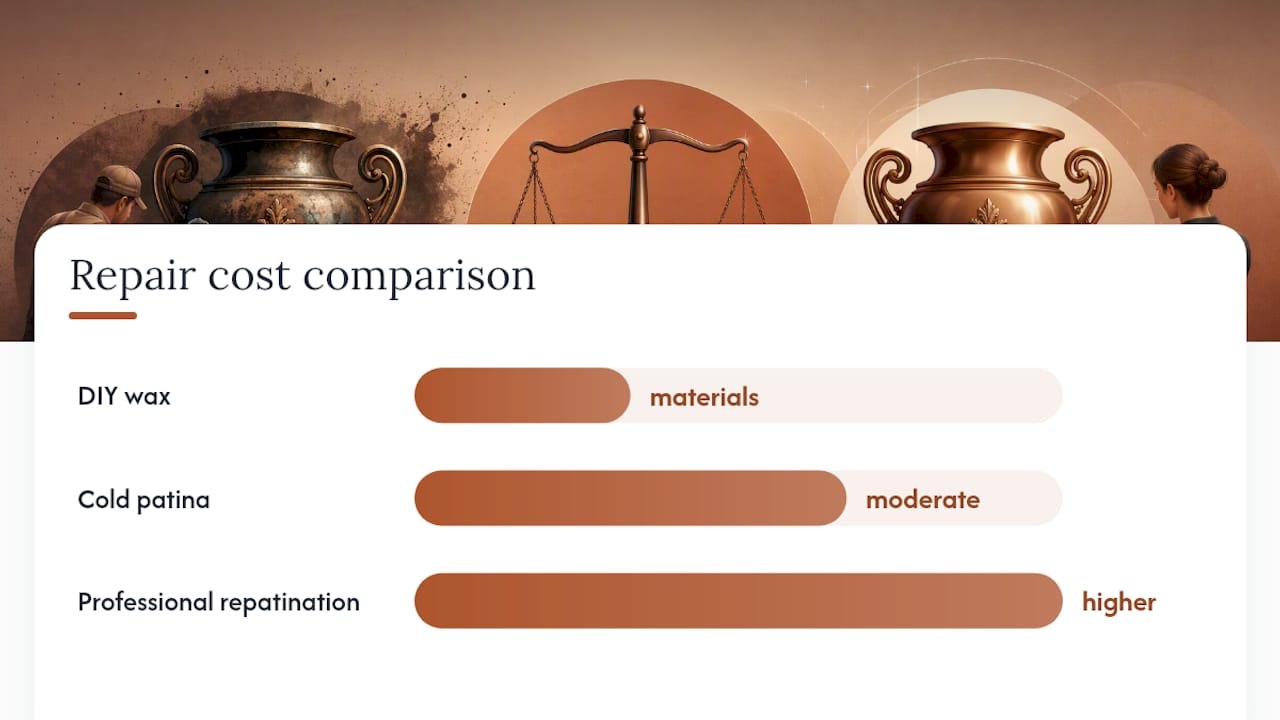
Option 2: Cold patina or spot inpainting Cold patina chemicals (liver of sulfur, ferric nitrate solutions) can be applied by a skilled conservator or experienced restorer to darken a bright spot and bring it closer to the surrounding tone. This requires precise color matching and a steady hand. Applied incorrectly, it creates a worse visual mismatch. Cost: moderate, depending on the conservator’s time. Partially reversible. Not recommended as a DIY procedure for valuable pieces.
Option 3: Full professional repatination For significant surface loss, pitting, or pieces where the over-cleaned area is large or prominent, a conservator can mechanically stabilize the surface, apply chemical patinas in controlled layers, and finish with microcrystalline wax. This is the most reliable route to aesthetic reintegration. Cost: higher, reflecting specialist time and materials. Fully documented and reversible in principle.
Questions to ask any conservator before commissioning work:
- What specific methods and materials will you use?
- Are all proposed treatments reversible?
- Will you provide written documentation of the condition before and after treatment?
- What is the expected timeline?
- Do you have experience with antique Asian or Southeast Asian bronzes specifically?
- Can you provide references or examples of comparable work?
How to protect the treated surface and maintain patina long-term
After any treatment, protection and consistent maintenance prevent recurrence. The goal is a stable, low-intervention routine.
Microcrystalline wax application (standard schedule):
- Apply a thin coat of microcrystalline wax once or twice per year for indoor bronzes in stable environments
- Warm the wax slightly (body heat on a fingertip is sufficient) before application
- Work in small sections, applying a thin, even layer with a soft cloth or fingertip
- Allow to haze (5–10 minutes), then buff gently with a clean, soft cloth
- Do not apply thick coats; multiple thin coats are more effective and easier to control
Routine maintenance checklist:
- Monthly: dust with a soft, dry natural-bristle brush; no pressure, no moisture
- Every 3–6 months: inspect the surface under raking light for any new green deposits, pitting, or changes in sheen
- Annually: assess whether the wax coat needs refreshing; re-wax if the surface feels dry or shows uneven sheen
- After any environmental change (move, renovation, humidity spike): photograph and inspect before resuming normal display
Storage and display guidance:
- Target relative humidity: 45–55%
- Avoid display near heating vents, air conditioning units, or exterior walls subject to condensation
- Keep away from salt air, industrial pollutants, and cooking fumes
- Handle with clean cotton or nitrile gloves; never touch bare metal with bare hands
- For long-term storage, follow the same acid-free tissue and padded box protocol described in the stabilization section
For detailed guidance on routine care for antique bronze statues, including storage and display protocols specific to Southeast Asian pieces, HDAsianArt’s collector guide covers the full maintenance cycle.
When to call a conservator and how to find the right one
Some damage is beyond conservative DIY treatment. Recognizing the threshold is the most important judgment call in this guide.
Red flags requiring immediate professional referral:
- Any pitting in the metal surface, active or historic
- Powdery, fuzzy, or flaky green deposits anywhere on the object
- Loose, flaking, or lifting surface material
- Structural damage: cracks, breaks, or unstable joins
- Evidence of previous aggressive interventions (deep scratches, uneven color from prior chemical treatment)
- Any uncertainty about the severity of the damage
How to find a qualified conservator:
- The American Institute for Conservation (AIC) maintains a Find a Conservator directory searchable by specialty, including metals and Asian art
- Regional art museums often provide conservator referrals for private collectors
- Auction houses with specialist Asian art departments can recommend conservators familiar with Southeast Asian bronzes
- Ask specifically for experience with antique bronze and, where relevant, with Southeast Asian bronze traditions
Expected scope and cost bands (descriptive):
- Minor stabilization and wax treatment: low cost, typically completed in a single session
- Spot inpainting or cold patina application: moderate cost, one to three sessions depending on complexity
- Full repatination with documentation: higher cost, multi-session process with written condition reports before and after
Always request a written condition report and treatment proposal before work begins. A conservator who declines to document their methods is not following professional standards.
A conservator’s case note: minimal intervention on a Khmer bronze
A small Khmer-style bronze figure arrived at HDAsianArt’s conservation contact with a single bright spot on the proper right shoulder, approximately 15mm in diameter. The surrounding patina was intact: a stable, smooth brown-green layer consistent with the piece’s age and Cambodian casting tradition. The bright spot showed exposed yellow-pink metal with no pitting and no green deposits.
The conservator’s approach was strictly minimal. After photographing the object under daylight and raking light, a dry brush pass confirmed no loose material. A spot test with a distilled water swab on a hidden area transferred no color. The bright spot was then addressed with a single pass of a barely damp swab (distilled water, trace of non-ionic detergent), immediately dried, and finished with a thin application of microcrystalline wax blended outward into the surrounding patina. No chemical patina was applied. The visual contrast reduced by roughly half; the spot remained slightly lighter than the surrounding surface but no longer read as damage at normal viewing distance.
Pro Tip: After any spot treatment, photograph the result immediately and again after 48 hours. Wax and patina both shift slightly as they settle, and the 48-hour image is a more accurate record of the final outcome.
HDAsianArt’s approach to conservation and collector support
HDAsianArt’s position on antique bronze care is straightforward: original patina is part of the object, and any intervention that removes it is irreversible. The gallery applies this standard to every piece it handles, from Khmer bronze deities to Laotian Buddha figures, and recommends the same conservative approach to collectors who acquire pieces from the gallery.

Collectors who need a conservation referral, a condition assessment, or guidance on a specific piece are welcome to reach out through HDAsianArt’s main gallery. The gallery works with conservators experienced in Southeast Asian bronzes and can help connect collectors with appropriate professional resources. This is an advisory service, not a commercial one: the priority is the object’s long-term preservation.
Sources
The following sources directly support the guidance in this article. Each is linked to the specific section it informs.
- Cleaning And Polishing Bronze | GSA
- Smithsonian Institution Collections
- The Metropolitan Museum of Art
- Restoration & Conservation Services — Bronze Restoration | Plowden & Smith
