



Naga in Buddhist Art: The Sacred Serpent Across Asia
Naga in Buddhist Art: The Sacred Serpent Across Asia
Few figures in naga Buddhist art travel as far as the naga, a serpent being who guards water, wealth, and the Buddha himself. Walk through a temple in Cambodia or Thailand and you will see hooded serpents rising behind seated Buddhas, lining stone stairways, and framing doorways. For collectors and home altar keepers, the useful question is rarely whether a naga belongs in Buddhist art. It is which naga you are looking at, where it came from, and what it was carved to do.
Table of Contents
- Quick Takeaways
- Who the Naga Are in Buddhist Thought
- The Mucalinda Episode and the Buddha's Shelter
- Nagas Bathing Siddhartha Across China
- Naga Guardians at Southeast Asian Temples
- Symbolism of the Sacred Serpent
- Naga Imagery in Modern Collecting
- Choosing a Naga Statue for Your Home or Collection
- Frequently Asked Questions
- References
Quick Takeaways
|
Key Insight |
Explanation |
|---|---|
|
Nagas are usually protectors, not threats |
In Buddhist settings the naga guards the Buddha, the teaching, or a sacred place. A naga at a threshold signals that something valuable lies beyond it. |
|
Hooded serpents behind a seated Buddha point to one story |
Many of these images refer to the Mucalinda episode, in which a naga king shelters the meditating Buddha from a storm. |
|
The same Indian-origin scene changes as it travels |
The Nagas Bathing Siddhartha image shows marked regional differences across China, so judge a piece against the region and period it claims. |
|
Count the hoods and study the base |
Hood number, symmetry, and the form of the coils help identify the episode and the workshop tradition behind a carving. |
|
Match material to where the statue will live |
Stone handles outdoor weather, bronze suits indoor altars where patina matters, and resin fits lighter budgets and small shelves. |
|
Separate online images from physical objects |
Naga imagery spreads widely on screens, so a striking photograph tells you little about age, material, or authenticity. |
Who the Naga Are in Buddhist Thought
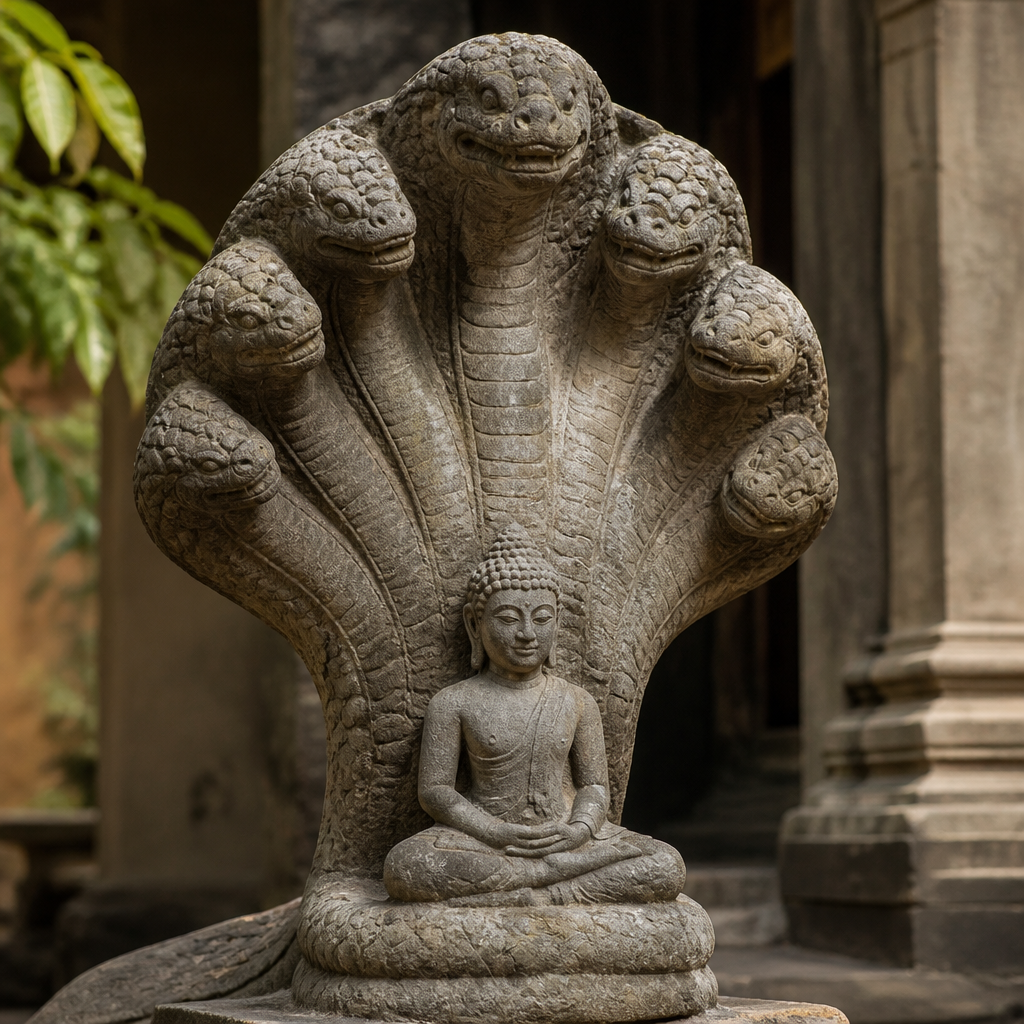
The naga is a serpent being associated with water, rain, and underground realms, and it is often shown with a human upper body or with a fully serpentine form. The figure existed in Indian religious life before Buddhism took shape, and Buddhist texts absorbed it and gave it a clear role. Many nagas appear as converts, protectors of teachings, or keepers of treasure.
Water Guardians and Keepers of Treasure
Nagas are repeatedly tied to water and buried wealth. That is why you find them at pond edges, river crossings, and temple thresholds in older Indian and Southeast Asian art. When a buyer asks what a naga “does,” the honest answer is that it protects a place that matters, whether that place is a sacred pool or a sealed store of treasure. Water and wealth are the two ideas most worth understanding before you look at any carving.
Shared Roots with Hindu Mythology
Nagas also appear in Hindu narratives, and the visual boundary between the two traditions is not always sharp. A naga on a Hindu temple and a naga beside a Buddha can look nearly identical in silhouette. What separates them is usually the central figure, the setting, and the story the sculpture is meant to tell. Iconography alone can mislead, so always check the composition as a whole.
The Mucalinda Episode and the Buddha's Shelter
The most recognizable naga scene in Buddhist art involves Mucalinda, a naga king who lives in a lake near the place where the Buddha sat in meditation. In the traditional account, a storm breaks over the Buddha, and Mucalinda coils beneath him and spreads his hood as a canopy. That image is the reason so many seated Buddhas in Southeast Asia are framed by a serpent's raised heads.
In practice, when you see a seated Buddha under a multi-headed hood, the naga is not decorative filler. It is a narrative signal that the figure is the Buddha at the moment of protection. Many buyers assume the hood is a crown or an ornament, and that misreading leads to poor choices when a statue is placed in a home setting.
Reading the Hood Count
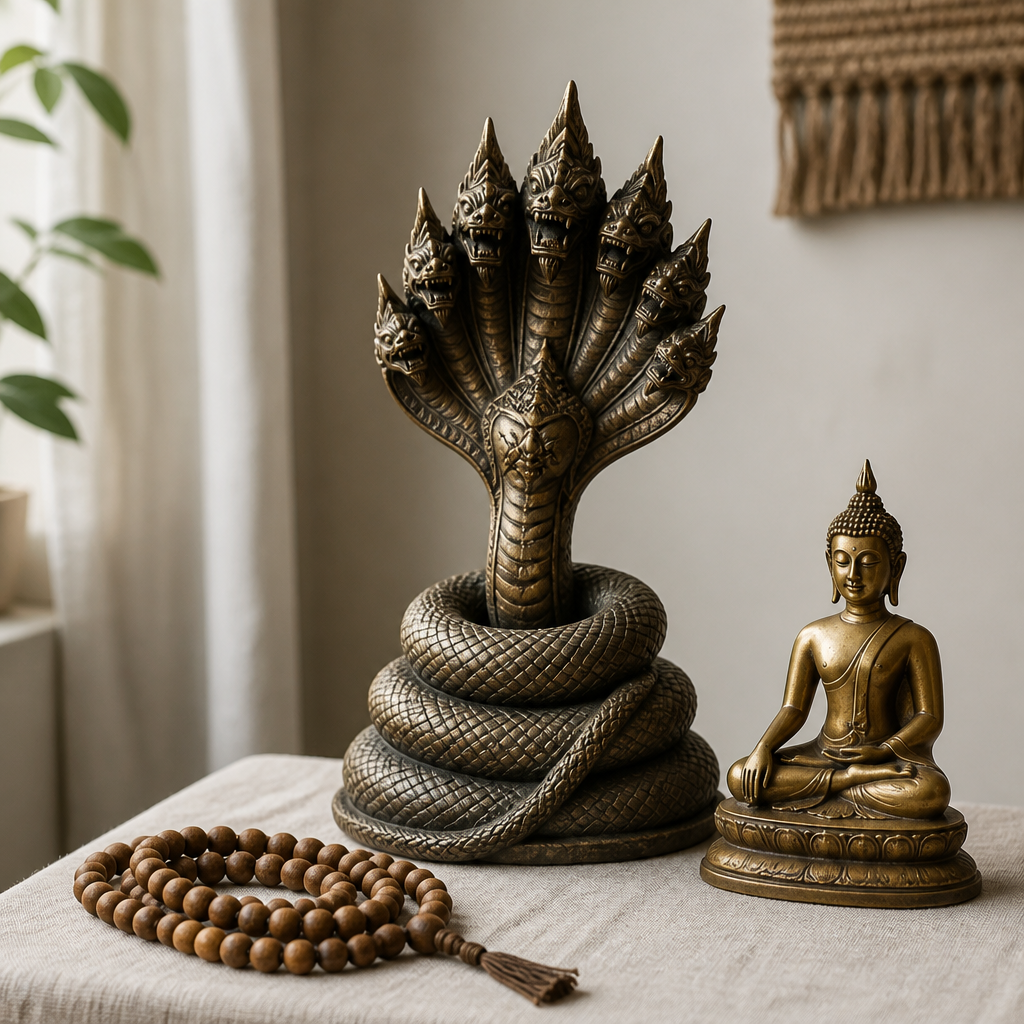
Seven heads is the most common count in the sculptures we handle, but counts vary by workshop, region, and period. A single-hooded naga and a five-hooded one can both depict the same episode. Count the hoods from the front, and check whether the heads are balanced. Asymmetry is often a sign of hand carving rather than mass production, and it is a useful clue when you compare two pieces side by side.
Pro tip: Photograph the statue straight on from the front before you buy. Hood symmetry, the shape of the coil at the base, and the position of the Buddha's hands tell you far more about the episode depicted than a product title ever will.
Nagas Bathing Siddhartha Across China
Scholarship on the “Nagas Bathing Siddhartha” image places its origin in India, with the composition later appearing across many parts of China. A 2023 study by Xiaodan Liu and co-authors, published in Trans/Form/Ação, traces the image through Xinjiang, Gansu, Qinghai, Shanxi, Shaanxi, Henan, Shandong, Jiangsu, Sichuan, Tibet, and other places. The authors describe its distribution as regional and link differences in style to the routes along which Buddhism spread.
Why the Same Scene Looks Different
The composition changes as it moves. Figures, water, and the nagas themselves are rendered differently across regions and periods, so the image works as a record of cultural exchange. For a collector, this means a Bathing Siddhartha relief from one region should not be judged by the standards of another. Ask which region and period the piece claims, then compare its details against that setting.
What to Look For in a Bathing Scene
The core elements are the newborn prince and the water poured over him by nagas or other divine attendants. Carvers vary how many figures appear and how much water is shown, so these details are not a reliable dating tool on their own. A JSTOR article on the representation of nagas in Buddhist art is a useful starting point for readers who want to move beyond product descriptions and into the scholarship behind the imagery.
Naga Guardians at Southeast Asian Temples
In Southeast Asia the naga moved from being a figure inside the narrative to a structural guardian. Along temple stairways and causeways, serpent bodies form railings, and hooded heads rise at the entrance. The effect marks a boundary between the ordinary world and the sacred space ahead.
Balustrades and Causeways in Cambodia
Khmer temple architecture is well known for naga balustrades, where the serpent body forms the railing and visitors walk between its coils. The naga becomes a threshold figure rather than a decorative one, and the multi-headed forms are bold in silhouette. Walking the path is part of the meaning, since the sculpture is designed to be passed through, not merely viewed.
Stairways and Guardians in Thailand
A seven-headed naga guards the 300 steps leading to Wat Phrathat Doi Suthep in Thailand, and it is one of the most photographed serpent guardians in the country. Stairway nagas teach a practical lesson for collectors. Architectural balustrades are rarely sold on their own, so the freestanding statues you find in shops usually adapt the same silhouette to a smaller scale for altars and shelves.
Symbolism of the Sacred Serpent
Across religious texts and the art itself, the naga recurs as a guardian of wisdom, water, fertility, and spiritual treasure. These meanings overlap, which is why a single naga can be read in more than one way. The mistake is to pin one meaning on every image without looking at the setting.
Water, Rain, and Fertility
Because nagas live in water, they are linked to rain and to the productivity of the land. Serpent beings in many Asian traditions were tied to good harvests and seasonal water, and that association carries into Buddhist-era imagery. A naga placed near a water bowl or a small fountain on a home altar fits this meaning naturally, and it gives the arrangement a clear focal point.
Guardians of Teaching and Treasure
In Buddhist narratives, nagas guard scriptures and treasures kept in watery or underground realms. That gives the naga a role as a protector of the Dharma. Practitioners often choose a naga to represent protection of their practice rather than good luck, and the distinction shapes how the statue should be placed.
A naga in a temple is rarely there to frighten. It is there to show that something valuable lies beyond the threshold.
Naga Imagery in Modern Collecting
Naga imagery now circulates far beyond temples. Prints, jewelry, and decor reuse the hooded serpent, often stripped of the story that gave it meaning. A 2024 study on naga iconography in visual art notes that naga images have become part of the cultural industry, and it examines how internet circulation shapes the way these images are read.
For buyers, this means a striking naga on a screen tells you very little about a carving's age, material, or origin. Learn to separate an image from an object, because a photograph can be cropped, lit, and retouched in ways no shelf can match.
Separating Reproductions from Period Carving
Reproductions are common and not inherently a problem, but they should be described honestly. A good listing states the material, the dimensions, and the region the design draws from. Look closely at the tooling in the scales and hoods. Hand-cut work tends to show small variations, while mass-produced pieces repeat the same surface detail across every hood.
Reading Wear and Patina
Genuine age shows up as wear in the high points of a carving, softening along the edges of hoods and coils, and sometimes as mineral staining in the crevices. New pieces can be artificially aged, so treat rapid patina claims with caution. A seller who explains how a piece was finished is usually more trustworthy than one who relies on a dramatic photograph.
Choosing a Naga Statue for Your Home or Collection
The material determines weight, durability, and how the naga will age in its location. Stone, bronze, and resin each suit different spaces, and the right choice depends more on placement than on price. The table below compares the three approaches most buyers consider.
|
Material |
Best Use |
Watch For |
|---|---|---|
|
Stone |
Outdoor gardens, shaded terraces, and heavy display pieces that should stay put |
Substantial weight, so confirm the shelf or base can hold it, and check that the stone is sealed or suited to outdoor exposure |
|
Bronze |
Indoor altars and collections where fine detail and a developing patina matter |
Quality varies with casting, so examine the hood edges and coil details for crisp, even finishing |
|
Resin |
Lighter budgets, small shelves, and décor settings where the statue is handled often |
Shallow detail and surface sheen can look artificial, so study close-up photos before buying |
Matching Material to Placement
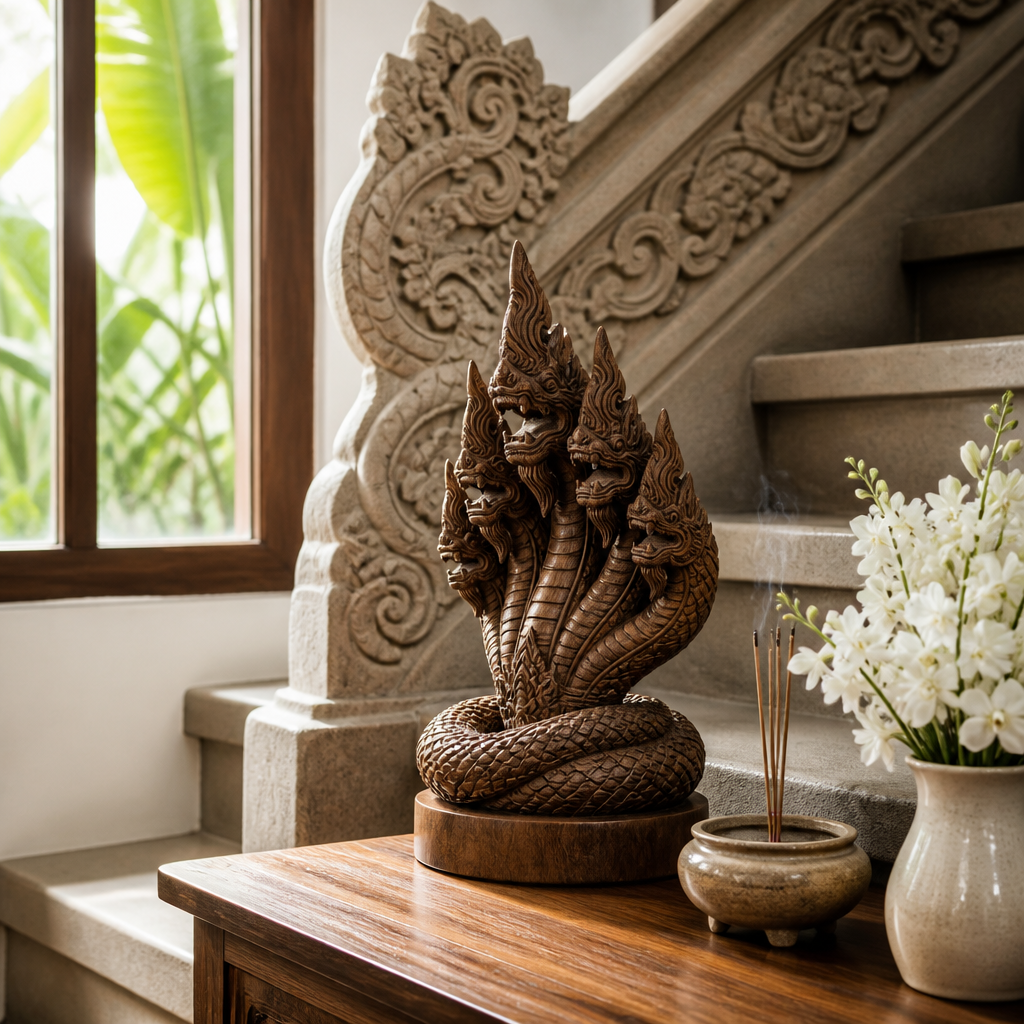
A stone naga belongs where rain and temperature change are part of the setting, and a bronze one belongs indoors where it can be seen up close. Resin is the practical choice for a shelf that gets dusted weekly. In practice, the most common mistake is buying a heavy stone piece for a shelf that was never built to hold it.
Pro tip: Measure the intended space before you compare sizes. Note the height of the shelf, the depth of the altar, and the clearance above the statue, because the hood height changes the visual weight more than the base dimensions suggest.
Checking Dimensions and Details Before You Order
Naga statues vary widely in height, and the hood often extends beyond the base in ways a thumbnail does not show. Read the listed dimensions carefully, and ask for a clear photograph of the hood from the front if it is not provided. Our orders over £35 ship free, but the time to check fit is before checkout, not after the box arrives.
Frequently Asked Questions
What does a naga represent in Buddhist art?
In Buddhist art the naga is usually a protector. It guards the Buddha, the teaching, water, and treasure, and its meaning depends on the scene and setting in which it appears.
Why is a naga shown behind the Buddha?
The most common reason is the Mucalinda story, in which a naga king shelters the meditating Buddha from a storm with his spread hood. A seated Buddha under a multi-headed hood usually refers to that moment.
Is a naga statue appropriate for a home altar?
Yes, as long as it is placed with intention. Many practitioners use a naga to represent protection of their practice, and a small statue on a stable shelf, away from direct water, is a sound arrangement.
How can I tell an old naga carving from a modern reproduction?
Look for uneven hand tooling, wear on the high points of the hoods, and honest descriptions of material and region. Be cautious of heavily staged photographs and of claims of age that come without any detail about how the piece was made.
Which material is best for a naga statue placed outdoors?
Stone is generally the most suitable choice for outdoor settings, provided it is sealed or otherwise suited to exposure. Bronze can work outdoors too, but it is usually better in sheltered positions where the patina develops evenly.
Where did the Nagas Bathing Siddhartha image originate?
Scholarship places its origin in India. The image later spread across many regions of China, and its style varies by region and period, which is why the place and date of a piece matter when you evaluate it.
Have you placed a naga statue on a home altar or in a collection, and what led you to choose that form? Tell us about your experience below.
References
-
JSTOR article on the representation of nagas in Buddhist art
-
2023 study on the regional spread of the Nagas Bathing Siddhartha image
-
2024 study on naga iconography and the influence of internet imagery
