



Mandalay Court Art: Royal Patronage and Sculptural Legacy
Mandalay Court Art: Royal Patronage and Sculptural Legacy
Ask a collector what defines Mandalay court art and you will often hear a stylistic answer, a certain face or posture. In practice, the story starts with politics and patronage. King Mindon founded Mandalay as a new royal city in 1859, a move tied to Britain's annexation of Pegu Province in Lower Burma. That decision shaped who commissioned sculpture, which workshops received the work, and which materials were chosen.
For buyers of Burmese Buddhist sculpture, the court context explains why many 19th century pieces look the way they do. It also explains why modern pieces labeled "Mandalay" are still being carved today. This guide traces royal patronage, the stone and wood traditions behind the sculpture, and how to read a piece without relying on a label.
Table of Contents
- Quick Takeaways
- Royal Patronage and the Founding of Mandalay
- Sculptural Materials: Stone, Wood, and Plaster
- Pagan and Ava Roots of the Mandalay Style
- Stone Carving and the Pantamault Tradition
- Wood Carving and the Problem of Survival
- Temple and Cave Sculpture
- Comparing Royal, Temple, and Workshop Sculpture
- A Buyer's Guide to Mandalay Style Sculpture
- Frequently Asked Questions
- References
Quick Takeaways
|
Key Insight |
Explanation |
|---|---|
|
Mandalay was a deliberate royal creation |
King Mindon founded the city in 1859, so its court commissions set the tone for a generation of sculpture. |
|
"Mandalay period" means 19th century |
Do not stretch the label back to Pagan (1044 to 1287) or Ava (1364 to 1555) work. These are separate periods with different forms. |
|
Stone carving has its own vocabulary |
The Burmese term Pantamault covers carving, chiseling, and breaking stone, which is a useful frame when examining a surface. |
|
Surviving wood is rare |
Wood is perishable, and most Pagan and Ava wood sculptures have been lost, so a claim of early wood needs strong evidence. |
|
Mandalay is still a workshop center |
Studios remain concentrated in Mandalay, so a Mandalay origin tells you where a piece was made, not when. |
|
Documentation beats style |
Inscriptions, provenance, and published references carry far more weight than an attribution based only on looks. |
|
Narrative relief is a regional signature |
Plaques portraying Buddhist birth stories, such as the Myinkapa plaques at Amarapura, show how Burmese carvers told sacred stories in stone. |
Royal Patronage and the Founding of Mandalay
A scholarly review of the study Mandalay and the Art of Building Cities in Burma confirms that the city was founded as a new royal capital in response to the British annexation of Lower Burma. The move was a political answer, and its art followed the same logic. A capital built to project authority needed images as much as walls.
Royal patronage in a Theravada Buddhist kingdom meant more than ordering a few statues. A new capital needed monasteries, shrines, ceremonial images, and the craftsmen to produce them. A king who commissioned a Buddha image gained religious merit, and the work doubled as a public display of who held power.
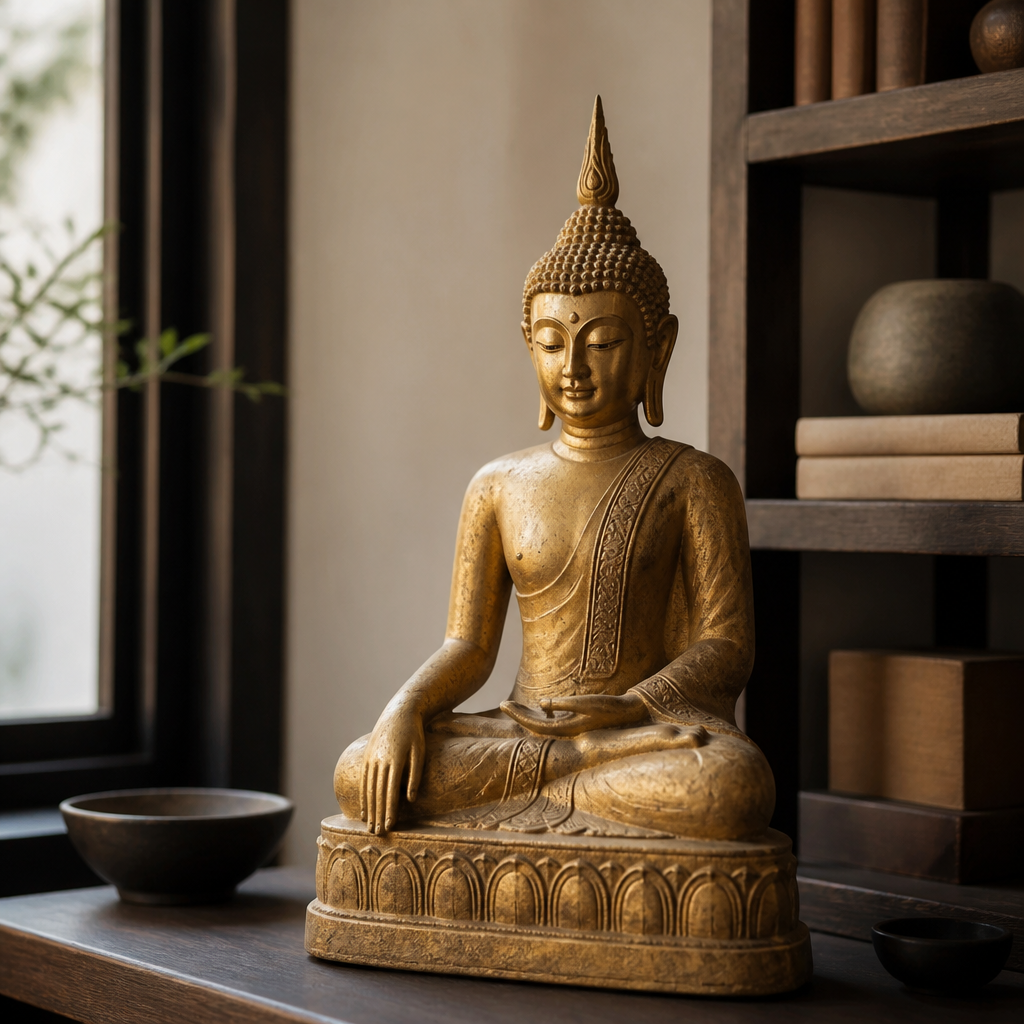
What a court commission demanded
Scale, material, and finish were the signals. A court image had to be finished to a standard that reflected the donor's rank, so workshops that could meet that standard were valuable. In practice, the strongest 19th century examples show consistent proportions, careful treatment of hair and drapery, and surfaces that were worked rather than rushed.
A royal city is built from images as much as from brick, and the images usually outlast the court that commissioned them.
The practical lesson for collectors is that a royal commission leaves a different trail than an ordinary donation. Court pieces tend to show higher finish and more consistent craftsmanship. Yet the surviving record is thin, so high finish alone does not prove a royal origin.
Pro tip: When a seller describes a piece as court-commissioned, ask what links it to royal or temple patronage. A dated inscription, a documented collection history, or a published reference carries far more weight than a stylistic label.
Sculptural Materials: Stone, Wood, and Plaster
Burmese traditional sculpture used wood, stone, and plaster as its main materials. Each material shaped what survives today, and each asks a different question of a buyer. Stone endures in a way wood does not, which means the surviving record is weighted toward stone.
Why materials shape the surviving record
Wood is perishable, and that single fact governs how we see the past. Stone sculptures from Pagan and Mandalay remain visible in temples, caves, and religious buildings, while comparable wood pieces are rare. A collector who expects an equal balance of materials from every period will be misled by what has simply not survived.
Plaster and the problem of original surfaces
Plaster appears in the material record alongside wood and stone, and it is a reminder that a sculpture's surface may not show its original material. Repainting, regilding, and restoration can change how a figure looks without changing its core. Test before you trust a label, and treat a surface that looks perfect with suspicion until you know its history.
Pagan and Ava Roots of the Mandalay Style
Mandalay did not invent Burmese Buddhist sculpture. Traditional sculpture emerged before the Pagan period and improved during the middle of the Pagan era, which ran from 1044 to 1287. Mandalay's workshops inherited a vocabulary of forms, postures, and decorative motifs that had been developing for centuries.
We would love your feedback and any insights you would share with others. What perspective would you add?
Pagan as the classical reference point
Pagan is the reference point most collectors reach for, and it is a sound one. The Pagan period produced stone and wood works that set standards for later carvers. One outstanding wood sculpture from the Pagan period is the carved portal at the old Shwesigone pagoda at Nyaung-U, which shows how demanding the tradition was even in a medium that rarely survives.
Ava and the outside influences
The Ava period ran from 1364 to 1555, and it sits between Pagan and the later courts. Burmese sculpture also absorbed influences from neighboring kingdoms, including the Mon, Thai, and Khmer, as well as from Hinduism and Indian art. A Mandalay style piece often carries these layers, so a single regional label rarely captures it fully.
When you compare a 19th century piece with an older one, look for continuity and change rather than a single signature feature. Mandalay carvers kept many classical forms while adjusting proportions and finish to suit their own patrons.
Stone Carving and the Pantamault Tradition
The Burmese word Pantamault refers to the art of sculpting with stone, primarily through carving, chiseling, and breaking the stone. Common images include the Buddha and scenes from Buddhist life, along with animals such as elephants and deer and mythical creatures, many of which trace their roots to India. Most stone sculptures visitors see sit inside temples or caves, or decorate the exteriors of religious buildings.
Stone carving remains a living craft. Sculpture studios and workshops can be found in Yangon and other towns, but the majority are concentrated in Mandalay. This is the single most important fact for a buyer to remember, because it means a stone Buddha made in Mandalay today can look convincingly old.
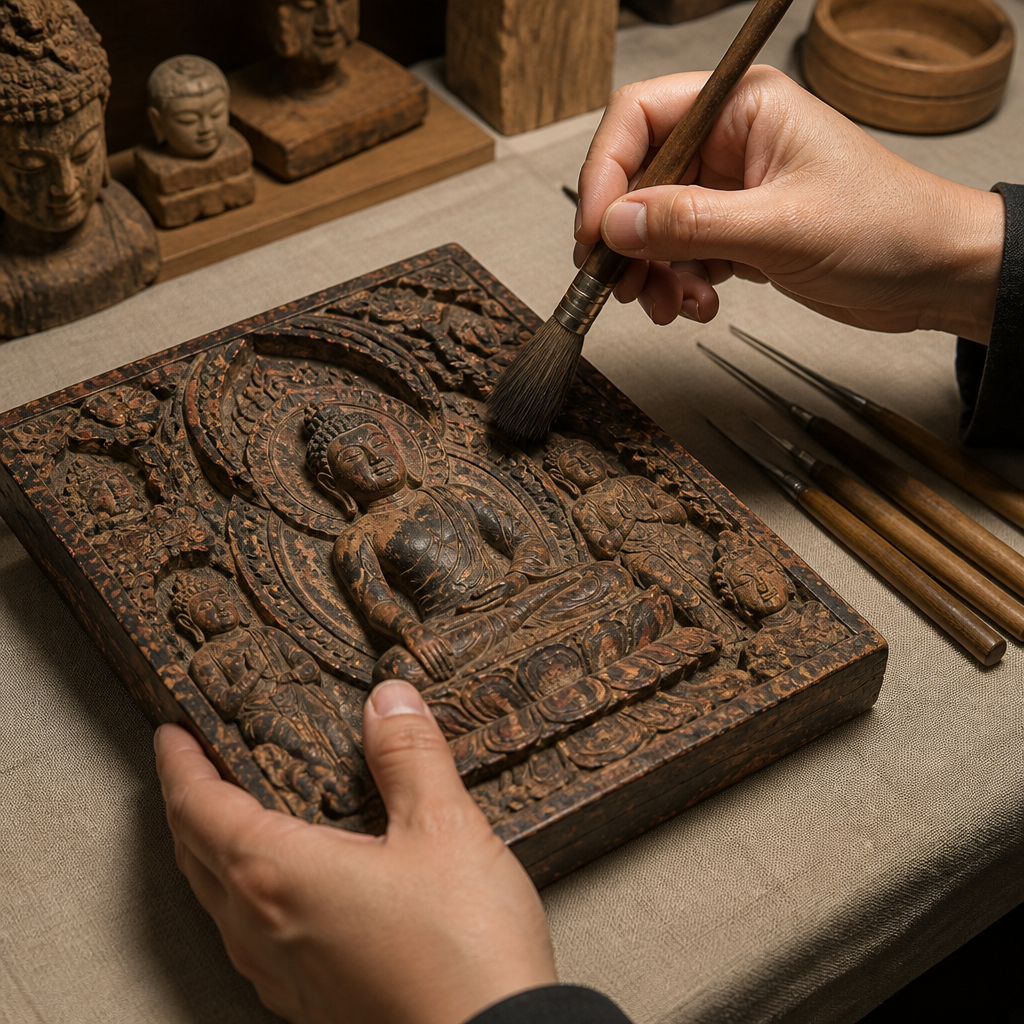
Stone narratives at Ananda and Amarapura
Some of the finest stone works depict the life of the Buddha, and the Ananda temple at Pagan is a standard reference for this. Other fine examples include the flower designs in the portal interior at Kyawkku-U min in Naung-U, and the Myinkapa plaques at Puhtotawkyi in Amarapura, which portray 550 Buddhist birth stories. These narrative reliefs are a regional signature worth learning to recognize.
The great image at the foot of Mandalay Hill
The great image at Kyauktawkyi, at the foot of Mandalay Hill, is one of the best-known stone works associated with the city. The source material also documents the making and transport of the largest stone Buddha and its arrival at Mandalay Hill. Those stories show that stone carving at this scale was a logistical project, not simply an artistic one.
Wood Carving and the Problem of Survival
The Burmese word Panbu refers to sculpting with wood, ivory, or similar material, primarily through carving. Common subjects include human, animal, and religious figures, along with floral designs. Wood carving was a serious tradition, but its survival record is poor.
Because wood is perishable, most of the wood sculptures of the Pagan and Ava periods have been lost, and only a few remain. A buyer who sees a wood figure claimed to be early should expect that claim to be difficult to prove. Strong evidence, such as documented provenance or expert examination, matters far more than a confident dealer description.
Pagan wood that survived
The carved portal at the old Shwesigone pagoda at Nyaung-U is a rare example of Pagan period wood work still visible. Its survival is exceptional, and it is useful as a benchmark. Most wood objects you encounter will not match that level of preservation, and their condition should be assessed on its own terms.
Nineteenth century wood and buyer caution
Fine sculptures were produced in the 19th century Mandalay period, which is sometimes called Yatanapon in sources. For wood from this era, examine insect damage, restoration, and whether the finish is original or later. Visible repainting over old gilding is common, and it can change an object's value far more than its shape.
Temple and Cave Sculpture
Court sculpture was not the only form of patronage. Much of what visitors encounter sits inside temples, caves, or religious buildings, or decorates their exteriors. Royal and devotional commissions overlapped, and the same workshops often served both, so the line between court and temple work is not always clean.
Devotional display versus royal display
A temple image was meant to be venerated, often by ordinary worshippers. A court image was meant to signal status. Both can be beautiful, but they usually carry different kinds of documentation and different expectations about where they were made and by whom. A temple donation does not automatically make a piece royal, and a royal commission can later pass into a monastery.
Why a temple history matters for collectors
Provenance from a temple is often undocumented, and sellers sometimes overstate it. In practice, a claim of temple origin should be treated as a starting point for research rather than a final attribution. Ask who held the piece, when it left the temple, and whether any record supports that move.
Comparing Royal, Temple, and Workshop Sculpture
Collectors usually encounter three broad categories of Burmese sculpture, and each rewards a different kind of scrutiny. The table below compares them by what each category shows and what a buyer should watch for. Treat it as a checklist rather than a rulebook.
|
Approach |
What It Shows |
What to Watch For |
|---|---|---|
|
Royal court commission |
Patron rank, high finish, and political intent tied to the Mandalay court |
Documentation is rare, so ask for inscriptions, provenance, or a published reference before accepting the claim |
|
Temple or cave devotional piece |
Local devotion, regional style, and the wear of use over time |
Restoration, regilding, and repainting can obscure the original age and surface |
|
Modern Mandalay workshop piece |
A continuing craft tradition with skilled hands and current market demand |
Recent work sold as antique is the most common problem, so verify the date and the seller's claims |
My recommendation is to value a documented piece over a stylish one. A modern workshop figure with honest labeling can be a fine purchase for an altar or a home. A court-style piece with no paperwork should be priced as a question, not as a certainty.
A Buyer's Guide to Mandalay Style Sculpture
Start with three questions: what is the material, what documentation exists, and what is the condition. These questions cut through most of the confusion that surrounds the Mandalay label. They also protect you from paying for a story rather than an object.
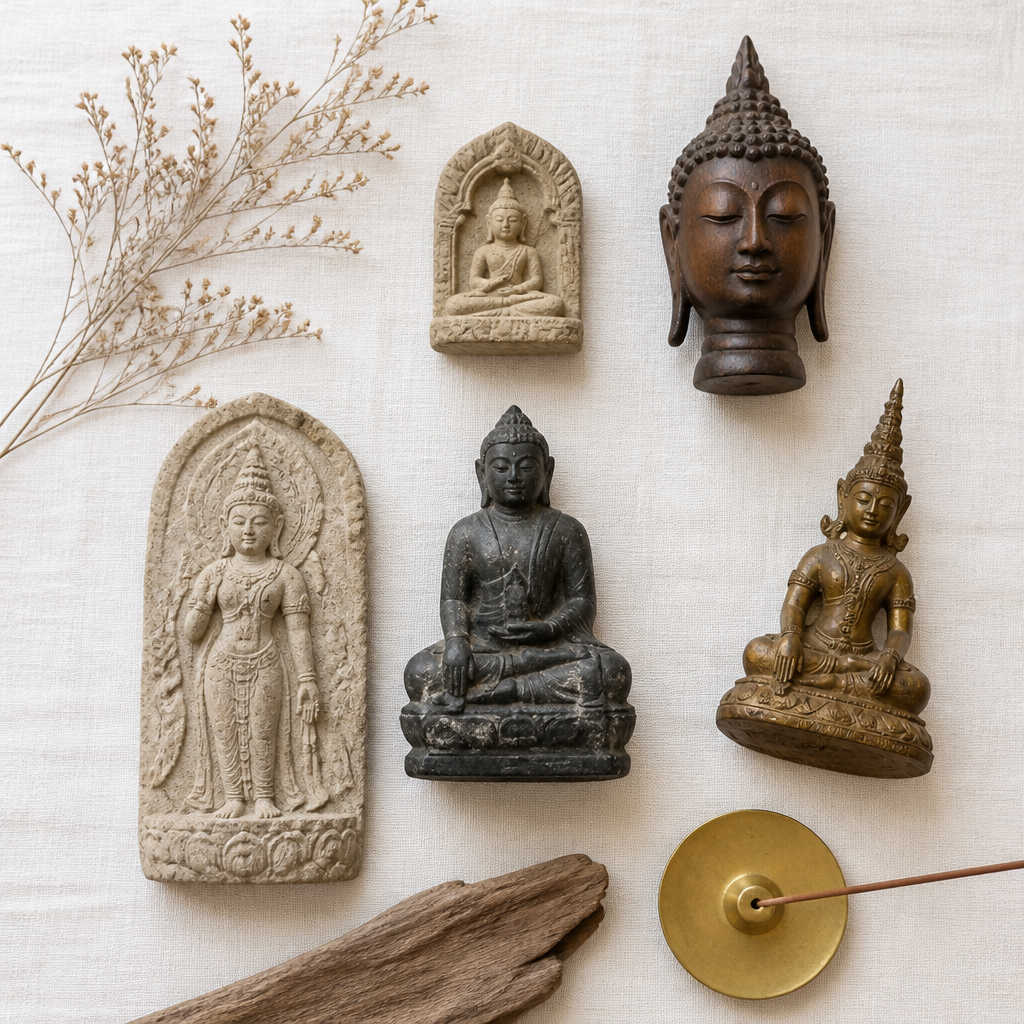
Checking the material and tool marks
Stone carving leaves tool marks, and those marks tell a story. Hand chisel work, irregular surfaces, and tooling that follows the form differ from the even, machine-finished surfaces common in modern production. Look at the base, the back, and any recessed areas where a carver would have worked less carefully.
Documentation and honest descriptions
An honest seller describes what is known and what is not. A seller who says "Mandalay workshop, modern carving" is giving you useful information, even if it lowers the price. A seller who promises an exact royal origin without records is asking you to take the risk alone.
Pro tip: Photograph the base, the back, any inscription, and any repairs before you buy. These images make it far easier to compare the piece with documented examples later, and they give you a record if the piece's history is questioned.
Frequently Asked Questions
How can I tell a Mandalay period piece from an older Pagan or Ava piece?
No single feature settles the question. Compare the material, the condition of the surface, the carving method, and the documentation together. A stylistic resemblance alone is not reliable evidence of date.
Does "Mandalay style" mean the sculpture was made in Mandalay?
Not necessarily. Mandalay is a major center for sculpture studios, but the style also appears in work made elsewhere and in later periods. Ask where the piece was made and when, and treat the style name as a description rather than an origin.
Are wood Burmese Buddha statues from before the 19th century easy to find?
No. Wood is perishable, and most Pagan and Ava wood sculptures have been lost. Any claim of an early wood piece should be supported by strong evidence, and it should be priced with that uncertainty in mind.
What does Pantamault mean?
Pantamault is the Burmese term for sculpting with stone, mainly through carving, chiseling, and breaking the stone. It is a useful word for understanding how stone sculpture is traditionally produced.
Is a Burmese stone sculpture a good choice for a home altar?
It can be, provided you buy for the object rather than the imagined history. A well-made modern piece with honest labeling suits an altar well, while a court-style claim should be verified before you pay a premium for it.
Why does provenance matter more than style for collectors?
aStyle can be copied, learned, and reproduced across generations of workshops. Provenance, meaning the documented history of ownership and location, is much harder to fake and is the strongest support for any claim about age or patronage.
If you have handled a Mandalay period piece or compared one with older Pagan work, we would welcome your experience and the details that made you trust it or doubt it.
References
-
JSTOR record for the study Mandalay and the Art of Building Cities in Burma
-
Overview of Burmese sculpture by period, material, and regional tradition
-
Courtauld overview of courts as centers of artistic production
