



Fake Buddha Statue: 7 Red Flags Every Collector Must Know
Fake Buddha Statue: 7 Red Flags Every Collector Must Know
The market for Buddhist and Hindu sculpture is full of beautiful, meaningful objects, and it is also full of misrepresented ones. A convincing fake Buddha statue can fool a casual buyer at first glance, and unscrupulous dealers know exactly how to pitch a story that makes a mass-produced resin piece sound like a rare temple artefact.
Whether you are building a serious collection, setting up a home altar, or searching for a museum-quality piece from Burma, Cambodia, or Thailand, knowing how to spot a fake before you spend real money is not optional. It is the foundation of smart collecting.
Table of Contents
- Quick Takeaways
- Why Fakes Are So Common in the Buddha Statue Market
- Red Flag 1: The Weight and Balance Feel Wrong
- Red Flag 2: The Iconography Doesn't Add Up
- Red Flag 3: The Back and Base Are Suspiciously Rough
- Red Flag 4: The Aging Looks Deliberate
- Red Flag 5: The Material Doesn't Match the Claimed Origin
- Red Flag 6: Provenance Is Vague or Theatrical
- Red Flag 7: The Price and the Story Don't Match
- How to Authenticate Asian Art: A Practical Comparison
- Frequently Asked Questions
- References
Quick Takeaways
|
Key Insight |
Explanation |
|---|---|
|
Always examine photos carefully |
Fakes often look convincing in photographs, initially but reveal poor finish, wrong details or cheap material when examined closely. |
|
Check the back and base first |
Forgers typically work from a front-facing photograph of the genuine article, so the rear and underside are where shortcuts show up most clearly. |
|
Iconography errors are a hard tell |
Mudras, attributes, and facial expressions must match the specific deity and regional tradition. A careless copy almost always gets at least one wrong. |
|
Artificial aging is easy to spot up close |
Genuine wear accumulates unevenly over time. Faked patina tends to be uniformly applied and sits on the surface rather than inside it. |
|
Vague provenance is a warning, not a mystery |
Authentic sellers can describe materials, likely region, and approximate period. "It came from a temple" with no further detail is a sales technique, not information. |
|
Material must match claimed origin |
Different Asian traditions use very specific materials and construction methods. A supposed Cambodian sandstone piece that feels like resin is a contradiction in terms. |
|
Price mismatches are a reliable signal |
A genuine antique Buddha statue priced at a fraction of auction estimates is almost certainly not what the seller claims. Bargains in this category are rare. |
Why Fakes Are So Common in the Buddha Statue Market
Buddhist and Hindu sculptures attract fakes for a simple reason: demand is high, the price range is wide, and most buyers are not specialists. A collector who knows Edo-period Japanese bronze inside out may know very little about Burmese lacquerware or Gandharan stone carving, and dealers who operate across multiple traditions exploit that gap constantly.
There is also a spectrum between outright fraud and honest misrepresentation. Some sellers genuinely do not know what they have. Others know precisely but rely on theatrical storytelling to fill in the gaps. The most dangerous sellers combine real knowledge with selective dishonesty, using correct terminology to build credibility before misrepresenting age, origin, or material.
The category of "fake Buddha statue" actually covers three distinct problems: misrepresented material (resin sold as bronze, plaster sold as stone), misrepresented age or origin (a modern Thai factory piece sold as an antique Cambodian relic), and careless or incorrect iconography (a mass-produced decorative object that borrows sacred forms without understanding them). Each requires a different eye to catch.
Pro tip: Before you walk into any antiques fair or open an online listing, decide which of these three categories concerns you most. A home decorator may care primarily about material honesty. A serious collector of antique sculpture needs to check all three. Knowing your own standard protects you from being sold to on terms you never agreed to.
Red Flag 1: The Weight and Balance Feel Wrong
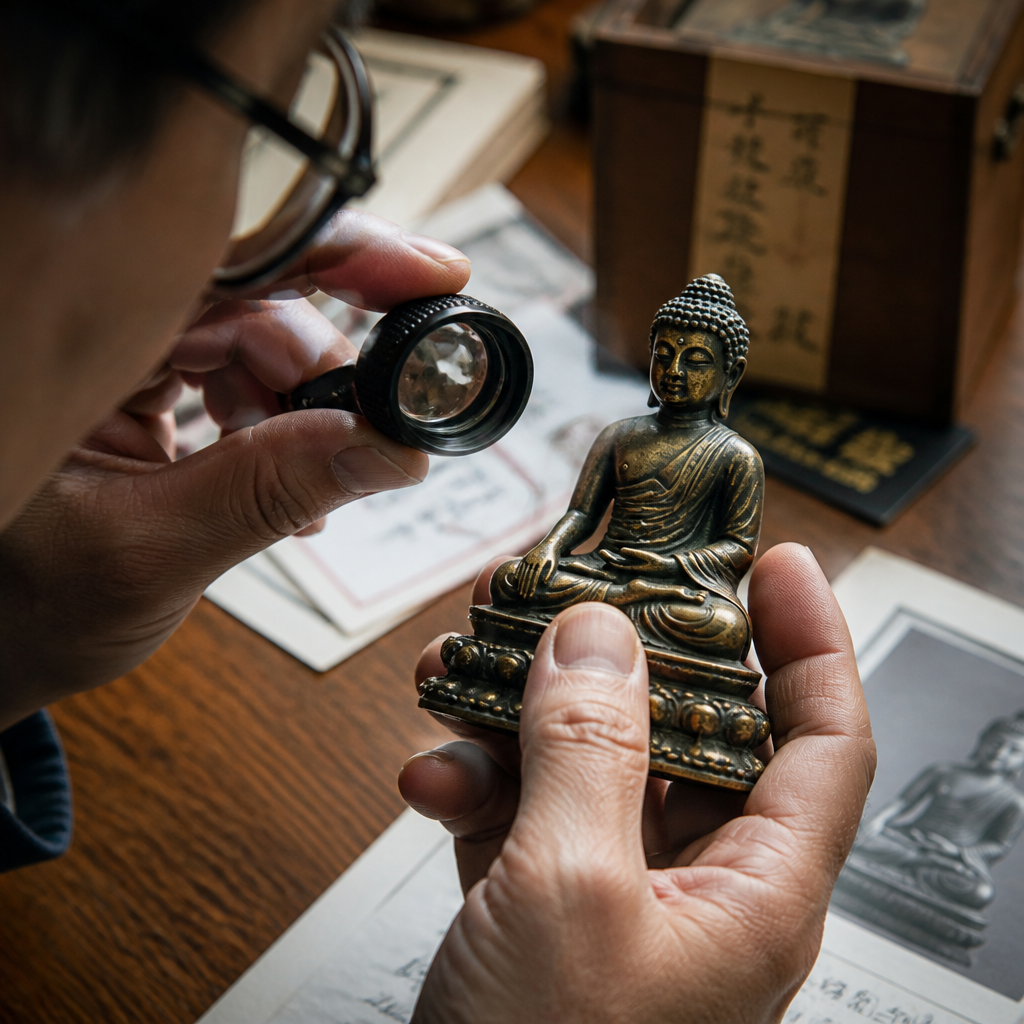
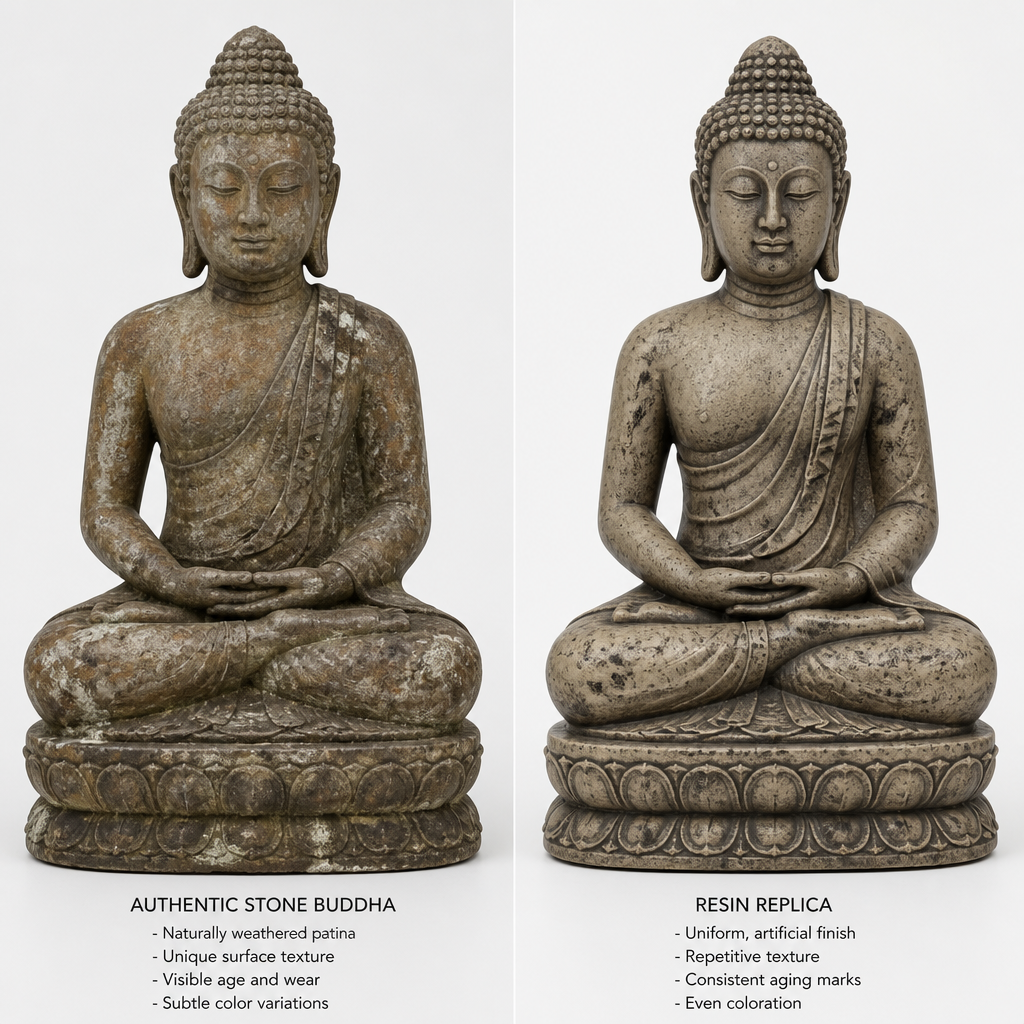
The single fastest check available to any buyer is knowing the weight of a potential purchase. Authentic bronze statues have a specific density. Genuine carved stone has a particular heft. Wood statues from Burma or Japan, even hollow ones, have a balance and weight distribution that reflects careful craftsmanship. A resin replica almost always feels too light, and a hollow plaster piece disguised as stone will feel deceptively uniform in weight rather than dense.
Weight alone is not conclusive. Some legitimate contemporary pieces use lighter alloys or composite materials, and a seller should be able to explain exactly what the piece is made from. But when the claimed material and the felt weight simply do not match, that contradiction is worth pursuing. Pay attention to what the weight of a piece is telling you.
What to Feel For in Bronze Versus Stone
Genuine bronze has a cool, dense feel and a slight roughness where the casting seams were finished by hand. Stone, whether sandstone, granite, or schist, feels genuinely mineral: heavy, slightly gritty, and cold in a way that synthetic materials cannot fully replicate. Resin and plaster feel plasticky at the edges even when they have been painted or patinated to look otherwise. Run a fingernail along an inconspicuous edge. Resin will feel slick and slightly flexible; stone will not move at all.
Red Flag 2: The Iconography Doesn't Add Up
Every Buddha figure and Hindu deity has a precise visual vocabulary: specific hand gestures (mudras), specific objects held or displayed, a specific facial expression, and a specific posture tied to a specific narrative or tradition. These are not decorative choices. They are a visual language developed over centuries across distinct regional schools, from the Gandharan style of the Indian subcontinent to the gilded lacquer figures of Burma and the serene sandstone Buddhas of Khmer Cambodia.
A careless fake almost always gets at least one iconographic element wrong. It may show the wrong mudra for the deity depicted, place attributes in the wrong hand, or combine visual elements from two completely different traditions. A Japanese Amida Buddha combined with the crown iconography of a Cambodian Bodhisattva is a nonsense object that no skilled carver working in a living tradition would produce.
The Specific Errors That Appear Most Often
Mudras are particularly vulnerable to error because forgers often copy from a single front-facing photograph and have to invent the details they cannot see. The result is hand positions that are almost correct but structurally wrong, fingers bent at impossible angles, or a gesture that exists in no recognised tradition. Facial expressions are another reliable test: the serene, inward gaze of an authentic Buddha figure requires a sculptor who understands what they are making. Mass-produced decorative pieces tend toward a generic "peaceful" expression that does not belong to any specific iconographic programme.
Pro tip: Before buying any Buddha or Hindu deity statue, spend fifteen minutes looking at verified examples from the same tradition in a museum collection or a trusted specialist catalogue. The differences between a genuine piece and a careless copy become immediately obvious once you have a reference point in your mind.
Red Flag 3: The Back and Base Are Suspiciously Rough
This is one of the most reliable tells in the entire authentication process, and it is the one most buyers never think to check. Forgers almost always work from a front-facing photograph of the genuine article. They get the front right, or close to right, and then have to improvise everything else. The result is a back that looks rushed, a base that is poorly finished, and decorative elements that stop or change abruptly where the forger ran out of reference material.
On an authentic piece, the back and base receive attention proportional to the tradition and period. A Burmese lacquerware Buddha will show consistent lacquer application on all surfaces. A Japanese bronze will have finished casting seams and deliberate surface treatment on the underside. A carved stone piece from India or Cambodia will show tool marks that are consistent in style across the entire surface, not just the front.
Forgers often work from a front-on photograph of the genuine article, which means they have to figure it out as they go along when it comes to the decoration around the back and on the base. The folds of a robe may fold strangely, or jewellery may sit in an awkward way, or the back and base may simply look rough and unfinished.
Always ask to see clear photographs of the back, base, and underside before committing to any purchase, especially when buying online. A seller who deflects this request without good reason is giving you important information.
Red Flag 4: The Aging Looks Deliberate
Genuine age on a Buddhist or Hindu sculpture is uneven, specific, and often surprising in where it appears. Stone wears at the highest points, at the edges of raised decoration, and in the hollows where cleaning cloths have passed repeatedly. Bronze develops patina that varies across the surface depending on humidity, contact, and exposure. Wood darkens along the grain and at joints. Lacquer develops fine networks of cracking that follow the structural movement of the object underneath.
Faked aging is almost always too even. It appears as a uniform coating of dark wax, painted-on patina, or chemically applied oxidisation that sits on the surface rather than developing from within it. Acid treatments on bronze leave a patina that is correct in colour but wrong in texture, typically too matte or too uniform to be convincing under close inspection. Artificial cracks in lacquer or painted surfaces follow patterns that do not correspond to natural structural movement.
How to Distinguish Natural Wear From Manufactured Distress
Look at where the wear is, not just whether it exists. A genuinely old bronze that sat in a shrine will show wear at the fingertips, the face, and any surface touched regularly in ritual. The base and back, which were rarely touched, will look different. A faked piece tends to apply "age" uniformly across all surfaces, which is structurally the opposite of how time actually works on an object.
Red Flag 5: The Material Doesn't Match the Claimed Origin
Different Buddhist and Hindu sculptural traditions use specific materials as a matter of both geography and convention. Cambodian Khmer sculpture is predominantly sandstone. Burmese Buddha statues are frequently gilded wood or lacquerware. Japanese Buddhist figures use bronze, wood, and lacquer in highly specific ways depending on the period and the workshop tradition. Chinese temple figures use bronze, gilded wood, and ceramic in ways that differ substantially from Thai or Sri Lankan equivalents.
When a seller claims a regional origin that does not match the material in front of you, that is a red flag. A supposed Cambodian sandstone Buddha that feels and scratches like resin is an immediate contradiction. A claimed Japanese Edo-period bronze that shows uniform, machined casting with no hand-finishing is not consistent with how Japanese bronze workshops operated.
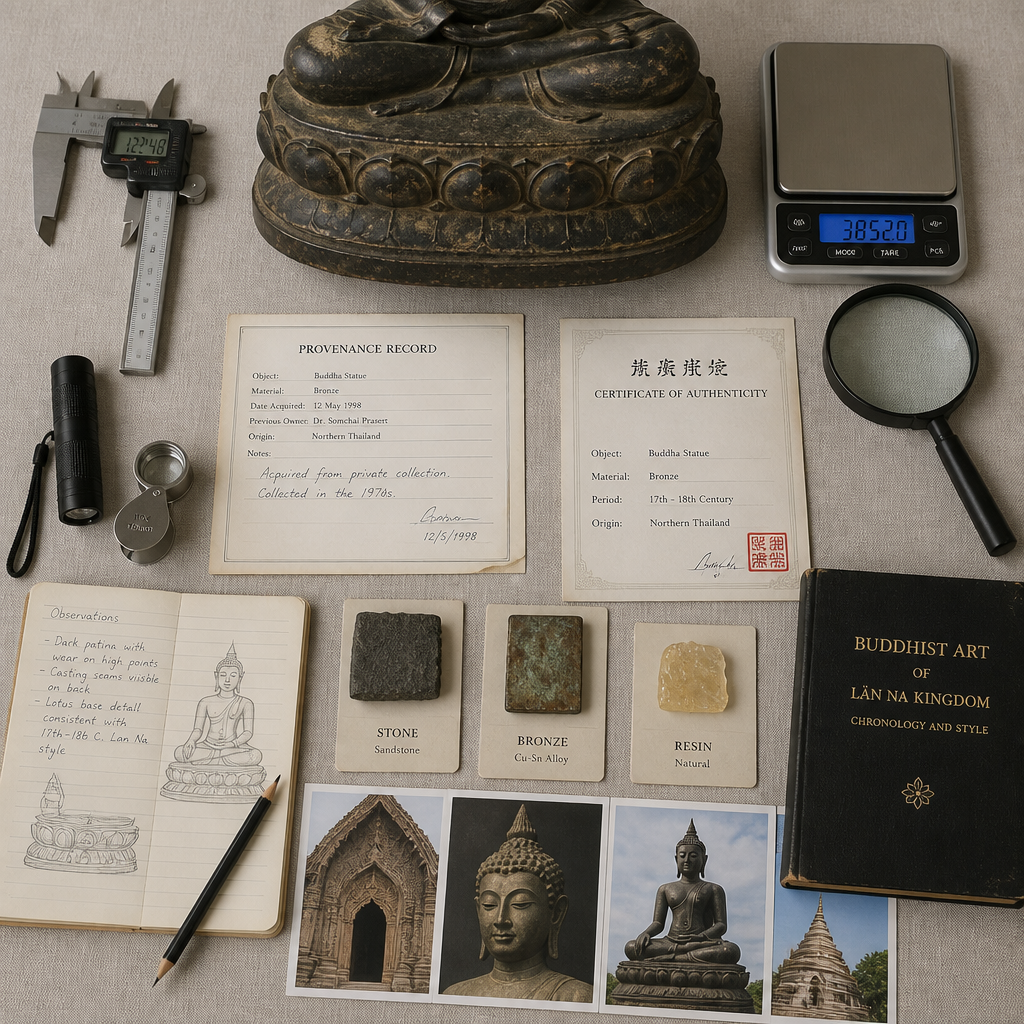
You do not need to be a materials scientist to catch these mismatches. You need a basic working knowledge of what each tradition actually produced, and the willingness to ask direct questions about material and construction method. A specialist retailer like HD Asian Art, which sources with Burma, Cambodia, China, India, Indonesia, Japan, Laos, Sri Lanka, and Thail heritage, will be able to answer those questions much more precisely.
Red Flag 6: Provenance Is Vague or Theatrical
Provenance in the art market means the documented history of an object: who made it, where, when, who has owned it, and how it changed hands. For antique Asian sculpture, complete provenance is rare. But there is a significant difference between honest uncertainty ("this is likely 19th-century Burmese, purchased at auction in the 1980s, no further documentation") and theatrical vagueness designed to imply significance ("it was ripped out of a temple").
The temple story is a classic sales technique in the Buddhist and Hindu sculpture market. It implies age, authenticity, and cultural weight without providing any verifiable information. It also raises a separate concern: the legal and ethical status of objects removed from active religious sites. Many countries across South and Southeast Asia have strict laws governing the export of cultural artefacts, and purchasing objects with dubious removal histories can expose buyers to legal risk as well as moral problems.
What Legitimate Provenance Actually Looks Like
A seller with genuine knowledge will be able to describe the regional style and approximate period, explain how the piece was acquired, and provide documentation where it exists. They will not use provenance as a sales tool but as factual information. Gaps in provenance are normal and acceptable when they are acknowledged honestly. What is not acceptable is a story designed to make you feel that asking for documentation is somehow unsophisticated.
Red Flag 7: The Price and the Story Don't Match
This is the simplest red flag of all, and the one buyers most often talk themselves out of noticing. If a dealer is selling a piece claimed to be a genuine antique Buddha statue from the Gandharan period, or a rare Khmer sandstone figure, or an Edo-period Japanese bronze, the price should reflect that claim. Genuine antique Asian sculpture in those categories sells at serious auction houses for significant sums. A piece claimed to be from those traditions priced at £80 or £150 is almost certainly not what the seller says it is.
This does not mean that affordable, authentic Buddhist sculpture does not exist. Contemporary pieces made with traditional methods and correct iconography can be excellent value and completely honest. The problem arises when the price is low and the story is grand. A seller cannot simultaneously offer you a bargain and a rare antique. Those two things are structurally incompatible.
A common mistake is letting the drama of the sale, the atmosphere of the antiques fair, the romance of the story, override the simple arithmetic of value. If the story were true, the piece would not be priced the way it is. Work backwards from the price, not forwards from the story.
How to Authenticate Asian Art: A Practical Comparison
Not every buyer has the same level of access to expertise or the same stakes in a purchase. The right authentication approach depends on what you are buying, how much you are spending, and how confident you are in your own eye. Here is a direct comparison of the three main approaches collectors use.
|
Approach |
Best For |
Key Limitations |
|---|---|---|
|
Self-authentication using iconographic knowledge |
Buyers with a working knowledge of regional Buddhist or Hindu art traditions, checking mudras, materials, construction, and surface condition in person |
Requires genuine study; works best for traditions you already know; less reliable for unfamiliar regional styles |
|
Buying from a trusted specialist retailer |
Collectors and spiritual practitioners who want museum-quality pieces with honest description, sourced by people who know the material directly |
Requires finding a retailer whose expertise and sourcing standards you have verified; not all "specialist" retailers are equally rigorous |
|
Third-party expert appraisal or auction house vetting |
High-value purchases of claimed antiques where provenance and age matter for collection or investment purposes |
Adds cost and time; not practical for smaller purchases; appraisers vary in specialist knowledge across different Asian traditions |
In practice, most serious collectors use all three approaches at different price points. For everyday additions to a collection, a trusted specialist retailer is the most efficient route. For major acquisitions of claimed antiques, a third-party appraisal is the only responsible standard. Self-authentication through study is the foundation that makes everything else more effective.
Frequently Asked Questions
How can I tell if a Buddha statue is genuinely old or artificially aged?
Look at where the wear appears, not just whether wear exists. Genuine aging is uneven and appears at the points most exposed to handling, light, and environmental change. Artificial aging is typically uniform across all surfaces, applied as a coating rather than developed from within the material. On bronze, look at whether the patina sits on top of the surface or is integrated into it. On lacquered wood, check whether cracks follow the structural movement of the piece or appear as a decorative pattern applied from outside.
Is a contemporary Buddha statue less valuable than an antique one?
Not necessarily, and this is one of the most important distinctions for new collectors to understand. A contemporary piece made with traditional methods, correct iconography, and high-quality materials can be more valuable, more meaningful, and more honest than a misrepresented antique. The question is always whether the object is what the seller says it is. A beautifully made contemporary Burmese lacquerware Buddha is a better purchase than a poorly preserved and falsely attributed antique.
What is a mudra, and why does it matter for authentication?
A mudra is a symbolic hand gesture with a specific meaning within Buddhist and Hindu iconographic traditions. Different Buddhas and deities are identified partly by their mudras: the earth-touching gesture (bhumisparsha mudra), the meditation gesture (dhyana mudra), the teaching gesture (dharmachakra mudra), and others. A genuine piece made within a living sculptural tradition will show the correct mudra for the specific figure depicted. A careless fake often gets this wrong, either because the copier did not know the correct gesture or could not see it clearly in the reference photograph they were working from.
Should I be worried about the legal status of antique Buddha statues?
Yes, this is a real concern for any collector of antique Asian religious sculpture. Many countries across South and Southeast Asia, including India, Thailand, Cambodia, and others, have laws restricting or prohibiting the export of cultural artefacts and religious objects. A piece claimed to have been "removed from a temple" may have entered the market illegally. Before purchasing any piece represented as genuinely old and originating from an active religious or protected cultural site, ask for documentation of legal export and clear ownership history. A reputable retailer will have this information and will not be uncomfortable being asked for it.
What is the safest way to buy an authentic Buddha statue online?
Buy from a specialist retailer who sources directly, describes materials and origins precisely, and is willing to provide additional photographs of the back, base, and underside on request. Read the product descriptions carefully: vague language about "antique style" or "temple-sourced" without specific detail is a warning sign. Retailers like HD Asian Art that specialise in museum-quality Buddhist and Hindu sculpture from specific regions, and describe their pieces with the kind of detail that comes from genuine expertise, give buyers the transparency needed to make an informed decision. Avoid any seller who makes the provenance sound romantic but cannot answer direct questions about material, region, and approximate period.
Can I trust auction houses for antique Buddhist sculpture?
Major auction houses with dedicated Asian art departments employ specialists who vet pieces carefully, and their reputations depend on that accuracy. However, smaller regional auction houses and online auction platforms vary enormously in the depth of their specialist knowledge. A piece described as "Asian bronze figure" at a general auction is receiving almost no authentication at all. If you are buying at auction, read the catalogue notes carefully, attend in person when possible to handle the piece, and treat non-specialist auction descriptions with appropriate scepticism. For high-value pieces, commission an independent appraisal before bidding.
Have you ever bought a Buddha or Hindu deity statue that turned out to be different from what you were told, or do you have a reliable method for spotting fakes that has served you well? Share your experience in the comments below.
References
