



Ardhanarishvara Statue: Shiva and Parvati in One Form
Ardhanarishvara Statue: Shiva and Parvati in One Form
Turn a Shiva statue around and you may find Parvati standing in the same stone. The Ardhanarishvara statue splits one body down the middle, with a male half and a female half, and asks the viewer to see two deities as a single presence. Collectors often meet this form by accident, in a catalogue or on a temple wall, and then struggle to explain what they are looking at. This guide covers the name, the iconography, the philosophy, and the practical points that matter when you choose one for a collection or a home altar.
Table of Contents
- Quick Takeaways
- What the Name Ardhanarishvara Means
- Reading the Split-Body Form
- Earliest Images and the Gupta Refinement
- Purusha, Prakriti and Shakti
- Regional Names and Local Variations
- Comparing Three Named Forms
- Buying an Ardhanarishvara Statue
- Common Mistakes Collectors Make
- Frequently Asked Questions
- References
Quick Takeaways
|
Key Insight |
Explanation |
|---|---|
|
The right side is usually Shiva |
In most traditional images the right half is the male Shiva, so start your reading there before you name the figure. |
|
The trishula marks the male side |
Shiva's trishula is the traditional weapon associated with this form, and it is a quick way to confirm which half you are looking at. |
|
Early images come from the Kushan period |
The earliest known images date to the first century CE, and the iconography was refined later in the Gupta era. |
|
Few temples are dedicated to it |
The form appears in most Shiva temples across India, yet very few temples are dedicated to Ardhanarishvara alone. |
|
Regional names carry meaning |
Labels such as Ammaiyappan in Tamil or Ardhayuvatishvara in Assam point to local traditions and help you understand the reading behind a piece. |
|
Check the centre line first |
When buying, look at whether the join runs straight and whether the two halves share a believable scale and posture. |

What the Name Ardhanarishvara Means
Ardhanarishvara is a Sanskrit name, and the name explains most of the image before you see it. It combines ardha, meaning half, nari, meaning woman, and ishvara, meaning lord, so the plain reading is the lord who is half woman. The Sanskrit spelling is अर्धनारीश्वर, and it is transliterated in several ways depending on the scholarly convention.
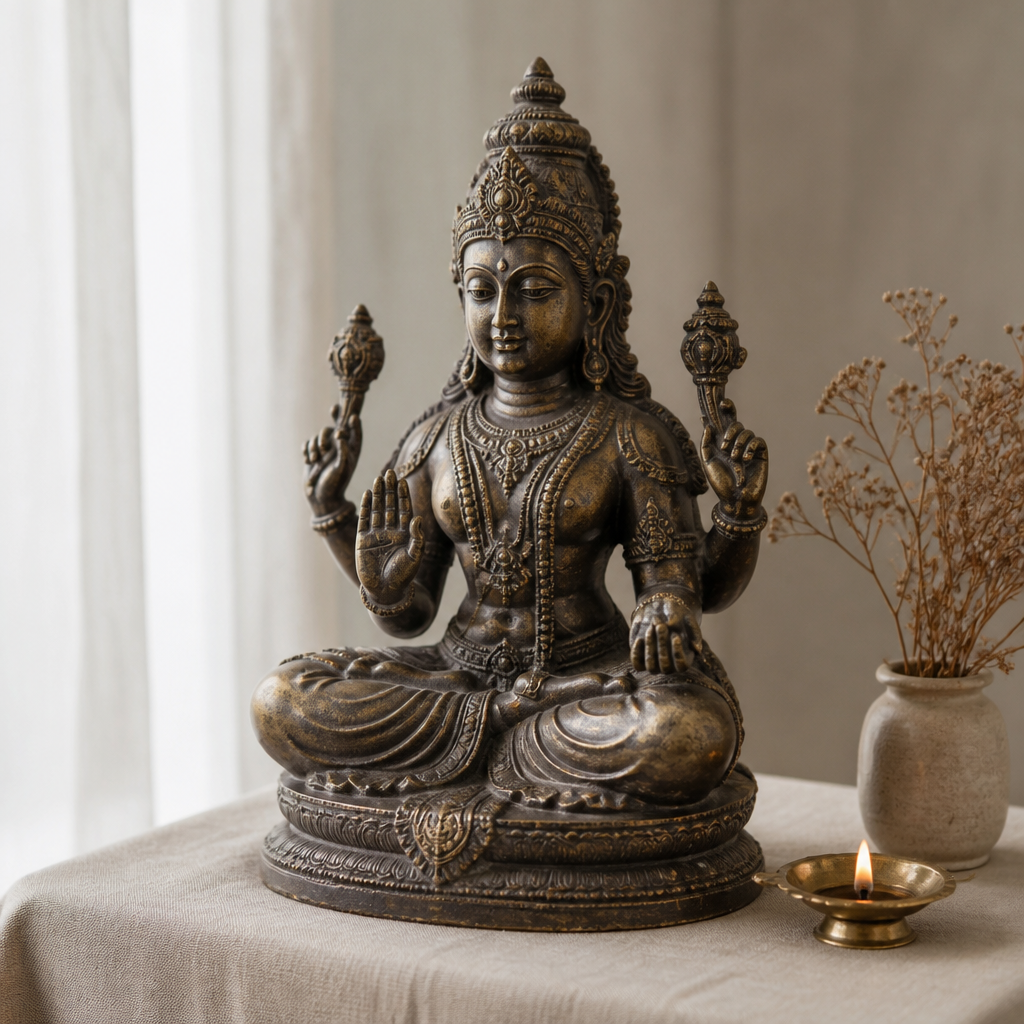
Texts and temple traditions use several other names. Ardhanaranari means "the half man-woman," Naranari means "man-woman," and Ardhanarisha repeats the idea of a lord who is half woman. Ardhanarinateshvara adds a dance element, calling him the Lord of Dance who is half woman, which shows that the figure was understood within Shiva's wider identity rather than as a standalone symbol.
Ardha, Nari and Ishvara in Practice
When you see the name on a label, read it as a description of the sculpture rather than a title. The word ardha tells you the body is divided into halves, which is why the split is usually drawn down the exact middle. A label that uses a shortened form or a regional name is still describing the same figure.
In practice, the name gives you a checklist. Ask whether the piece is meant to be read as equal halves, which is the classic form, or whether it leans toward a distinct regional style. Labels vary across the trade, so the name alone does not settle the iconography.
Other Names Found in Texts
The Gupta-era writer Pushpadanta, in the Mahimnastava, refers to this form as dehardhaghatana, which means "Thou and She art each the half of one body." That phrase is a useful reminder that the idea is about partnership within one body, not a simple merging.
Utpala, commenting on the Brihat Samhita, calls the form Ardha-Gaurishvara, "the Lord whose half is the fair one." Gauri is an attribute of Parvati, so this name shifts the emphasis from the male lord to the female half.
Reading the Split-Body Form
The first thing to read in an Ardhanarishvara statue is the split. The right half is usually the male Shiva and illustrates his traditional attributes, while the left half is Parvati. Once you know this, the rest of the image becomes easier to parse, because the two halves are designed to contrast on purpose.
The Right Side Belongs to Shiva
In practice, start at the top of the head. The male half typically wears matted, piled hair associated with Shiva as an ascetic, while the female side tends to show softer hair and more elaborate ornament. Many images also differ in the earrings, with the male side often carrying a simpler or heavier ornament. These are tendencies rather than rules, and workshops varied in how they handled them.
Telling the Two Halves Apart in Stone or Bronze
Material changes how the halves read. In stone, the contrast often comes from the modelling of the chest, hips and the drape of cloth, and worn surfaces can blur these lines. In bronze, the sharper detail of jewellery and hair tends to carry the contrast, so a piece can look more clearly divided even when the anatomy is subtle.
Look also at the hands. In many depictions the male side holds the trishula, and the female side may hold a mirror, a motif that appears in some Parvati images. If a piece shows the trishula on the female side, treat that as a question for the seller rather than an automatic error, because workshops did not always follow one template.
Pro tip: Photograph the figure from directly in front and from the back before you buy. The join line and the balance of the two halves are easier to judge in a straight-on view than in a three-quarter product photo.
#
Earliest Images and the Gupta Refinement
Kushan Period Origins
The earliest Ardhanarishvara images are dated to the Kushan period, starting in the first century CE. That makes the form far older than many collectors assume when they first meet it in a shop or temple. Its appearance this early shows that the idea of a combined Shiva and Parvati was already in circulation well before the classical iconography settled.
Early examples are harder to date with confidence than later ones, and the surfaces of old stone often make visual dating unreliable for a non-specialist. A seller who offers a firm early date should be able to explain the basis for it, whether that is style, material, find context or published comparison.
The Gupta Refinement
The iconography evolved and was perfected in the Gupta era. By this period the split was clearly organised, the attributes were assigned to each half, and the figure took on the balanced, poised look that most collectors now picture when they hear the name.
The Puranas and various iconographic treatises also describe the mythology and iconography of the form. That textual tradition is one reason the figure is recognisable across regions, even when local sculptors added their own details.
Purusha, Prakriti and Shakti
Purusha and Prakriti as Two Principles
Ardhanarishvara represents the synthesis of masculine and feminine energies of the universe, which the tradition describes as Purusha and Prakriti. Purusha is the male principle and Prakriti is the female principle, and the figure places them in one body so that neither can be seen apart from the other.
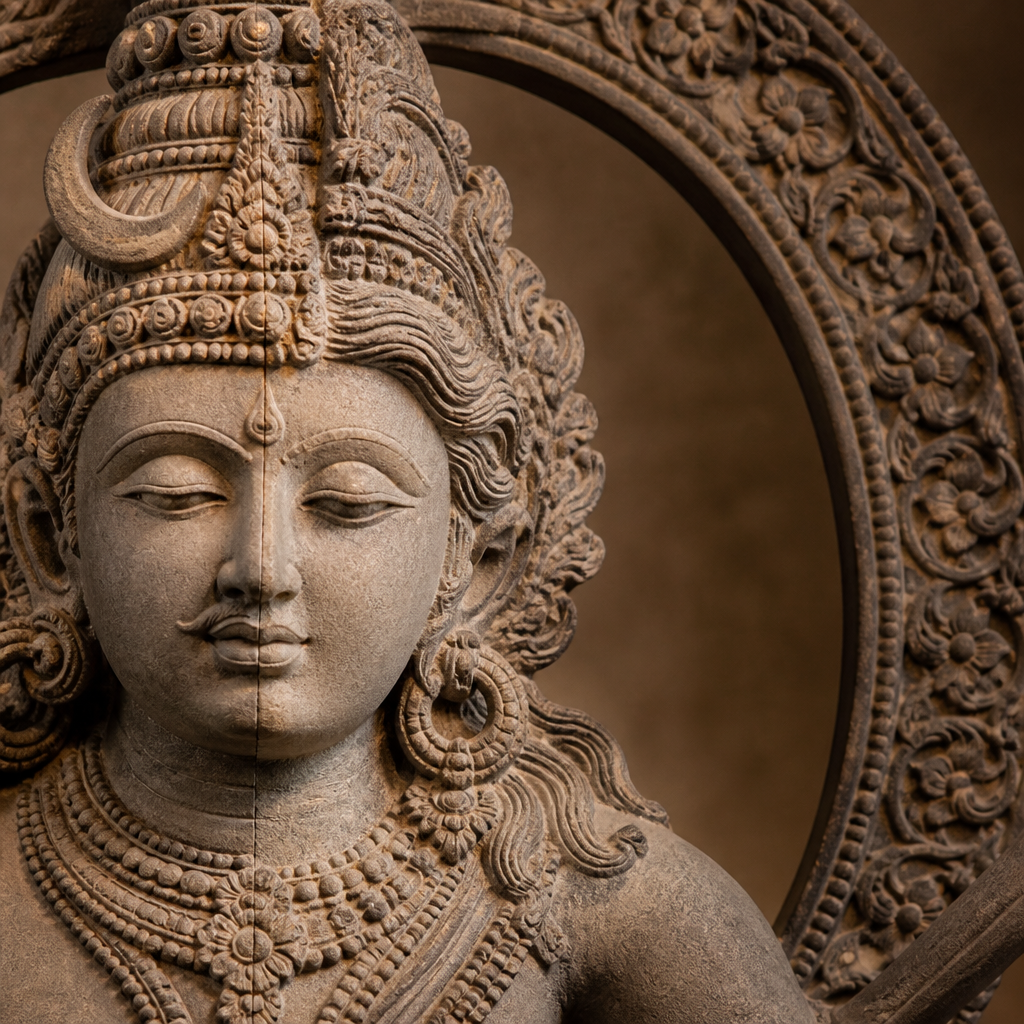
This matters when you decide how to display the piece. A statue that divides the body evenly is making an argument about balance, not about one deity being subordinate to another. Buyers who expect the female half to look like an add-on usually misread the sculpture.
Shiva and Shakti Are Not Separate
The figure also illustrates how Shakti, the female principle of God, is inseparable from Shiva, or in some interpretations the same as him, and the reverse is equally true. In many traditions the union is treated as the root and womb of all creation.
The figure does not argue that two gods were fused. It shows that the masculine and feminine principles were never separate to begin with.
A 2013 article in the Indian Journal of Psychiatry by B N Raveesh, of Mysore Medical College and Research Institute, reads the figure as harmonising two ways of life: the ascetic path represented by Shiva and the householder path symbolised by Parvati. The article also presents the concept as a way of resolving opposites into unity through lived experience, which explains why it still draws interest beyond temple settings.
Regional Names and Local Variations
Ammaiyappan in Tamil Tradition
In Tamil, the figure is known as Ammaiyappan, a name that means "Mother-Father." The label places the parental pair at the centre, so for many readers the figure works as a family image as much as a cosmic one. That reading is easy to miss if you only know the Sanskrit name.
Ardhayuvatishvara in Assam
In Assam the form is called Ardhayuvatishvara, meaning "the Lord whose half is a young woman or girl." The change from a general term for a woman to a young woman or girl shifts the emphasis toward youth and newness, which is a useful detail when you compare pieces from different regions.
Local sculptors chose different proportions and jewellery, so a piece from one region often looks different even when the core iconography is the same. For a collector, regional labels are useful context. When a piece carries a Tamil or Assamese name, ask what that name is drawn from, because the phrasing usually reflects local devotional vocabulary rather than the standard Sanskrit treatise.
Comparing Three Named Forms
The three names below are the ones most useful to a buyer, because each points to a different reading of the same sculpture. The table compares them side by side so you can see which emphasis a piece is likely built around.
|
Name |
Tradition or Source |
What the Name Emphasises |
|---|---|---|
|
Ardhanarishvara |
Sanskrit name used across the Puranas and iconographic treatises |
The lord who is half woman, with an equal division of the body and the union of Purusha and Prakriti |
|
Ammaiyappan |
Tamil name |
The parental pair as Mother-Father, with a family reading of the figure |
|
Ardhayuvatishvara |
Name used in Assam |
The female half as a young woman or girl, with emphasis on youth |
Comparing these names helps you read a piece before you commit. If the seller calls it Ardhayuvatishvara, expect a regional reading that stresses youth, and if the label is the standard Sanskrit name, expect the classic balance of two principles. Neither reading is wrong, but the label should match the iconography you can see.
Pro tip: Ask the seller which name they used and why. A good answer names a textual or regional source, while a vague answer usually means the label was copied without checking.
Buying an Ardhanarishvara Statue
Checking the Centre Line and Proportion
The most useful check is the centre line. The join between the two halves should run straight through the figure, with the nose, chest and waist aligned along the same vertical axis. A seam that drifts off centre, or a face that seems to belong to two different scales, usually points to careless carving or poorly finished casting.
Next, compare the two halves for weight and posture. The figure is one body, so the legs, hips and shoulders should feel like one composition. If the female side looks like a separate statue placed against the male side, look for a better example.
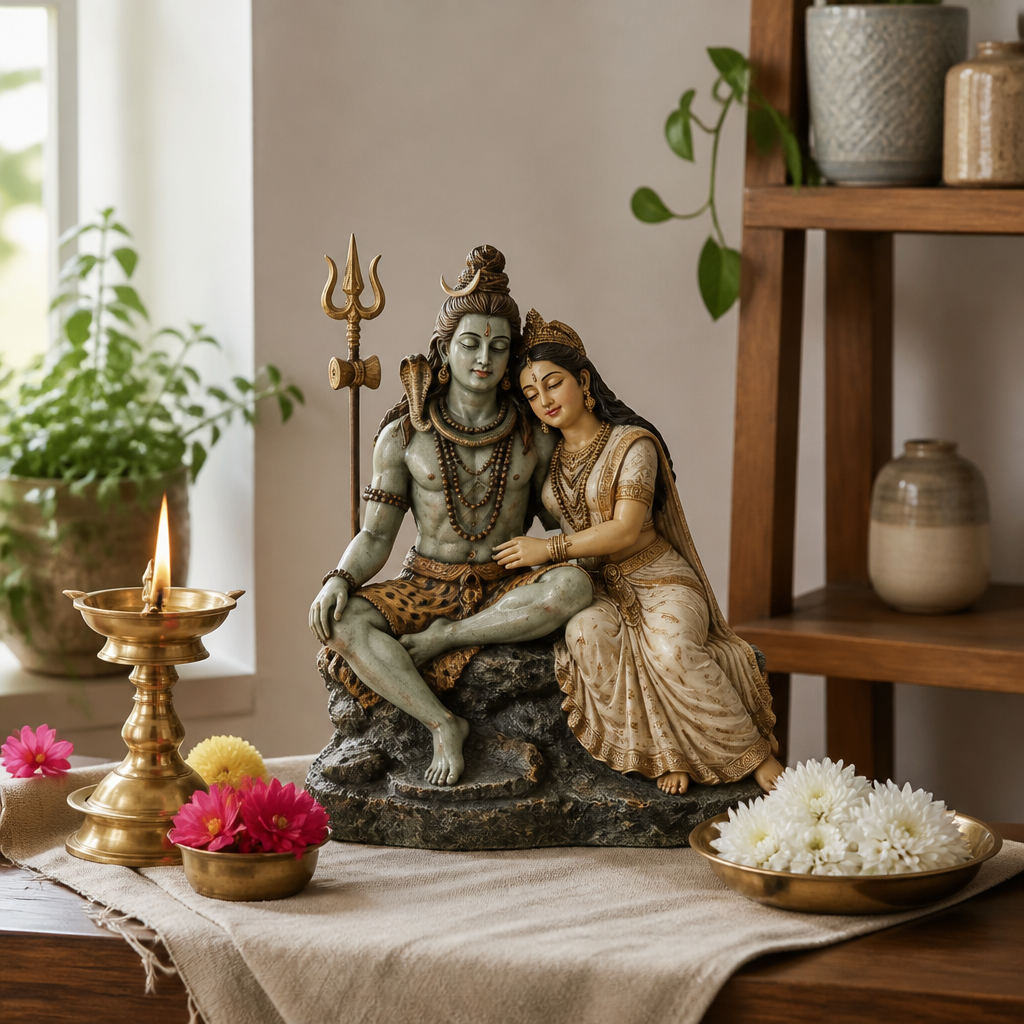
Material, Finish and Provenance
Stone, bronze and other materials each carry different risks. Stone rewards close inspection of the surface, because weathering and repair can change how the modelling reads. Bronze shows the quality of the casting in its edges and the clarity of jewellery, so ask for details about the finish rather than relying on a single photograph.
Whatever the material, ask for accurate dimensions, the weight and a clear account of the finish. Honest sellers can explain what has been restored and what has been added, and provenance written down in the listing is worth more than a confident adjective. We offer free shipping on orders over £35, but shipping is only one part of the decision, and a figure that arrives well packed and accurately described is worth more than a cheap one that does not.
Placing the Figure on a Home Altar
On a home altar, the figure should sit at a height where it can be seen directly, not tucked behind other objects. Keep it away from direct sunlight, heaters and damp, since these change the surface of stone and metal over time. Clean it with a soft dry cloth, and avoid household cleaners that can damage finishes.
Common Mistakes Collectors Make
Treating It as Just Shiva or Just Parvati
The most frequent error is naming the figure as a standard Shiva or a standard Parvati because one half is more visible in a photograph. The form is a composite form, and a catalogue entry that drops the second deity misses what makes the piece distinctive. A correct description names both halves and says how they are arranged.
Collectors also tend to judge the piece by the face alone. The face is split between the two halves, so it can look odd at first glance. Look at the whole body, from the crown to the feet, before deciding whether the piece is well made.
Accepting an Early Date Without Evidence
Early dates attract buyers, and some sellers use them loosely. Because the earliest images come from the Kushan period, a claim of very early origin should be treated with caution unless it is backed by a clear basis. Ask what the date rests on, and be wary of a single confident word with no supporting detail.
Pro tip: Save every listing, description and photograph before you buy. If a dating claim later turns out to be wrong, a written record is the fastest way to raise the question with the seller.
Frequently Asked Questions
Is an Ardhanarishvara statue Shiva or Parvati?
It is both, combined into one body. The right half is usually the male Shiva and the left half is Parvati, so a complete description names both deities and how they are arranged.
Why is the figure divided exactly down the middle?
The division expresses the idea that the masculine and feminine principles are equal and inseparable. In the tradition, the female principle is Shakti, and the figure shows that Shiva and Shakti are one.
Where do the earliest Ardhanarishvara images come from?
The earliest known images are dated to the Kushan period, starting in the first century CE. The iconography was later perfected in the Gupta era, which is when many of the classic features became standard.
Is Ardhanarishvara still worshipped in temples?
The form remains a popular iconographic type found in most Shiva temples throughout India. Very few temples are dedicated to it alone, so you are more likely to see it as part of a larger Shiva shrine than as the main deity.
What should I check first when buying an Ardhanarishvara statue?
Start with the centre line and the proportion of the two halves, then look at the material and finish. Ask for accurate dimensions and a clear account of any restoration, and compare the name on the label with the iconography you can see.
Are there different names for this figure?
Yes. Names include Ardhanaranari, Naranari and Ardhanarisha, along with Ammaiyappan in Tamil and Ardhayuvatishvara in Assam. The variant names reflect regional emphasis, so they can help you understand the tradition behind a piece.
What did you notice first about the balance between the two halves when you saw an Ardhanarishvara figure, and would you share your experience with us?
References
-
Encyclopedia overview of Ardhanarishvara names, iconography and history
-
Psychiatry article on the Ardhanareeshwara concept and the unity of opposites
-
Short introduction to Ardhanarishvara as Shiva joined with Parvati
