



How to Insure Valuable Antique Buddha Statues
How to Insure Valuable Antique Buddha Statues
Table of Contents
- Why Antique Buddha Statues Need Their Own Insurance Strategy
- Homeowners Insurance Coverage for Antiques: What It Actually Pays
- How to Get an Insurance Appraisal for Antiques
- Your Antique Statue Documentation Checklist
- Photographing and Measuring the Statue for the Record
- Safe Handling, Storage, and Risk Reduction at Home
- Filing a Claim: What to Do If the Statue Is Damaged or Stolen
- Choosing and Registering Your Antique Buddha Statue
- Frequently Asked Questions
Why Antique Buddha Statues Need Their Own Insurance Strategy
A standard home policy treats a temple bronze and a television the same way: as generic personal property. That works fine for a couch.
Pieces with real age and provenance are irreplaceable, a claims adjuster cannot order a replacement from a showroom.
Here is the part most guides get wrong. Insurers do not pay what you think a statue is worth.
What Standard Policies Usually Miss
Most homeowners policies cap valuables at a sublimit, a percentage of your total personal property coverage. Anything above that cap is your loss, not theirs.
Three gaps show up again and again:
- The sublimit trap. A statue worth far more than the cap gets paid only up to the cap.
- Actual cash value. Some policies pay depreciated value, not replacement cost (Am I Covered?).
- No pair or set coverage. Lose one piece of a matched pair and you may get half a settlement.
The Insurance Information Institute's guide to homeowners coverage explains how personal property limits work in plain terms. Read your declarations page before you assume you are covered.
Homeowners Insurance Coverage for Antiques: What It Actually Pays
Homeowners insurance coverage for antiques usually pays the lesser of three numbers: your sublimit, your appraised value, or the adjuster's estimate. That surprises most collectors.
A sublimit is the maximum your policy pays for a category of property, such as collectibles or fine art.
Scheduling changes everything: you and the insurer agree on a value up front, so there is no haggling at claim time.
Sublimits, Deductibles, and Scheduled Property
Think of it as three tiers of protection:
| Coverage Type | How It Pays | Best For | Main Drawback |
|---|---|---|---|
| Standard homeowners | Up to sublimit, often depreciated | Low-value decor | Caps and ACV |
| Scheduled endorsement | Agreed value per item | Single high-value statues | Requires appraisal |
| Standalone collectibles policy | Broad, itemized coverage | Whole collections | Higher premium |
A standalone collectibles policy typically covers theft, breakage, and transit. Ask specifically about mysterious disappearance, meaning loss with no explanation. Not every policy includes it.
Exclusions and Loss Scenarios to Compare
Two policies can quote the same premium and behave very differently at claim time, usually because of exclusions. Compare these scenarios side by side:
- Breakage. A dropped or tipped statue is the most common loss. Some homeowners policies exclude breakage of fragile items unless scheduled; a collectibles policy usually covers it.
- Theft. Standard policies cover theft up to the sublimit, but a high-value statue will blow past it. Scheduled coverage pays the agreed value.
- Earthquake and flood. These are typically excluded from homeowners policies and require separate endorsements or a standalone policy (Which disasters are covered by homeowners insurance?). A statue on a shelf in a seismic zone is exposed unless you address it.
Pair and Set Clauses
If your statue is one of a matched pair or part of a set, a pair and set clause governs how a partial loss is settled. Under some policies, losing one piece of a pair means you are paid for the pair as a unit, which can leave you short if the surviving piece is now orphaned and worth less.
When a Homeowners Policy Is Not Enough
A homeowners policy is usually adequate for decorative pieces below the sublimit. It becomes inadequate when a single statue exceeds the sublimit, when the piece is fragile enough that breakage is a real risk, or when the collection as a whole exceeds what the policy will pay in a single loss. At that point, a scheduled endorsement or standalone collectibles policy is the better tool.
How to Get an Insurance Appraisal for Antiques
An insurance appraisal for antiques is a written valuation prepared for coverage purposes, not for resale. Securing an accurate valuation is only the first step in protecting your investment, as the risks inherent in transit often necessitate a separate policy for antique shipping insurance to cover potential damage during relocation.
Follow these steps:
- Find a qualified appraiser. Look for credentials from a recognized appraisal association and demonstrated experience with Asian sculpture. Ask for sample reports before you book.
- Ask what method they use. Replacement cost is the standard for insurance; fair market value suits estate and tax work. Make sure the report states the method explicitly.
- Request a written report. Verbal opinions and phone estimates will not survive a claim review.
- Update it periodically. Values shift, and a stale appraisal invites a dispute at claim time.
- Keep a digital copy stored away from the statue, ideally in cloud backup and a second physical location.
If you want to understand how specialists assess Khmer-style pieces before you book an appraisal, our guide to evaluating the investment value of Khmer-style art walks through the factors appraisers weigh. For help locating qualified experts, see our guide to finding reputable antique Buddhist art dealers.
What a Proper Appraisal Report Must Contain
A usable report is specific, and insurers reject vague ones. Yours should include:
- A full description of the statue, including subject, material, and dimensions
- Clear photographs of all sides plus any marks or inscriptions
- The valuation method and the effective date of value
A report missing the purpose statement or the effective date may be set aside by an adjuster. The effective date anchors the value to a specific moment; without it, an insurer cannot tell whether the figure reflects today's market or a decade-old one.
Insurance Appraisal vs. Sale Estimate
The single most common mistake is submitting a dealer's sale estimate as if it were an insurance appraisal. They are not interchangeable.
| Document | Purpose | Typical Method | Accepted by Insurers? |
|---|---|---|---|
| Dealer sale estimate | Set an asking price | Retail markup | Rarely, and only as supporting evidence |
| Auction estimate | Predict a sale range | Comparable lots | Sometimes, as a cross-check |
| Insurance appraisal | Establish replacement value | Replacement cost | Yes, when properly formatted |
A sale estimate is written to move merchandise. An insurance appraisal is written to survive scrutiny from a claims adjuster with no incentive to accept your number. Submit the wrong document and your coverage may rest on a figure the insurer never agreed to.
Appraiser Qualifications Insurers Look For
Insurers do not require a specific license, but they look for credibility signals: membership in a recognized professional appraisal association, credentials relevant to the object type, and a track record with comparable sculpture. Ask whether the appraiser has prepared reports accepted by insurers and will sign one naming insurance coverage as its purpose. Hesitation on either question is a red flag.
Your Antique Statue Documentation Checklist
An antique statue documentation checklist is the file you hand an insurer or adjuster when it counts. Build it before you need it. Reconstructing history after a theft is close to impossible.
- Purchase receipt or invoice with seller name and date
- Seller's written description, including any provenance claims, and see our guide on how to verify provenance for Buddhist antiquities for practical verification steps
- Auction catalog page or lot number, if bought at auction
Provenance is the spine of this file. For a structured approach to tracing a statue's history, see our Buddhist Sculpture Provenance Archive Research guide.
Photographing and Measuring the Statue for the Record
Photographs are the difference between a smooth claim and a disputed one. Adjusters want proof of what existed, in what condition, at what size.
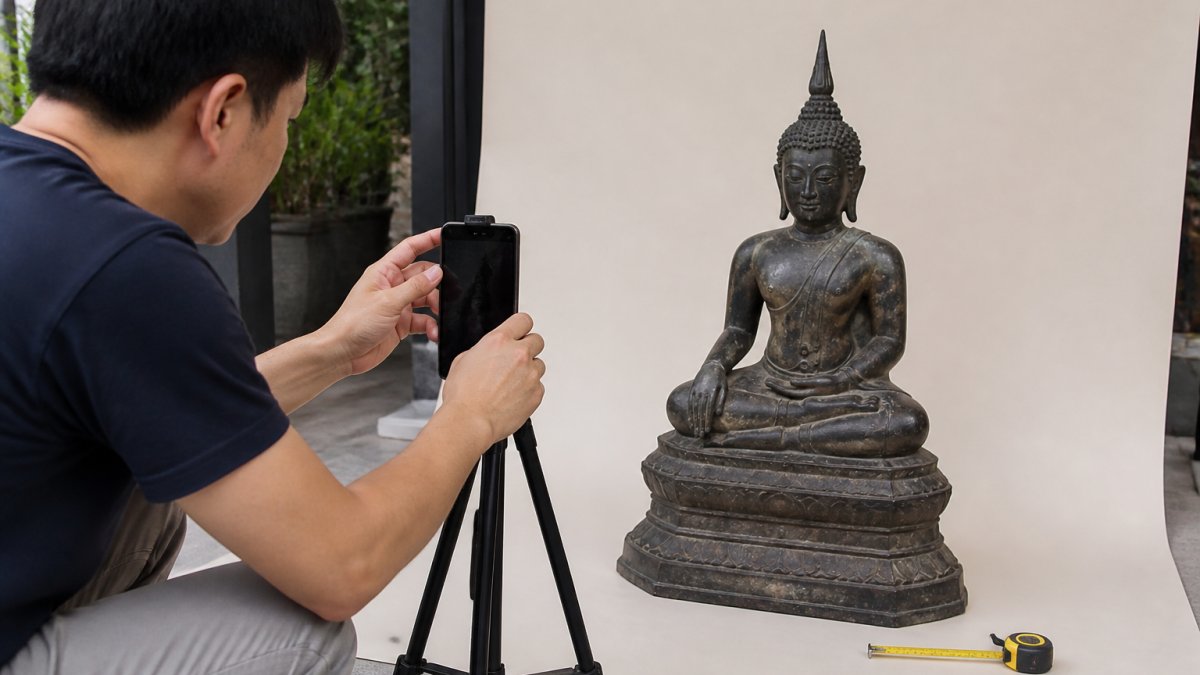
Shoot in soft, even daylight. Avoid flash, which flattens detail. Capture:
- Front, back, left, right, top, and base
- Close-ups of the face, hands, and any maker's marks or inscriptions
- Any damage, chips, or old repairs
Record sculpture dimensions in writing too: height, width, depth, and weight. Note the material, whether bronze, wood, or stone. Store photos in cloud backup and print a set for your file.
Safe Handling, Storage, and Risk Reduction at Home
Most statue losses are not dramatic thefts. They are clumsy accidents, and insurers notice carelessness. Show that you protect the piece and claims get easier.
Start with placement. Keep statues off unstable shelves and away from doorways. Use museum putty or a weighted base on anything tall.
Then reduce the quiet risks:
- Keep pieces out of direct sun, which fades finishes and dries wood
- Control humidity in the room, since swings crack both wood and bronze patina
- Skip open flames and candles near the statue
For pieces of real value, a climate-controlled space or proper display case is worth considering.
Filing a Claim: What to Do If the Statue Is Damaged or Stolen
Report the loss fast. Most policies require prompt notice, and delay gives an insurer grounds to question the claim.
Work through it in order:
- Document the damage with fresh photographs before moving anything.
- Call your insurer and open a claim. Get the claim number in writing.
- File a police report for theft. Insurers usually require one.
- Send your appraisal and documentation file to the adjuster.
- Get an independent opinion if the settlement offer looks low.
- Keep every receipt for emergency stabilization or storage.
Do not repair or restore the piece before the adjuster sees it. That can reduce your payout. If the statue was one of a pair, say so early. Pair and set clauses affect the settlement.
Choosing and Registering Your Antique Buddha Statue
The best insurance strategy starts at purchase. Buy from a source that gives you real paperwork, then register the piece with your insurer before it goes on display.
Ask three questions of any seller:
- Can you provide a written description with provenance?
- Will you supply purchase records I can give my insurer?
- Is the piece documented well enough to appraise?
An antique Buddha statue with clear history is far easier to insure than one with a vague story. Our ethical sourcing guide for antique Buddhist art explains how to choose pieces that come with insurable documentation.
Once the piece arrives, photograph it, add it to your schedule, and set a calendar reminder to revisit the appraisal. Registration is not a one-time task.
Frequently Asked Questions
Can you insure an antique Buddha statue?
Yes. You can insure an antique Buddha statue by adding it to a homeowners or renters policy as scheduled personal property, or by buying a stand-alone collectibles policy. Insurers generally want a professional appraisal, clear photographs of all sides, and proof of ownership before they will cover a high-value piece. Without that paperwork, a claim is likely to be capped by the policy's standard sublimit for personal property.
Does homeowners insurance cover valuable antiques?
Homeowners insurance coverage for antiques usually applies, but only up to the policy's standard sublimit for personal property, which is often far below what a serious antique Buddha statue is worth. To close that gap, ask your insurer to schedule the statue at an agreed value or move it to a dedicated collectibles policy. Review the deductible and any per-item cap before you assume the piece is fully protected.
What information should an insurance appraisal include?
An insurance appraisal for antiques should state the statue's subject and iconography, material and method of construction, dimensions and weight, age and region of origin, condition, and any repairs or restoration. It should also describe maker's marks or inscriptions, summarize provenance, and give a replacement value in USD with the appraiser's credentials and signature. Ask for a dated report you can hand straight to your insurer.
How should you store records for an insured antique statue?
Keep digital copies of the appraisal, purchase records, seller correspondence, and photographs in cloud storage, and a printed set somewhere off site. Your antique statue documentation checklist should also include a short condition report updated after any move or repair. If a loss occurs, that file lets you prove ownership, value, and pre-loss condition quickly, which speeds up the claims process.
Insuring a serious sculpture takes paperwork, patience, and a seller who gives you something to work with. That is the standard we hold ourselves to at HD Asian Art. Every piece in our curated collection of Buddhist, Hindu, Khmer, and Southeast Asian sculpture comes with the kind of description and history a collector can build a file around, and we ship free so your piece arrives safely. Browse the collection and start your documentation the day it lands.

