



Evaluating the Investment Value of Khmer-Style Art
Evaluating the Investment Value of Khmer-Style Art
Table of Contents
- Why Khmer-Style Art Attracts Serious Collectors
- Khmer Sculpture Value: The Factors That Drive Price
- Khmer Art Provenance: What Verifiable Ownership Looks Like
- Ancient Artifact or Contemporary Khmer-Style Work?
- Art Investment Risks Every Khmer Buyer Should Weigh
- Fitting Khmer Art Into an Art Investment Portfolio
- A Step-by-Step Framework for Evaluating Khmer-Style Art
- Frequently Asked Questions
Why Khmer-Style Art Attracts Serious Collectors
The global art market recorded estimated sales of USD 57.5 billion in 2024, a 12% year-over-year decline, according to The Art Basel and UBS Survey of Global Collecting 2026. Works priced under USD 50,000 made up 61% of lots sold in 2025, up from a 48% average between 2015 and 2019, per Bank of America Private Bank's Art Market Update Spring 2026.
Khmer-style art sits squarely in that shift, offering stone carving with deep heritage value, a clear visual identity, and entry points that don't require a seven-figure budget.
Collectors want pieces that hold meaning, not just resale potential.
Evaluating the investment value of Khmer style art means judging three things: what drives price, what proves ownership, and what risks sit between you and a real return.
Khmer Sculpture Value: The Factors That Drive Price
Khmer sculpture value comes down to four levers: style period, iconography, rarity, and condition.
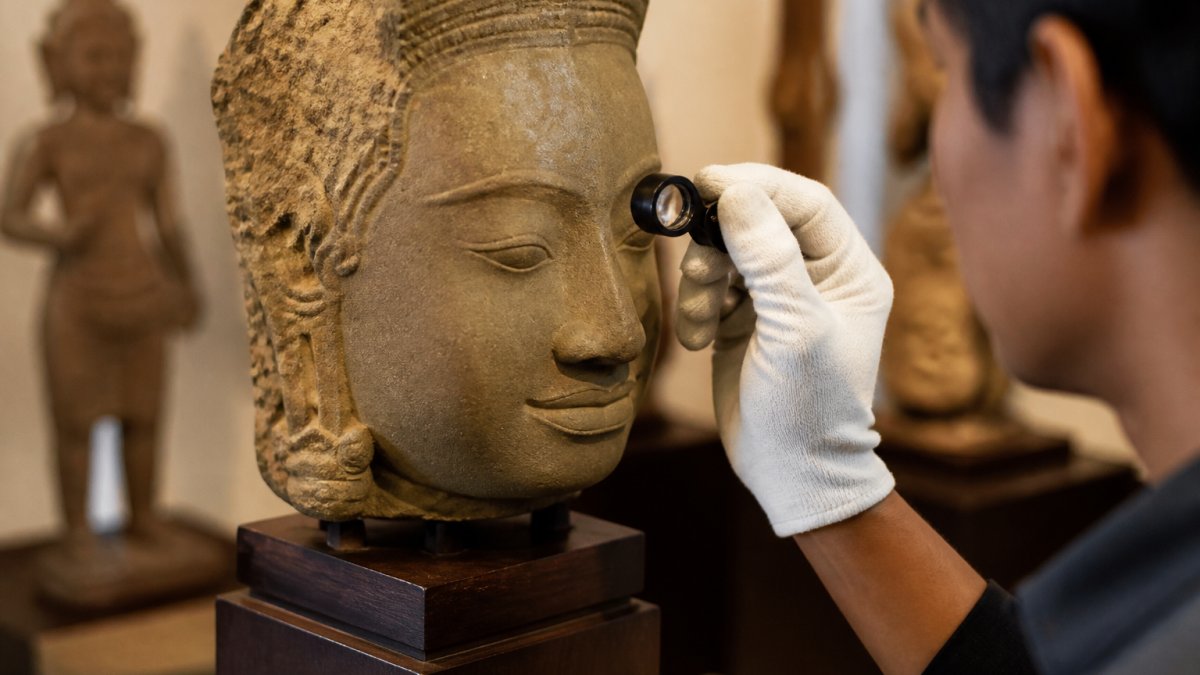
Style Period, Iconography, and Rarity
The Khmer Empire produced distinct style periods, from the 9th-century Kulen style through the 12th-century Angkor Wat period. Each period has its own facial proportions, ornamentation, and iconography.
Rarity works on two levels. Fewer surviving examples of a style period raise value. So does an unusual subject within that period.
- Style period: earlier or transitional work often commands more
- Iconography: rare deities or poses outperform common ones
- Rarity: fewer comparable pieces means less price competition
Condition, Craftsmanship, and Material
Condition matters more than most buyers expect. Stone weathering, cracks, and repairs all affect market value. So does the quality of the original carving.
Look at facial detail, hand positions, and the finish of the stone. Strong technical execution holds value. Crude work doesn't, no matter how old it is.
Khmer Art Provenance: What Verifiable Ownership Looks Like
Khmer art provenance is the documented ownership history of a piece, from its origin to the present day. Without it, you're buying on trust, not evidence. The mechanics matter most: how to verify a chain, what a gap costs you, and how U.S. law treats the risk.
What Counts as Verifiable Provenance
A defensible chain usually includes several of these, ideally overlapping:
- Auction records with house name, lot number, sale date, and hammer result
- Dealer or gallery invoices that name the piece and the parties
- Export permits or customs entries from the country of origin
A vague claim of "old family collection" is not provenance. Real provenance is paper you can check, and the strongest chains have at least two independent corroborating sources.
How to Actually Verify a Chain
Work backward from the present: ask for the most recent transaction, request the document behind it, then repeat. Each hop should produce a name, a date, and a document.
Cross-check what you're given:
- Call the auction house and confirm the lot number and result
- Search the catalog archive for the plate and description
- Check the dealer's name against state business registries
A chain with one clean, documented mid-century auction appearance is worth more than three vague dealer letters: auction records are public and hard to fabricate; private letters are neither.
The Legal Layer U.S. Buyers Must Understand
Two frameworks matter most for Khmer material entering the United States:
- The 1970 UNESCO Convention on the Means of Prohibiting and Preventing the Illicit Import, Export and Transfer of Ownership of Cultural Property, which the United States implemented through the Convention on Cultural Property Implementation Act (CPIA). The CPIA allows the U.S. to enter bilateral agreements with source countries restricting import of specified categories of archaeological and ethnological material.
- The National Stolen Property Act, which U.S. courts have applied to cultural property that a foreign nation has declared state-owned and that was removed without authorization.
In practice, a Khmer piece without documented export authorization from the source country carries real seizure and forfeiture risk, not just reputational risk. U.S. Customs and Border Protection can detain shipments, and the Department of Justice has pursued civil forfeiture in cultural-property cases.
Pricing the Risk of a Gap
A provenance gap is not binary. Treat it as a discount:
- Clean chain with auction records: full market comparables apply
- Chain with one documented mid-century appearance: small discount, often within normal negotiation range
- Chain with only dealer letters: meaningful discount, and expect resale friction
The discount exists because the next buyer will ask the same questions you did. If you can't answer them, you're the end of the line.
A Due-Diligence Checklist Before Money Moves
- Request the full document set in writing, not summaries
- Independently confirm every auction record cited
- Confirm export authorization from the source country, or a documented pre-1970 removal
- Run the piece against the Art Loss Register and the FBI National Stolen Art File
- Have counsel review the chain if the price is material to your portfolio
- Keep copies of everything, provenance is an asset you pass to the next buyer
Provenance is not paperwork for its own sake. It is the mechanism that converts a beautiful object into a transferable asset.
Ancient Artifact or Contemporary Khmer-Style Work?
Distinguishing ancient artifacts from contemporary Khmer-style works is the first question any serious buyer should ask. The two markets behave very differently.
Ancient pieces carry heritage value, stricter legal rules, and thinner supply. Contemporary Khmer-style works offer craftsmanship without the legal exposure, and they're easier to source and insure.
Here's how to tell them apart:
| Signal | Ancient Artifact | Contemporary Khmer-Style Work |
|---|---|---|
| Surface wear | Deep, uneven patina | Even finish, minimal wear |
| Tool marks | Hand-chiseled, irregular | Consistent, sometimes machine-cut |
| Documentation | Export and ownership papers | Maker or gallery records |
| Price band | Higher, less predictable | More stable, easier to compare |
| Legal risk | High without permits | Low |
Neither is automatically the better buy. What matters is that you know which one you're looking at, and pay accordingly.
Art Investment Risks Every Khmer Buyer Should Weigh
Art investment risks in this category are real and often understated. Broad market figures don't tell you how a specific Khmer piece will perform. The reported annualized gain for evening-sale works was 4.4% in 2025, down from 5.3% in 2024, according to Merrill Lynch's 2026 U.S. Art Market Report. Those numbers describe the top end of the market, not Khmer stone.
Liquidity: The Real Constraint
Khmer-style art can take months or years to resell. There is no daily price index, and comparable sales are thin, so your holding period is set by the market's appetite for the specific style period, subject, and condition of your piece.
A common pattern among collectors:
- Common subjects in mainstream condition: resale window of 6 to 18 months through a specialist dealer
- Rare subjects with clean provenance: resale window of 12 to 36 months, often through auction
- Pieces with provenance gaps or heavy restoration: effectively illiquid outside a deep-discount private sale
Plan your exit before you buy, and assume the longer end of the range.
Comparable Sales: How to Build Khmer-Specific Evidence
Asking prices are wishes. Comparable sales are evidence. Build your own comp set:
- Pull auction results for the same style period from the major houses' online archives
- Filter to pieces within roughly 30% of your target's size and within the same subject category
- Note the sale date, hammer price, buyer's premium, and whether the lot sold or was bought in
- Adjust for condition, provenance strength, and restoration history
- Weight recent sales more heavily than older ones
A piece that sold at a strong house with clean provenance sets a ceiling; one that failed to sell sets a warning. Both are data.
Total Ownership Costs: The Math Most Guides Skip
Your net return is sale proceeds minus every cost of ownership. The main line items:
- Buyer's premium at auction, typically a tiered percentage of the hammer price
- Shipping and professional packing for stone, which is heavy and fragile
- Insurance, commonly quoted as an annual percentage of declared value
A simple model: take your expected sale price, subtract the seller's commission and resale fees, then subtract cumulative insurance, conservation, and storage costs over your hold period. Subtract your purchase price and buyer's premium to get net profit, then divide by total capital outlay, including carrying costs, for a true annualized return. Most collectors who run this math find a piece needs to appreciate meaningfully just to break even after a decade of ownership costs.
Transparency and Valuation Variance
Valuation standards vary, and two appraisers can land on very different numbers, widest for pieces with unusual iconography, uncertain style-period attribution, or incomplete provenance. When you commission an appraisal, ask for the assumptions behind the number and the range the appraiser considers defensible. A single point estimate without a range is a red flag.
Concentration and Style-Period Risk
Khmer art is not one market. The Kulen, Preah Ko, Bakheng, Koh Ker, Baphuon, and Angkor Wat styles each have their own collector base, supply, and price behavior, and a piece in a thinly collected style can sit for years even when the broader category is healthy. Diversify across style periods if you hold more than one piece.
A Risk Scorecard
Before committing capital, score the piece on each dimension:
- Provenance strength: clean chain, partial chain, or none
- Legal exposure: documented export authorization, pre-1970 removal, or unknown
- Condition: original, minor restoration, or heavy restoration
Any piece scoring poorly on two or more dimensions should be priced at a significant discount or passed on. The scorecard is not a formula but a discipline that keeps you from talking yourself into a purchase the market will not reward.
Fitting Khmer Art Into an Art Investment Portfolio
Khmer-style art belongs in the alternative-asset slice of a portfolio, not the core: small allocation, long horizon, clear purpose.
A practical split for most collectors:
- Core holdings: stocks and fixed income securities
- Satellite holdings: art, including Khmer pieces
- Allocation: keep art under 10% of total investable assets
The fine art market rewards patience. Buyers who need quick liquidity usually sell at a loss. Buyers who hold quality pieces with clean provenance tend to do better.
A Step-by-Step Framework for Evaluating Khmer-Style Art
Use this framework before any purchase.
Step 1: Confirm what you're buying. Ancient artifact or contemporary work?
Step 2: Document provenance. Request auction records, invoices, and export permits.
Step 3: Assess condition. Look for cracks, repairs, and over-restoration.
Step 5: Benchmark price. Compare against real comparable sales, not asking prices.
This framework won't guarantee a profit.
Frequently Asked Questions
What factors affect the value of Khmer-style art?
Value rests on several connected factors: style period and iconography, rarity within that period, condition, craftsmanship, material, and documented provenance. Market context matters too. Global art sales were an estimated USD 57.5 billion in 2024, down 12% year over year, according to Art Basel and UBS, while works under USD 50,000 made up 61% of lots sold in 2025 per Bank of America Private Bank. No Khmer-specific price index exists, so each piece must be judged on its own evidence.
How can you assess the investment potential of a Khmer-style sculpture?
Start with verified Khmer art provenance, then commission an independent appraisal from a specialist in Southeast Asian art. Compare the work against documented comparable sales rather than broad market averages. Note that evening-sale works posted a 4.4% annualized gain in 2025, down from 5.3% in 2024, per Merrill Lynch, and that figure covers the general market, not Khmer-style art. Treat any projection as a scenario, not a promise.
How does an antique Khmer-style sculpture differ from a contemporary piece as an investment?
Antique pieces carry heritage value and scarcity but also conservation needs and legal scrutiny. Contemporary Khmer-style works offer lower entry costs, cleaner documentation, and easier replacement, though they rarely appreciate the same way. The Cambodia art and sculpture market was estimated at USD 244 million in 2025 and projected to reach USD 321 million by 2032 at a 4.0% CAGR, per Wresearch. Neither category guarantees returns; each suits a different time horizon.
The hardest part of collecting Khmer-style art isn't finding a beautiful piece. It's finding one with documented provenance, honest condition reporting, and craftsmanship that holds up in person. That's where HD Asian Art comes in. We curate Buddhist and Hindu statues alongside Khmer and Southeast Asian sculptures, with handpicked antique and contemporary pieces and free shipping on every order. Browse HD Asian Art and find a piece that earns its place in your collection and your portfolio.
