



Caractéristiques de l'art bouddhiste sri lankais : guide du chercheur
Caractéristiques de l'art bouddhiste sri lankais : guide du chercheur
L'art bouddhiste sri-lankais est défini comme une expression régionale distincte de la culture visuelle bouddhiste Theravada, produite sur deux millénaires à travers des sculptures monumentales, des peintures murales rupestres et l'architecture des stupas. La tradition s'étend sur des sites emblématiques, notamment Anuradhapura, Polonnaruwa, le temple de la grotte de Dambulla et les hauts plateaux de Kandyan.
Ses œuvres déterminantes, du Bouddha Avukana aux reliefs en granit Gal Vihara, synthétisent les influences indiennes Amaravati et Gupta avec une esthétique cinghalaise locale qu'aucune autre tradition bouddhiste ne reproduit. Comprendre les caractéristiques de l’art bouddhiste sri lankais signifie lire à la fois l’intention spirituelle et la maîtrise technique derrière chaque forme.
1. Quels sont les styles de sculpture distinctifs de l’art bouddhiste srilankais ?
Les sculptures bouddhistes sri lankaises se définissent par une échelle monumentale, le granit comme support principal et un vocabulaire iconographique précis enraciné dans la doctrine Theravada. La tradition privilégie les sculptures en haut-relief plutôt que les formes autonomes, produisant des images qui émergent de la roche vivante plutôt que de s'en détacher.
Le Statue de Bouddha Avukana est l’exemple le plus clair de ces caractéristiques. D'une hauteur de plus de 14 mètres et sculptée entre le Ve et le VIIIe siècle de notre ère, elle présente le mudra Asisa, une variante sri lankaise du mudra Abhaya qui exprime le réconfort et la protection propres à la tradition iconographique de l'île. Le traitement de la robe plissée et les proportions allongées reflètent les influences des écoles Amaravati et Gupta absorbées et localisées par les artisans cingalais.
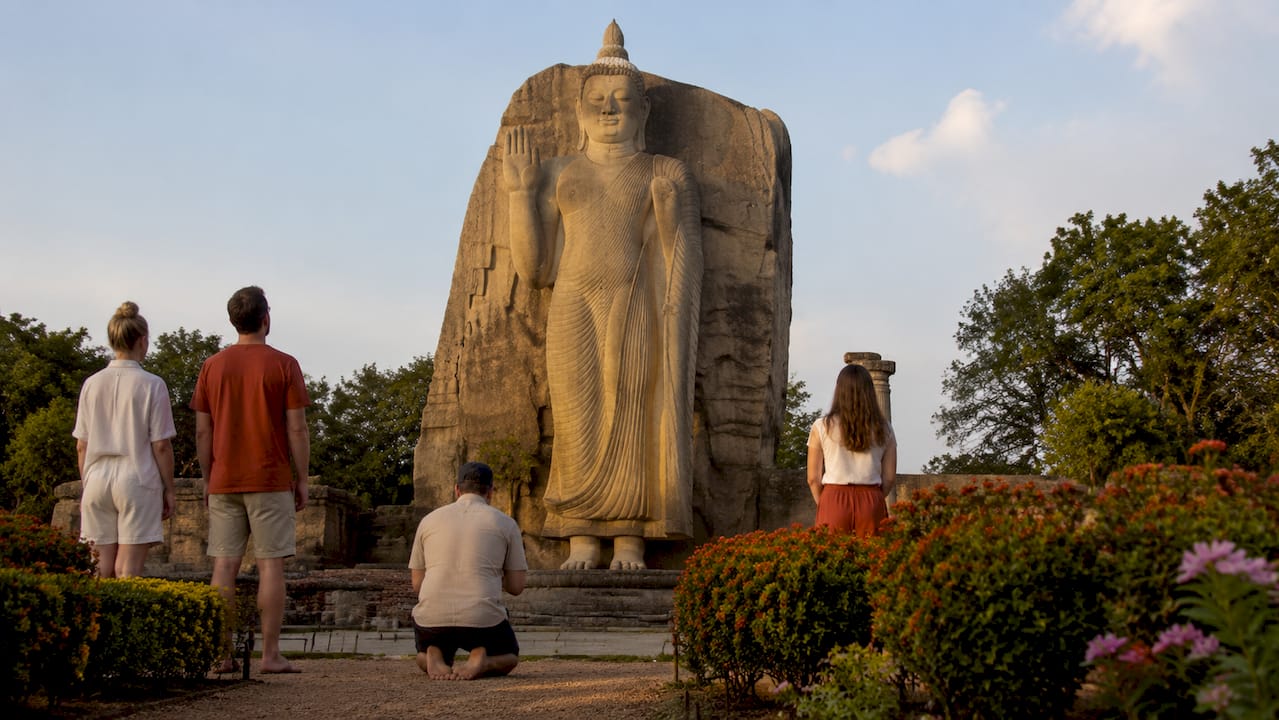
Le Gal Vihara Le complexe, construit sous le roi Parakramabahu I au 12ème siècle de notre ère, représente le style sculptural cingalais mature. Ses quatre images taillées dans la roche comprennent un Bouddha assis en méditation, une figure debout de plus de 7 mètres de haut et une image colossale de parinirvana allongé s'étendant sur 15 mètres. Les compositions démontrent une planification spatiale contrôlée et une compréhension raffinée des proportions qui distinguent le travail srilankais de ses homologues du sud de l'Inde.
Les principales caractéristiques sculpturales comprennent :
- Matériel: Le granit et le calcaire dominent, avec quelques coulées de bronze dans les périodes ultérieures
- Échelle : Personnages monumentaux destinés à la vénération communautaire et non à la dévotion privée
- Mudras : La variante Asisa d'Abhaya mudra apparaît fréquemment et est spécifique à Sri Lanka
- Draperie : Robes fines et collantes avec des plis incisés dérivés du modelage Gupta
- Type de visage : Caractéristiques sereines et idéalisées avec des lobes d'oreilles allongés et une saillie crânienne ushnisha
Conseil de pro : Lorsque vous examinez les sculptures bouddhistes sri lankaises, concentrez-vous d’abord sur le geste de la main. L'Asisa mudra, avec la paume levée et les doigts étendus vers le haut, identifie une pièce comme étant d'origine distinctement sri lankaise plutôt que sud-indienne ou asiatique du sud-est.
2. Comment les peintures murales et les fresques reflètent-elles les styles de peinture bouddhiste Sri Lanka?
La peinture bouddhiste sri lankaise se définit par une clarté narrative, une composition rythmique contrôlée et un vocabulaire symbolique de couleurs dérivé de pigments minéraux naturels. Le but premier des peintures murales des temples était didactique. Premier art bouddhiste sri-lankais était collectif et fonctionnel, axé sur la communication des contes Jataka aux fidèles plutôt que sur l'expression de l'identité artistique individuelle.
Le temple de la grotte de Dambulla abrite le groupe de peintures murales bouddhistes le plus important conservé au monde. Sri Lanka. Ses cinq sanctuaires rupestres contiennent Peintures murales kandyennes du XVIIIe siècle qui recouvrent les murs et les plafonds de scènes de la vie du Bouddha et des histoires de naissance des Jataka. La période Kandyan, qui s'étend de 1592 à 1815, a produit un style mural caractérisé par des figures plates et stylisées disposées en registres horizontaux avec des bordures florales séparant les épisodes narratifs.
Trois caractéristiques déterminantes de la peinture murale kandyenne :
- Approvisionnement en pigments : Les artistes ont utilisé de l'ocre, de l'oxyde de fer rouge, du noir de fumée et de la chaux blanche dérivée de minéraux locaux. Ces pigments produisent la palette chaude et terreuse qui identifie le travail kandyen.
- Conventions des figures : Les figures humaines apparaissent de trois quarts avec de grands yeux, des cheveux stylisés et des vêtements à motifs. Le Bouddha est toujours représenté plus grand que les figures environnantes pour signaler la hiérarchie spirituelle.
- Motifs de bordure : Des fleurs de lotus, des motifs de plantes grimpantes et des bandes géométriques encadrent des panneaux narratifs. Ces motifs ont une signification symbolique, le lotus représentant la pureté et l'illumination.
Les fresques de Sigiriya, datant du 5ème siècle de notre ère, sont antérieures au style Kandyan et montrent une approche plus naturaliste. Les figures de Sigiriya présentent des ombres, du volume et une richesse sensorielle absentes des compositions kandyennes ultérieures et plus formalisées. La comparaison des deux groupes révèle comment les styles de peinture bouddhiste sri-lankais ont évolué du naturalisme vers l'abstraction symbolique sur une période de mille ans.
Conseil de pro : À Dambulla, regardez les peintures murales du plafond plutôt que les panneaux muraux. Les compositions du plafond sont plus complexes et mieux conservées, montrant toute la gamme de la planification compositionnelle kandyenne.
3. Quelles caractéristiques architecturales distinguent les sites religieux bouddhistes du Sri Lanka ?
L'architecture bouddhiste sri-lankaise est définie par des formes de stupa, des monastères taillés dans la roche et des salles de réunion à piliers qui constituent ensemble l'une des traditions de construction monastique les plus variées d'Asie. Plus de 25 styles distincts de monastères développé au cours de deux millénaires de construction sur des sites allant d'Anuradhapura à Polonnaruwa.
Le stupa est la forme architecturale centrale. Les stupas sri lankais ont développé quatre formes principales au fil du temps :
| Forme du stupa | Descriptif | Exemple clé |
|---|---|---|
| Tas de riz | Forme de monticule arrondi, type le plus ancien, enraciné dans le symbolisme agraire | Jetavanaramaya, Anuradhapura |
| Bulle | Dôme hémisphérique avec une conicité minimale | Ruwanwelisaya, Anuradhapura |
| Pot | Base plus large se rétrécissant vers un tambour plus étroit | Variantes régionales à travers l'île |
| Cloche | Profil haut et effilé avec flèche prononcée | Thuparama, Anuradhapura |
Le stupa Jetavanaramaya d'Anuradhapura atteignait 122 mètres de hauteur, ce qui en faisait la troisième plus haute structure du monde antique. Cette échelle nécessitait des solutions d'ingénierie, notamment un noyau en briques cuites avec un remplissage de moellons, qui placent la construction sri lankaise parmi les plus avancées techniquement de l'ère pré-moderne.
L'architecture à piliers montre une sophistication égale. Les piliers en tiges de lotus du Nissanka Latha Mandapaya à Polonnaruwa sont sculptés pour ressembler à des tiges de lotus groupées, avec des chapiteaux en forme de fleurs ouvertes. Ce détail démontre que les constructeurs de temples sri-lankais ont traité les éléments structurels comme des opportunités sculpturales et non comme de simples supports fonctionnels.
4. Quelles influences externes et adaptations locales façonnent l’art bouddhiste sri lankais ?
L’art bouddhiste sri-lankais est le produit d’une synthèse documentée entre les écoles artistiques indiennes et les valeurs esthétiques indigènes cinghalaises. L'école Amaravati du Sud Indie, actif à partir du IIe siècle avant notre ère, a fourni la grammaire fondamentale des types de figures, de la composition narrative en relief et de la décoration du stupa. L'école Gupta, dominante dans le Nord Indie du 4ème au 6ème siècle de notre ère, a contribué au type de visage idéalisé, à la convention des drapés collants et à l'accent mis sur l'expression spirituelle sereine.
Les artistes sri lankais ont absorbé les deux traditions et ont produit quelque chose de distinct. Les sculptures de Gal Vihara montrent les proportions de Gupta appliquées à une échelle et dans une paroi rocheuse de granit moyenne, que les ateliers de Gupta n'ont jamais tentées. Le résultat est une gravité monumentale que les originaux indiens ne possèdent pas.
La période coloniale a introduit le réalisme occidental dans la culture visuelle sri-lankaise. La présence britannique et néerlandaise à partir du XVIe siècle a apporté les conventions de la peinture à l'huile, du dessin en perspective et du portrait. Les artistes sri lankais ont négocié ces importations contre leurs propres traditions iconographiques plutôt que de simplement remplacer l'une par l'autre.
Georges Keyt (1901-1993) représente l’exemple le plus significatif de cette négociation. Keyt a intégré la fragmentation cubiste et les plans d'images aplatis avec l'iconographie bouddhiste et les types de figures cinghalaises. Ses peintures se lisent à la fois comme des compositions modernistes et comme des extensions de la tradition murale kandyenne.
« L’art srilankais négocie continuellement l’identité entre le patrimoine culturel local et les mouvements artistiques mondiaux, garantissant ainsi que la tradition reste dynamique et pertinente. » — artinscapes.com
La persistance du motif du lotus, de la structure narrative Jataka et du type idéalisé de Bouddha à travers toutes ces périodes de contacts extérieurs confirme que les artistes sri lankais traitaient les influences étrangères comme une matière première et non comme des substituts à leur propre tradition.
5. Comment les caractéristiques de l’art bouddhiste sri-lankais perdurent-elles dans les pratiques contemporaines ?
L’art bouddhiste sri-lankais contemporain conserve les caractéristiques fondamentales de la tradition tout en élargissant sa gamme formelle. La longue tradition de l'art bouddhiste en Sri Lanka concerne autant la mémoire communautaire et la fonction spirituelle que l’esthétique visuelle, et cette orientation persiste dans la pratique actuelle.
Plusieurs modèles définissent l'engagement contemporain avec l'art bouddhiste traditionnel dans Sri Lanka:
- La préservation comme participation : Les communautés de temples de Dambulla et d'autres sites traitent les ajouts ultérieurs de Kandyan comme une histoire spirituelle intégrale plutôt que comme une interférence esthétique. Les nouvelles peintures murales sont ajoutées à côté des couches plus anciennes, et non par-dessus.
- Continuité iconographique : Les peintres religieux contemporains continuent d'utiliser les conventions des figures kandyennes, le système de bordure de lotus et le système d'échelle hiérarchique qui place le Bouddha au-dessus de toutes les autres figures.
- Paternité individuelle : Les artistes sri-lankais modernes signent de plus en plus leurs œuvres et exposent à l’international, s’éloignant ainsi de la production collective anonyme de l’art des temples. Ce changement reflète les normes du marché de l’art mondial sans abandonner les sujets bouddhistes.
- Expérimentation matérielle : Les artistes travaillent désormais avec l'acrylique, les médias numériques et les matériaux mixtes tout en conservant le vocabulaire symbolique des styles de peinture bouddhistes traditionnels. Sri Lanka.
- Documentation académique : Les universités sri lankaises et les institutions internationales cataloguent et étudient désormais systématiquement l’art bouddhiste de l’île, créant ainsi un cadre scientifique qui soutient à la fois la préservation et la réinterprétation.
Le résultat est une tradition qui reste clairement sri lankaise dans ses priorités iconographiques tout en absorbant les possibilités formelles et matérielles du 21e siècle. Pour les collectionneurs et les érudits, cette continuité fait de l’art bouddhiste sri-lankais l’une des traditions vivantes les plus traçables de l’histoire de l’art asiatique.
Points clés à retenir
L'art bouddhiste sri lankais se définit par des sculptures monumentales en granit, des peintures murales narratives de Kandyan et une architecture de stupa qui synthétisent les influences indiennes Amaravati et Gupta avec une identité visuelle cinghalaise distincte soutenue sur deux millénaires.
| Point | Détails |
|---|---|
| Identité de la sculpture | Le mudra Asisa et les hauts-reliefs en granit distinguent les sculptures bouddhistes sri lankaises de tous leurs voisins régionaux. |
| Tradition murale | Les peintures murales de Kandyan utilisent des pigments minéraux naturels, une échelle de figures hiérarchiques et des récits Jataka comme caractéristiques déterminantes. |
| Échelle architecturale | Les stupas comme Jetavanaramaya comptent parmi les plus grandes structures en briques pré-modernes, avec quatre types de formes distincts uniques à Sri Lanka. |
| Modèle de synthèse | Les artistes sri lankais ont absorbé les influences d'Amaravati et de Gupta et ont produit des formes, comme Gal Vihara, qui dépassent leurs sources indiennes en termes d'échelle et de gravité. |
| Tradition vivante | L'art bouddhiste sri-lankais contemporain maintient une continuité iconographique tout en incorporant la paternité individuelle et de nouveaux matériaux. |
Ce que je trouve le plus négligé dans l'art bouddhiste sri lankais
La plupart des études sur l'art bouddhiste traitent Sri Lanka comme une note de bas de page aux traditions indiennes ou asiatiques du Sud-Est. Ce cadrage passe complètement à côté de l’essentiel.
Ce qui me frappe le plus, après des années de manipulation et de recherche d'œuvres chez HDAsianArt, c'est l'ambition technique derrière l'intention spirituelle. Le stupa Jetavanaramaya n’était pas seulement un monument religieux. C'était un argument structurel. Construire 122 mètres de haut en briques cuites, sans armature en acier ni outils de topographie modernes, nécessitait des connaissances institutionnelles, une planification à long terme et une main-d'œuvre organisée autour d'un objectif commun que la plupart des sociétés anciennes n'ont jamais atteint.
La même logique s'applique au Gal Vihara. Sculpter quatre figures monumentales à partir d'une seule face de granit, en conservant des proportions cohérentes entre une figure allongée de 15 mètres de long et une figure debout de plus de 7 mètres de haut, est un exploit de calcul spatial que les sculpteurs modernes trouveraient exigeant. Les artisans cingalais qui l'ont exécuté n'ont laissé aucune trace écrite de leurs méthodes. L'œuvre elle-même est la documentation.
Je pense également que la tradition murale kandyenne est sous-estimée par rapport à ses homologues indiennes. Les grottes d'Ajanta attirent beaucoup plus l'attention des chercheurs, mais les compositions de Dambulla montrent une compréhension tout aussi sophistiquée de la séquence narrative et de la couleur symbolique. La différence réside en partie dans l’accessibilité et en partie dans les canons persistants de l’histoire de l’art. Indie-centrisme.
Pour les collectionneurs, les implications pratiques sont claires. Les œuvres d'art bouddhistes sri lankaises, qu'elles soient en bronze, en pierre ou en bois, possèdent une profondeur de spécificité iconographique qui récompense une étude approfondie. Une pièce qui ressemble à un Bouddha debout générique s'avère souvent, après examen, porter l'Asisa mudra, la robe plissée Gupta, et des proportions qui la placent fermement dans la tradition cingalaise. C’est cette spécificité qui fait que ces œuvres méritent d’être acquises et préservées. Vous pouvez explorer le art et symbolisme derrière les statues de Bouddha du Sri Lanka pour développer cet œil avant d'acheter.
— Jacques, HDAsianArt.com
Explorez l'art bouddhiste sri-lankais authentique à HDAsianArt
HDAsianArt propose une sélection de statues et de sculptures bouddhistes anciennes et traditionnelles, y compris des pièces de Sri Lanka, Cambodge, Thaïlande, et au-delà. Chaque œuvre est étudiée et décrite individuellement par des spécialistes ayant une connaissance directe des traditions iconographiques, de l'histoire matérielle et des conventions stylistiques régionales.
Pour les collectionneurs et les universitaires qui souhaitent s'intéresser directement aux caractéristiques de l'art sri lankais, la collection HDAsianArt propose des pièces de qualité muséale avec une documentation complète, une expédition DHL assurée dans le monde entier et un soutien d'experts. Parcourez l'intégralité Collection de statues bouddhistes pour trouver des œuvres qui reflètent les traditions sculpturales et iconographiques abordées dans cet article.
FAQ
Qu’est-ce qui définit l’art bouddhiste srilankais par rapport à l’art bouddhiste indien ?
L'art bouddhiste sri-lankais se définit par son utilisation du granit comme support sculptural principal, la variante Asisa mudra spécifique à l'île et une tradition murale enracinée dans les conventions de composition de Kandyan. L'art bouddhiste indien, en particulier les écoles Gupta et Amaravati, a fourni des influences fondamentales que les artistes sri lankais ont absorbées et transformées en un style régional clairement distinct.
Qu'est-ce que l'Asisa mudra dans les sculptures bouddhistes sri lankaises ?
L'Asisa mudra est une variante sri lankaise de l'Abhaya mudra, avec la paume levée et les doigts tendus vers le haut pour exprimer réconfort et protection. Il apparaît en bonne place dans la statue du Bouddha Avukana et est spécifique à la tradition iconographique sri-lankaise.
Quelles sont les principales formes de stupa dans l’architecture bouddhiste srilankaise ?
Les stupas sri lankais ont développé quatre formes principales : le tas de riz, la bulle, le pot et la cloche. Le Jetavanaramaya d'Anuradhapura, construit sous forme de tas de riz, atteignait 122 mètres et se classait comme la troisième plus haute structure du monde antique.
Quel âge ont les peintures murales du temple de la grotte de Dambulla ?
Le principal cycle mural de Dambulla date de la période Kandyan du XVIIIe siècle, s'étendant de 1592 à 1815. Le site contient également des couches antérieures, et les pratiques de préservation à Dambulla traitent tous les ajouts historiques comme faisant partie du registre spirituel continu du site.
Qui est George Keyt et pourquoi est-il important pour l’art bouddhiste sri-lankais ?
George Keyt (1901-1993) était un peintre sri-lankais qui a intégré les principes formels cubistes à l'iconographie bouddhiste et aux types de figures cinghalaises. Son travail représente l'exemple le plus documenté de la manière dont les artistes sri lankais ont absorbé les mouvements artistiques mondiaux tout en conservant les priorités iconographiques de leur propre tradition.
Recommandé
- Les statues de Bouddha sri lankaises expliquées : art et symbolisme – HD Asian Art
- Sculpture de la période de Sukhothai : Guide d’histoire de l’art d’un érudit – HD Asian Art
- La sculpture bouddhiste Theravada expliquée aux chercheurs en art – HD Asian Art
- Tradition artistique du bouddhisme Mahayana : un guide visuel – HD Asian Art
