



Signes d'une fonte du bronze de haute qualité : guide du collectionneur
Signes d'une fonte du bronze de haute qualité : guide du collectionneur
Table des matières
Comprendre les signes d’une coulée de bronze de haute qualité
Le bronze de haute qualité se révèle à travers ses caractéristiques physiques, ses techniques de fabrication et la composition des matériaux. La différence entre un chef-d’œuvre et un casting médiocre réside dans la précision : un bronze alliage correctement mélangé, versé à la bonne température et refroidi progressivement, il affiche des caractéristiques qu'aucun raccourci ne peut reproduire.
Ce guide couvre les marqueurs techniques qui distinguent les pièces moulées en bronze exceptionnelles des pièces ordinaires : répartition du poids, finition de surface, son de résonance, authenticité de la patine et documentation de la fonderie.
Pourquoi la qualité du bronze est importante pour les collectionneurs
Votre investissement dans une sculpture en bronze dépend entièrement du savoir-faire, de la pureté des matériaux et de la précision de fabrication. Un bronze mal coulé peut se fissurer ou perdre son intégrité structurelle en quelques années. Un moulage à la cire perdue correctement exécuté peut durer des siècles avec une dégradation minimale.
Comprendre la qualité vous évite également de payer trop cher pour des répliques. De nombreux fabricants contemporains utilisent le moulage au sable ou le moulage par rotation pour produire des copies peu coûteuses qui imitent les moindres détails mais n'ont pas la cohérence interne du moulage à modèle perdu.
Le rôle de la composition de l’alliage de bronze
Le bronze traditionnel contient 88 % de cuivre et 12 % d'étain, créant un alliage avec des propriétés de moulage supérieures et un développement naturel de patine. Lorsque vous tenez un bronze de haute qualité, le poids semble substantiel et équilibré. Les alliages de qualité inférieure semblent souvent plus légers que prévu, ce qui indique soit des parois plus minces, soit des substituts métalliques moins chers comme le régule (alliage zinc-plomb) ou l'aluminium.
Qualité de fonderie à la cire perdue : le fondement de l’excellence
Le processus de moulage à la cire perdue, également appelé moulage de précision, reste la référence en matière de sculpture fine en bronze, car il préserve les détails fins tout en créant des pièces structurellement solides. Un artiste crée un modèle en cire détaillé, l'entoure d'un matériau de revêtement (coque en céramique) et chauffe le moule pour brûler la cire. Le bronze en fusion est ensuite coulé dans la cavité, capturant chaque nuance de la sculpture originale.
Comment le moulage à la cire perdue préserve les détails fins
Le matériau de revêtement utilisé dans le moulage à la cire perdue capture la texture de surface microscopique avec une précision extraordinaire. Sous grossissement, un bronze à la cire perdue présente des bords nets, une définition nette des traits du visage et des détails fins dans les plis du tissu ou les éléments décoratifs. Cette netteté est physiquement impossible à obtenir par moulage au sable.
La préservation des détails fins dépend de la température de coulée et de la vitesse de refroidissement. Un maître fondeur contrôle avec précision la vitesse de refroidissement, ce qui donne lieu à des surfaces qui révèlent toutes les intentions du sculpteur original. Lorsque vous examinez un bronze, faites attention aux détails les plus fins : doigts, traits du visage, motifs textiles, bordures décoratives. Si ceux-ci semblent mous, arrondis ou manquent de bords nets, le moulage a probablement été créé par moulage au sable.
Moulage de précision ou moulage en sable : implications en matière de qualité
Le moulage au sable utilise un moule fabriqué à partir de sable compacté, permettant une production plus rapide et des coûts réduits, mais ne peut pas capturer les détails les plus fins. Les grains de sable créent une finition de surface naturellement rugueuse et le processus introduit des lignes de moule, des irrégularités de surface et une porosité nécessitant une finition manuelle approfondie.
Le moulage de précision produit des résultats supérieurs car la coque en céramique est beaucoup plus fine que le sable, permettant une capture des détails plus nette et réduisant la porosité. Vous pouvez identifier les bronzes coulés au sable en examinant la finition de la surface : joints de coulée visibles, texture rugueuse même après la finition et lignes de moulage sur la surface. Les bronzes moulés à investissement présentent des coutures minimales, une finition de surface uniforme et des détails nets partout.
| Méthode de coulée | Finition de surface | Netteté des détails | Risque de porosité | Temps de production |
|---|---|---|---|---|
| Cire perdue (Investissement) | Lisse, uniforme | Bords nets et nets | Faible | 4-8 semaines |
| Moulage au sable | Rugueux, granuleux | Bords doux et arrondis | Élevé | 1-2 semaines |
| Lancer par rotation | Mince, inégal | Détail variable | Très élevé | 2-3 jours |
Caractéristiques physiques qui révèlent la qualité
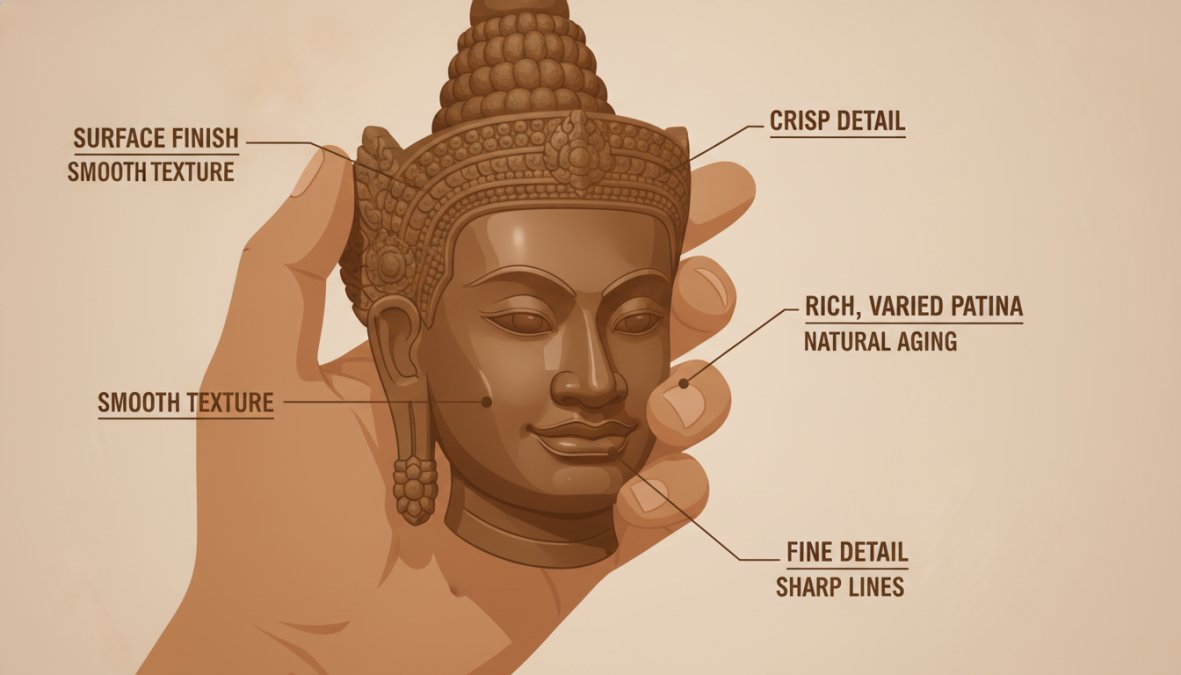
Dès que vous tenez un bronze de haute qualité, vos mains vous disent que quelque chose est différent. La répartition du poids semble équilibrée, la texture de la surface varie de manière appropriée et la présence globale retient l'attention.
Poids et densité du métal comme indicateurs de qualité
Une sculpture en bronze coulée dans un alliage de bronze approprié sera nettement plus lourde qu'une réplique en régule ou en aluminium. Une statue en bronze de 12 pouces devrait peser entre 8 et 15 livres selon l'épaisseur du mur et la structure interne. Une réplique en régule de taille similaire pèse généralement entre 3 et 5 livres.
La répartition du poids au sein d'une sculpture révèle également la qualité. Dans un bronze bien coulé, le métal est réparti intelligemment, plus épais dans les zones nécessitant un support structurel, plus fin dans les sections délicates. Lorsque vous soulevez la pièce, elle semble équilibrée et stable.
:::pro Lorsque vous évaluez un bronze lors d'une galerie ou d'une vente immobilière, prenez-le toujours et ressentez son poids. Les bronzes authentiques ont un poids substantiel et confiant qui leur convient. Les répliques semblent souvent étonnamment légères. :::
Finition de surface et détails finis à la main
La finition de surface d'un bronze de haute qualité présente des variations de texture, des zones polies alternant avec des sections naturellement sombres et des marques faites à la main qui révèlent la touche de l'artisan.
La chasse manuelle implique l'utilisation d'outils spécialisés pour affiner les détails de la surface après la coulée. Un maître ciseleur travaille méthodiquement sur la sculpture, aiguisant les bords, approfondissant les lignes de définition et créant des variations de texture intentionnelles. Lorsque vous examinez de près un bronze de haute qualité, vous verrez des preuves de ce travail de finition à la main. Les traits du visage montrent une modélisation subtile au-delà de ce que possédait la sculpture originale. Les plis du tissu affichent une définition raffinée.
Tests de son de résonance et d’intégrité structurelle
Faites sonner doucement un bronze de haute qualité avec un maillet doux et vous entendrez un son clair et soutenu qui sonnera pendant plusieurs secondes. Cette résonance indique une densité métallique appropriée, une absence de porosité significative et une intégrité structurelle dans toute la pièce. Un bronze présentant une porosité interne ou des défauts de coulée produit un bruit sourd qui meurt rapidement.
Identifier les défauts et les défauts de moulage
Chaque moulage contient quelques défauts mineurs. Ce qui distingue la qualité, c'est que les défauts sont minimes, correctement réparés et ne compromettent jamais l'intégrité structurelle.
Problèmes de lignes de moule, de retrait et de porosité
Des coutures de coulée (lignes de moule) apparaissent à l'endroit où deux sections du moule d'investissement se rencontrent. Sur les bronzes de haute qualité, ces coutures sont minimes et soigneusement finies. Le retrait se produit lorsque le bronze fondu refroidit et se contracte. Un bronze correctement coulé présente un retrait minime, généralement dans les zones où il est moins visible.
La porosité, de minuscules poches d'air emprisonnées dans le métal, représente le défaut de coulée le plus grave. La porosité de la surface apparaît sous forme de petits trous ou piqûres. Lorsque vous examinez un bronze, passez vos doigts sur toutes les surfaces en recherchant des piqûres ou des aspérités. Si vous trouvez des piqûres éparses, le bronze est acceptable. Si les piqûres sont étendues ou concentrées dans une zone, la qualité de la coulée est compromise.
Surfaces froides au toucher et problèmes de taux de refroidissement
Un bronze correctement refroidi développe une patine et une finition de surface constantes. Un bronze refroidi trop rapidement présente une coloration inégale, avec certaines zones plus foncées ou plus claires que d’autres, indiquant des fluctuations de température lors du refroidissement.
Marques de fonderie et authentification des artistes
Les marques de fonderie et les signatures d'artistes fournissent une documentation cruciale sur l'origine, le numéro d'édition et l'authenticité.
Lecture des marques de fonderie et des numéros d'édition
La plupart des bronzes fins comportent une marque de fonderie coulée sur la surface, généralement sur la base ou à un endroit discret. La marque de fonderie identifie quelle fonderie a coulé la pièce, information essentielle pour l'authentification et la valorisation. Des fonderies célèbres comme Susse Frères, Barbedienne et Gorham ont développé une réputation de qualité qui a un impact direct sur la valeur d'un bronze.
Les numéros d'édition apparaissent sous forme de fractions (1/8, 5/10) indiquant de quel casting il s'agit dans une édition limitée. Lorsque vous examinez un bronze, localisez la marque de fonderie et le numéro d'édition. Des marques légitimes sont gravées sur la surface avec la même précision que le reste de la sculpture. Les marques forgées semblent rugueuses, mal définies ou ajoutées après la coulée.
Vérification des signatures et de la provenance des artistes
La signature d'un artiste, coulée dans le bronze lors de la création, sert de principal marqueur d'authentification. La signature doit apparaître dans le même style et dans le même état que la marque de fonderie, intégrée à la surface avec un développement cohérent de la patine.
Provenance, le historique documenté de propriété, fournit l'authentification la plus forte. Un bronze dont la provenance est claire coûte cher et inspire confiance. Lors de l'achat d'un bronze, demandez toute la documentation disponible, y compris les certificats d'authenticité, les dossiers de la fonderie, l'historique des expositions et les informations sur l'ancien propriétaire.
Authenticité de la patine du bronze : analyse chimique et visuelle
La patine, la couche superficielle colorée qui se développe sur le bronze par oxydation, révèle l'âge, l'histoire environnementale et si le bronze a été traité artificiellement.
Développement naturel de la patine vs vieillissement artificiel
La patine naturelle se développe lentement au fil des décennies, voire des siècles, sous l'effet de l'exposition à l'air, à l'humidité et aux produits chimiques atmosphériques. Un bronze exposé aux éléments extérieurs développe des verts et des bleus riches à mesure que le cuivre s’oxyde. Les bronzes d'intérieur développent des bruns et des noirs plus foncés. La patine se développe de manière inégale, avec des variations de couleur reflétant différentes expositions environnementales.
La patine artificielle est appliquée chimiquement sur les nouvelles pièces moulées pour créer une apparence vieillissante. Bien que des artisans qualifiés puissent créer une patine artificielle convaincante, elle diffère de la patine naturelle de plusieurs manières. La patine artificielle semble plus uniforme en termes de couleur et de répartition et peut être grattée plus facilement que la patine naturelle.
Pour évaluer l'authenticité de la patine, examinez le bronze sous grossissement. La patine naturelle présente des micro-variations de couleur et une profonde intégration avec la surface métallique. La patine artificielle apparaît plus uniforme et repose sur la surface plutôt que de s'y lier.
Modèles d’oxydation et évaluation de l’authenticité
Les modèles d'oxydation racontent l'histoire environnementale d'un bronze. Un bronze conservé à l’intérieur présente une oxydation minime et conserve davantage sa couleur cuivrée d’origine. Un bronze exposé aux éléments extérieurs présente une oxydation importante avec un riche développement de couleurs.
Les modèles d'oxydation authentiques sont irréguliers et reflètent l'exposition environnementale réelle. Lors de l’évaluation de l’authenticité de l’oxydation, tenez compte de l’histoire documentée du bronze. Si la provenance indique que la pièce a été conservée à l’intérieur pendant 100 ans, vous vous attendez à une oxydation minime. Les modèles d’oxydation qui contredisent l’histoire documentée soulèvent des questions d’authenticité.
Bronze vs Spelter : distinguer le réel de la réplique
Le régule, un alliage zinc-plomb, est utilisé depuis la fin des années 1800 pour créer des répliques peu coûteuses de bronzes fins. Le régule ressemble à première vue au bronze mais possède des propriétés fondamentalement différentes.
Composition des matériaux et différences de poids
Le régule pèse nettement moins que le bronze. Une sculpture qui pèserait 12 livres en bronze pèse généralement entre 4 et 6 livres en régule. Le régule est également plus fragile et sujet aux fissures, de sorte que les pièces moulées en régule présentent souvent des fissures visibles, en particulier dans les sections minces.
Le régule s'oxyde différemment du bronze. Alors que le bronze développe une jolie patine verte, l'oxydation du régule produit une corrosion gris terne ou blanche. De nombreuses pièces en régule sont peintes ou laquées pour masquer cette oxydation peu esthétique. Si vous voyez des surfaces peintes sur ce qui prétend être du bronze, il s'agit presque certainement de régule.
Pour tester définitivement la composition du matériau, utilisez un aimant. Le régule contient du fer et est légèrement magnétique. Le bronze n'est pas magnétique. Si un aimant colle à la surface, vous tenez du régule, pas du bronze.
Contrôles Non Destructifs (CND) pour les collectionneurs sérieux
Pour les acquisitions de grande valeur, les tests non destructifs professionnels fournissent une analyse définitive du matériau sans endommager la pièce. Les tests de fluorescence X (XRF) identifient la composition métallique en analysant la façon dont la surface reflète les rayons X. Ce test prend quelques secondes et ne nécessite aucune préparation d'échantillon.
Pour les collectionneurs sérieux constituer de précieuses collections, les tests CND professionnels deviennent une pratique courante. Les musées et les maisons de ventes aux enchères utilisent régulièrement ces méthodes pour vérifier l'authenticité et évaluer l'état des objets.
Évaluation avancée : chasse, armature et savoir-faire
Les bronzes de la plus haute qualité révèlent leur excellence à travers les détails travaillés à la main, la conception de l'armature interne et le savoir-faire global qui va bien au-delà du processus de moulage de base.
Qualité de chasse à la main et de raffinement de surface
Le ciselage à la main, processus d'affinage des détails de la surface après le moulage, sépare les bronzes de qualité musée des moulages ordinaires. Un maître chasseur passe des semaines à travailler avec des outils spécialisés pour affiner les bords, approfondir les lignes de définition et affiner les traits du visage.
Les pièces moulées de qualité inférieure évitent le ciselage manuel ou l'effectuent de manière minimale, ce qui donne des surfaces qui semblent plates et finies à la machine. Comparez un bronze ciselé à la main à un bronze peu fini, et la différence devient immédiatement évidente.
Contrôle de l'armature interne et de l'expansion du métal
L'armature interne, le cadre structurel à l'intérieur des pièces moulées creuses, détermine la façon dont un bronze gère l'expansion du métal pendant le refroidissement et comment il vieillit au fil du temps. Une armature correctement conçue soutient les murs en bronze sans créer de points de contrainte conduisant à des fissures.
Lorsque vous examinez un bronze plus ancien, vérifiez s'il y a des fissures qui rayonnent depuis les joints ou les points de contrainte. Ces fissures indiquent que des contraintes internes se sont développées au fil du temps, suggérant une conception d'armature inadéquate ou un refroidissement inapproprié. Un bronze de haute qualité vieux de plusieurs siècles doit présenter un minimum de fissures et une excellente intégrité structurelle.
L'identification d'un moulage en bronze authentique et de haute qualité nécessite de comprendre tout le parcours, depuis la composition de l'alliage jusqu'au développement de la patine. Les signes de qualité, le poids approprié, les détails précis, la patine naturelle, les défauts minimes, la provenance documentée, travaillent ensemble pour créer des pièces qui inspirent et durent.
Foire aux questions
Quelles sont les principales caractéristiques d’une fonte de bronze de haute qualité ?
Le moulage en bronze de haute qualité présente plusieurs caractéristiques : préservation des détails fins grâce aux méthodes de moulage à la cire perdue, surfaces lisses finies à la main avec des défauts de moulage minimes, répartition appropriée du poids correspondant à la composition de l'alliage de bronze, développement authentique de la patine montrant une oxydation naturelle et marques de fonderie claires avec signatures d'artiste vérifiables. La pièce doit être substantielle et froide au toucher, sans lignes de moulage visibles, ni problèmes de retrait ou de porosité. Un son de résonance lorsqu'on le frappe doucement indique une bonne intégrité structurelle et un refroidissement adéquat pendant le processus de coulée.
Comment puis-je distinguer le bronze du régule à l’aide de tests simples ?
Le bronze et le régule diffèrent considérablement par leurs propriétés matérielles. Le bronze est plus dense et plus lourd que le régule, qui est un alliage à base de zinc. Utilisez un aimant : le bronze est amagnétique, tandis que certaines compositions de régule peuvent présenter de légères propriétés magnétiques. Examinez la répartition du poids, les sculptures en bronze authentiques semblent proportionnellement plus lourdes. Recherchez les joints de coulée et la qualité de la surface ; Le moulage à la cire perdue produit des détails plus fins que le moulage au régule typique. Pour les collectionneurs sérieux, les tests non destructifs (CND) comme la fluorescence X peuvent confirmer définitivement la composition du bronze sans endommager la pièce.
Quel rôle jouent les marques de fonderie et la patine dans l’authentification du bronze ?
Les marques de fonderie en bronze sont des indicateurs d'authentification cruciaux. Les marques de fonderie légitimes incluent le nom du fondateur, les numéros d'édition et les informations sur la date de coulée. Recherchez l'histoire de la fonderie et croisez les marques avec des bases de données établies. L'authenticité authentique de la patine du bronze se développe naturellement au fil des décennies par oxydation, créant des variations de couleur et des caractéristiques de surface uniques. La patine artificielle appliquée aux répliques semble souvent uniforme et n'a pas la profondeur d'un véritable vieillissement. Examinez la patine dans les crevasses et les zones en retrait : l'oxydation authentique s'y concentre naturellement, tandis que les finitions artificielles peuvent paraître minces ou incohérentes.
Quels défauts de coulée courants dois-je éviter lors de l’évaluation de la qualité ?
Évitez les pièces présentant des défauts de coulée visibles, notamment des lignes de moule (joints dus à la séparation du moule), un retrait (dépressions de surface dues à un refroidissement trop rapide du métal) et une porosité (petits trous dus à des bulles de gaz dans le métal en fusion). Les surfaces froides au toucher dans des zones inattendues suggèrent des taux de refroidissement inappropriés pendant le processus de coulée. Vérifiez s’il y a des signes d’expansion inégale du métal ou des fissures. La qualité de moulage à la cire perdue de haute qualité minimise ces défauts grâce à des techniques précises de moulage à modèle perdu, une gestion minutieuse des moules et un refroidissement contrôlé. Les surfaces finies à la main doivent montrer des preuves de cisaillement et de raffinement pour éliminer les défauts mineurs, indiquant l'attention de l'artisan aux détails et aux normes de savoir-faire.
