



Comment le contexte religieux façonne la valorisation des antiquités
Comment le contexte religieux façonne la valorisation des antiquités
Le contexte religieux modifie la valeur marchande des antiquités asiatiques en repondérant la provenance, l'utilisation rituelle et l'importance communautaire par rapport à la rareté et à l'état des matériaux. Pour les évaluateurs travaillant avec des artefacts bouddhistes et hindous, ce n’est pas une considération négligeable.
Il s'agit d'une variable fondamentale que Conseil des normes internationales d’évaluation (IVSC) aborde directement : la base de valeur doit correspondre à l’objectif du client, et les variables non monétaires telles que l’histoire sacrée et le pouvoir symbolique nécessitent une justification raisonnée dans le rapport. Des organisations telles que l’Appraisers Association of America (AAA) et HDAsianArt renforcent cela dans la pratique. Lorsque les comparables aux enchères sont rares, donnez d’abord la priorité aux preuves documentées de provenance et d’utilisation rituelle.
Conseil de pro : Avant toute autre étape de recherche, confirmez si l’objet a été utilisé dans une pratique rituelle active. Ce simple fait peut modifier l’ensemble du cadre d’évaluation.
Points clés à retenir
Le contexte religieux est une catégorie de preuve documentée dans l’évaluation des antiquités, et non un complément subjectif, et les évaluateurs qui le traitent de cette façon produisent des opinions plus défendables et plus précises.
| Point | Détails |
|---|---|
| Base de valeur d'abord | Faites correspondre la JVM, le remplacement ou la base de don à l'objectif du client avant de sélectionner des comparables. |
| Le port rituel comme preuve | L’usure issue d’une pratique active peut renforcer la crédibilité de la provenance plutôt que de réduire la valeur. |
| Provenance sur le matériau | La garde documentée au temple ou au monastère dépasse souvent la faible valeur matérielle intrinsèque sur les marchés spécialisés. |
| Vérifications légales américaines requises | Vérifiez la conformité CPIA, les matériaux restreints et le statut du registre des pertes d'art avant toute transaction. |
| HDAsianArt comme référence | Le catalogue de HDAsianArt présente la documentation de provenance et les normes de rapport d’état des artefacts bouddhistes et hindous. |
Table des matières
Comment le contexte religieux modifie-t-il l’évaluation standard des antiquités ?
Le concept d’« économie du sacré » est un bon point de départ. Bourse sur les institutions du temple montre que les temples et les organisations sacerdotales fonctionnaient comme de véritables entités économiques, collectant et gérant les richesses parallèlement à leurs rôles rituels. Un bronze votif déposé dans un sanctuaire de pèlerinage thaïlandais ou une idole d'un temple cambodgien consacré par une cérémonie formelle porte à la fois une puissance rituelle et une histoire économique traçable. Ces deux dimensions sont distinctes et les évaluateurs doivent les traiter séparément.
La puissance rituelle fait référence au poids symbolique : le rôle de l’objet dans la pratique dévotionnelle, sa complétude iconographique et sa signification communautaire. La rareté du marché fait référence à la rareté des matériaux, à la technique de production et à la fréquence des enchères. Note des praticiens que ces deux variables divergent souvent. Un objet ayant une faible valeur matérielle intrinsèque peut susciter un fort intérêt chez les collectionneurs lorsqu’il représente une pratique de dévotion sous-documentée. La confusion des deux conduit à une sous-évaluation systématique.
Les directives de l'IVSC sur l'évaluation des biens personnels abordent ce problème directement. Faire correspondre la base de valeur à l’objectif du client – juste valeur marchande (JVM) pour une vente, valeur de remplacement pour une assurance ou valeur de don pour une contribution caritative – constitue le principal contrôle d’évaluation. Pour les objets religieux, ce choix est rarement évident et le rapport doit l'expliquer.
- Documentez l’utilisation rituelle et l’importance de la communauté dès l’entretien d’admission.
- Distinguez le poids symbolique de la rareté matérielle dans chaque opinion écrite.
- Sélectionnez la base de valeur avant de commencer la recherche de comparables, pas après.
Conseil de pro : Demandez à l'expéditeur ou au collectionneur si l'objet a déjà été formellement consacré, conservé dans le trésor d'un temple ou utilisé dans un cycle de festival nommé. La lignée orale, même non vérifiée, restreint la portée de la recherche et indique où une corroboration archivistique peut exister.
Quels critères d’évaluation changent lorsqu’un objet a une signification religieuse ?
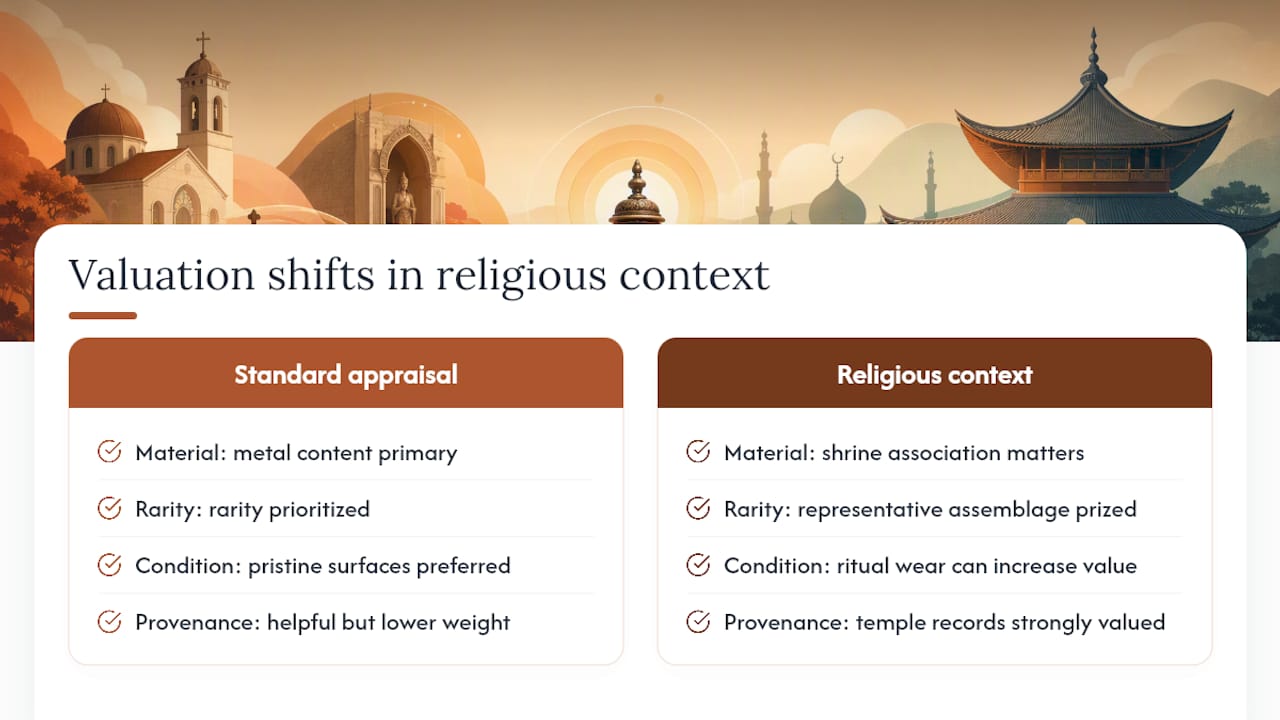
Les facteurs d’évaluation standards ne disparaissent pas pour les objets religieux. Ils changent de poids et d’interprétation.
Matériel et technique. Le manque de métaux précieux ne signifie pas une faible valeur pour les objets votifs ou cultes. Recherches sur les assemblages votifs confirme que les objets votifs bon marché produits en série peuvent avoir un poids symbolique et culturel majeur lorsque la provenance et la représentativité sont fortes. Une petite figure votive en bronze coulé provenant d'un sanctuaire bouddhiste sri-lankais peut valoir beaucoup plus que ce que suggère sa teneur en métal, une fois que son association avec le sanctuaire est documentée.

Rareté vs représentativité. Les votives produites en masse ne sont pas automatiquement de faible valeur. Études archéologiques des dépôts de sanctuaires italiens montrent que les offres répétitives et à faible coût accumulaient la valeur intrinsèque du métal et représentaient des dépôts de richesse agrégés. La même logique s’applique à la provenance des assemblages dans des contextes asiatiques : un groupe de bronzes votifs stylistiquement cohérents provenant d’un seul site de temple a plus de poids probant que des pièces isolées.
État et tenue rituelle. L’usure due à la pratique rituelle active – résidus d’encens, perte de dorure due à des onctions répétées, surfaces de contact usées – peut accroître la crédibilité de la provenance plutôt que de réduire la valeur. Traitez ces marques comme des signaux d'authenticité, et non comme des déductions automatiques, lorsqu'elles sont étayées par des documents.
Provenance et chaîne de traçabilité. Les registres de propriété des temples, les registres de garde monastique, les lignées orales et les documents d'exportation constituent tous des preuves. Les études de Cambridge sur l'économie des temples confirment que la provenance liée au temple peut indiquer une signification à la fois rituelle et économique. Les lacunes dans la chaîne nécessitent une divulgation et non une dissimulation.
Demande du marché. La demande des collectionneurs spécialisés pour les artefacts bouddhistes et hindous sur le marché américain fluctue en fonction des cycles d'exposition, des nouvelles sur les rapatriements et de l'intérêt de la communauté de la diaspora. Les objets provenant fortement de temples attirent à la fois les collectionneurs privés et les acheteurs institutionnels, mais la sensibilité au rapatriement peut également introduire un risque de réduction des prix.
Quel est le processus d'évaluation étape par étape des objets religieux ?
Conseils pratiques d’évaluation est cohérent : définissez d'abord l'objectif et la norme de valeur, puis compilez l'état, la provenance et les comparables. Pour les objets religieux, cette séquence nécessite des étapes supplémentaires.
- Confirmer l’objectif du client et la base de valeur. JVM, remplacement, assurance ou don : chacun nécessite une stratégie de comparaison différente et une structure de rapport différente.
- Rassemblez la documentation de provenance. Registres du temple, historiques d'enchères, permis d'exportation/importation, inscriptions et correspondance des collectionneurs. Pour les pièces asiatiques, consulter ressources de recherche de provenance qui portent sur les sources d'archives régionales.
- Traduction des inscriptions de commission. Les inscriptions sanscrites, pali, khmères ou birmanes peuvent identifier la divinité, le donateur, la date et l'institution commanditaire. Chacun de ces points de données affecte la sélection des comparables.
- Effectuer des analyses stylistiques et techniques. Les attributs iconographiques, la technique de moulage et les marqueurs de style régional aident à dater et à localiser l'objet. Se référer à guides de référence iconographiques pour les conventions statuaires bouddhistes.
- Commandez des tests techniques lorsque cela est justifié. Fluorescence X (XRF) pour la composition des alliages, thermoluminescence (TL) pour les céramiques cuites et radiographie pour la structure interne. Signaler la méthode, le laboratoire et les limites de chaque essai dans l'avis final.
- Les recherches sont comparables au sens large. Dossiers d'enchères, prix d'entrée aux musées, ventes privées et catalogues d'exposition. Lorsque les enregistrements sont rares, documentez la méthodologie de recherche et expliquez les ajustements de manière transparente.
- Rédiger l'avis avec une justification motivée. Lorsque les comparables sont limités, expliquez pourquoi la méthode du coût ou de remplacement a été ou n'a pas été utilisée. L’IVSC exige cette divulgation.
Conseil de pro : Signalez l’usure rituelle et les réparations historiques comme preuve d’une utilisation continue plutôt que de les déduire automatiquement. Un historique de réparation bien documenté dans un contexte monastique renforce la provenance, et non l'affaiblit.
Que doit contenir un rapport d’évaluation professionnelle pour un objet religieux ?
Conseils BADA spécifie les champs minimaux pour une évaluation défendable : type d'objet, matériaux et technique, mesures, inscriptions et marquages, caractéristiques distinctives, sujet, date/période, fabricant, photographies et notes d'état. Pour les objets religieux, plusieurs domaines nécessitent une expansion.
- Objectif du client et base de valeur : explicitement indiqué en tête du rapport.
- Description complète de l'objet : matériaux, technique de moulage ou de sculpture, dimensions métriques et impériales, identification iconographique et éventuelles inscriptions avec traductions.
- Rapport de condition avec photos : état général, problèmes d'état spécifiques, notation d'usure rituelle et réparations antérieures avec dates estimées.
- Résumé de provenance : tous les historiques de propriété connus, les associations de temples ou d'institutions, les documents d'exportation/importation et les lacunes avec explication.
- Tableau des comparables : date de vente, lieu, numéro de lot, notes d'état, prix réalisé (net de la prime de l'acheteur lorsqu'elle est connue) et justification de l'ajustement.
- Authentification et tests : méthodes utilisées, nom du laboratoire, date du test et limites de chaque méthode.
- Conditions limites : ce que l'évaluateur n'a pas pu vérifier et pourquoi.
Aux fins des dons et des impôts aux États-Unis, une « justification motivée » est requise lorsque les comparables sont limités. La méthode du coût à elle seule est généralement inadéquate pour l’évaluation des œuvres d’art et des dons dans ce contexte.
Quels contrôles juridiques et éthiques aux États-Unis s’appliquent aux évaluations d’objets religieux ?
Une documentation de provenance incomplète n'empêche pas automatiquement une évaluation, mais elle oblige l'évaluateur à divulguer les lacunes, à appliquer des ajustements conservateurs et, dans certains cas, à refuser de donner son avis à des fins transactionnelles.
La loi sur la mise en œuvre des biens culturels (CPIA) régit les restrictions américaines à l’importation de biens culturels en provenance de pays ayant conclu des accords bilatéraux. Les objets dépourvus de documents d'exportation légaux en provenance du pays d'origine sont confrontés à une valeur marchande réduite et à une saisie potentielle. Ce risque doit être reflété dans l'évaluation.
- CPIA et enregistrements d’importation : vérifiez que l'objet est entré aux États-Unis avec les documents appropriés. Absence de permis d'exportation de Cambodge, Thaïlande, ou Indonésie, par exemple, constitue un facteur de risque important.
- Espèces menacées et matériaux restreints : l'ivoire, l'écaille de tortue et certains bois protégés sont soumis aux réglementations du US Fish and Wildlife Service. Ces matériaux affectent la commercialisation et doivent être divulgués.
- Demandes de rapatriement : Les efforts de rapatriement des musées et du gouvernement pour l’art religieux d’Asie du Sud-Est sont actifs. Les objets présentant des lacunes de provenance institutionnelle peuvent faire l’objet de réclamations qui réduisent la valeur marchande.
- Vérifications recommandées : recherche d'archives, dossiers de douane et d'importation, fichiers de provenance des maisons de ventes aux enchères et consultation de conservateurs spécialisés dans des institutions telles que le Metropolitan Museum of Art ou la Freer Gallery.
Conseil de pro : Effectuez une recherche de titre dans le registre des pertes d’art et dans la base de données des œuvres volées d’Interpol avant d’accepter une commission à des fins d’évaluation transactionnelle.
Deux vignettes montrant comment le contexte religieux a modifié la valeur estimative
Vignette A : Petit bronze votif provenant d'un sanctuaire de pèlerinage
Un collectionneur a présenté une petite figurine en bronze coulé, mesurant environ 8 cm, ne contenant aucun métal précieux et présentant une corrosion de surface compatible avec un enterrement ou une exposition extérieure à long terme. L’évaluation initiale des matériaux suggérait une valeur minime. Des recherches ultérieures ont identifié la pièce comme faisant partie d'un dépôt votif documenté provenant d'un site de pèlerinage thaïlandais, soutenu par une facture du revendeur faisant référence au site par son nom, une correspondance stylistique avec un catalogue de fouilles publié et des tests TL cohérents avec une date pré-moderne.
La documentation de provenance a déplacé la base d'évaluation du remplacement matériel vers la JVM pour un marché de collectionneur spécialisé, produisant une opinion nettement supérieure à l'estimation matérielle initiale.
Preuves qui ont fait évoluer la valeur : association de sanctuaire dans les archives des revendeurs, corroboration stylistique dans les études publiées et plage de dates TL. L'usure rituelle de la base a été traitée comme un indicateur d'authenticité positif et non comme une déduction de condition.
Vignette B : Tête de Bouddha en bronze avec restauration et provenance monastique
Une tête de Bouddha en bronze plus grande, mesurant 34 cm, présentait une restauration significative de la couronne et d'une oreille. L’analyse des matériaux et de l’état à elle seule aurait soutenu une opinion conservatrice. L'expéditeur a fourni des registres d'acquisition du monastère s'étalant sur plusieurs décennies, une photographie de la pièce in situ dans une salle monastique et une correspondance avec un érudit régional confirmant que le style iconographique était conforme à une tradition d'atelier spécifique du Laos.
Le dossier de garde monastique continu, combiné à l’attribution du savant, justifiait le choix de la JVM pour un acheteur institutionnel spécialisé comme base de valeur. Des ventes comparables de bronzes laotiens documentés de provenance institutionnelle ont soutenu une fourchette plus élevée que ce que l'état seul aurait permis.
Preuves qui ont fait évoluer la valeur : registres de garde monastique, photographie in situ et attribution scientifique. La restauration a été divulguée et ajustée, mais la prime de provenance dépassait la remise sur l'état.
Quand les collectionneurs et les évaluateurs doivent-ils faire réaliser des évaluations spécialisées ?
L’évaluation d’un spécialiste est justifiée dans des circonstances spécifiques et non comme un défaut pour chaque acquisition.
- Provenance temple ou monastique : lorsque l’objet a documenté l’histoire institutionnelle, un évaluateur généraliste peut ne pas disposer de l’expertise régionale nécessaire pour évaluer les preuves.
- Inscriptions nécessitant une traduction : Les inscriptions sanscrites, pali, khmères, birmanes ou tibétaines nécessitent une traduction spécialisée avant que l'objet puisse être daté ou attribué avec précision.
- Risque de rapatriement suspecté : si les écarts de provenance coïncident avec des périodes connues de pillage ou de restrictions à l’exportation, une consultation juridique et curatoriale spécialisée est recommandée avant toute transaction.
- Dons ou fins fiscales : La loi fiscale américaine exige une évaluation qualifiée par un évaluateur agréé pour les déductions de contributions caritatives supérieures à 5 000 $.
Pour la planification des assurances, la valeur de remplacement et la JVM diffèrent sensiblement pour les objets religieux. Conservez les évaluations antérieures, les reçus d’achat et les photographies d’état dans une archive sécurisée. Services d'évaluation institutionnelle notez que de nombreuses collections sont sous-évaluées à des fins d'assurance car les objets sacrés ne sont pas programmés séparément.
- Obtenez plusieurs évaluations pour des pièces de grande valeur ou juridiquement sensibles.
- Mettez à jour les évaluations tous les trois à cinq ans ou après des événements importants sur le marché.
- Archivez tous les rapports, photographies et correspondances dans un format accessible aux héritiers ou successeurs institutionnels.
Les facteurs de coûts pour les évaluations spécialisées comprennent la profondeur de la recherche de provenance, les frais de traduction des inscriptions, les tests en laboratoire et la complexité des rapports. Les objets nécessitant des tests TL ou une analyse XRF ajoutent des coûts de laboratoire aux honoraires de l'évaluateur. Budgétisez en conséquence avant la mise en service.
Conseil de pro : Pour les collectionneurs construisant un Collection d'art bouddhiste, documentez la provenance au moment de l'acquisition, et non des années plus tard. Les recherches rétroactives sont plus lentes et moins concluantes.
Le point de vue d’un praticien sur la valorisation des objets religieux
L’erreur la plus constante dans l’évaluation des artefacts religieux est de traiter la signification symbolique comme une variable douce plutôt que documentée. L’usage rituel, l’association au temple et la lignée communautaire sont des catégories de preuves et non des ajouts impressionnistes. Lorsqu’un évaluateur les documente avec la même rigueur appliquée à l’état et aux comparables, l’opinion qui en résulte est défendable et exacte.
HDAsianArt applique cette norme à chaque pièce de son catalogue. Chaque objet fait l'objet d'une recherche individuelle, avec des notes de provenance, une identification iconographique et des observations d'état enregistrées avant d'être répertoriées. Là où des inscriptions sont présentes, des traductions sont commandées. Lorsque l’attribution régionale est incertaine, des spécialistes sont consultés. Ce processus reflète ce que l'IVSC et l'AAA attendent d'un avis accrédité, et c'est la même norme que les collectionneurs devraient exiger de tout évaluateur spécialisé.
HDAsianArt : recherche spécialisée de sourcing et de provenance pour les collectionneurs sérieux
Les collectionneurs et les évaluateurs qui ont besoin d’un point de référence pour les artefacts religieux documentés peuvent consulter directement le catalogue organisé par HDAsianArt. Chaque liste comprend des notes de condition, des métadonnées de provenance, une identification iconographique et une attribution régionale, sur le modèle des normes de rapport décrites dans cet article.
La grande statue de Bouddha antique de style thaïlandais dans l'enseignement du Mudra et de l'Antiquité Laos Style Bronze Charity Gautama Buddha sont des exemples de l'apparence pratique de la documentation de provenance et de la description spécialisée. Pour les collectionneurs recherchant une aide à l'approvisionnement, une recherche de provenance ou des conseils sur le rapport de condition, contactez HDAsianArt via le page de destination de la galerie.
Sources
- Conseil international des normes d'évaluation — L'art d'évaluer les biens personnels (document Perspectives)
- Publicera — Article sur la valeur symbolique par rapport à la valeur économique dans les études anciennes
- British Antique Dealers’ Association — Valorisation des antiquités (estimations, sécurité et assurance)
- Classe et pouvoir en Palestine romaine – Économie du sacré (Cambridge Core)
- Recherche de l'Université Sapienza — Valeur, signification et contexte dans l'étude des céramiques mycéniennes et des bronzes votifs
- AntiquesMart — Méthodes d'évaluation des antiquités (guide pratique)
- Oxford Research Archive — Aperçu d'un praticien sur la puissance du rituel par rapport au prix du marché
Recommandé
- Pourquoi une statue antique est un cadeau significatif – expliqué – HD Asian Art
- Art reliquaire bouddhiste rare : exemples pour les collectionneurs – HD Asian Art
- Comment dater des images antiques de Bouddha thaïlandais : Guide du collectionneur – HD Asian Art
- Comment afficher respectueusement l’art bouddhiste religieux – HD Asian Art
