



Comment installer un autel de méditation à la maison : un guide pratique
Comment installer un autel de méditation à la maison : un guide pratique
Table des matières
Comment installer un autel de méditation à la maison : étape par étape
Créer un espace sacré pour la méditation transforme un coin ordinaire en un sanctuaire de pleine conscience et de paix intérieure. À HD Asian Art, nous avons aidé d'innombrables pratiquants à établir des autels qui servent à la fois d'ancres visuelles pour leur pratique et de représentations physiques de leurs aspirations spirituelles. Votre autel devient un point focal pendant la méditation, un lieu où les distractions extérieures s'estompent et où votre esprit s'installe dans une conscience plus profonde.
Ce dont vous aurez besoin avant de commencer
Votre autel ne nécessite pas d'objets coûteux ou rares. La fondation repose sur l’intention et non sur l’investissement. Commencez par identifier ce qui vous attire spirituellement, qu'il s'agisse de la philosophie bouddhiste, des traditions hindoues, de la spiritualité basée sur la nature ou de la pleine conscience laïque, car cette clarté façonne chaque choix que vous ferez.
Les catégories essentielles comprennent une surface (table, étagère ou banc), un objet central (statue, image ou symbole), des objets destinés à l'engagement sensoriel (encens, bougies) et des objets personnels qui ont un sens. De nombreux praticiens incluent des perles de mala, des cristaux ou des matériaux naturels comme le bois et la pierre.
Choisir l'emplacement et la surface de votre autel
Votre autel doit être situé dans un coin tranquille où vous pouvez vous asseoir confortablement sans interruption, idéalement face au nord-est, une direction considérée comme spirituellement propice dans de nombreuses traditions orientales. Si le nord-est n'est pas possible, choisissez la direction la plus paisible et la moins exposée à la circulation domestique.
La surface peut être presque n'importe quoi : une petite table en bois, une étagère flottante, un banc solide ou le coin d'une commode. Les matériaux naturels comme le chêne, le bambou ou le bois de récupération transportent une énergie d'ancrage que les surfaces synthétiques n'ont pas. Pour les petits espaces, une étagère murale résout le problème de l’encombrement tout en gardant votre autel accessible. Une simple toile de fond, peut-être une tenture en lin naturel ou en coton, crée un confinement visuel qui aide votre esprit à se concentrer sur l'intérieur.
Objets essentiels de l’autel de méditation et matériaux naturels
Le pouvoir de votre autel vient de la signification que porte chaque objet, et non de la quantité. Sélectionnez des objets qui soutiennent véritablement votre pratique plutôt que de remplir l’espace d’objets décoratifs.
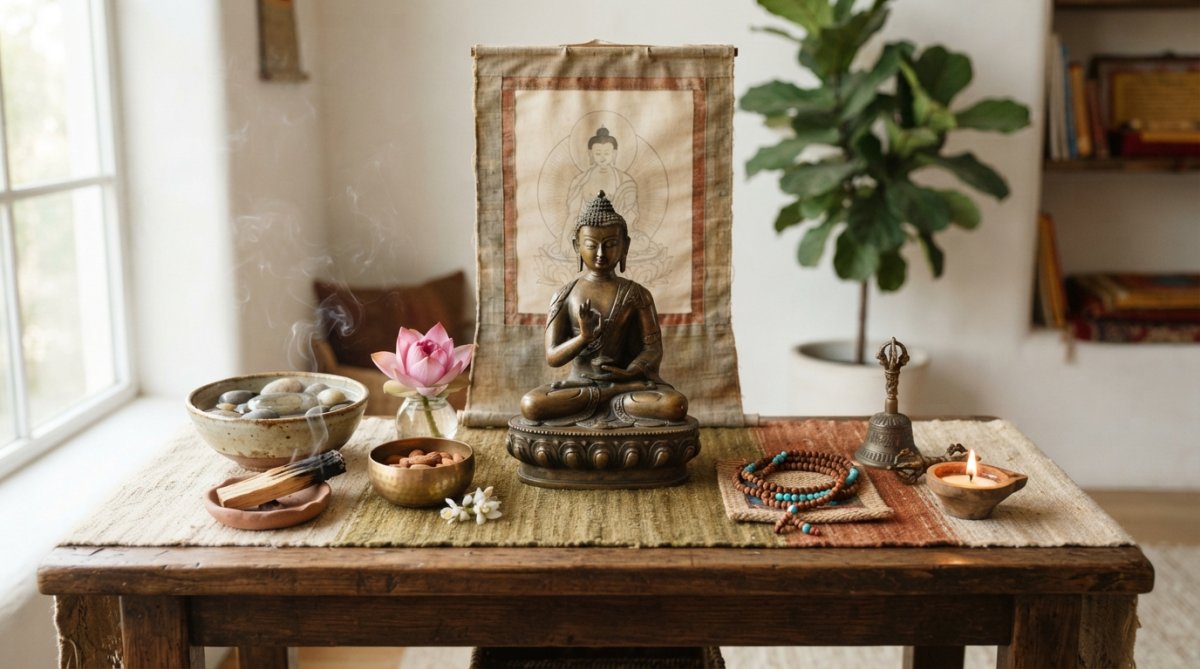
Statues, cristaux et objets sacrés
Une statue ou une image point focal ancre votre autel visuellement et spirituellement. De nombreux praticiens choisissent Statue bouddhistes pour leur association avec l'illumination et la paix, tandis que d'autres sélectionnent des divinités hindoues qui incarnent les qualités qu'ils souhaitent cultiver. HD Asian Art se spécialise dans les statues bouddhistes et hindoues soigneusement sélectionnées, y compris des pièces antiques et contemporaines triées sur le volet issues des traditions khmères et d'Asie du Sud-Est.
Choisissez une statue qui vous parle émotionnellement, un Bouddha en pose de méditation, une figure de Ganesh pour éliminer les obstacles ou une statue de Tara pour la compassion. Les cristaux ajoutent une autre dimension : le quartz clair amplifie l'intention, l'améthyste favorise la concentration calme et le quartz rose invite la compassion dans votre pratique.
Encens, bougies et perles Mala
L'encens transforme votre autel en une pratique multisensorielle. Le bois de santal, l’encens et le nag champa sont des choix traditionnels qui favorisent une concentration plus profonde. Allumez de l’encens avant la méditation pour signaler à votre esprit que le temps sacré a commencé.
Les bougies remplissent une fonction similaire tout en ajoutant une lumière chaleureuse et vivante. Une seule bougie allumée pendant la méditation crée un éclairage doux qui est plus agréable pour les yeux qu'une lumière artificielle intense. Les perles mala, des chaînes de 108 perles utilisées pour compter les mantras ou les respirations, reposent souvent sur l'autel entre les utilisations pour rappeler visiblement votre engagement dans la pratique.
Choisir des matériaux naturels pour ancrer l’énergie
Les matériaux naturels constituent la base d’un autel qui fonde véritablement votre pratique. Le bois, la pierre, les os et les fibres végétales possèdent tous des propriétés vibratoires qui manquent aux matériaux synthétiques. La surface de votre autel devrait idéalement être en bois, le bambou est durable et léger, le chêne transporte une énergie profonde et le bois récupéré contient l'histoire de sa vie antérieure.
Les éléments en tissu doivent être en fibres naturelles : coton, lin, soie ou laine. Ces matériaux respirent et vieillissent magnifiquement, développant une patine que les tissus synthétiques n'atteignent jamais.
Créer un espace de méditation à la maison : localisation et orientation
Votre autel existe dans une pièce, et l’énergie de cette pièce soutient ou sape votre pratique. Un placement réfléchi crée un sanctuaire qui invite à une méditation plus profonde.
Placement nord-est et géométrie sacrée
Dans les traditions Vastu Shastra et feng shui, l’orientation nord-est revêt une importance particulière pour la pratique spirituelle. Cette direction est associée à la sagesse, à la clarté et à la connexion à une conscience supérieure. Si votre maison le permet, placez votre autel de manière à faire face au nord-est lorsque vous méditez.
Si le nord-est n’est pas possible, votre intention compte plus que la direction. Gardez la zone autour de votre autel dégagée sur au moins deux pieds dans toutes les directions. Cela crée un tampon visuel qui indique à votre esprit : cet espace est différent.
Concevoir pour les petits espaces et les appartements
Vivre dans un petit espace ne vous disqualifie pas d’avoir un autel significatif. Une étagère flottante au-dessus d'une commode, un coin d'une bibliothèque ou même une petite table dans un placard peut devenir votre espace de méditation. Certains praticiens créent des autels portables à l'aide d'une petite boîte ou d'un panier en bois qui stocke les objets de l'autel pendant la journée et se déplie chaque soir pour former une configuration complète.
Si l'espace est vraiment minime, une seule statue, une petite bougie et des perles de mala sur une étagère constituent un autel complet. La simplicité approfondit souvent la pratique plus que l’abondance.
Avantages d'un autel de méditation pour votre pratique spirituelle
Un autel bien conçu devient un outil de transformation, soutenant votre pratique de manière mesurable qui s’accroît au fil des mois et des années.
Approfondir la pleine conscience et la définition des intentions
Un autel fonctionne comme une ancre physique pour vos intentions spirituelles. Chaque fois que vous vous asseyez devant lui, vous prenez un engagement envers vous-même et envers les qualités que vous cultivez. Au fil du temps, le simple fait de s'asseoir devant votre autel déclenche l'état méditatif plus rapidement, car votre esprit reconnaît les signaux environnementaux. De nombreux pratiquants utilisent leur autel comme lieu pour définir leurs intentions mensuelles ou saisonnières.
Créer un sanctuaire sacré sans encombrement
Un autel dédié crée une séparation psychologique du chaos de la vie quotidienne. Lorsque votre chambre semble écrasante, votre autel reste un petit îlot d’intentionnalité. Le fait de maintenir un autel sans encombrement entraîne également votre esprit à la simplicité, initiant souvent un processus de désencombrement plus large dans tout votre espace de vie.
Autel de méditation DIY : solutions économiques
Un autel authentique ne coûte presque rien si vous êtes prêt à rassembler les matériaux de manière réfléchie et à réutiliser les objets déjà présents dans votre maison.
Utiliser des articles ménagers et des meubles recyclés
Votre première surface d’autel existe probablement déjà dans votre maison. Ce petit tabouret en bois, l'étagère d'angle de votre placard ou la boîte solide sous votre lit peuvent devenir votre autel. Comme point central, pensez à ce que vous possédez déjà, une photographie qui vous émeut spirituellement, une pierre provenant d'un endroit significatif ou un morceau de bois flotté qui ont souvent plus de pouvoir que les objets achetés.
Naturel matériaux pour la décoration ne coûte rien si vous les rassemblez vous-même. Des pierres issues d'une promenade significative, des branches dans un simple vase ou des fleurs de votre jardin ancrent votre autel dans le monde naturel tout en maintenant un budget nul.
Construire un autel avec un budget minimal
Une configuration d'autel complète nécessite moins de cinq éléments de base : une surface, un point focal, de l'encens ou une bougie, un tissu et un objet significatif supplémentaire. Vous pouvez l’assembler pour moins de vingt dollars si vous vous approvisionnez de manière réfléchie. Visitez les friperies locales pour trouver des surfaces en bois et des tissus, et recherchez dans votre propre maison des objets qui résonnent spirituellement.
Nettoyer, entretenir et personnaliser votre autel
Un autel n'est pas un affichage statique. C'est un espace de pratique vivant qui nécessite une attention régulière et évolue au fur et à mesure de votre croissance.
Purifier votre espace et vos pratiques rituelles
De nombreuses traditions incluent des pratiques de nettoyage pour purifier l’espace de l’autel. Badigeonner de sauge, faire sonner une cloche ou simplement définir une intention claire de nettoyer votre autel fonctionne efficacement. La propreté physique compte aussi, dépoussiérez votre statue, essuyez votre surface et rafraîchissez régulièrement les fleurs ou les éléments naturels.
Garder votre autel en vie : routines d'entretien régulières
Un autel qui semble vivant, avec des fleurs fraîches, des bougies régulièrement allumées et des éléments saisonniers en rotation, favorise une pratique plus profonde qu'un affichage statique. Les fleurs fraîches durent une à deux semaines. De nombreux pratiquants rafraîchissent leur autel lors des nouvelles ou des pleines lunes, créant ainsi un rythme mensuel qui s'aligne sur les cycles lunaires.
Sensibilité culturelle et personnalisation respectueuse
Si vous êtes attiré par les traditions bouddhistes ou hindoues, abordez-les avec un véritable respect plutôt qu'une appropriation esthétique. Comprenez la signification spirituelle des objets que vous incluez. La personnalisation signifie ajouter des éléments qui reflètent votre propre expérience et votre lignée. L'authenticité compte plus que la pureté religieuse.
Erreurs courantes à éviter lors de la configuration de votre autel
La plupart des erreurs sur l’autel de méditation proviennent d’une réflexion excessive plutôt que d’une réflexion insuffisante. La première erreur est l’accumulation sans intention, votre autel devient encombré et votre esprit suit. La seconde est le perfectionnisme qui vous empêche de démarrer. Un autel imparfait que vous utilisez quotidiennement vous sert bien mieux qu’un autel parfait que vous n’avez jamais créé.
La troisième erreur est de négliger la maintenance. Un autel qui ramasse la poussière communique la stagnation. La quatrième consiste à ignorer votre situation de vie réelle. Travaillez avec la réalité, pas avec la fantaisie. Le cinquième consiste à séparer votre autel de votre pratique. Asseyez-vous régulièrement devant lui et laissez-le s’intégrer à votre routine spirituelle.
Conclusion : votre espace sacré vous attend
Créer un autel de méditation à la maison est l’un des moyens les plus directs d’approfondir votre pratique et d’établir un sanctuaire au sein de votre espace de vie. Le processus nécessite de l’intention, mais pas de dépenses ou de complexité. Vous pouvez commencer dès aujourd’hui avec des objets déjà présents chez vous.
Si vous recherchez des pièces maîtresses de haute qualité qui élèvent votre autel au-delà des bases du bricolage, HD Asian Art propose des offres bouddhistes et soigneusement sélectionnées Statues hindoues aux côtés d'exquises sculptures khmères et d'Asie du Sud-Est. Leur collection comprend à la fois des trésors antiques et des pièces contemporaines conçues spécifiquement pour améliorer les espaces de méditation. Avec la livraison gratuite et un engagement envers l'authenticité inspirée du temple, ils fournissent le genre de pièces qui approfondissent la puissance d'un autel au fil des années de pratique.
Votre autel de méditation vous attend. Commencez là où vous êtes, avec ce que vous avez. Laissez votre espace évoluer à mesure que votre pratique s’approfondit. Les autels les plus sacrés ne sont pas les plus élaborés, ce sont ceux qui soutiennent véritablement votre retour au calme, encore et encore.
Le rôle de la conception environnementale dans la pratique de la méditation du Journal of Environmental Psychology
Foire aux questions
Que dois-je mettre sur mon autel de méditation ?
Les objets essentiels de l'autel de méditation comprennent généralement une statue (bouddhiste, hindoue ou figure spirituelle significative pour votre pratique), des bougies pour la lumière et la concentration, de l'encens pour la purification, des perles de mala pour compter les respirations ou les mantras et des cristaux choisis pour leurs propriétés énergétiques. Les matériaux naturels comme le bambou, le chêne ou la pierre améliorent l'ancrage. Commencez simplement avec juste une statue et une bougie, puis ajoutez des éléments qui correspondent à votre pratique spirituelle et à votre intention au fil du temps.
Où dois-je placer un autel de méditation dans ma maison ?
Choisissez un coin calme de votre chambre, de votre salon ou d'un espace dédié à la méditation où vous ne serez pas interrompu. De nombreuses traditions recommandent l’orientation nord-est pour s’aligner sur l’énergie spirituelle. Gardez votre espace de méditation à la maison bien rangé et éloigné des zones à fort trafic. Dans les appartements ou les petits espaces, une étagère murale, une petite table ou même un coin d'étagère fonctionnent bien. Assurez-vous que la zone reçoit de la lumière naturelle et vous semble paisible.
Comment nettoyer et entretenir mon autel de méditation ?
Nettoyez physiquement votre espace en époussetant régulièrement et en gardant les objets organisés. Spirituellement, utilisez la fumée de l'encens ou de la sauge pour purifier la zone chaque semaine. Entretenez votre autel en rafraîchissant les bougies, en remplaçant les fleurs fanées et en gardant les perles et les cristaux de mala propres. Établissez une routine d'entretien, même 5 minutes par semaine, pour garder votre espace sacré dynamique. Faites pivoter les éléments de façon saisonnière et supprimez tout ce qui ne sert plus votre pratique de méditation ou vos intentions spirituelles.
Puis-je créer un autel de méditation avec un budget limité ?
Absolument. Un autel de méditation DIY fonctionne à merveille avec des articles ménagers : utilisez une étagère, une petite table ou un banc que vous possédez déjà. Procurez-vous des matériaux naturels gratuits ou à faible coût comme des pierres, des branches ou du bois flotté. Créez vos propres bougies ou utilisez des bougies chauffe-plat. Imprimez des images significatives au lieu d’acheter des statues au départ. Les friperies proposent souvent des statues et des récipients de Bouddha à des prix abordables. La clé est l'intention et la pleine conscience, le pouvoir d'un autel vient de votre pratique spirituelle, et non d'objets coûteux. Commencez simplement et ajoutez des pièces sélectionnées au fil du temps.
