



Guide des statues des dieux de l'hindouisme sur la signification et le style
Guide des statues des dieux de l'hindouisme sur la signification et le style
Vous vous trouvez dans un magasin d'antiquités britannique, parcourez une collection en ligne ou disposez une étagère tranquille chez vous lorsqu'une statue attire votre attention. La figure à tête d'éléphant semble accueillante, la surface en bronze est chaleureuse et la pose semble familière, mais vous vous demandez peut-être encore : Est-ce Ganesha pour un autel, un cadeau attentionné ou une œuvre de sculpture ? Bien choisir implique bien plus que faire correspondre une divinité à une pièce.
Les statues des dieux de l'hindouisme peuvent fonctionner comme des images de dévotion, des objets culturels, des œuvres d'art ou plusieurs d'entre elles à la fois. La signification dépend de la divinité, de l’iconographie, du décor et de l’intention de la personne qui ramène l’œuvre à la maison. En Grande-Bretagne, cette conversation est importante pour une communauté importante et diversifiée. La population hindoue d'Angleterre et du Pays de Galles est passée de 546 982 en 2001 à 1 020 533 en 2021, avec des hindous représentant 1.7% de la population en 2021, selon Analyse du recensement britannique sur les communautés hindoues.
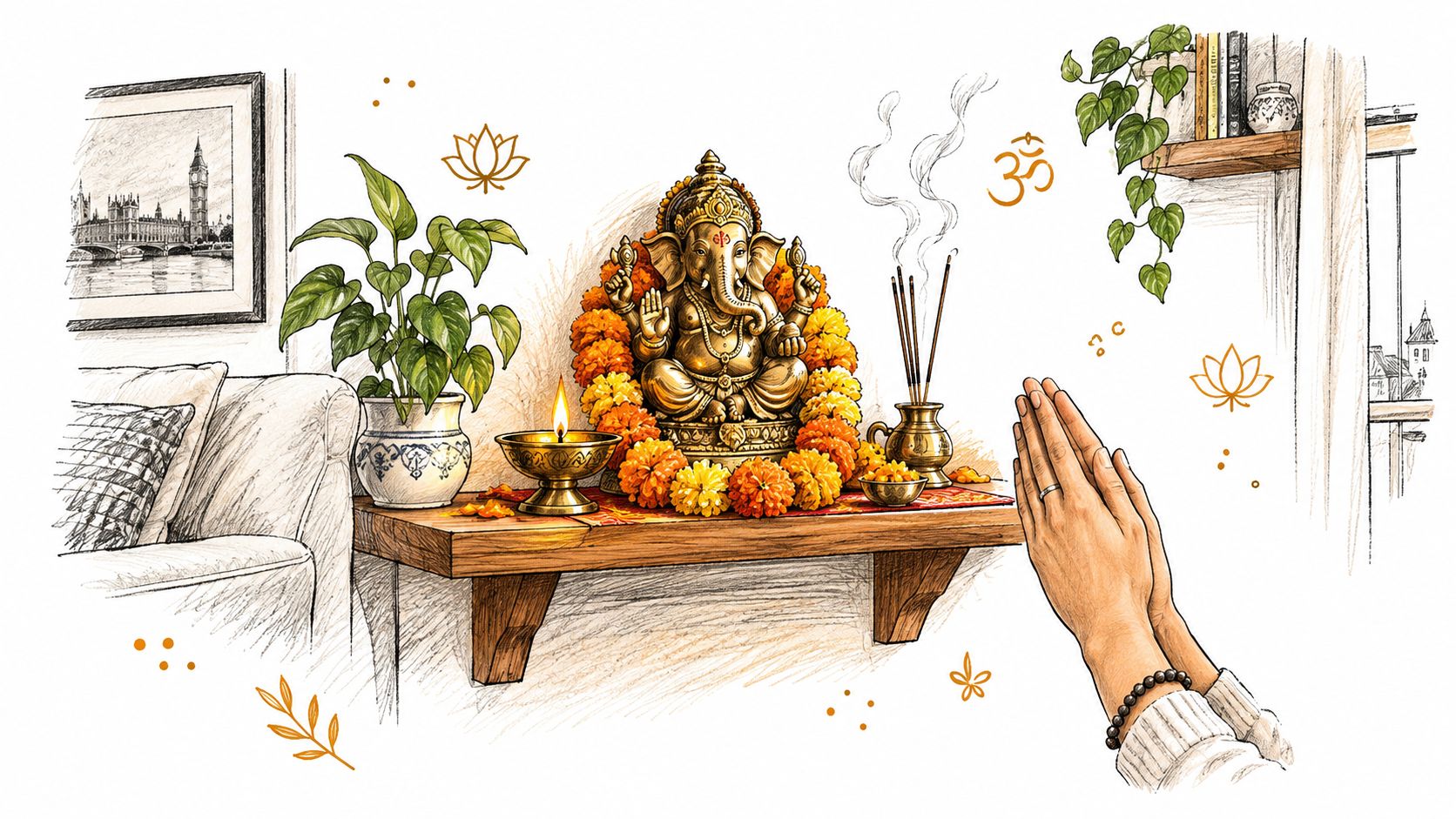
Ce guide aborde le sujet comme un conservateur de galerie pourrait guider un collectionneur débutant. Commencez par but, apprenez à lire le langage visuel de la divinité, comparez les styles et les matériaux régionaux, puis réfléchissez à l'échelle, à l'authenticité, à l'exposition et aux soins. Vous n’aurez pas besoin de devenir historien de l’art pour faire un choix respectueux. Vous devez regarder attentivement et comprendre ce que l’image communique.
Table des matières
- Introduction aux statues des dieux de l'hindouisme et à leur objectif
- Ce que représentent les statues de divinités hindoues et comment elles sont comprises
- Principaux dieux hindous et comment reconnaître leurs statues
- Matériaux de styles régionaux et indices de datation à travers les traditions
- Comment choisir une statue authentique et appropriée pour votre espace
- Prendre soin et exposer des statues de Dieu hindou à la maison
- Ramenez la statue que vous avez choisie à la maison en toute confiance
Introduction aux statues des dieux de l'hindouisme et à leur objectif
Une statue placée sur l’autel d’une maison pose des questions différentes de celles exposées sur une console. Une image d'autel peut faire partie de la prière, des offrandes et de l'attention quotidienne. Une sculpture choisie pour un intérieur peut être appréciée pour son équilibre, sa surface, sa facture et sa présence sans être utilisée dans un rituel. Aucun des deux contextes ne doit être supposé à partir de la seule apparence.
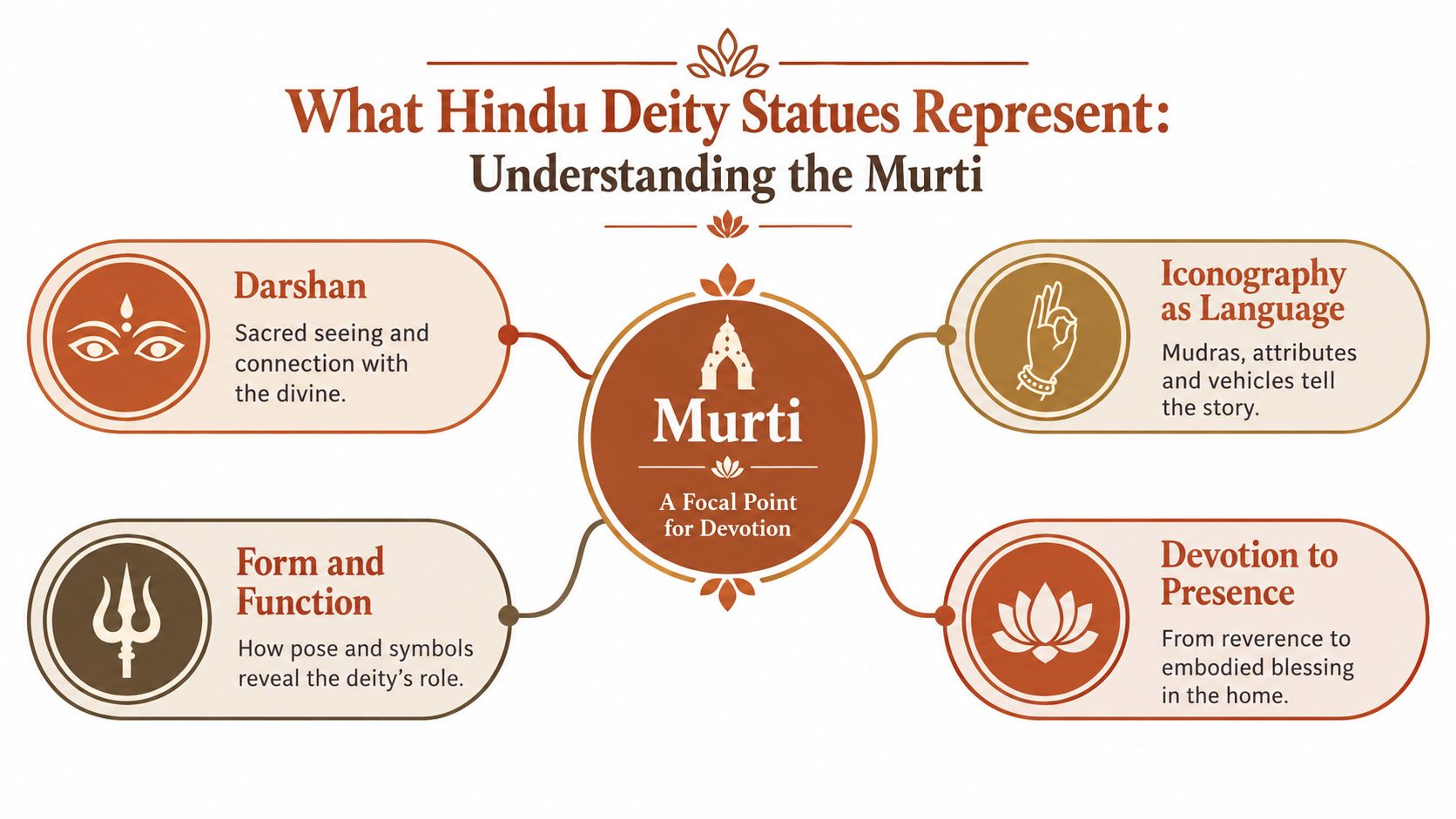
Le mot murti est souvent utilisé pour une image de divinité comprise comme un point focal de dévotion. Pour de nombreux hindous, l’image n’est pas simplement le portrait d’une figure surnaturelle. Il peut soutenir une relation de révérence et d’attention, permettant à l’adorateur de concentrer son esprit et de rencontrer le divin à travers une forme visible. Les pratiques diffèrent selon les familles, les temples et les traditions. Un collectionneur ne devrait donc pas regrouper chaque expérience hindoue en une seule règle universelle.
La Grande-Bretagne a une longue histoire institutionnelle en matière de collection et d’exposition de sculptures hindoues. Le Récit du British Museum sur les histoires de collection tantriques décrit sa vaste collection de culture visuelle tantrique, démontrant que l'imagerie religieuse hindoue a également été traitée comme un élément patrimonial majeur au Royaume-Uni. Les musées, temples, maisons et galeries du pays rencontrent donc les mêmes objets à travers des lentilles différentes mais superposées, dévotionnelles, historiques et esthétiques.
Un point de départ utile : décidez quel rôle vous voulez que la statue joue avant de décider quelle divinité ou quelle finition vous préférez.
Pour un autel domestique, demandez si l'image semble appropriée pour votre pratique et si vous pouvez garder son cadre propre et soigné. Pour un cadeau, pensez à la tradition du destinataire, à sa relation avec la divinité et à l'espace disponible. Pour le style intérieur, examinez la sculpture comme un objet complet, y compris sa silhouette, son échelle et son matériau, sans emprunter avec désinvolture un langage dévotionnel. Pour une collection, la provenance, l’état, le style régional et le savoir-faire deviennent centraux.
Cette approche axée sur l’objectif évite une erreur courante. Les acheteurs commencent souvent par la couleur ou le prix, puis tentent ensuite de justifier la statue. Un parcours plus respectueux commence par l'intention, puis les matches iconographie, échelle et matériau à la vie que l'objet aura dans votre maison.
Ce que représentent les statues de divinités hindoues et comment elles sont comprises
Une analogie utile consiste à considérer une statue de divinité hindoue comme une phrase visuelle. Le visage, les mains, les objets, la posture, le véhicule et les symboles environnants travaillent ensemble pour communiquer du sens. La suppression d'un élément ne rend pas toujours l'image impossible à identifier, mais elle peut modifier l'accent mis sur l'image.
La forme de la statue peut supporter darshan, communément compris comme un acte sacré de voir et d'être vu en relation avec le divin. Il ne s’agit pas de regarder un objet attrayant. Dans les contextes de dévotion, le spectateur s'approche avec attention, respect et conscience que l'image a un rôle dans le culte. Le visiteur de musée, en revanche, peut rencontrer la même forme à travers des questions d'histoire, de matériaux et de techniques artistiques.
Lire l'image comme langage visuel
Commencez par la tête et le visage. Une tête d'éléphant suggère Ganesha, tandis qu'un visage semblable à celui d'un singe pointe vers Hanuman. Plusieurs visages ou bras ne sont pas des exagérations décoratives. Ils peuvent exprimer des connaissances élargies, un pouvoir, une présence ou la capacité d’accomplir plusieurs fonctions à la fois.
Ensuite, étudiez les mains. Un mudra, ou geste de la main, peut communiquer le réconfort, l'enseignement, la générosité ou la méditation. Les objets tenus dans les mains ajoutent une autre couche. Un trident, une conque, un disque, un lotus, une masse ou un instrument de musique peuvent aider à identifier la divinité et suggérer les qualités représentées.
Le véhicule, connu sous le nom de vahana, fournit un autre indice. Il peut s'agir d'un animal, d'un oiseau ou d'une autre monture symbolique associée à la divinité. Un lion sous Durga crée un message visuel différent du taureau associé à Shiva. La base n'est pas seulement un support structurel. Cela peut compléter l’histoire.
Les significations décoratives et dévotionnelles peuvent coexister
Une statue n’est pas automatiquement sacrée pour tous les spectateurs, ni automatiquement un simple décor. Une personne peut acheter une sculpture de Ganesha pour une étude, un dévot peut établir une image de Ganesha sur un autel et un musée peut cataloguer un exemple historique comme objet du patrimoine culturel. La forme physique peut être similaire, mais la relation avec celle-ci diffère.
Cette distinction nécessite une attention particulière en matière de langue et de placement. Évitez de traiter chaque divinité comme un porte-bonheur générique, surtout lorsque vous offrez une statue en cadeau. Demandez ce que croit le destinataire, comment il compte l'utiliser et s'il accueillerait favorablement une image de dévotion dans sa maison.
Le Exposition du British Museum Antique Indie Traditions vivantes présente plus de 180 objets et retrace l'art sacré hindou, bouddhiste et jaïn à travers plus de 2 000 ans, montrant pourquoi ces images méritent une interprétation plutôt qu’une seule étiquette simplifiée.
Principaux dieux hindous et comment reconnaître leurs statues
La reconnaissance devient plus facile lorsque vous recherchez une combinaison d’indices plutôt qu’un élément isolé. Un lotus n’identifie pas une seule divinité, et une paire de bras supplémentaire ne suffit pas à elle seule. Lisez ensemble le visage, la posture, les objets, le véhicule et la composition globale.
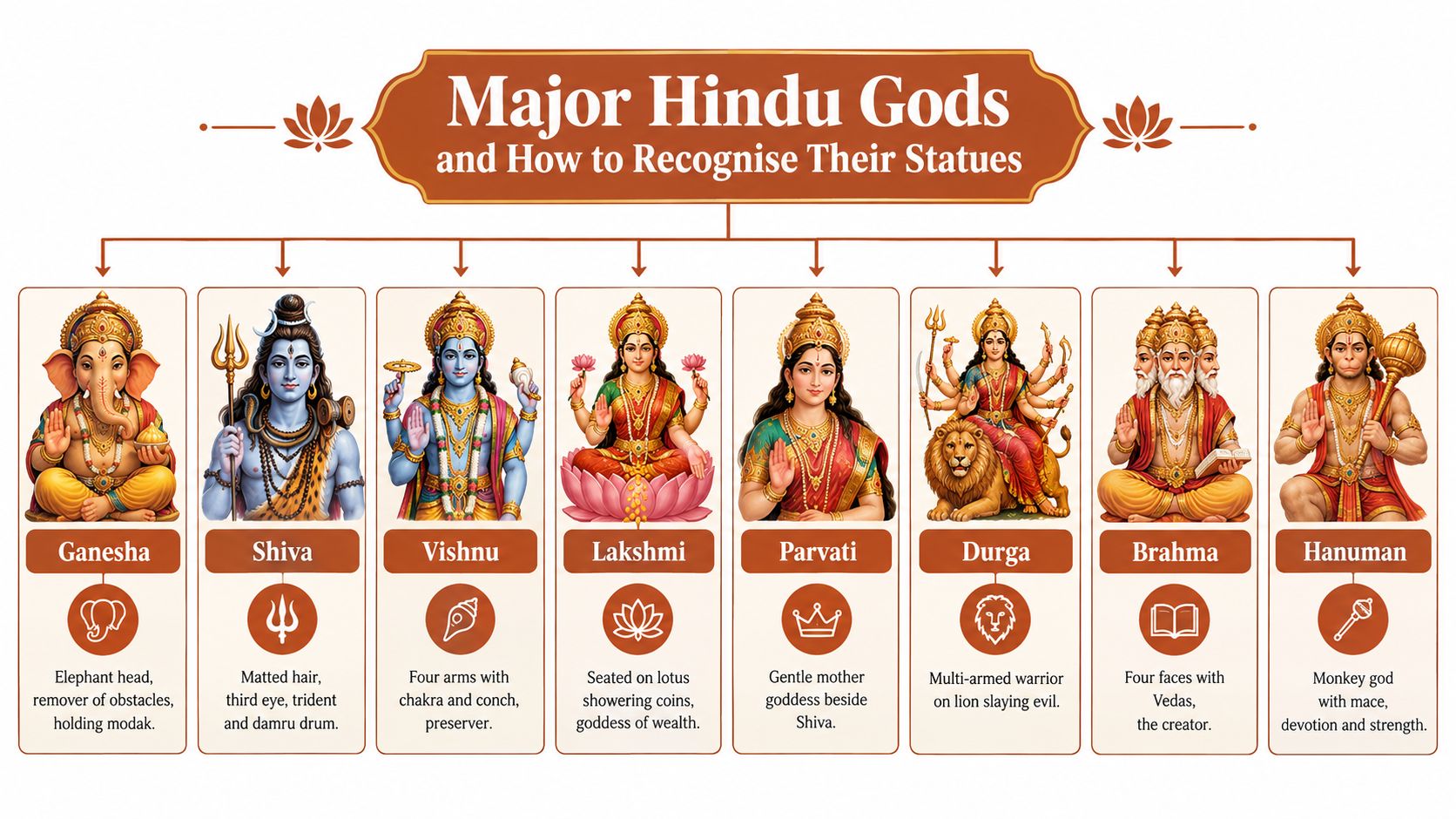
Ganesh est généralement reconnu par sa tête d'éléphant, son ventre arrondi et son corps humain. Il peut tenir ou être accompagné d'un modak, sucrerie associée à l'épanouissement, et son imagerie est souvent choisie pour les débuts, l'apprentissage ou la levée des obstacles. Shiva peut apparaître avec des cheveux emmêlés, un troisième œil, un trident et un tambour damru. Certaines formes sont dynamiques, comme Nataraja, tandis que d'autres sont méditatives ou aniconiques.
Vishnu a généralement quatre bras et porte le chakra, ou disque, et la conque. Son imagerie est liée à la préservation et au maintien de l'ordre cosmique. Lakshmi est fréquemment représenté assis ou debout sur un lotus, avec des gestes et des récipients associés à la générosité, à l'abondance et au bon augure. Sa forme peut être choisie pour un autel, un décor festif ou un cadeau, mais l'acheteur doit tout de même tenir compte des croyances du destinataire plutôt que de la réduire à un symbole de prospérité.
Parvati apparaît souvent comme une déesse mère gracieuse, parfois aux côtés de Shiva. Durga est généralement représenté avec plusieurs armes, des armes et un lion, exprimant une protection courageuse et la défaite des forces destructrices. Brahma peut être identifié par quatre visages et associations avec les Vedas, tandis que Hanuman a un visage de singe et peut porter une masse, exprimant la dévotion, la force et le service.
Krishna et Murugan nécessitent une attention particulière car leurs formes varient. Krishna peut être représenté comme un jeune personnage jouant de la flûte, souvent dans une position gracieuse et courbée. Murugan, également connu sous le nom de Kartikeya ou Skanda, peut porter une lance et apparaître avec un paon. Les détails varient selon la région, la période et l'atelier, donc une identification sûre doit provenir de la conception complète plutôt que d'un seul accessoire.
Pour une introduction plus large aux noms et aux formes, consultez ceci guide des dieux hindous et de leurs noms.
Guide de reconnaissance rapide des statues de divinités hindoues populaires
| Divinité | Attributs clés à rechercher | Intention ou placement commun |
|---|---|---|
| Ganesh | Tête d'éléphant, modak, symbolisme expressif du tronc et de la souris | Débuts, zones d'étude, autel de la maison ou cadeau attentionné |
| Shiva | Cheveux emmêlés, troisième œil, trident, damru ou pose méditative | Espace de dévotion, de méditation ou de collection |
| Vishnu | Quatre bras, chakra et conque | Conservation, autel ou collection théologique |
| Lakshmi | Lotus, forme gracieuse assise ou debout, mains ouvertes | Cadre de dévotion, exposition festive ou cadeau |
| Parvati | Forme maternelle, couronne, association avec Shiva | Autel familial ou collection |
| Durga | Armes multiples, armes, lion | Protection, espace de dévotion ou collection |
| Brahma | Quatre visages, associations védiques | Collection historique ou exposition pédagogique |
| Hanuman | Visage de singe, masse, posture puissante ou à genoux | Dévotion, force et symbolisme protecteur |
Ces intentions sont des points de départ et non des règles fixes. Un collectionneur peut choisir une divinité en raison d'une pratique familiale, d'une préférence artistique, d'un lien régional ou d'un moment particulier de la vie. L’important est de savoir ce que signifie la forme avant de la présenter comme un ornement occasionnel.
Matériaux de styles régionaux et indices de datation à travers les traditions
Deux statues de Shiva peuvent être totalement différentes tout en restant fidèles à leurs traditions. Un bronze du sud de l'Inde peut s'appuyer sur un mouvement rythmique et un moulage soigneusement équilibré, tandis qu'une image en pierre de l'Est Indie peut sembler plus dense, plus frontal et richement orné. La différence n’est pas la preuve d’une qualité inégale. Cela reflète souvent région, période, matériau et langue d'atelier.
IndieLes traditions sculpturales de se sont développées parallèlement à des échanges asiatiques plus larges. L'exposition du British Museum sur l'Antiquité Indie place l'art sacré hindou dans une longue histoire de mouvement et d'adaptation, tandis que le Collection du musée Clive au château de Powis est décrite par le National Trust comme la plus grande collection privée d'objets d'Asie du Sud et de l'Est au Royaume-Uni. Ses avoirs comprennent plus de 1 000 articles datant d'environ 1600 aux années 1830, y compris des statues de dieux hindous.
Comparez le matériel avant de juger de l’âge
Laiton est courant dans la sculpture dévotionnelle et décorative contemporaine. Il peut avoir une finition polie brillante, une surface vieillie plus foncée ou des zones de variation contrôlée. Bronze peut présenter une patine plus profonde et plus complexe, en particulier lorsque la surface a vieilli plutôt que polie à plusieurs reprises. Une finition sombre ne prouve pas l’antiquité, et une finition brillante ne la réfute pas.
Pierre a un poids visuel différent. Le schiste noir, le grès et la pierre volcanique peuvent supporter des bijoux impeccables, des plaques architecturales et des attributs nettement découpés. Bois peut présenter du grain, une décoration peinte et une usure sur les bords exposés. Les reproductions en résine peuvent reproduire une silhouette familière, mais la surface, le poids et les marques d'outils différeront de celles du métal moulé ou de la pierre sculptée.
Le moulage à la cire perdue est particulièrement important si l’on considère les traditions du bronze du sud de l’Inde. Le processus peut créer des contours fluides et un mouvement vif, mais les acheteurs doivent inspecter les joints, les fines projections, la cohérence des détails et la stabilité de la base. Un moulage moderne bien réalisé peut être attrayant et approprié sans être représenté comme un objet de temple ancien.
Remarquez les indices visuels régionaux
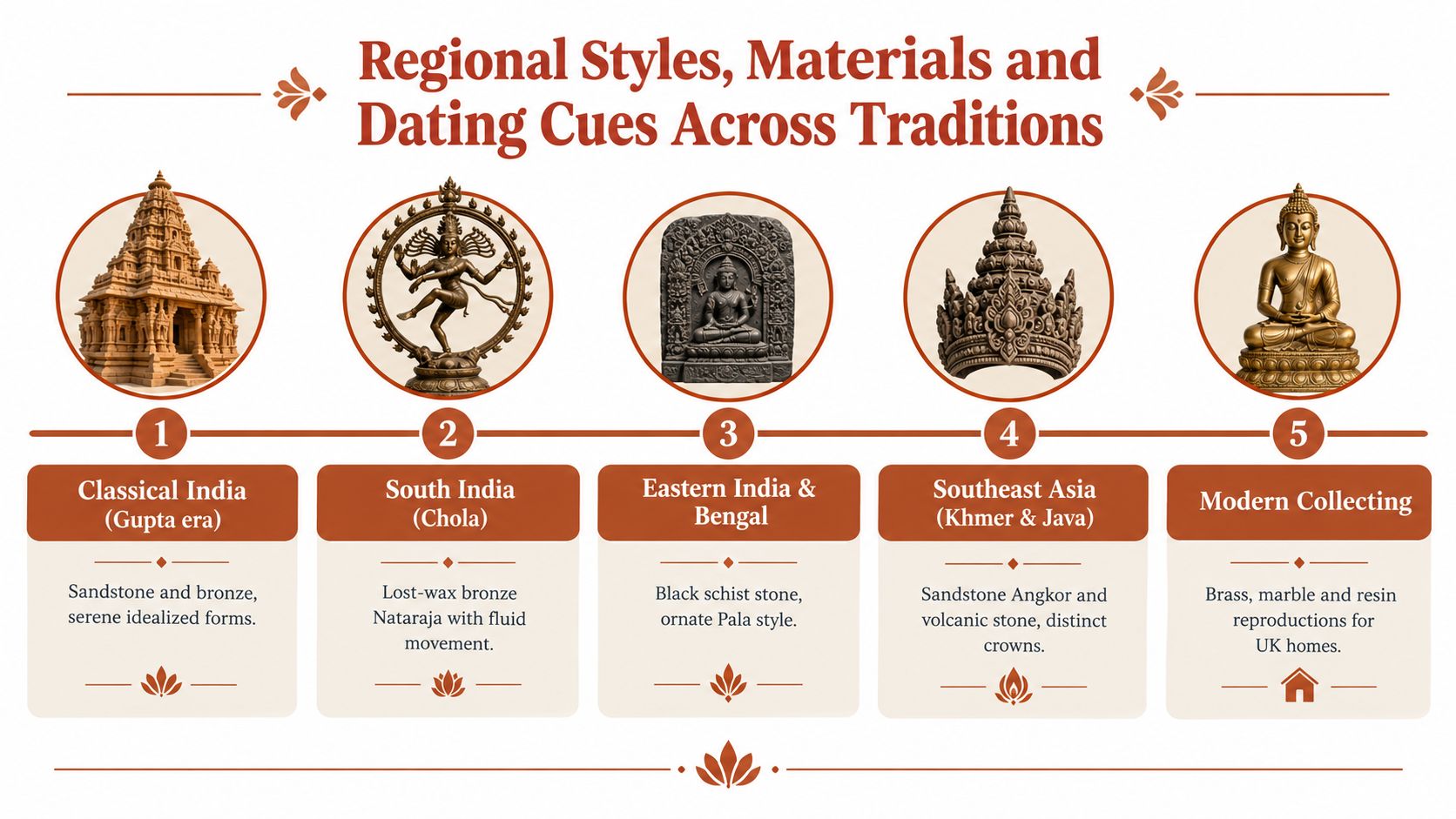
L’imagerie de la période Gupta est souvent associée à des formes sereines et idéalisées. Les bronzes Nataraja de style Chola sont connus pour leurs compositions circulaires dynamiques et leur équilibre expressif. Les traditions de l'Inde orientale et du Bengale peuvent utiliser des pierres sombres et des ornements élaborés, tandis que les sculptures khmères et javanaises peuvent afficher des couronnes distinctives, une forte présence frontale et des approches régionales des proportions corporelles.
Le Guide d'identification de style Majapahit peut aider un nouveau collectionneur à examiner la sculpture indonésienne hindoue et bouddhiste à travers les détails plutôt que de se fier à une vague impression de « style asiatique ». Regardez la couronne, les bijoux, le modelage du visage, la base, la plaque arrière et le traitement du corps. Ces éléments forment un accent régional, un peu comme un dialecte dans la langue parlée.
Les rencontres nécessitent de la retenue. L'usure des surfaces, les dépôts minéraux, les réparations anciennes et la patine peuvent offrir des indices, mais aucun ne doit être considéré comme une preuve sans documentation. Demandez une description claire du matériau, des dimensions, de l'état, de la provenance et si la pièce est ancienne, vintage ou contemporaine.
Comment choisir une statue authentique et appropriée pour votre espace
Choisissez d'abord le but. Une statue destinée à un autel nécessite un processus de sélection différent de celle destinée à un hall d'entrée, un bureau, un cadeau ou une collection spécialisée. Le même Ganesha peut convenir à plusieurs contextes, mais l'échelle, la finition et le niveau d'engagement dévotionnel requis seront différents.
Faire correspondre le but avec le formulaire
Utilisez cette matrice de décision compacte avant de naviguer :
| Objectif | Prioriser | Réfléchissez bien |
|---|---|---|
| Autel de la maison | Iconographie correcte, échelle respectueuse, base stable et nettoyage facile | Que l'image corresponde à votre famille ou à votre pratique personnelle |
| Cadeau | Divinité du destinataire, tradition, espace et confort avec les objets de dévotion | Éviter les hypothèses basées uniquement sur l’apparence |
| Style intérieur | Silhouette, proportion, surface et relation avec le mobilier environnant | Garder l’imagerie sacrée à l’écart des contextes négligents ou inappropriés |
| Collecte | Documentation, style régional, matériaux, état et savoir-faire | Si le vendeur fait la distinction entre l'âge et la reproduction moderne |
L'échelle doit être mesurée et non devinée à partir d'une photographie du produit. Vérifiez la hauteur, la largeur et la profondeur de la statue par rapport à l'étagère ou à l'autel, puis laissez de la place pour le nettoyage, les offrandes ou un espace de respiration visuel. Une image haute et étroite peut fonctionner sur une bibliothèque, tandis qu'une forme large à plusieurs bras nécessite plus d'espace latéral.
Le matériau doit suivre l’environnement. Le laiton et le bronze peuvent convenir aux environnements intérieurs, mais leurs surfaces réagissent toujours à l'humidité, à la poussière et aux manipulations. La pierre peut sembler importante, mais elle peut être lourde et difficile à déplacer. Les pièces peintes ou composites peuvent avoir des finitions plus délicates. Si la statue doit être placée près d'une fenêtre, d'un radiateur ou d'une porte fréquemment utilisée, choisissez en tenant compte de ces conditions.
Testez l’authenticité grâce à la transparence
L'authenticité n'est pas la même chose que l'âge. Une statue contemporaine peut être réalisée, joliment finie et adaptée à un autel ou à un intérieur de maison. Le panneau d'avertissement n'est pas une fabrication moderne. L'étiquetage n'est pas clair.
Avant d'acheter, recherchez :
- Une description précise : Le vendeur doit identifier la divinité, le matériau, les dimensions et l'âge ou le statut de production déclaré.
- Informations sur l'état : Renseignez-vous sur les réparations, les fissures, les pertes, les problèmes de moulage, la repeinture et la stabilité structurelle.
- Des photographies claires : Regardez le devant, le dos, la base et les détails rapprochés des mains, des attributs et des ornements.
- Explication contextuelle : Une description responsable doit distinguer la signification dévotionnelle du style décoratif.
- Un processus de retour pratique : Cela est important si l’échelle, la couleur ou l’état diffère de vos attentes.
Une collection spécialisée organisée par divinité, région et matériau peut faciliter la comparaison. HD Asian ArtCollection de statues de divinités hindoues est un exemple de catalogue qui regroupe les pièces par formes et traditions reconnaissables. Considérez-le comme un point de référence aux côtés des galeries, des musées et des marchands de confiance, et non comme un substitut à la pose de questions.
Prendre soin et exposer des statues de Dieu hindou à la maison
De bons soins commencent par l’environnement. Les travaux de conservation britanniques sur les statues hindoues en laiton, bronze et albâtre identifient l'humidité et la contamination des surfaces comme des risques de corrosion importants, tandis que la conservation préventive se concentre sur la température, l'humidité relative, la lumière, les particules et l'activité biologique. Le recherche sur la conservation des statues de divinités hindoues avertit également qu'une manipulation et un nettoyage agressifs peuvent éliminer la patine protectrice et exposer le métal réactif.
Placez la statue sur une surface stable et bien soutenue, à une hauteur de visualisation confortable. Évitez de le poser directement sur le sol, dans une salle de bain, à côté d'un radiateur ou là où de la condensation se forme régulièrement. Gardez-le à l’écart des rayons directs du soleil, des fumées de cuisson et des zones où des personnes ou des animaux domestiques peuvent heurter des bras, des armes ou des couronnes en saillie.
Continuez à nettoyer en douceur
Époussetez avec une brosse douce et sèche ou un chiffon propre et non pelucheux. N'utilisez pas de crème abrasive, de produit à polir pour métaux ou de spray domestique à moins qu'un restaurateur ne l'ait conseillé pour ce matériau et cette finition spécifiques. Le polissage peut effacer la subtile variation de surface qui donne son caractère à un bronze plus ancien, et il peut éliminer la patine qui contribue à la protection et à l’interprétation.
Les statues composites nécessitent une prudence particulière. Le Étude de cas sur la conservation du musée Pitt Rivers sur les personnages de Jagannath décrit des éléments en papier fragiles qui nécessitaient une humidification avant d'être remodelés. La leçon pratique est claire : stabilisez d’abord le composant le plus sensible à l’humidité, puis réalignez-le mécaniquement plutôt que de le forcer à se mettre en place.
Règle pratique : Si une statue comporte des éléments en papier, en textile, peints, en bois ou attachés séparément, ne la nettoyez pas et ne la réparez pas comme s'il s'agissait de laiton massif.
La manipulation doit être planifiée. Soulevez à partir de la partie la plus solide du corps ou de la base, soutenez les éléments saillants et utilisez les deux mains pour la pierre lourde ou le bronze. Avant de déplacer une pièce de valeur ou fragile, photographiez son état et enveloppez-la dans un tissu sans acide ou tout autre matériau de protection approprié. Pour un déménagement plus long, consultez ceci Guide d'emballage des illustrations de déménagement et de stockage TLC pour les principes pratiques d’emballage.
Si l'objet fait partie d'un culte actif, suivez la tradition de la maison ou du temple régissant les offrandes, le nettoyage et le placement. Les conseils de conservation peuvent protéger le matériel, mais ils ne peuvent pas remplacer les conseils religieux des personnes qui utilisent l'image.
Ramenez la statue que vous avez choisie à la maison en toute confiance
Un bon choix suit une séquence simple. Décidez d’abord si la statue va soutenir la dévotion, marquer un cadeau, enrichir un intérieur ou développer une collection. Identifiez ensuite la divinité à travers son iconographie complète, comparez le style et les matériaux régionaux, vérifiez l'échelle et l'état, et planifiez un emplacement stable et respectueux.
Vous n'avez pas besoin de connaître toutes les variantes avant d'acheter. Vous avez besoin d'informations honnêtes et de suffisamment de patience pour distinguer un Ganesha d'une figure d'éléphant générique, un bronze contemporain d'une antiquité et un objet de dévotion d'une pièce sélectionnée uniquement pour son effet visuel.
Les musées britanniques offrent des points de référence utiles. La BBC a rapporté qu'un Statue de Ganesha vieille de 800 ans prêté du British Museum a été exposé avec des objets de la communauté hindoue d'Oxford et a été visité sept musées, montrant comment une image peut relier l’interprétation d’un musée à l’expérience d’une communauté vivante. Les archives du Science Museum Group identifient également des formes spécifiques, notamment Gaja-Lakshmi, Shiva et Parvati sur Nandin, Brahma et Vishnu avec Lakshmi, plutôt que de traiter la sculpture hindoue comme une catégorie indifférenciée. Explorez lentement ces exemples, puis choisissez une statue dont vous pouvez respecter la signification et la vie matérielle.
HD Asian Art propose des sculptures de divinités hindoues organisées autour de formes telles que Ganesha, Shiva, Vishnu, Lakshmi, Durga, Hanuman, Parvati, Brahma, Krishna et Murugan, ainsi que des sculptures et des ressources pédagogiques d'Asie du Sud-Est. Visite HD Asian Art pour comparer les statues par divinité, région et matériau, et choisir une pièce qui correspond à votre objectif, votre espace et votre approche.
