



Shiva the Destroyer: Meaning, Symbols and Iconography
Shiva the Destroyer: Meaning, Symbols and Iconography
Most introductions tell you to remember one simple formula and stop there. Brahma made the world, Vishnu keeps it, and Shiva destroys it. That's neat, memorable, and misleading.
Used without context, Shiva the Destroyer sounds like a warning label. It suggests rage, death, and final endings. Read properly, the title describes something more precise and more interesting, a deity who removes what blocks renewal, including ignorance itself.
Once you understand what is being cleared away, the images change too. A flame, a drum, a raised foot, a swallowed poison, or a plain carved linga stops being decoration and becomes readable. You can identify the form in front of you, judge its mood, and decide how it should be treated.
Table of Contents
- What Shiva the Destroyer Means in the Trimurti
- What Shiva Actually Destroys
- Reading Nataraja Attributes One by One
- Forms That Express Destruction and Renewal
- How Shiva Imagery Varies Across Regions and Centuries
- Displaying a Shiva Image With Respect
- Confirm the Form and Context Before You Buy
What Shiva the Destroyer Means in the Trimurti
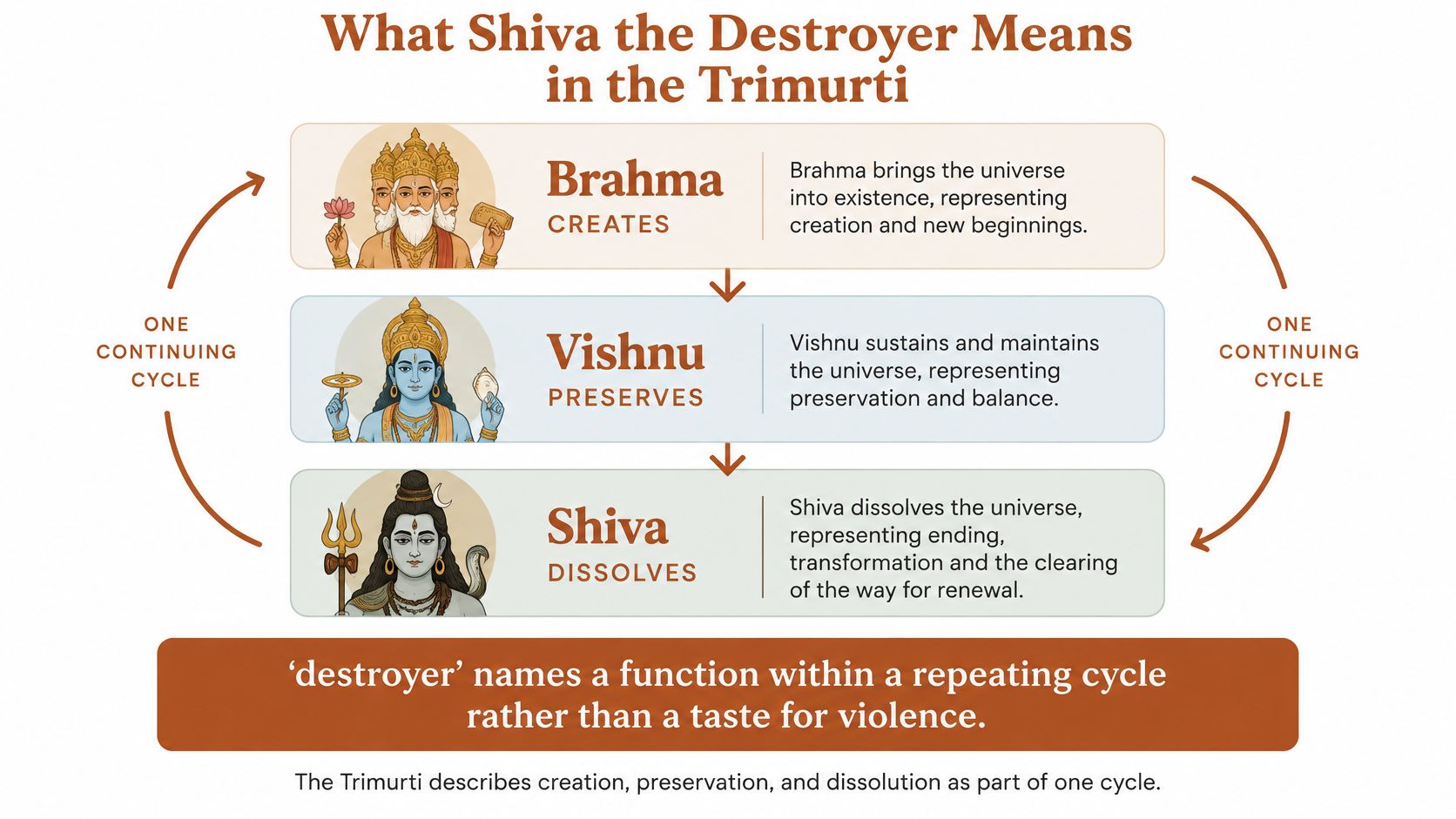
In the Hindu Trimurti, Brahma creates, Vishnu preserves, and Shiva dissolves. According to the British Museum's Mumbai London large print guide, Brahma represents creation, Vishnu preservation, and Shiva destruction. That wording matters. Destruction here is a cosmic function inside a repeating cycle, not a taste for violence.
The same museum interpretation identifies Shiva as lord of time and as Nataraja, the Lord of the Dance. His dance symbolises both beginnings and endings, so the two ideas belong together. Time wears forms down, but it also makes new forms possible.
The Three Roles Side by Side
| Deity | Cosmic function | Common attributes | Visual cue |
|---|---|---|---|
| Brahma | Creation | Four faces, lotus, water pot | Four heads and a lotus seat |
| Vishnu | Preservation | Conch, discus, mace, lotus | Multiple arms holding sacred objects |
| Shiva | Dissolution and transformation | Drum, flame, trident, crescent moon | Flaming aureole, drum and flame in the hands |
Think of the cycle as a loop you can say aloud. Form appears, form is sustained, form dissolves, and the conditions for form return. Dissolution is the turning point, not the end of meaning.
Why the Shorthand Still Falls Short
Many Shaiva traditions don't treat Shiva as only one third of a team. They regard him as supreme, holding creation, preservation, and dissolution himself. He's also approached as a personal god and protector, and at the most abstract level as Nirguna Brahman, reality without limiting qualities.
Keep this distinction: Trimurti language tells you which job is being emphasised in a particular image. It doesn't exhaust who Shiva is for his devotees.
That is why a fierce statue and a peaceful family group can both be Shiva without contradiction. The form tells you which aspect the maker wanted you to meet. If you'd like the wider framework first, our guide to the Trimurti in Hinduism and its three functions sets out the triad in detail.
What Shiva Actually Destroys
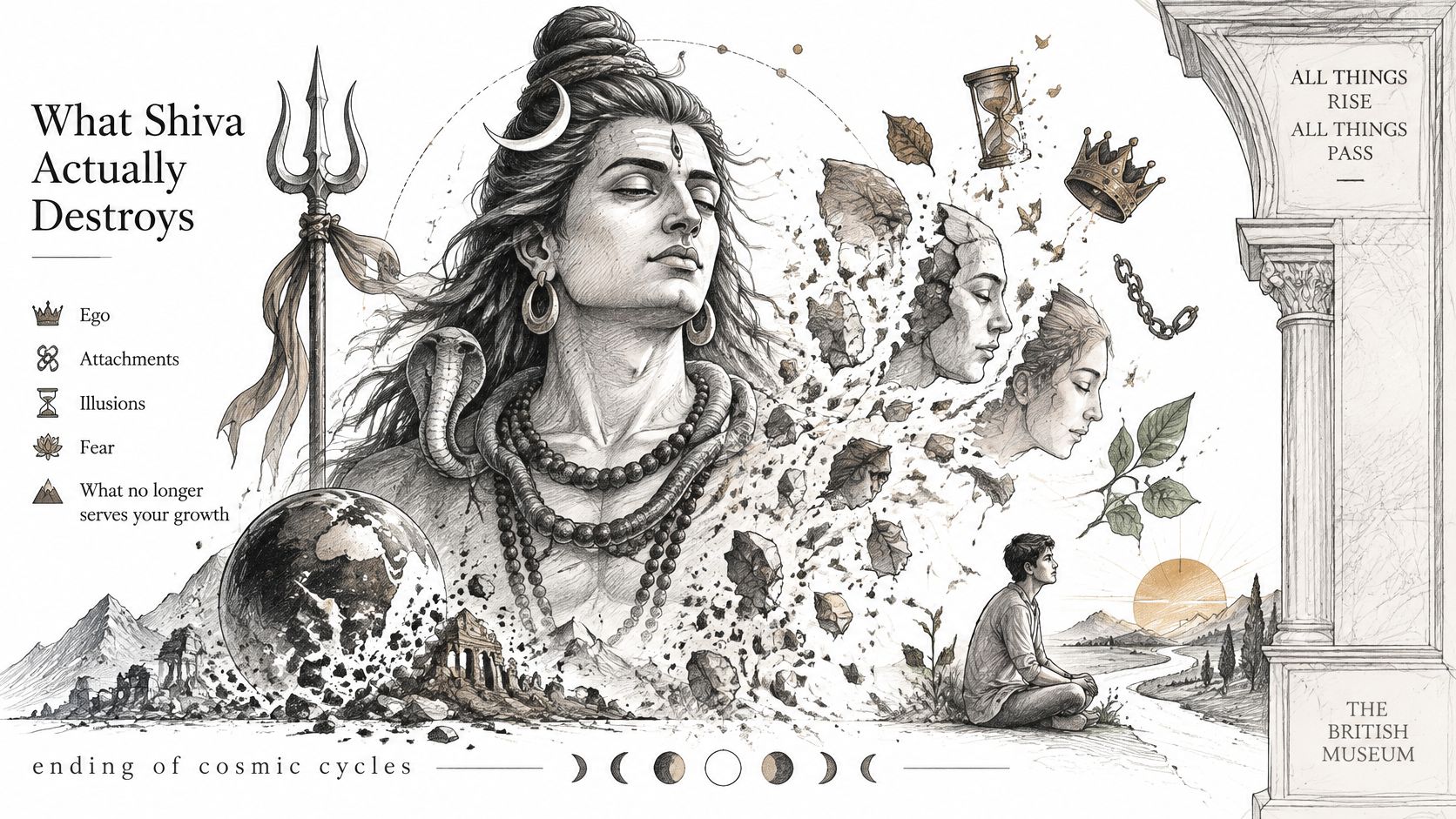
“Destroyer” can sound like a title for a god who breaks things in anger. In many Shaiva teachings, the word points instead to the ending of ignorance, attachment and limited forms of existence. Destruction makes room for change, much as pruning removes growth that prevents a plant from flourishing.
Four Targets Worth Naming
- Ignorance: Mistaking a passing mood, the body or social status for the whole self.
- Ego: Defending a separate identity through the need to win, possess or receive praise.
- Attachment: Treating people and things as permanent, then suffering when they change.
- Cosmic limitation: The boundaries of a created world, which is formed, sustained and eventually withdrawn.
These ideas operate at different scales. Ignorance, ego and attachment describe obstacles in spiritual understanding; cosmic dissolution describes the withdrawal of a world within a cycle of renewal. Neither use makes destruction equivalent to annihilation. Readers curious about scientific theories of a universe's ultimate fate can explore cosmic endgame theories with maxijournal.
Hindu belief and worship remain living traditions in Britain, practiced in temples and homes as well as encountered in public collections. For a related image of Shiva as Ardhanarishvara, see the British Museum collection record.
A useful reading question is: what does this image show being cleared away? The answer may be ignorance or pride, or it may be an exhausted cosmic form giving way to renewal. The specific form and its attributes help distinguish those meanings.
Reading Nataraja Attributes One by One
Start with the upper hands, because they settle the identification fastest. Look for a drum in one and a flame in another. Then check the other hands, then the feet, then the small figure underneath.
That order prevents the most common mistake. Readers notice the ring of fire first, call every dancing figure Nataraja, and miss whether the specific symbols match. A Nataraja is a structured visual argument, not just Shiva moving energetically.
What the Main Attributes Mean
The British Museum copper-alloy Nataraja record describes an hourglass drum, a flame, protective and grace-related hand gestures, a raised foot, and a dwarf representing ignorance beneath the other foot. The drum signifies creation through sound, while the flame signifies destruction. The raised hand conveys protection, and the foot arrangement relates to refuge and liberation.
| Attribute | Meaning | What to check |
|---|---|---|
| Hourglass drum | Creation through sound | Drum held in an upper hand |
| Flame | Destruction | Flame held in another upper hand |
| Raised hand | Protection and grace | Palm turned outward |
| Apasmara | Ignorance overcome | Dwarf beneath the raised foot |
| Flaming circle | Cosmic cycle of time | Open ring of flames, about 70 cm across in one British Museum example |
| Crescent moon | Time | Crescent placed in the hair |
The scale can be more precise than people expect. In a British Museum podcast transcript, the open flaming circle measures about 70 centimetres in diameter, with small flames at regular intervals around the wheel-like rim. Shiva has four arms, one foot rests on Apasmara, and generative sound, protection, fire, and defeated ignorance appear in one programme.
Details Readers Often Miss
Look closely at the hair and ears once the main checklist is secure. The museum record notes that the crescent moon signifies time and that contrasting earrings communicate Shiva's androgynous nature. Those details widen the reading beyond destruction alone.
If the drum or flame is broken, replaced, or missing, say so in condition and provenance notes. A missing attribute can materially change identification.
Work in this sequence every time. Check flame and drum first, then hand gestures, then the lifted foot and Apasmara below, then the aureole and hair ornaments. You'll separate a true Nataraja type from a loosely related dancing Shiva much more reliably.
Forms That Express Destruction and Renewal
The clearest corrective to the destroyer stereotype is a story where Shiva takes destruction into his own body. As Vishapaharana, he swallows deadly poison to save the universe. The danger isn't celebrated. It's contained.
The British Museum Shiva Vishapaharana bronze record dates the object to India in AD 940 to 950 and identifies its material as pancha loha, a traditional five-metal alloy. The four-armed Shiva holds an axe, a deer, and a cobra, while another hand forms abhaya mudra, the gesture of protection. One leg rests in lalitasana, or royal ease, so protection and self-sacrifice sit in the same calm body.
Four Forms, Four Different Emphases
| Form | What it depicts | How destruction is expressed |
|---|---|---|
| Lingam | Shiva's abstract presence as a shaped symbol | Dissolution into a formless origin |
| Bhairava | Fierce form of Shiva | Ending of ego and of an age |
| Ardhanarishvara | Shiva and Parvati combined in one body | Dissolution of opposites |
| Vishapaharana | Shiva swallowing poison | Destruction redirected onto Shiva himself |
The lingam, often written linga, needs separate handling. The British Museum's Ancient India large print guide explains that the Sanskrit term means "symbol" or "sign" and that lingas can be made from clay, metal, or stone. It isn't a story scene with arms and attributes. It's an abstract cult object marking Shiva's presence.
Bhairava is easier to spot once you know the signals. Look for a wrathful expression, matted hair, a skull-topped staff, and a dog beside the figure. Those features mark fierce removal, especially the ending of ego and of an age, and they separate Bhairava from the balanced dance of Nataraja.
Ardhanarishvara works by dissolving a boundary instead. Shiva and Parvati share one body, so male and female, ascetic and householder, stillness and energy aren't kept apart.
Identify the form before you decide what is being destroyed. Poison, ego, duality, and form itself are different targets, and the sculpture usually tells you which one it means.
How Shiva Imagery Varies Across Regions and Centuries
Shiva's imagery does not follow one regional template. A Bengal bronze, a Benares figure and a southern Indian painting present different relationships: family, devotion or symbolic worship. Comparing specific objects helps show how place and period shaped those choices.
The British Museum collection record for a copper-alloy Shiva with Parvati dates the image to the 12th century and historic Bengal. Four-armed Shiva appears with Parvati, Ganesha, Karttikeya and the bull Nandi. The group presents him within a family setting, rather than alone.
Dated Examples in UK Collections
| Date | Place | Object | Notable detail |
|---|---|---|---|
| Twelfth century | Historic Bengal | Copper-alloy Shiva with Parvati | Four arms, with Parvati, Ganesha, Karttikeya and Nandi |
| Around the 1780s | Benares | Shiva figure in the V&A collection | Donated by Sir Charles Wilkins, transferred to South Kensington Museum in 1879 |
The Victoria and Albert Museum record for a Shiva figure dates the Benares example to around the 1780s. Sir Charles Wilkins donated it, and it was transferred to the South Kensington Museum in 1879. This collection history traces one route by which regional Indian imagery entered British public collections.
A southern Indian painting offers a different kind of encounter. In a Tiruchirapalli gouache, Shiva stops the devotee Kannappa from sacrificing an eye. The scene centres on devotion to a linga, presenting Shiva as protector and recipient of the devotee's offering, rather than as a cosmic dancer.
A Simple Regional Reading Method
- Check date and place first: They help establish which styles and stories may be relevant.
- Identify the subject: Is it a family group, linga, dancer, ascetic or fierce form?
- List the attributes: Note objects, vehicles, companions and gestures.
- Ask what the image emphasises: One may foreground kinship; another, a devotee's story.
These clues are starting points, not fixed rules. Regional and sectarian traditions vary, and a form's meaning depends on its specific context. For a comparison beyond India, the history of Shiva iconography in Southeast Asia traces how Shiva's imagery travels and changes.
Displaying a Shiva Image With Respect
Begin with the object's double status. For a devotee, a Shiva image can be a sacred focus. For a collector, it can also be an artwork with a date, region, and maker. Respect means you don't let the second fact erase the first.
That shift toward living context is now explicit in major displays. Coverage of the British Museum's work with UK Asian faith communities describes an exhibition designed with Hindu, Jain, and Buddhist communities in the UK, bringing together more than 180 objects as continuing traditions. A home display can follow that same principle on a smaller scale.
Practical Placement Points
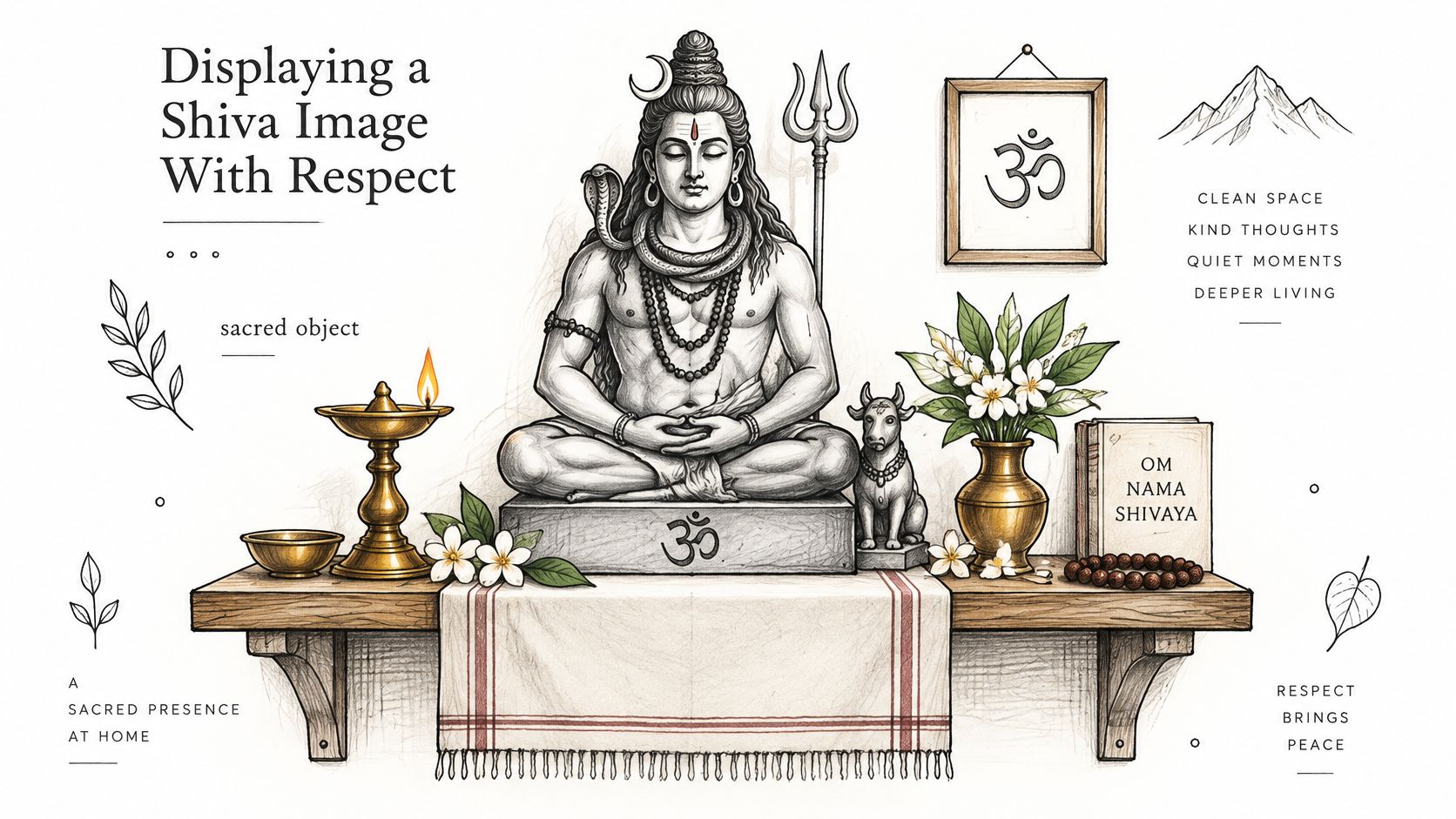
- Choose a clean, calm spot: A pooja room, meditation corner, or dedicated shelf works better than a crowded mantel.
- Raise it off the floor: A plinth, shelf, or shrine surface signals care and keeps the object safe.
- Avoid careless settings: Don't place it in a bathroom, beside bins, or where shoes and clutter gather.
- Label display pieces: A small note naming the form, date, and region turns décor into informed reference.
Wall-mounted pieces need the same thought. General guidance on how to style 3D wall sculptures can help with height and spacing, but sacred images need an extra step. Ask whether the presentation honours the subject, not just whether it fills a wall.
There's no universal placement rule that speaks for all Hindus. Consecration, lineage, household custom, and whether the image receives worship can matter more than a generic direction chart.
For ritual questions, ask a temple or a knowledgeable practitioner from the relevant tradition. For study, a museum-style label is appropriate. Decide first whether the image will be worshipped, studied, or admired, because that decision governs handling, offerings, cleaning, and where guests encounter it.
Confirm the Form and Context Before You Buy
Buy the form, not the nickname. Two statues both marketed through Shiva the Destroyer language can suit opposite rooms, one a dynamic Nataraja for considered display, the other a lingam or seated figure for a shrine. The checklist below keeps meaning ahead of impulse.

Five Checks Before You Commit
- Confirm the form: Is it Nataraja, lingam, Vishapaharana, Bhairava, Ardhanarishvara, or a family group?
- Check the attributes: Match drum, flame, gestures, vehicle, weapons, and companions against the form you think you're buying.
- Note date and region: Ask whether it's antique, contemporary, or made in an earlier regional style.
- Decide the role: Worship, study, meditation, or display each point to a different size, material, and placement.
- Choose material for the setting: Pick a finish you can maintain in that room's light and humidity.
Material changes the presence of the same iconography. Bronze Shiva sculptures have fine, crisp details and a warm metallic presence, while stone Shiva statues feel more architectural and grounded. Neither is automatically better. Bronze rewards close viewing of hands and ornaments, while stone often suits a quieter, weightier shrine or garden setting.
Our statues are suitable for home shrines, meditation rooms, and puja spaces, as well as for home decor and collections. We offer Shiva statues for sale to collectors in the UK and ship many bronze Shiva sculptures to the US and other countries. Before browsing, work through our guide to buying a Shiva statue online and choosing the right form, then answer one question. What is this statue meant to do in the room?
Browse our Shiva statues once you've settled the form, role, and material, whether you need a Nataraja for a collection, a lingam for a puja space, or a seated Shiva for meditation. Visit HD Asian Art to compare bronze and stone pieces with their iconography explained, so your choice starts from meaning rather than a misleading nickname.
