



How to Set Up a Buddhist Altar at Home: A Complete Guide
How to Set Up a Buddhist Altar at Home: A Complete Guide
Table of Contents
- What to Put on a Buddhist Altar: Essential Items and Their Purposes
- Where to Place a Buddhist Altar at Home: Choosing the Right Location
- Buddhist Altar Items and Their Meanings: A Complete Breakdown
- Step-by-Step: How to Arrange Objects on Your Buddhist Altar
- Creating a Buddhist Meditation Space at Home Around Your Altar
- Small Spaces, Rentals, and Temporary Setups: Making It Work Anywhere
- Keeping Your Altar Clean, Safe, and Respectfully Maintained
- Common Mistakes to Avoid When Setting Up a Buddhist Altar
- Frequently Asked Questions
What to Put on a Buddhist Altar: Essential Items and Their Purposes
Setting up a buddhist altar at home starts with understanding what the altar is for.
At HD Asian Art, we work with collectors and practitioners who care about both meaning and craftsmanship. This guide walks through what to place, where to place it, and how to keep it.
Most guides skip the practical questions. How do you handle a rental apartment? What if you have one shelf? We cover those too.
Where to Place a Buddhist Altar at Home: Choosing the Right Location
The best location for a home shrine is a quiet, clean spot you pass often but that is not a walkway. Height matters more than room size. Beyond that, the right spot depends on your housing situation, your household, and how you actually practice.
Aim for these conditions:
- A high position, ideally at chest level or above
- A clean space away from bathrooms, shoes, and floor traffic
- Good light, but not direct harsh sun
Matching the Location to Your Space
A dedicated room is ideal but rare. Most practitioners work with one of these setups:
- Living room corner. The most common choice. Pick a corner away from the TV and the main traffic path. A corner shelf or a small side table works.
- Bedroom. Works if the altar does not face the bed directly. Some practitioners prefer to cover the image at night with a small cloth. If you share the room, ask your partner before committing to a spot.
- Hallway or entry shelf. A narrow wall shelf at chest height keeps the altar out of the way while keeping it visible. Avoid spots where people brush past it or set down keys and mail.
Placement Rules That Vary by Tradition
Some placement advice is broadly shared; some is tradition-specific. In general, most traditions agree the altar should be elevated, clean, and set apart from ordinary clutter. Beyond that:
- Many Tibetan Buddhist practitioners place the altar so the central figure faces east or sits on the highest surface in the room.
- Zen setups often favor simplicity and a low, stable platform rather than a tall shelf.
- Some traditions place the altar against a wall so there is a solid backing; others are comfortable with a freestanding setup.
If you have a teacher or a local community, follow their guidance over any general rule. Where you have no teacher, choose a spot that supports consistent practice and treat the rest as preference, not requirement.
What to Avoid
- Bathrooms and spaces directly under or over a toilet
- The floor where people walk
- Directly beneath a television, a loud speaker, or a busy doorway
If your only option is a spot that is not ideal, use it anyway. A slightly imperfect altar you actually use is better than a perfect one you never visit.
Buddhist Altar Items and Their Meanings: A Complete Breakdown
A traditional Buddhist shrine holds a small set of objects, each with a purpose. Beginners often buy too much. Start with the core items and add later.
The essentials:
- A Buddha statue or Buddha image as the central focus
- A small table, shelf, or cloth-covered surface
- An incense holder
Optional items include a singing bowl, a mala, a small photo of a teacher, or a memorial plaque for ancestors.
The Five Standard Offerings and What They Represent
Many traditions arrange five offerings in front of the central image. Each one stands for something specific.
| Offering | Represents | Simple Alternative |
|---|---|---|
| Water | Purity and clarity | A small clean bowl |
| Flowers | Impermanence | Fresh or dried flowers |
| Incense | Discipline and devotion | A single stick |
| Light | Wisdom | A candle or small lamp |
| Food | Gratitude | Fruit or a small bowl of rice |
You do not need all five every day. Water and a light are the easiest to keep up.
Step-by-Step: How to Arrange Objects on Your Buddhist Altar
Arrange your altar from the center outward, with the largest and most important object in the middle and smaller items in front. Height signals importance, so place the central image highest and offerings below it.
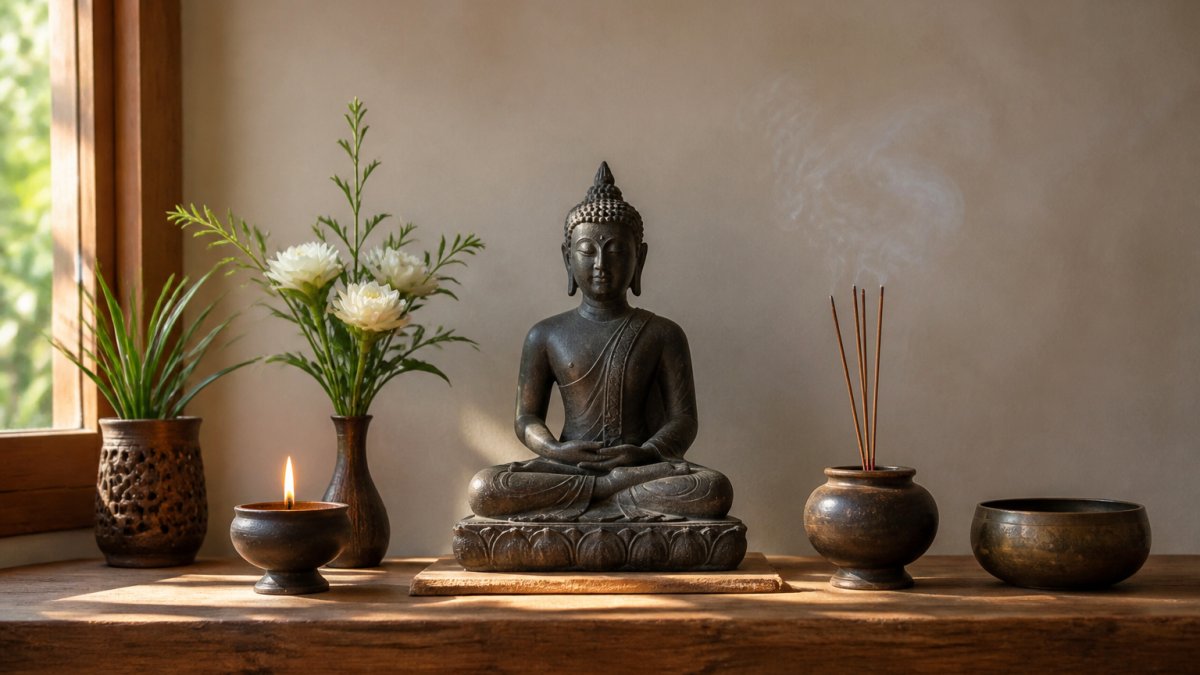
The Basic Layout
Follow these steps:
- Clear and wipe the surface. A clean start sets the tone.
- Place a cloth if you want one. Natural fabric in a muted color works well.
- Set the Buddha statue or image at the back center, at eye level when seated.
- Place taller items behind, shorter items in front so nothing blocks the view.
- Put the incense holder slightly to one side, not directly under the statue.
- Add the candle or lamp on the opposite side.
- Place flowers and the water bowl at the front.
- Step back and check the balance. Adjust until it feels calm.
What Is Required vs. What Is Optional
Beginners often assume they need a full set of objects before they can start. They do not. Most teachers and communities treat a small number of items as the practical minimum.
Useful to start:
- A Buddha statue or image as the central focus
- A clean surface or small table
- A bowl for water
Optional, add as your practice grows:
- Incense and an incense holder
- A small vase for fresh flowers
- A singing bowl
You do not need to buy anything specialized. A clean glass of water and a plain candle are enough to begin.
Tradition-Specific Arrangements
How you arrange the objects depends partly on the tradition you follow.
- Tibetan Buddhist altars commonly include seven offering bowls in a row, filled with water and arranged front to back in a specific order. The central image may be a Buddha, a deity, or a lineage figure, and thangkas or framed images often sit behind the statue.
- Zen altars tend to be spare: a single Buddha or Bodhisattva figure, a candle, an incense holder, and a small bowl. Less is treated as more.
- General or non-sectarian altars usually follow the five-offering pattern (water, flowers, incense, light, food) with a single central image.
Neither approach is more correct. Match the altar to the practice you actually keep. If you have a teacher, ask them how they arrange their own altar.
Small-Space and Temporary Layouts
If you have one shelf, a desk, or a windowsill, you can still arrange a complete altar. The principle is the same: central image highest, offerings in front, nothing blocking the view.
- One shelf: statue at the back, a small bowl and a candle in front, incense holder to one side.
- A desk: use the back corner. A small statue, a water bowl, and a single candle fit without crowding your work area.
- A windowsill: a single statue and a small bowl. Skip the candle if the sun hits it directly.
Common Arrangement Mistakes
- Crowding the surface until the central image is hidden
- Placing the incense holder directly under the statue, where ash falls on it
- Putting the altar too low, at floor or ankle height
Start with a Buddha statue, a candle, and a bowl of water. Add the rest as your practice grows. If you want a piece with real presence and a clear history, browse the HD Asian Art collection of Buddhist and Hindu statues, handpicked for altars and meditation rooms, with free shipping. These physical objects serve as anchors for the mind, providing a stable foundation for starting a spiritual practice that extends well beyond the boundaries of the altar itself.
Creating a Buddhist Meditation Space at Home Around Your Altar
A Buddhist meditation space at home is the area around your altar where you sit. The altar supports the practice; the space makes it usable.
Keep a cushion or low bench within arm's reach. Leave enough room to sit without moving furniture each time.
Small additions help:
- A timer or bell to mark the session
- A blanket for cooler rooms
- A small shelf for a book of chants or readings
The goal is a setup you can use in under a minute. Friction kills daily practice faster than lack of motivation.
Small Spaces, Rentals, and Temporary Setups: Making It Work Anywhere
You can keep a respectful altar in a studio apartment or a rented room. Size is not the measure of sincerity.
Options that work well:
- A wall shelf at chest height
- A small cabinet that closes, useful if you need to put things away
- A windowsill with a single statue and a small bowl
For rentals, avoid drilling if your lease restricts it. Adhesive hooks and freestanding shelves solve most problems. For temporary setups, keep a small cloth and wrap the statue when you travel or move.
Keeping Your Altar Clean, Safe, and Respectfully Maintained
A clean altar is a maintained altar. Set a simple routine and it takes minutes.
- Wipe the surface weekly with a dry or barely damp cloth
- Replace water daily and empty it before it sits
- Trim incense ash and empty the holder before it overflows
For care of your statue itself, follow the guidance that comes with the piece.
Dispose of offerings with care. Old flowers, water, and ash can go outside in a garden or a clean bin. The point is attention, not ritual precision.
Common Mistakes to Avoid When Setting Up a Buddhist Altar
Most beginner mistakes come from buying before planning. Fix the space first, then choose the objects.
Watch for these:
- Placing the altar too low, at floor or ankle height
- Crowding the surface until the central image is hidden
- Choosing a location next to a TV, a messy desk, or a loud doorway
A common mistake is copying a photo of someone else's altar exactly. Their space, tradition, and practice are not yours.
Start with a Buddha statue, a candle, and a bowl of water. Add the rest as your practice grows. If you want a piece with real presence and a clear history, browse the HD Asian Art collection of Buddhist and Hindu statues, handpicked for altars and meditation rooms, with free shipping.
Frequently Asked Questions
Where should a Buddhist altar be placed at home?
Choose a quiet, elevated spot in a living room, study, or dedicated meditation area. The altar should face the room's entrance so it is visible when you walk in, but not be placed in a bathroom, directly on the floor, or in a high-traffic hallway. A shelf, table, or cabinet at chest height or above works well. Avoid placing it under stairs or in areas where people walk over it.
Does a Buddhist altar need a Buddha statue?
A Buddha statue or image serves as the central focus of most Buddhist altars, but it is not strictly required. Some practitioners use a simple framed image, a calligraphy scroll, or a natural object like a stone or flower. The purpose is to have a visual anchor for attention and respect. If you do use a statue, choose one that feels meaningful to you and place it at the highest point on the altar.
Can a Buddhist altar be set up in a small space?
Yes. A small shelf, windowsill, or corner of a desk can serve as a functional altar. Use a single statue or image, one small incense holder, and a tiny candle or LED light. Wall-mounted shelves work well in apartments. The size of the altar does not determine its effectiveness; consistency of practice and a respectful attitude matter far more than square footage.
How do you use a Buddhist altar for meditation?
Sit facing the altar at a comfortable distance. Begin by offering incense or lighting a candle if you wish, then bring your attention to the statue or image. Use it as a focal point for calm abiding or as a reminder of the qualities you are cultivating. Many practitioners bow three times before and after sitting. The altar supports your meditation space at home by giving your practice a consistent, dedicated location.
Setting up a home shrine raises real questions: what belongs on it, where it should sit, and how to keep it meaningful over time. HD Asian Art can help you answer the part that matters most, choosing a central image worth building around. Our collection includes carefully curated Buddhist and Hindu statues, handpicked antique and contemporary pieces, and Khmer and Southeast Asian sculptures with temple-inspired presence. Browse the collection and find the focal point for your practice.
