



Choosing Small Buddhist Statues: A Guide for Collectors
Choosing Small Buddhist Statues: A Guide for Collectors
When you search for small Buddhist statues online, the choice can become confusing very quickly. One listing presents a serene bronze figure, another a brightly painted resin Buddha, while a third focuses almost entirely on height and price. You may be looking for a meaningful gift or a compact altar piece, yet the product page tells you little about the figure's region, mudra, material, or appropriate placement.
A small statue deserves more consideration than its dimensions suggest. It may represent a specific Buddhist tradition, contain delicate historic finishes, or have been constructed as a devotional object rather than a general ornament. The right choice balances iconography, material, condition, provenance, and respectful use, not appearance alone.
Table of Contents
- Understanding Small Buddhist Statues for Your Home
- Navigating Iconography and Regional Styles
- Selecting the Right Size and Material
- Displaying and Caring for Your Statue
- Ensuring Safe Delivery of Fragile Pieces
- Debunking Myths About Affordable Buddhist Art
- Your Guide to Meaningful Buddhist Statue Selection
Understanding Small Buddhist Statues for Your Home
A reader recently described the familiar buying experience perfectly: after searching for a modest Buddha for a meditation corner, she had opened several tabs and found dozens of nearly identical figures. Some were labelled Thai, others Japanese or just “Buddha ornament”. Their sizes seemed comparable, but the photographs revealed very different postures, facial expressions, finishes, and bases.

The difficulty isn't a lack of choice. It's that many listings reduce a culturally specific object to a decorative category. A seated figure with hands resting in the lap communicates something different from one touching the ground, raising a palm, or holding an attribute. Even when a buyer chooses primarily for interior design, understanding those differences prevents an accidental mismatch between the statue and its intended setting.
Small does not mean simple
“Small” is a practical description, not an artistic or religious category. A compact Buddha may be intended for a personal altar, a portable shrine, a household display, or a collector's cabinet. The British Museum's record of a Tang-dynasty carved wooden Buddha gives a useful example. The figure measures 9.40 cm high and 6.60 cm wide, is seated cross-legged on a lotus pedestal, and displays Dhyāna mudrā, the meditation gesture, with a documented 9th-century date and provenance from Cave 17 at Qian Fo Dong, the Cave of a Thousand Buddhas (British Museum object record for the carved wooden Buddha).
That example shows why scale alone can't determine significance. A very small figure may preserve information about devotional practice, regional style, construction, and collecting history. For a home, it should also be proportionate to the surface around it, stable enough to handle safely, and placed where it won't be treated as an incidental trinket.
Start with intention
Before comparing finishes, decide what role the statue will have. A meditation room may suit a quiet seated figure with restrained decoration. A gift may call for a recognisable posture and a short explanation of its meaning. A collector may prioritise material, date, regional attribution, or documented condition.
A considered object can also support a calm interior without overcrowding it. If you're arranging several meaningful pieces, advice on how to achieve a clutter-free personalized home can help you give the statue visual space rather than surrounding it with unrelated ornaments.
Navigating Iconography and Regional Styles
Regional style is more than a colour preference. It reflects workshop practice, religious context, available materials, and established conventions for the Buddha's body, robes, throne, hair, and hand gestures. A buyer who learns to read these features can distinguish a purposeful selection from a generic figure described only by its finish.
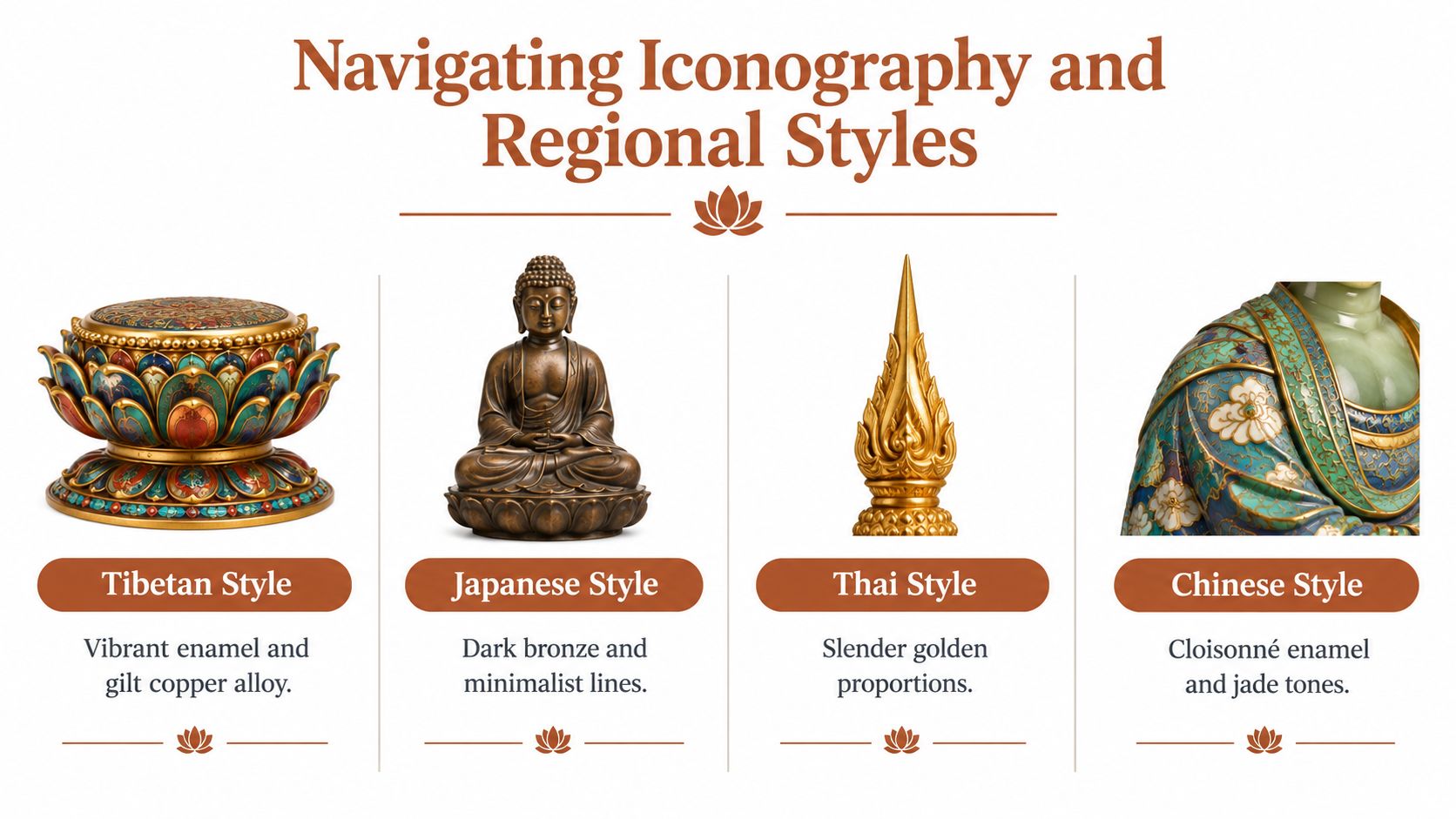
Read the gesture before the colour
The hands often provide the quickest route into the figure's meaning.
- Dhyāna mudrā: Both hands rest in the lap, commonly associated with meditation and contemplative stillness.
- Bhūmisparśa mudrā: One hand reaches towards the ground, recalling the Buddha's calling of the earth to witness.
- Abhaya mudrā: A raised open palm communicates reassurance or fearlessness.
- Varada mudrā: A lowered open hand is associated with generosity and giving.
These gestures shouldn't be treated as interchangeable decorative details. A seller should identify them accurately, and a serious buyer should be wary when the product title says only “peaceful Buddha” while the photographs clearly show a particular mudra.
The British Museum's Japanese Buddhist holdings contain about 1,000 objects, spanning from the 8th century to the present, with most dating from the 18th and 19th centuries. The collection includes sculptures, paintings, portable shrines, ritual objects, and votive objects, providing useful context for why many small Japanese Buddhist statues belong to portable devotional traditions rather than monumental temple art (Courtauld research on the British Museum's Japanese Buddhist holdings).
Compare regional cues carefully
Thai figures often have elegant, elongated proportions, refined robes, and a pronounced ushnisha, sometimes shaped into a flame-like finial. Burmese figures commonly show a broad, composed presence, carefully modelled robes, and, in some examples, lacquer and gilding that require particularly cautious handling. Chinese figures may feature fuller robes and a more rounded modelling of the body, while Japanese statues often favour concentrated expression, controlled surfaces, and compact devotional formats.
Those are useful tendencies, not rigid rules. Later commercial pieces may deliberately combine features, and a regional label shouldn't be accepted without examining the whole object. The regional Buddha statue styles guide is useful for comparing Thai, Burmese, Chinese, Tibetan, and Gandharan characteristics before you buy.
Museum collections also demonstrate that Buddhist sculpture has never been a single visual language. The Amaravati reliefs in the British Museum were made to decorate the exterior of a stupa, while the Great Shrine of Amaravati was founded around 200 BC in what is now Andhra Pradesh (British Museum gallery on the Amaravati sculptures). That early architectural context differs sharply from a small household statue, but it reminds us to ask what an object was made to do, not just what it looks like.
Selecting the Right Size and Material
The best material depends on where the statue will live, how often it will be moved, and whether the object is intended as a gift, a devotional focus, or a collection piece. A compact statue can fit a narrow shelf, but a small footprint doesn't remove the need for a stable base or adequate clearance around fragile projecting parts.
Bronze and brass generally offer visual weight and resilience. They can work well in a busy household, provided the surface isn't aggressively polished. Wood has warmth and tactile character, but it responds to changes in the indoor environment and can be vulnerable around joins, old repairs, or carved projections. Resin is accessible and light, though it often gives less information about traditional construction and may be unsuitable for someone seeking a material with lasting collector interest.
Lacquerware can be exceptionally attractive, especially where black, red, gilded, or mirror-like surfaces create depth. It also demands restraint. A glossy surface isn't permission to use household polish, and a statue with glass inlay or pigment needs the same caution as a mixed-media artwork.
Match the object to the setting
| Intended use | What usually works | What to question |
|---|---|---|
| Home altar | Stable bronze, wood, or carefully finished composite | A narrow base or unstable halo |
| Meditation room | Quiet posture and restrained surface treatment | Decorative clutter around the figure |
| Gift | Clear iconographic explanation and manageable size | A vague regional description |
| Collector's shelf | Documented material, condition, and provenance | Fresh-looking surfaces with no conservation information |
| Damp or variable environment | Durable metal in a protected interior position | Unsealed wood, lacquer, or porous stone near moisture |
UK listings show a broad spread, from low-cost marketplace pieces to specialist offerings. Indexed listings range from about £3.25 to £143.56, with an average around £19.38, while dedicated retailers also offer small pieces in the £35 to £85 range and above (UK religious statue listings). That spread doesn't prove that an expensive object is better. It does show why price should be considered alongside construction, cultural specificity, and condition.
For a practical comparison of bronze, brass, stone, wood, and resin, consult this guide to Buddha statue materials. A modest budget can still buy a meaningful piece, but the listing should tell you what you are buying.
Displaying and Caring for Your Statue
A respectful display begins with placement, not cleaning. Choose a secure, level shelf above floor level, away from a radiator, draughty window, or damp windowsill. Traditional household practice varies, so avoid presenting one universal rule as mandatory. The consistent principle is to place the statue deliberately, in a clean area where people won't knock against it or use it as a casual storage surface.
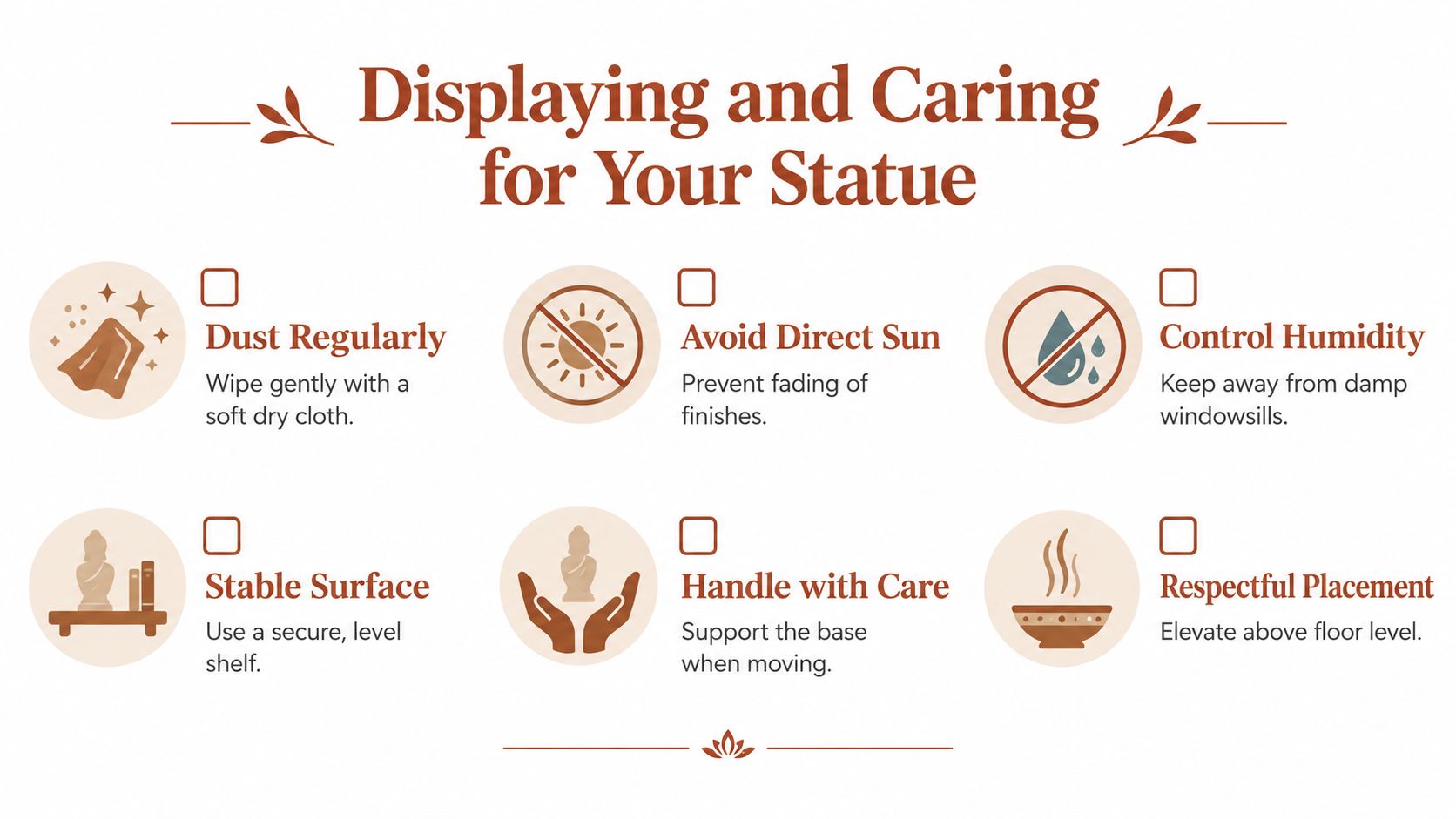
Use a light-touch routine
Dust regularly with a soft, dry cloth, supporting projecting elements rather than dragging the cloth across them. Don't lift a statue by its halo, hand, crown, or other attached feature. When moving it, place both hands around the body and base, and clear the route before you pick it up.
Direct sunlight can fade pigment, warm finishes unevenly, and make gilding appear patchy over time. Humidity is equally relevant in UK homes, particularly near bathrooms, kitchens, unheated conservatories, and external walls. A stable interior shelf is safer than a picturesque but exposed windowsill.
Practical rule: If you can't identify the surface, don't apply a liquid cleaner.
Treat decorated surfaces as vulnerable
UK conservation guidance stresses material-specific treatment because small Buddhist statues may combine lacquer, gilding, pigment, glass inlay, and wood. These surfaces can be highly solvent-sensitive. In the V&A's treatment of a Burmese Buddha, conservators described the lacquered surfaces as “very delicate” and used water-based gels over Japanese tissue, with the tissue and wax acting as a barrier to protect lacquer and gilding from moisture (V&A conservation treatment of a Burmese Buddha).
That approach is a conservation methodology, not a recommendation to wash a household statue. For a decorated object, localised and barrier-protected cleaning is safer than direct aqueous cleaning. Household sprays, metal polish, cotton buds pushed into recesses, and abrasive cloths can dull lacquer or lift gilding permanently.
If the statue has flaking pigment, loose inlay, a cracked base, or a powdery surface, stop dusting and seek a conservator's advice. A stable-looking object may still have a vulnerable finish beneath surface dirt.
Ensuring Safe Delivery of Fragile Pieces
Safe delivery starts before checkout. A small Buddhist statue may have a thin halo, extended fingers, a projecting crown, a separate base, or an old repair that isn't obvious in a front-facing photograph. Ask the seller how the piece will be supported, whether the object is wrapped separately from its accessories, and whether the package is designed to prevent movement rather than fill empty space.
Good packaging protects in layers. The statue should be immobilised at its strongest points, with cushioning around the object but not pressure on fragile projections. A box within a box can reduce impact transfer, while a clear condition record gives the buyer a reference if damage appears on arrival. Loose packing material that allows the statue to shift is not an acceptable substitute for structural support.
Ask useful questions before purchase
- Request dimensions: Confirm height, width, depth, and base dimensions, not just the figure's height.
- Ask about vulnerable areas: Check the condition of fingers, halo, crown, lotus petals, and joins.
- Clarify returns: Read the seller's process for reporting transit damage before ordering.
- Check photographs: Request underside, rear, and close-up images where the listing doesn't show them.
- Plan the first inspection: Open the parcel on a clear surface and photograph the packaging before moving the object.
Conservation evidence explains why these questions matter. In a documented V&A case, a 14th-century Tibetan copper-alloy Buddha appeared comparatively light, and a crack at the rear led to X-radiography. Imaging confirmed that the sculpture was hollow and helped conservators avoid destabilising handling; spectroscopy then helped identify coating layers and inform treatment decisions (JCMS case study on the Tibetan copper-alloy Buddha).
The same principle applies after delivery. A light statue with visible cracking may contain a cavity or previous repair seam. Don't clean, transport, or display a damaged figure until its condition has been assessed. Guidance on shipping large bronze Buddha sculptures also reinforces a point relevant to smaller pieces: packaging must respond to the object's construction, not merely its weight.
Debunking Myths About Affordable Buddhist Art
Affordable doesn't automatically mean meaningless, and a high price doesn't automatically establish quality. A small, well-proportioned figure made from an honest material may be a more satisfying purchase than a larger object with an unclear regional label, unstable construction, or misleading surface treatment.
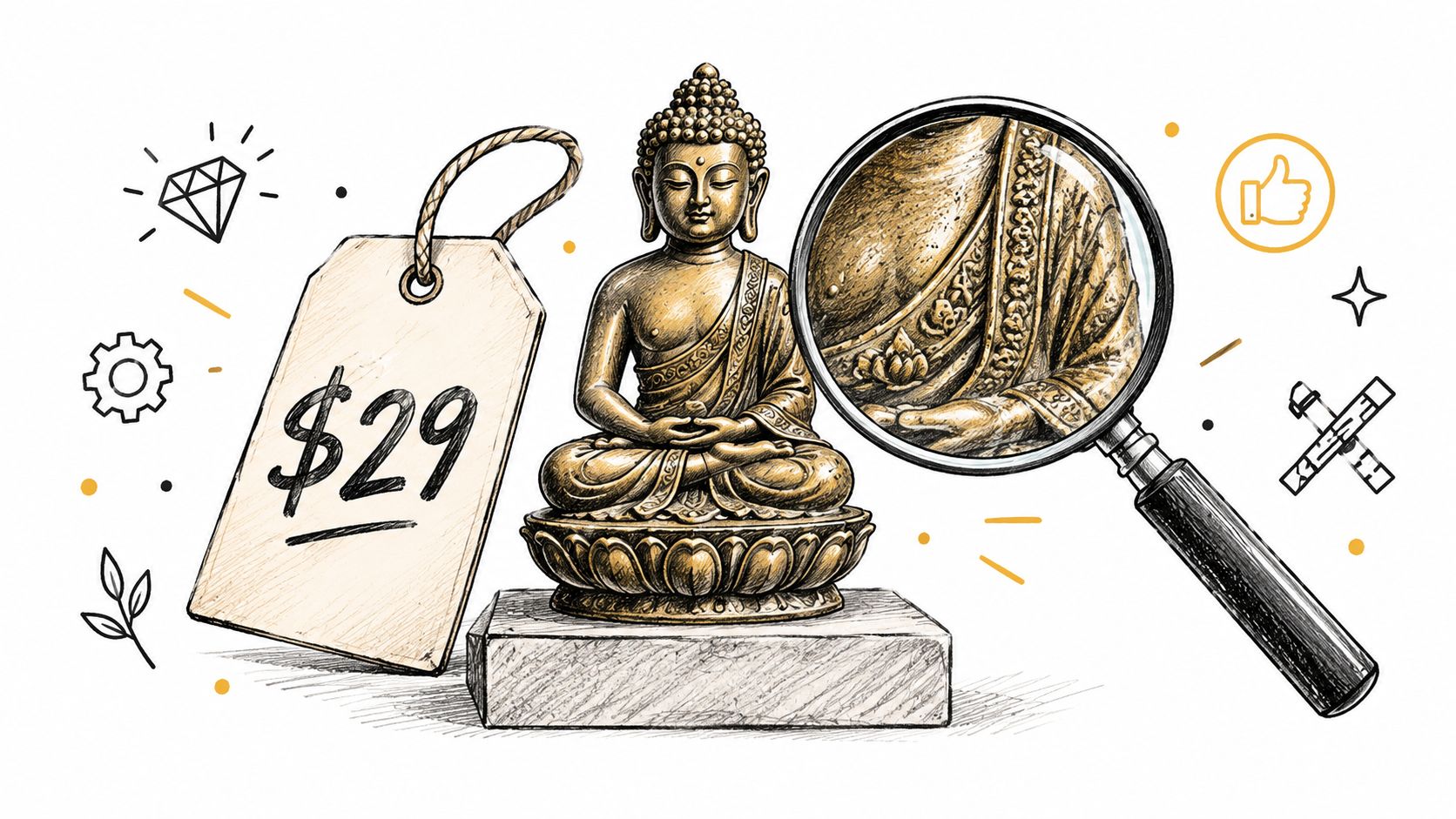
The opposite assumption is also unreliable. A low price can reflect resin production, simplified modelling, modern manufacture, or mass-market distribution. It can also reflect a small scale, plain finish, or a seller clearing stock. The buyer's task is to identify what the price represents rather than treating cost as a shortcut for spiritual or artistic value.
Assess value through evidence
Look for a clear description of material, dimensions, posture, region, condition, and intended use. Photographs should show the base and sides, not only the most flattering angle. If the listing claims age or rarity, ask what supports that claim. A generic “antique-style” description is not the same as documented provenance.
The UK market includes very low-cost marketplace figurines as well as specialist pieces priced substantially higher. Specialist UK garden ranges currently show small Buddhist pieces across materials including resin, wood, bronze, brass, and stone-like finishes, with advertised prices from under £20 to around £45 to £729 (UK statue listings and ranges). Those figures describe market positioning, not quality by themselves.
A practical buyer can choose affordably by prioritising sound construction, accurate iconography, and honest description. The statue doesn't need to be rare to be appropriate. It does need to be treated as more than a generic gold-coloured ornament.
Your Guide to Meaningful Buddhist Statue Selection
A meaningful purchase begins with a clear purpose. Decide whether the statue is for meditation, gifting, collecting, or an interior that needs a quiet focal point. Then examine the figure's posture and mudra before considering colour or finish. A listing that explains those features gives you more to work with than one that offers only a size and a price.
Material determines both character and care. Bronze and brass can provide durability and visual weight, while wood offers warmth and evidence of carving. Resin may suit a low-cost decorative purchase, but it tells you less about traditional making unless the seller provides fuller information. Lacquer, gilding, pigment, and glass inlay need particular restraint because their surfaces may be more fragile than they appear.
A collector's final checks
- Identify the form: Record the mudra, posture, throne, attributes, and regional cues.
- Inspect the construction: Look for cracks, loose parts, separate bases, repairs, and signs that the figure may be hollow.
- Check the environment: Choose a stable shelf away from direct sun, damp, heat, and accidental contact.
- Plan the care: Use dry, gentle dusting unless a conservator gives material-specific advice.
- Review delivery: Confirm protective packaging, insurance or returns arrangements, and the seller's condition documentation.
- Keep the context: Save the description, photographs, purchase record, and any information about origin or previous ownership.
The V&A's specialist Buddhist galleries, created through a later two-phase redevelopment after the UK's first dedicated Buddhist sculpture gallery opened there in 2009, now bring together sculptures, paintings, and ritual objects from across Asia (Victoria and Albert Museum Buddhist art project). That institutional context is useful for private buyers because it places small Buddhist statues within a wider field of art, ritual, and material culture.
Choose slowly, ask precise questions, and give the finished object enough space to be seen and respected. The most successful purchase is not necessarily the largest or most ornate. It's the one whose form, material, condition, and intended setting make sense together.
HD Asian Art offers compact Buddha statues organised by region and material, alongside Burmese lacquerware and knowledge resources about meaning, forms, and placement. Visit HD Asian Art to compare small pieces for home altars, thoughtful gifts, and serious collections, then contact the specialist team if you need help assessing a statue's style or care requirements.
