



Crying Buddha Statue: True Story, Symbolism, & Tips
Crying Buddha Statue: True Story, Symbolism, & Tips
The familiar advice to buy a crying Buddha statue as an ancient symbol of divine sorrow deserves scrutiny. A moving expression doesn't establish a sculpture’s religious identity, age, or traditional meaning. Collectors gain more from asking what the object depicts, how it was made, and which claims its documentation can support.
Table of Contents
- The Truth Behind the Tears
- Legends of the Weeping Leshan Giant Buddha
- Deconstructing the Crying Buddha Motif
- Modern Interpretations and Contemporary Meanings
- A Collector's Guide to Judging Authenticity
- How to Preserve Your Statue
- Is a Crying Buddha Right for Your Space
- Frequently Asked Questions
The Truth Behind the Tears
A sorrowful face can communicate something immediate: grief, tenderness, exhaustion, or compassion. That emotional response is real, but it isn't the same as an art-historical identification. A sculpture can feel spiritually meaningful without belonging to an established Buddhist image tradition.
The phrase crying Buddha creates confusion because sellers and storytellers apply it to different things. It can describe a deliberately carved sorrowful figure, an image associated with a weeping legend, or a statue with wet-looking marks beneath its eyes. Those descriptions don't necessarily identify the same subject or origin.

Separate the object from the interpretation
The first distinction concerns what a viewer can observe and what someone believes it means. A carved tear is a physical feature. A claim that the figure removes sorrow is an interpretation that needs its own cultural context.
Descriptions of the weeping Buddha motif assign meanings such as compassion, mourning, and repentance, but those meanings vary by seller and audience. They shouldn't be presented as a single teaching accepted across Buddhist traditions.
A useful starting point separates several questions:
- Visible form: Does the sculpture show tears, a lowered head, or a face hidden by the hands?
- Claimed identity: Does the seller identify a particular Buddha, bodhisattva, or regional subject?
- Supporting context: Does an inscription, documented history, or reliable comparison support that identification?
This approach doesn't diminish the sculpture’s emotional appeal. It allows appreciation without turning a retail description into religious authority, and it leaves room for uncertainty where the evidence remains incomplete.
Legends of the Weeping Leshan Giant Buddha
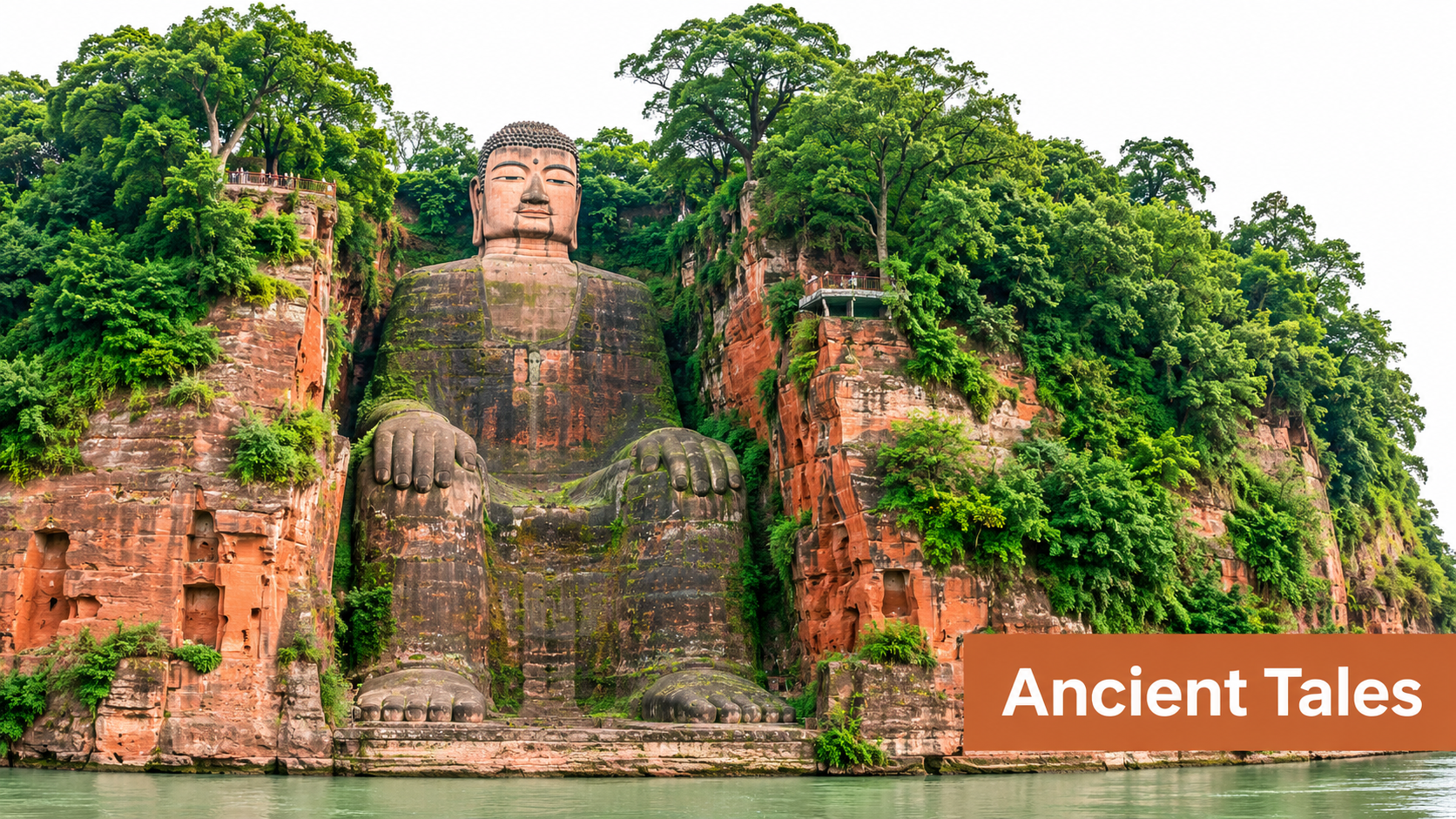
The most prominent crying-Buddha stories concern a monument rather than a small sorrowful carving. At Leshan in Sichuan, China, a vast image of Maitreya sits carved into a cliff. Its scale and long history help explain why changes in its appearance attract such attention.
China Underground’s account of the Leshan legends describes a Tang-dynasty monument approximately 71 meters (233 feet) high, begun under the monk Haitong in 713 CE and completed around 803 CE. The same account records reported weeping or eye-closing episodes in 1962, 1963, and 1976, with the latter especially associated with the 7.8-magnitude Tangshan earthquake.
What the stories preserve
In these accounts, moisture and darkened areas around the eyes become expressions of shared suffering. Observers connect a familiar sacred face with events too painful to regard as ordinary. The monument appears to participate in mourning.
That interpretation matters as cultural history. It reveals how people give public tragedy a visible form and attach meaning to changes in a revered image. It doesn't, however, verify that the statue produced tears or deliberately closed its eyes.
A legend can document human responses to disaster without proving a supernatural event.
What the surface can explain
Modern explanations focus on the statue’s physical condition: rainwater entering cracks, drainage, weathering, pollution, and changing light. These processes can produce streaks, stains, shadows, and altered contrasts around the eyes.
The distinction is between an observation and its proposed cause. Someone may accurately observe a dark trail beneath an eye while interpreting that trail in a way that physical evidence doesn't establish.
Leshan therefore shouldn't be treated as proof of an ancient category of tear-producing Buddha statues. Nor does the monument establish the ancestry of every wooden figure sold under a similar name. A historical monument, the legends surrounding it, and a contemporary decorative carving each require separate examination.
Deconstructing the Crying Buddha Motif
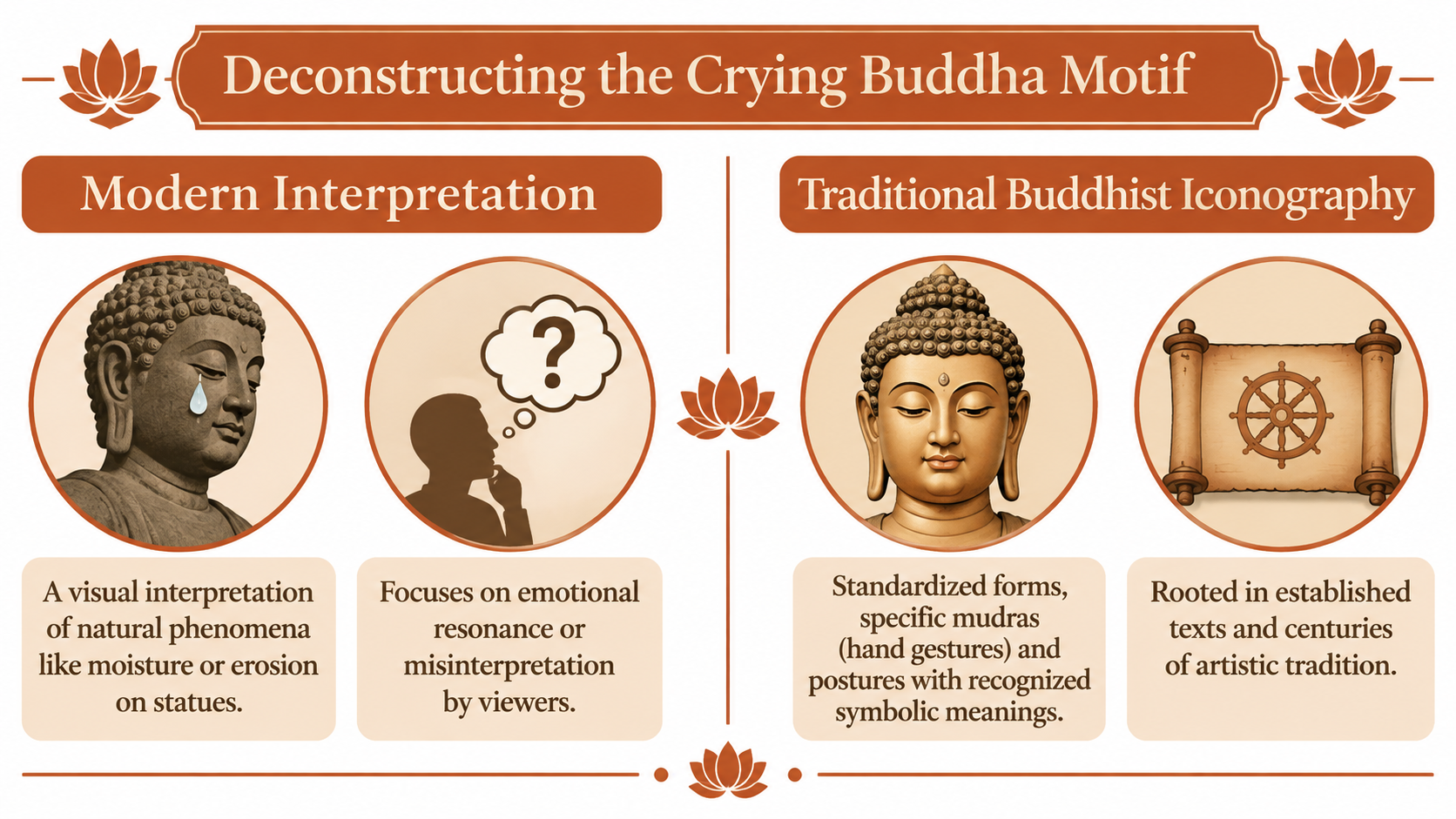
Iconography means the features used to identify a subject and communicate its meaning. In Buddhist art, posture, hand position, bodily attributes, and accompanying details help establish what an image represents. Facial emotion alone isn't enough.
Le Monde’s explanation of Buddha representations provides context for established attributes such as the ushnisha, urna, halo, and mudras. These belong to developed systems of representation, unlike a general retail description based on sadness or apparent tears.
Identify the attributes before assigning meaning
A careful description starts with observable details rather than an appealing story. The following vocabulary helps distinguish established identifying features from an expressive addition.
| Feature | Plain-language description | Identification value |
|---|---|---|
| Ushnisha | A cranial prominence | An established attribute of Buddha imagery |
| Urna | A mark between the eyebrows | An established iconographic feature |
| Mudra | A particular hand gesture | Helps interpret the depicted figure or action |
| Halo | A surrounding radiant form | Part of established sacred imagery |
| Tear or sorrowful expression | An emotional or surface feature | Doesn't establish a standardized Buddhist subject |
These features still require context. A label should consider regional style, technique, inscriptions, and the relationship between the attributes, not merely note that a familiar detail appears.
For example, a seated figure hiding its face in its hands may communicate distress clearly. That pose alone doesn't establish that it depicts the historical Buddha, explain its regional origin, or connect it with a particular teaching.
Distinguish a motif from an established subject
A motif is a recurring visual idea. Crying can function as a motif across different objects without turning those objects into a single recognized religious type.
This distinction also prevents a misleading either-or judgment. A contemporary sculpture isn't necessarily meaningless because it departs from traditional imagery, and a conventionally rendered image isn't automatically old. Religious identification, artistic interpretation, and date answer different questions.
Collectors can describe uncertainty directly: a contemporary sorrowful figure marketed as a weeping Buddha, for example. That wording acknowledges both the object’s presentation and the limits of the identification. It is more useful than assigning a specific religious meaning that neither the sculpture nor its records can support.
Modern Interpretations and Contemporary Meanings
For some viewers, a sorrowful sculpture gives visible expression to feelings that are difficult to articulate. Its value may lie in prompting reflection rather than representing a precisely identified religious subject. Contemporary meaning can be personal without being historically ancient.
Commercial and devotional descriptions commonly associate the motif with compassion for suffering or relief from grief. Such interpretations should remain attributed to their context rather than presented as guaranteed effects of ownership. A statue doesn't need a promise of healing to serve as a meaningful memorial object.
Different intentions produce different readings
The distinction becomes clearer when attention shifts from what the object supposedly does to how a person understands it.
- Compassion: A viewer may interpret the expression as an invitation to respond more gently to suffering.
- Remembrance: A household may choose the figure to acknowledge bereavement or preserve a personal association.
- Reflection: Someone may use the sculpture as a focus for contemplating sadness without claiming that it changes external events.
These are possible uses, not universal Buddhist instructions. They also don't justify assumptions about every owner’s beliefs or emotional state.
When apparent tears become a public event
The account of Myanmar’s Maravijaya Buddha records that dark or wet-looking stripes beneath its eyes prompted reports of “crying” in March 2023. Authorities associated with the statue reportedly covered its face, restricted visitors, and prohibited photography.
The response demonstrates how quickly an ambiguous mark can acquire public significance. Access restrictions can also limit opportunities to examine what viewers believe they have seen.
This episode shouldn't be confused with a sculpture deliberately carved to appear sorrowful. One concerns an interpretation of surface markings; the other concerns an artist’s chosen form. Both can provoke strong reactions, but the physical circumstances differ.
Personal significance doesn't require a miracle claim, and an unexplained mark doesn't establish one.
A Collector's Guide to Judging Authenticity
“Authentic” is too broad to be useful unless the seller explains what the word covers. A newly carved sculpture can be authentic workshop production, while an old object can still carry an inaccurate attribution. Age deserves examination, but it shouldn't replace every other judgment.
For Buddhist statues offered as authentic, buyers should separate workmanship, substance, and ownership history. The same questions apply whether a listing describes a crying Buddha statue as contemporary, antique, or temple-associated.
Three Pillars of Statue Authenticity
| Type of Authenticity | What to Look For | Why It Matters |
|---|---|---|
| Craft authenticity | Named artisan or workshop where known, clear technique descriptions, detailed photographs | Connects claims about workmanship to something buyers can examine |
| Material authenticity | Written material identification and disclosure of coatings, repairs, and replacements | Helps establish what the object contains and how it should be cared for |
| Provenance authenticity | Collection records, prior sale documentation, supported origin claims, applicable export paperwork | Allows buyers to assess the stated history and legal movement |
Turn claims into answerable questions
Craft assessment begins with the seller’s language. If a listing says “hand-carved,” buyers can request close photographs and a description of the process. If it names a workshop, the invoice should preserve that attribution rather than substitute a less specific description.
Material assessment should distinguish the body of the sculpture from its surface. A bronze object may also carry lacquer, paint, gilding, or pigment. Buyers should ask whether visible finishes are original, later additions, or of uncertain date, rather than treating appearance as a complete material identification.
Provenance assessment requires records, not only a persuasive story. A statement such as “from a temple” should prompt a request for supporting documents and clarification of who supplied that information.
A practical request list includes:
- Obtain written claims: Ask the seller to record the proposed age, origin, material, and attribution.
- Request complete views: Examine the base, back, underside, and damaged or restored areas.
- Trace earlier ownership: Seek collection records or previous sale documents where available.
- Clarify legal movement: Ask for export documentation where applicable, without assuming a document proves every other claim.
A seller’s willingness to distinguish known facts from uncertain opinions is useful in itself. Missing records don't automatically prove wrongdoing, but they should limit the certainty of the description and the buyer’s confidence.
A transparent contemporary work may therefore be the more responsible acquisition than an allegedly ancient piece with an unsupported history. That is a judgment about evidence and suitability, not a promise of resale value.
How to Preserve Your Statue
Care should follow the statue’s material and condition, not its retail name. A sorrowful wooden carving, a painted bronze, and a weathered stone image shouldn't receive an identical cleaning treatment. When a finish is uncertain, minimal intervention is safer than an attempt to make it look new.

Begin with dry, gentle care
For antique objects, HD Asian Art’s conservation guidance recommends soft dry dusting and stable environmental conditions. Despite the bowl shown in the illustration, water isn't part of the recommended routine for an antique or unidentified surface.
A soft, dry brush or cloth should touch only stable areas. Loose pigment, lifting decoration, or active flaking calls for a pause rather than more persistent cleaning.
- Bronze surfaces: Avoid polishing compounds and abrasive rubbing, which can remove meaningful patina or surviving decoration.
- Wooden forms: Favor stable conditions because environmental fluctuations can cause movement and damage.
- Stone carvings: Don't assume that a hard material makes every surface resistant to moisture or cleaning products.
- Decorative layers: Leave uncertain paint, lacquer, gilding, and pigment undisturbed until assessed.
Record changes before attempting repairs
Dated photographs can document cracks, corrosion, flaking, and stained areas. Consistent views give a conservator something more useful than a recollection that the object “looks different.”
Direct sunlight and ultraviolet exposure should remain low. Oils, waxes, acidic cleaners, water, and household polishing products shouldn't be used as default treatments.
Preservation means retaining meaningful material, not restoring a uniformly bright appearance.
If a statue develops new moisture or dark streaks, owners should document the change and seek qualified conservation advice. An emotionally suggestive mark is still a condition issue that deserves physical assessment.
Is a Crying Buddha Right for Your Space
The most useful placement decision begins with intended use. A traditional devotional object, a memorial sculpture, and an expressive decorative work can occupy similar rooms while serving different purposes. Choosing among them requires clarity rather than a universal placement formula.
Match the object to its purpose
For a traditional altar, an image identifiable within the household’s Buddhist tradition is a more defensible choice than a figure selected only for its sorrowful expression. Where suitability remains uncertain, a knowledgeable teacher or community member can offer tradition-specific guidance.
A meditation area or memorial setting allows a different decision. A clearly described contemporary sculpture may suit the intended mood without requiring a claim of canonical status.
| Intended use | Question that helps guide selection |
|---|---|
| Devotional practice | Can the subject and its relevance to the practice be identified? |
| Memorial setting | Does the expression support the intended remembrance? |
| Interior display | Are the material, scale, and visual character appropriate for the setting? |
Thoughtful placement of Buddha statues at home should bring practical display choices into agreement with the household’s purpose. A secure surface and suitable environmental conditions matter alongside visual composition.
The strongest choice is an object whose description, meaning, and intended use agree. A buyer shouldn't have to depend on an unsupported temple story or miraculous promise to explain why the sculpture belongs in the room.
Frequently Asked Questions
Does a tear-shaped mark prove that a statue was designed to cry?
No. Before interpreting it as an intentional feature, an examiner should distinguish carved detail from staining, runoff, or later surface alteration. Close photographs and condition records are more useful than the seller’s chosen name.
Is a contemporary carving a reproduction or a fake?
Not necessarily. A contemporary work sold accurately as contemporary isn't deceptive solely because it draws on older artistic traditions. Misrepresentation arises when the description claims an unsupported age, material, maker, or history.
What should happen when the seller can't identify the figure?
The uncertainty should remain visible in the description. Buyers can ask which features support the proposed identification and whether a specialist has examined the object. An uncertain attribution shouldn't become definite merely because the listing needs a confident title.
An honest description can include uncertainty without making the sculpture unworthy of appreciation.
Can a decorative sculpture be used for personal reflection?
It can be chosen for that purpose without claiming formal religious approval. Personal reflection and established devotional practice aren't interchangeable, so the intended role should remain clear.
What should a buyer prioritize before paying?
The first priority is agreement between the object and its written description. Clear photographs, condition disclosure, material information, and support for historical claims give the buyer a sounder basis for deciding than an emotionally persuasive name alone.
Collectors considering compassion-themed imagery can examine HD Asian Art’s Avalokiteshvara collection, then request the identifying attributes, material details, and condition information for any shortlisted piece.
