



Shiva Statues: Nataraja, Lingam & Hindu God Art
Shiva Statues: Nataraja, Lingam & Hindu God Art
Most people who search for a Shiva statue already know they want one. What they underestimate is how much the specific form of Shiva they choose will define the energy, meaning, and visual weight of the piece in their space or on their altar. Shiva is not a single image.
He appears in at least 64 canonical forms, and the three most collected, namely Nataraja, Lingam, and Maheshmurti, carry entirely different philosophical and aesthetic registers. Choosing without understanding the difference is one of the most common and most correctable mistakes collectors and practitioners make.
Table of Contents
Quick Takeaways
|
Key Insight |
Explanation |
|---|---|
|
Shiva has 64 canonical iconographic forms |
Each form, from Nataraja to Bhairava, carries distinct theological meaning and visual conventions. Buying the wrong form for your intent is a common mistake. |
|
Nataraja is the most iconographically complex Shiva sculpture |
The four arms, the dwarf Apasmara underfoot, the ring of fire, and the drum each encode specific cosmological meaning. A well-cast Nataraja should show all of them clearly. |
|
The Lingam is not a fertility symbol in the reductive sense |
In Shaivite theology, the Lingam represents the formless infinite and the union of cosmic principles. Its simplicity is intentional and philosophically significant. |
|
South Indian bronze casting (Chola period style) is the gold standard for Nataraja sculpture |
Chola bronzes from the 9th to 13th centuries set the canonical proportions still used by master craftsmen today. Authentic reproductions follow these proportions precisely. |
|
Material affects more than aesthetics in Hindu god Shiva art |
Brass, bronze, and stone carry different ritual associations. Many practitioners specifically seek bronze for altar use and stone for garden or outdoor placement. |
|
Size matters differently for Shiva than for Buddha statues |
Nataraja requires horizontal space for the ring of fire. A 30cm Nataraja sculpture may look cramped on a narrow shelf where the same height Buddha would sit comfortably. |
|
Provenance and sourcing transparency separate serious retailers from volume sellers |
Museum-quality pieces are traceable to specific regional craft traditions. Ask where and how a piece was made before purchasing. |
Who Is Shiva: The Destroyer, the Creator, and the Ascetic
Shiva occupies a position in the Hindu pantheon that has no clean Western equivalent. He is simultaneously the destroyer of the universe, its regenerator, the supreme ascetic sitting in eternal meditation on Mount Kailash, and the ecstatic dancer whose movement sustains cosmic time. This is not contradiction. In Shaivite philosophy, destruction and creation are the same act viewed from different points in the cycle.
The earliest roots of Shiva-worship trace back to the Indus Valley civilisation, where proto-Shiva figures appear on seals dated to around 2500 BCE. By the time of the Mahabharata and the Shiva Purana, his mythology had expanded into one of the most intricate theological architectures in any religious tradition. This depth is exactly what makes Shiva statues so rich as objects of both devotion and collection.
For collectors at HD Asian Art, this matters practically. A piece labelled simply as a Shiva statue tells you almost nothing about what you are actually buying. The iconographic form, the regional casting tradition, and the material all define the object far more precisely than the deity name alone.
Shiva's Core Attributes in Iconography
Certain attributes appear consistently across Shiva's many forms and are reliable markers of quality and authenticity in any Shiva sculpture. These include the third eye on the forehead, the crescent moon in the matted hair, the Ganges river flowing from his locks, the trident (trishula), the snake coiled at the neck or wrist, and the sacred bull Nandi as his vehicle. A high-quality piece will render at least the most form-specific of these with precision, not as decorative afterthoughts.
Pro tip: When examining any Shiva statue, look at the third eye. In well-executed traditional sculpture, it is rendered as a distinct vertical eye, not a simple incised line. Lazy casting treats it as a mark. Skilled casting treats it as an eye.
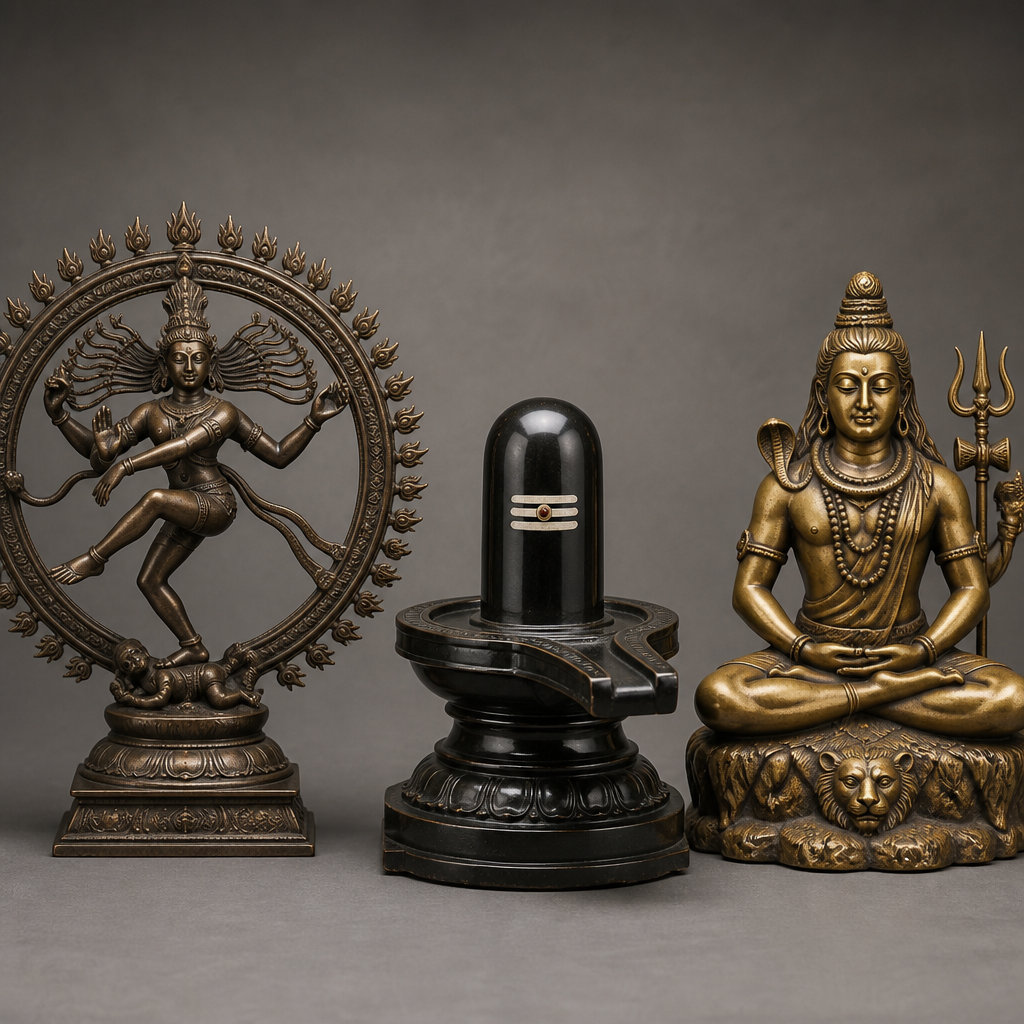
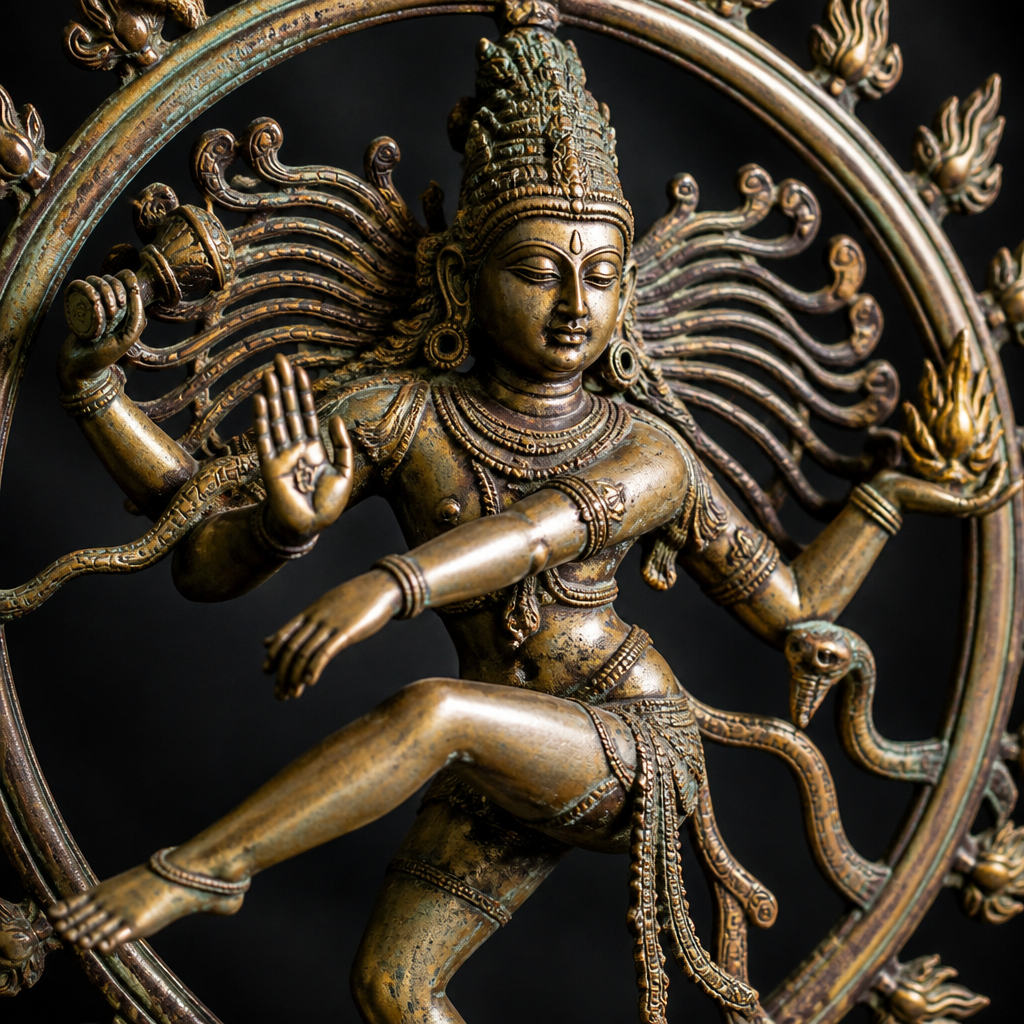
Nataraja Sculpture: The Cosmic Dance of Destruction and Renewal
The Nataraja, meaning Lord of the Dance, is the most philosophically loaded image in all of Hindu iconography. The German physicist Fritjof Capra famously observed that the Nataraja anticipates concepts in modern physics, particularly the idea of matter as dynamic energy rather than static substance. Whether or not that reading appeals to you, it illustrates how seriously scholars across disciplines take this image.
The canonical Nataraja form was perfected during the Chola dynasty of South India, roughly 880 to 1279 CE. Chola bronzes of Nataraja are held in the collections of the Metropolitan Museum of Art in New York, the British Museum in London, and the Musée Guimet in Paris. These are the benchmark. Any serious reproduction of a Nataraja sculpture is measured against Chola proportions.
Reading a Nataraja: What Every Element Means
The upper right hand holds a small drum (damaru), whose sound represents the first vibration of creation. The upper left hand holds fire, representing destruction. The lower right hand is raised in the abhaya mudra, the gesture of protection and reassurance. The lower left hand points downward to the raised foot, indicating liberation available to the devotee. The right foot stands on Apasmara, the demon of ignorance. The left foot is raised in the moment of dance.
The ring of fire surrounding the entire figure is the prabhamandala, representing the cosmos and the endless cycle of time. When a casting omits or simplifies this ring, it is cutting iconographic corners. The same applies to Apasmara beneath the foot. He should be a recognisable figure, not a lump.
In practice, the quality of a Nataraja sculpture is most easily assessed by looking at three points: the flame ring detail, the clarity of the facial expression (composed and slightly smiling, not blank), and the articulation of all four hands. Poor casting shows up immediately in the fingers of the upper hands, which are small and technically difficult to render.
Pro tip: A Nataraja sculpture needs room to breathe horizontally. The flame ring typically extends 30 to 40 percent beyond the body on each side. Measure your display space width before purchasing, not just height.
"The most beautiful and profound emotion we can experience is the sensation of the mystical. It is the power of all true art and science. The Nataraja is the supreme symbol of that mystical rhythm." - Fritjof Capra, physicist and author of The Tao of Physics
The Shiva Lingam: Symbol, Form, and Misunderstood Icon
No element of Hindu iconography is more frequently misread by Western collectors than the Lingam. It is routinely described as a phallic symbol, which captures perhaps 10 percent of its actual meaning and misses the other 90. The Lingam in Shaivite theology represents the formless, infinite nature of Shiva, the absolute that precedes and exceeds all form. Its cylindrical, upright shape points toward the sky, toward the unconditioned, toward what cannot be depicted with limbs and faces.
The Lingam is almost always presented on the Yoni, a circular or square base with a spout. The Yoni represents Shakti, the feminine creative principle. Together they form the Shivalingam, the union of the cosmic masculine and feminine, the static and the dynamic, being and becoming. This is among the most sophisticated symbolic dyads in any world religion.
Types of Shiva Lingam in Sculpture
The Mukhalinga is a Lingam with one or more faces of Shiva carved directly into it. The Panchamukha Lingam has five faces representing the five aspects of Shiva: Sadyojata, Vamadeva, Aghora, Tatpurusha, and Ishana. These are exceptionally complex to execute well and represent some of the highest craft demands in Hindu sculpture.
The Jyotirlinga refers to the 12 sacred pilgrimage Lingams across India, which are considered self-manifested rather than humanly crafted. Sculptural representations of these carry specific regional stylistic markers. A collector who knows this can date and locate a piece with much greater precision.
Stone Lingams, particularly those in black basalt or granite, have a long tradition of outdoor and temple installation. The material choice here is not arbitrary. Stone carries thermal stability, durability in variable climates, and a visual gravity that metal cannot replicate. For an altar or garden installation, a quality stone Lingam often outperforms a brass or bronze equivalent in both presence and longevity.

Other Major Forms of Shiva in Sculpture
Beyond Nataraja and the Lingam, collectors regularly encounter several other major iconographic forms of Shiva that deserve specific attention rather than being lumped together as miscellaneous variations.
Ardhanarishvara: The Half-Male, Half-Female Form
Ardhanarishvara is one of the most intellectually striking images in all of religious art. The left half of the body is Parvati, Shiva's consort, depicted with female attributes including a rounded breast, ornamental dress, and feminine posture. The right half is Shiva, with a muscular torso, matted hair, and the attributes of the ascetic. The image embodies the inseparability of masculine and feminine principles at the cosmic level.
In practice, this form is exceptionally difficult to cast well. The line dividing the two halves of the body must be clear but not harsh. The facial expression must somehow unify the qualities of both deities. A mediocre Ardhanarishvara looks simply odd. A masterful one is among the most arresting pieces in any collection.
Bhairava: The Fierce Form
Bhairava is Shiva in his most terrifying aspect, associated with annihilation, time, and the transgression of limits. Bhairava iconography includes bulging eyes, fanged teeth, dishevelled hair, a skull garland, and often a severed head. This is not decorative horror. Each element encodes specific theology about the nature of time (Kala), death, and liberation through the confrontation with what frightens us.
Bhairava statues are less commonly sold by generalist retailers precisely because they require both craft and theological knowledge to execute correctly. When you encounter a well-made Bhairava at a specialist retailer, it is worth examining carefully. The quality gap between a well-made and a poorly-made Bhairava is enormous.
Shiva as the Ascetic: Mahayogi Form
The Mahayogi or Yogeshvara form shows Shiva in deep meditation, seated in padmasana or on a tiger skin, with the trident beside him and his eyes closed or downcast. This is the form most associated with inner stillness and spiritual practice, and it is the form most likely to resonate with buyers who are practitioners rather than primarily collectors.
Comparing the Three Most Collected Shiva Forms
The three forms below account for the majority of Shiva statues purchased by collectors and practitioners in Western markets. Understanding their differences before buying saves regret later.
|
Form |
Primary Meaning and Use |
Key Considerations for Buyers |
|---|---|---|
|
Nataraja |
Cosmic dance, the rhythm of creation and destruction, liberation through movement. Ideal for spaces associated with transformation, creativity, or artistic practice. |
Requires horizontal space for the flame ring. Quality is immediately visible in finger articulation and face expression. Chola-period bronze proportions are the benchmark. |
|
Shiva Lingam |
Formless infinite, union of cosmic principles (Shiva and Shakti), the unmanifest source of all existence. Central to Shaivite devotional practice and temple worship. |
Should always include the Yoni base. Stone versions suit outdoor or garden use. Mukhalinga and Panchamukha variations are more complex and command higher prices. |
|
Mahayogi |
Shiva as the supreme meditator, stillness at the centre of cosmic activity, inner transformation. Well suited to meditation spaces and home altars. |
Facial expression is everything in this form. Blank or stiff faces indicate poor craftsmanship. The closed-eye expression should convey depth, not absence. |
Materials, Craftsmanship, and What Separates Museum Quality from Mass Production
The majority of Shiva statues sold online are cast in resin, finished to look like stone or patinated bronze, and produced in volume without reference to any specific craft tradition. They are decorative objects, not sculptures. There is nothing wrong with buying a decorative object if that is what you want. But it is worth knowing the difference before you spend money.
Museum-quality Hindu god Shiva art is produced using lost-wax casting (cire-perdue) in bronze or brass by craftsmen trained in regional traditions. In South India, particularly in Kumbakonam and Swamimalai in Tamil Nadu, this tradition is alive and produces work that is directly continuous with Chola-period technique. These pieces are heavier, more precisely detailed, and structurally different from anything produced by industrial casting.
Bronze vs. Brass vs. Stone: What the Material Choice Actually Means
Bronze, an alloy of copper and tin, has been the preferred material for Hindu temple sculpture for over a thousand years. It develops a natural patina over time, has excellent structural integrity for fine detail, and carries deep historical legitimacy. Brass, copper and zinc, is more common in contemporary production, less expensive, and slightly brighter in colour. Stone, particularly black basalt, granite, and sandstone, is the material of choice for larger pieces and outdoor placement.
A common mistake is assuming that heavier always means better quality. Industrial resin can be filled to add weight. The reliable quality indicators are surface detail (particularly in small elements like fingers, jewellery, and facial features), consistent finishing without pitting or air bubbles visible on close inspection, and the overall compositional balance of the piece.
Pro tip: Ask any retailer specifically where a piece was made and in what tradition. A specialist like HD Asian Art sources directly from established Asian craft traditions and can answer this. A volume seller cannot, because their pieces are produced without traceable craft provenance.
Placement, Use, and Altar Considerations
Where and how you place a Shiva statue matters both aesthetically and, for practitioners, spiritually. The general principle in Hindu practice is that the deity image should face either east or north, with the worshipper facing the image. Nataraja is traditionally placed facing west in temple settings, with the worshipper approaching from the east, but this convention is adapted in home altar contexts.
For a home altar, the Lingam is ideally placed at a height that allows comfortable worship, not on the floor and not at eye level if you sit in meditation. The Nataraja needs space around it, particularly lateral space, to avoid the flame ring being visually compressed by adjacent objects. The Mahayogi form suits a slightly elevated position that reinforces the sense of the seated figure looking downward into stillness.
Garden and Outdoor Placement
Stone Lingams and large Mahayogi figures work well in garden settings provided the stone is appropriate for your climate. Black granite and basalt handle rain and temperature variation well. Sandstone is more vulnerable and should be avoided in climates with heavy frost. Bronze figures can be placed outdoors but will develop a green verdigris patina over time. Some collectors consider this desirable. Others prefer to keep bronze indoors to maintain the original finish.
For spiritual practitioners who maintain a dedicated altar space, the coherence of the ensemble matters as much as any individual piece. A Nataraja sculpture at the centre of an altar, flanked by offerings, flowers, and a smaller Lingam, is a traditional and visually powerful arrangement that works in both traditional temple aesthetics and contemporary interior spaces.
Frequently Asked Questions
What is the difference between a Nataraja and a standard Shiva statue?
A standard Shiva statue can depict the deity in any of his many iconographic forms, including the ascetic seated in meditation, the warrior, or the householder with Parvati. The Nataraja is one specific form, showing Shiva in the cosmic dance, surrounded by the flame ring, with four arms in specific gestures, and one foot on the demon Apasmara. It is the most recognisable and the most iconographically complex form of Shiva in sculpture.
Is a Shiva Lingam appropriate for a non-Hindu home altar?
The Lingam has been used as a meditative object by practitioners outside Hinduism for decades, particularly in yoga communities and among those drawn to non-dualist philosophy. Whether you approach it as a devotional object or as a symbol of formless presence, it functions effectively in both contexts. Many non-Hindu collectors choose it precisely because its abstract form makes fewer iconographic demands than a multi-armed anthropomorphic deity image.
What size Nataraja sculpture should I buy for a home altar?
In practice, a Nataraja between 25cm and 45cm in height works well for most home altar contexts. Below 20cm, the detail in the flame ring and the four hands becomes difficult to render well, and many pieces at that scale cut iconographic corners. Above 60cm, the piece starts to require a dedicated architectural setting rather than a shelf or altar surface. Measure your space width as well as height, since the flame ring adds significant horizontal dimension.
How do I identify a high-quality Shiva statue from a mass-produced one?
Look at the finger articulation of the upper hands, particularly in a Nataraja. These are technically the hardest elements to cast well, and they are where quality gaps show up immediately. Also examine the face for compositional balance and expression depth. A high-quality piece will have a face that reads as composed and intentional at normal viewing distance. Check for pitting, rough patches, or blurred detail on small ornamental elements like the crescent moon, the skull on the hair, or the jewellery. These indicate poor casting quality.
What material is best for a Shiva statue intended for outdoor use?
Black basalt and granite are the most durable materials for outdoor Shiva statues in variable climates. Both handle rain and frost far better than sandstone or cast resin. Bronze can be used outdoors but will patinate to green, which some collectors find beautiful and others do not. Avoid brass outdoors in high-humidity environments, as it corrodes unevenly and loses its finish quickly. Stone Lingams are the most traditional choice for garden installation.
Does the direction a Shiva statue faces matter?
In traditional Hindu temple architecture, Nataraja faces west, which places the worshipper approaching from the east, the direction of the rising sun. In home altars, east or north-facing placement is generally recommended across Hindu traditions. For collectors using the piece primarily aesthetically rather than devotionally, placement is determined by the visual logic of the space. That said, if you are setting up a dedicated altar, following the traditional orientation is both respectful and tends to produce a more visually centred result.
Have you already placed a Shiva statue in your home or altar, and which form did you choose? Share your experience in the comments.
References
