



How to Mix Asian Art Into Modern Interior Design
How to Mix Asian Art Into Modern Interior Design
Mixing Asian art with modern interior design works when you apply three principles from the start: choose one anchor object, build a restrained neutral palette around it, and control scale so the piece has room to breathe. Those three moves resolve most of the tension between contemporary furniture and culturally specific objects.
Quick-start checklist:
- Select one primary object — a bronze sculpture, lacquered panel, or carved stone figure — and let it set the room’s visual hierarchy.
- Pull two or three colors from the piece itself and repeat them sparingly in textiles or ceramics. Nothing else.
- Clear a reasonable amount of open space around the object on every side. Negative space is not wasted space.
Key Takeaways
Mixing Asian art with modern interiors works when you prioritize one anchor object, build a restrained palette from the piece itself, and give the work enough negative space to carry its own cultural presence.
| Point | Details |
|---|---|
| One anchor object | Choose a single primary piece and build the room’s hierarchy around it. |
| Restrained palette | Pull two or three colors from the piece; repeat them once in textiles or ceramics only. |
| Provenance first | Ask for written documentation of origin, age, and acquisition before purchasing any piece. |
| Lighting controls the reading | A narrow-beam adjustable spot at 30 degrees above horizontal reveals carving and patina accurately. |
| HDAsianArt for sourcing | Each piece ships worldwide with full provenance records, condition notes, and insured DHL delivery. |
Table of Contents
How to mix Asian art with modern interior design: the core principles
Modern Asian design balances harmony and tranquility with measured vibrancy. The discipline is not about surface motifs. It is about site, context, and craftsmanship — reinterpreting cultural heritage rather than applying it as decoration.
Five principles determine whether a pairing feels considered or merely themed:
- Harmony over accumulation. One well-chosen piece creates more presence than five objects competing for attention. William Lim’s framework for contemporary Asian design centers heritage and craft as the basis for meaningful interiors, not quantity.
- Restraint in color. A modern neutral base — warm white, pale stone, natural linen — lets the art speak. Accent colors drawn from the piece itself (a lacquer red, a celadon green) appear in one or two supporting objects only.
- Scale awareness. A 24-inch bronze figure on a low credenza reads differently than the same figure on a high shelf. The object’s visual weight must relate to the furniture plane it occupies.
- Repetition of material, not motif. Repeating a material — dark wood, matte stone, raw silk — ties Asian pieces to modern furnishings without forcing a theme. Repeating a motif (dragons, lotus patterns everywhere) tips into pastiche.
- Negative space as a design element. Empty wall and floor area around a piece is not absence. It is the frame that gives the object cultural presence.
A critical note from ArtAsiaPacific’s review of Lim’s work: “Asian” spans dozens of distinct visual traditions across Cambodia, Thailand, Indonesia, Vietnam, Sri Lanka, and beyond. Treating them as interchangeable is the first design error. Identify the specific origin of each piece and let that specificity guide your choices.
Pro Tip: Before placing any object, ask: does this piece have room to be itself? If the answer is no, remove something else rather than shrinking the art.
Room-ready tactics: palettes, materials, and lighting that complement Asian art
Material pairings
Scandinavian and Asian design share a core value set — natural materials, simplicity, and honest craftsmanship — which makes their fusion one of the most reliable approaches for modern homes. That overlap suggests a practical pairing logic:
| Asian material quality | Complementary modern finish |
|---|---|
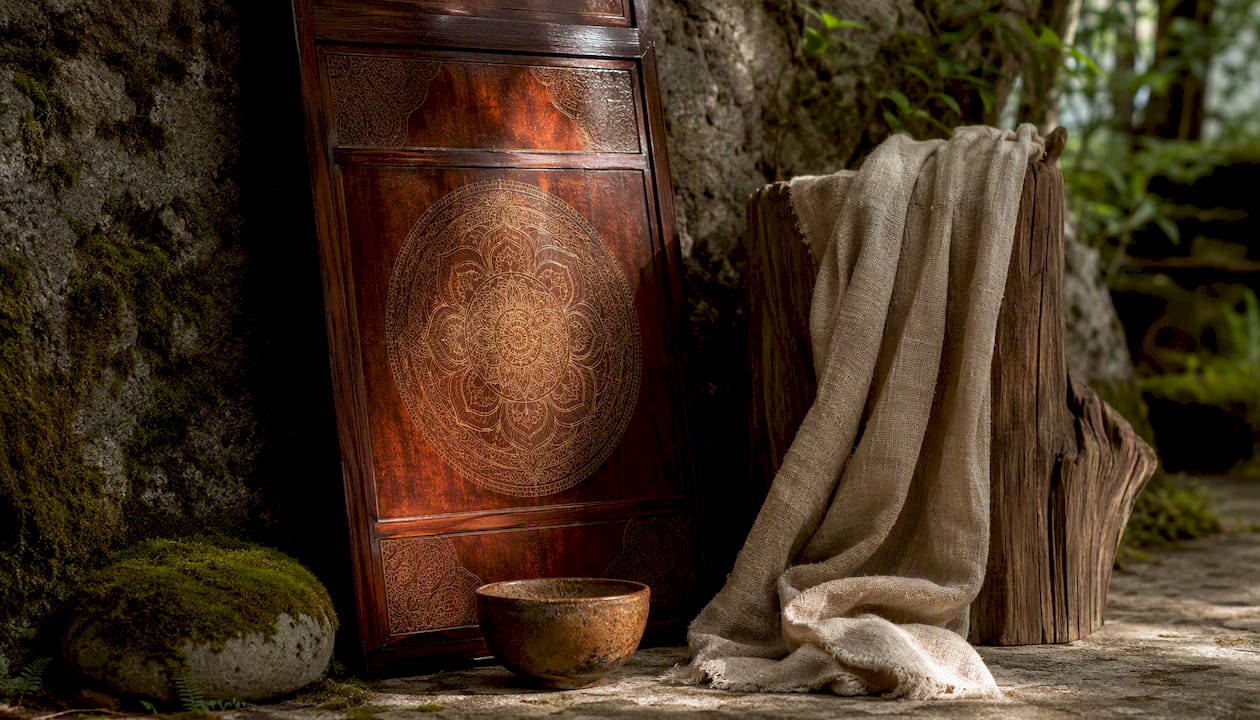
| Lacquered wood (high gloss, deep color) | Light oak, matte plaster, raw linen |
| Patinated bronze or stone | Concrete, brushed steel, pale travertine |
| Carved teak or ebony | Bleached oak, white-washed brick, wool textiles |
| Gilded or painted wood panel | Warm white walls, natural jute, unglazed ceramic |
| Silk or woven textile | Chunky wool rug, linen upholstery, bare timber floor |
The logic in each pairing: contrast in finish (matte against gloss, rough against smooth) creates visual separation that lets both elements read clearly. Matching finishes — lacquer against lacquer, for example — collapses that separation.
Accent color placement
Natural materials and neutral palettes are the reliable base. Introduce accent color in a single object or textile, not across multiple surfaces. A jade green celadon vase on a shelf, a single lacquer-red cushion on a linen sofa — these read as intentional. The same red repeated in a rug, a throw, and a wall panel reads as a theme park.
Lighting for sculptures and panels
KEIJI ASHIZAWA DESIGN’s Loca Niru project demonstrates the approach most relevant to home display: soften light around the object and reduce visual noise so the art feels primary rather than decorative. In practice:
- Use a narrow-beam adjustable spotlight aimed at the object from a 30-degree angle above horizontal, choosing an appropriate beam spread for your space. This creates shadow depth that reveals carving and texture.
- Avoid uplighting stone or bronze figures from below. It flattens relief and creates an unnatural shadow pattern.
- For wall panels and screens, graze the surface with a low-angle track light to bring out lacquer depth or painted detail.
- Keep ambient light in the room lower than the accent light on the piece to make the art stand out.
Pro Tip: Dimmer switches on every accent circuit are not optional. The same sculpture reads very differently at noon and at 8 PM, and fixed-output fixtures give you no control over that shift.
How each room handles the mix differently
Living room
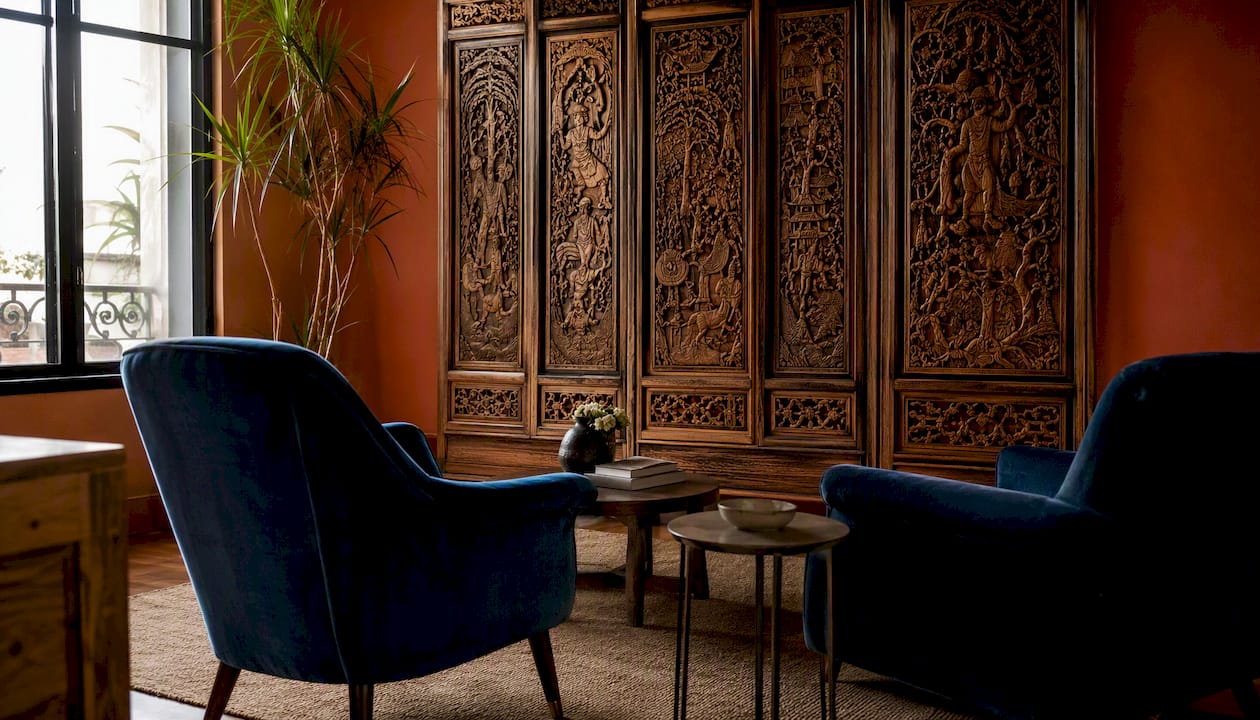
The living room tolerates the largest, most commanding pieces. Anchor with a single large panel, carved screen, or substantial sculpture — not both. Arrange seating to face the object, leaving clear sightlines from the primary seat. A dramatic vignette works here because the room has the floor area to absorb the object’s visual weight. Keep side tables and shelving sparse. One supporting ceramic or textile is enough.
Bedroom
The bedroom calls for restraint. Asian sculptures in a bedroom sanctuary work best when the piece is quiet in subject matter — a seated Bodhisattva, a smooth stone figure — rather than a dramatic multi-armed deity. Low-profile furniture (platform bed, low nightstands) keeps the ceiling plane open and gives a wall-mounted panel or shelf-placed figure room to register without dominating. One piece, correctly lit, is the complete statement.
Dining room
A dining room can support one dramatic object — a tall carved screen behind a sideboard, a single bronze figure on a plinth at the room’s end wall — because the table itself anchors the space. Pendant lighting over the table and a separate accent light on the art object create two distinct light zones that define the room without competing. Avoid placing small objects on the dining table itself; they read as clutter at meal height.
Entry and hallway
Scale is the critical variable in an entry. A narrow hallway cannot absorb a wide screen or a large-footprint sculpture without blocking circulation. A single vertical object — a tall stone figure, a narrow carved panel — placed against the end wall or in a niche works well. Keep the floor clear. The entry is the first impression, and one well-placed piece with clear space around it communicates more than a grouped arrangement ever will.
Choosing and placing Asian art pieces for maximum effect
Selection criteria
Before purchasing, ask these questions:
- Material and condition. Bronze, stone, and carved wood each age differently. Surface patina on bronze is a sign of age; fresh bright metal on a supposedly antique piece is a red flag.
- Subject and context. A religious figure carries specific iconographic meaning. Understand what the piece represents before placing it in a secular context. Respectful display of religious Buddhist art requires knowing the object’s original function.
- Provenance. Ask the seller for documentation: country of origin, approximate age, acquisition history, and any export or import records. A reputable gallery provides this as standard.
- Scale relative to your space. Measure the wall height, the furniture plane, and the sightline distance before committing to a piece. A figure that reads as medium-scale in a gallery can overwhelm a standard 9-foot ceiling room.
Placement and lighting reference
| Object type | Recommended placement | Lighting note |
|---|---|---|
| Bronze or stone figure | Plinth or low credenza, eye level when seated | Narrow-beam spot, 30° above horizontal |
| Large carved panel or screen | Wall-mounted or freestanding, centered on primary sightline | Grazing track light from one side |
| Lacquered cabinet or chest | Against a wall, functioning as furniture | Ambient light sufficient; accent optional |
| Textile or silk hanging | Wall-mounted, framed or on a rod | Diffuse overhead or soft wash; avoid direct heat sources |
Pro Tip: For sculptures on plinths, the top of the figure’s head should sit at or slightly below standing eye level (roughly 60–66 inches from the floor for most adults). Higher placement creates distance; lower placement invites closer inspection — choose based on the piece’s scale and detail.
Conservation basics: keep sculptures away from direct sunlight and heating vents. For bronze and stone, stable humidity between 45–55% reduces surface deterioration. Silk and painted wood panels are sensitive to UV; use UV-filtering glass or film on nearby windows.
Sourcing authentic pieces and respecting cultural context
Ethical-sourcing checklist
- Ask for a written provenance statement: country of origin, approximate period, and acquisition history.
- Request condition photos in natural light, not just gallery lighting.
- Verify that the piece has legal export documentation from its country of origin. Objects removed after 1970 require documentation under the 1970 UNESCO Convention standard, which most reputable U.S. dealers follow.
- For religious objects (Buddha figures, Hindu deities, temple bronzes), confirm the piece was not removed from an active place of worship.
- Ask whether the gallery or dealer is a member of a professional body such as the Art Dealers Association of America (ADAA) or the American Alliance of Museums (AAM).
Sourcing channels
Vetted specialist galleries and auction houses with documented provenance are the most reliable sources for authentic pieces. Specialist online galleries — those that research, photograph, and describe each work individually — offer comparable rigor with broader access. General antique markets and unverified online marketplaces carry higher risk of reproductions and undocumented pieces.
Cultural sensitivity
Contemporary curation projects like the East Asian Graphics Archive demonstrate that East Asian visual culture is most effectively presented when treated as contemporary art rather than decorative ethnic motif. The same principle applies at home: display a piece for what it is, not as a stand-in for a generalized “Asian aesthetic.”
When a piece has religious or ceremonial significance, display it with appropriate orientation and context. A Buddha figure, for example, is traditionally placed at or above eye level and never on the floor. Understanding what Asian religious art represents is the starting point for respectful display.
Avoid grouping objects from unrelated traditions as though they form a coherent set. A Cambodian Vishnu, a Japanese screen, and a Thai Buddha placed together without context collapses distinct cultural histories into a single “Asian” category — the error the ArtAsiaPacific review of Lim’s work specifically cautions against.
A case study: integrating a Javanese Bodhisattva into a modern living room
Client brief: A homeowner with a modern open-plan living room — white plaster walls, light oak flooring, linen upholstery — wanted a single significant object to anchor the space without introducing a themed “Asian room.”
Piece selected: A 20.5 cm antique Javanese Avalokiteshvara Bodhisattva in bronze, sourced through HDAsianArt with full provenance documentation and worldwide insured DHL shipping.
Design decisions:
- The figure was placed on a narrow oak plinth (60 cm height) positioned against the end wall, centered on the primary sofa sightline.
- A single narrow-beam adjustable spotlight (20-degree spread) was installed on the ceiling track, angled at 30 degrees to the figure. No other accent lighting competed with it.
- The surrounding wall remained bare. No secondary objects were placed on the plinth or the adjacent credenza.
- A single linen cushion in a warm ochre tone — pulled from the bronze’s patina color — was introduced on the sofa. No other color reference to the piece appeared in the room.
Before: The room read as a well-furnished but undifferentiated modern space. No focal point. No hierarchy.
After: The Bodhisattva created an immediate visual anchor. The quiet order around the piece — bare wall, clear floor, single light source — gave the figure cultural presence rather than decorative status.
Pro Tip: Treating a home like a curated space — selecting each object with the same care as a piece of jewelry — produces rooms that feel considered rather than assembled.
Common mistakes to avoid when decorating with Asian art
- Over-collecting. Too many objects destroy the negative space that gives each piece presence. Fix: remove two smaller objects for every significant piece you add.
- Wrong scale. A small figure on a large wall disappears. A large screen in a narrow hallway blocks circulation. Measure before buying.
- Tokenizing imagery. Placing a Buddha figure as generic “zen decor” without regard for its iconographic meaning reduces a cultural object to a prop. Fix: research the subject before displaying it.
- Flat or upward lighting. Uplighting a carved figure flattens its relief and creates unnatural shadows. Fix: use a downward-angled narrow-beam spot.
- Ignoring provenance. Buying without documentation risks acquiring reproductions or illicitly traded pieces. Fix: always ask for a written provenance statement and condition photos.
- Grouping unrelated traditions. Mixing objects from Cambodia, Japan, and India as a single “Asian” collection collapses distinct histories. Fix: display objects from one tradition together, or give each piece its own isolated context.
- Cluttered vignette rescue rule: If a shelf or surface looks busy, remove everything and return only the single most significant object.
Authenticity and restraint: a perspective on display
The most common error in decorating with Asian art is treating cultural specificity as optional. A Cambodian Devata and a Thai Buddha are not interchangeable objects in a neutral “Asian” category. Each carries a distinct iconographic history, a specific material tradition, and a regional craft lineage. Displaying them with that specificity intact — correct orientation, appropriate scale, honest provenance — is what separates a considered interior from a themed one.
Restraint is the practical expression of that respect. One well-documented, correctly placed piece does more for a room than a shelf of undifferentiated objects. Provenance is not just an ethical requirement; it is a display decision. Knowing where a piece came from, what it represents, and how it was made gives you the information to place it accurately. Without that, placement is guesswork.
The earthy tones and material qualities of authentic bronze, stone, and carved wood integrate naturally with modern interiors precisely because they are honest materials. They do not need to be styled. They need space, light, and context.
HDAsianArt offers curator-grade sourcing for modern interiors
For homeowners and designers who want a single, significant piece rather than a curated shelf of decorative objects, HDAsianArt provides a direct route to museum-quality Asian sculpture with full provenance documentation.
Each piece in the gallery is individually researched, photographed in high resolution, and described by specialists. Provenance records, condition notes, and regional context come with every work. Worldwide insured DHL shipping means the piece arrives in the same condition it left the gallery.
The antique Javanese Avalokiteshvara Bodhisattva shown in the case study above is one example: a 20.5 cm bronze figure with full documentation, ready to anchor a modern interior without any additional styling required. Browse the full collection at HDAsianArt to find the piece that fits your space and your standard.
Sources
- A Bay Area Home that Celebrates Modern Asian Design | Rue
- East Meets East: William Lim: Contemporary Asian Design
- East Meets East: William Lim: Contemporary Asian Design — ArtAsiaPacific
- Loca Niru | KEIJI ASHIZAWA DESIGN
- The East Asian Graphics Archive is a love letter to contemporary design — Radii
- Incorporating Asian-Inspired Style Into Modern Décor — Homedit
- How to mix Scandinavian & Asian elements for a unique look — The Interior Lab
