



Mantra for Lord Vishnu: Meaning and Practice
Mantra for Lord Vishnu: Meaning and Practice
Om Namo Narayanaya is a short mantra for Lord Vishnu to begin with, traditionally repeated 108 times on a mala or used in a shorter sitting. Choose its row in the comparison table below if you want a straightforward practice of private devotion.
But if chanting becomes only a question of how many repetitions to complete, what happens to understanding whom you're addressing? Sanskrit sound, devotional meaning and household circumstances all matter. A suitable practice begins with a line you can learn attentively, not with a promise of protection, prosperity or a particular feeling.
Table of Contents
- Choose a Mantra for Lord Vishnu
- Meanings and Pronunciation in Plain English
- How to Recite the Mantra at Home
- Tips for Timing Mala and a Quiet Home
- Fixes When the Practice Falters
- Begin This Week Beside a Respected Image
Choose a Mantra for Lord Vishnu
Om Namo Narayanaya is an eight-syllable salutation to Narayana, a name of Vishnu understood as the all-pervading refuge. Its plain devotional meaning is “I bow to Narayana”. It's a useful starting point because the short line can remain familiar while you learn its sounds.
Classical mantras for Lord Vishnu by purpose
| Form | Length | Usual purpose | Difficulty | How it is counted |
|---|---|---|---|---|
| Om Namo Narayanaya | 8 syllables | Daily private devotion to Narayana | Easy | 108 on a mala, then silence |
| Om Namo Bhagavate Vasudevaya | 12 syllables | Praise of Vasudeva, often in Krishna-centred devotion | Easy | 108, or a shorter fixed sitting |
| Vishnu Gayatri | 3 lines | Meditation asking Vishnu to illumine the mind | Moderate | 3, 11, 27 or 108, learnt slowly |
| Mangalam Bhagavan Vishnu | Short verse | Auspicious opening of worship | Easy | Once or a few times, not a japa quota |
| Vishnu Ashtottara Shatanamavali | 108 names | Numbered namavali, each Om … Namah | Moderate | One name per bead, 108 in all |
| Vishnu Sahasranama or temple archana | 1,000 names, or 108 or 1,008 in archana | Full hymn, or priest-led worship; Maha Vishnu homam is a separate fire ritual | Advanced | Whole text, or temple archana rather than solo speed-reading |
Treat the shorter counts in this table as practical options, not universal ritual requirements. A household custom or teacher's instruction may establish a different approach.
Match the form to the devotion
Om Namo Narayanaya suits someone who wants to remember Vishnu before work or during a quiet evening. You don't need to add a longer text because the short salutation becomes familiar.
Om Namo Bhagavate Vasudevaya addresses the blessed Lord Vasudeva and is widely used where Krishna devotion is central. If your household already honours Krishna, this may be a more natural choice than adopting a new formula.
The Vishnu Gayatri used here is:
Om Narayanaya vidmahe
Vasudevaya dhimahi
Tanno Vishnuh prachodayat
It asks for Vishnu's illumination of the mind. Choose it when you want to dwell on that prayer and are willing to learn the phrases carefully, preferably with guidance.
Mangalam Bhagavan Vishnu serves another purpose. It opens worship auspiciously, invoking Vishnu as Garuda-bannered, lotus-eyed Hari, rather than giving you a line to repeat towards a quota.
The Ashtottara offers successive names through a namavali, or litany of names. The Sahasranama is a sustained hymn, so learning its sequence is a different undertaking from repeating a short salutation.
Private repetition or temple worship
At Aberdeen Hindu Temple, Sahasranama Archana involves a priest reciting 1,008 names, while other archanas may use 108 names; the temple also lists homams for Maha Vishnu. An archana is priest-led worship through names and offerings, whereas a homam is a fire ritual, not private repetition.
Pick the row that fits your devotional purpose and keep it for four weeks as a practical trial. Protection, calm and prosperity are traditional hopes, not guaranteed outcomes, and chanting isn't a substitute for medical or psychological care.
Meanings and Pronunciation in Plain English
Begin with sound before arranging a procedure. Say the chosen line slowly, then practise it phrase by phrase, giving each syllable room rather than imposing the strong word stress familiar from English.
The approximations below are learning aids, not exact Sanskrit notation. Listen to a priest or a careful recording so that written English doesn't become your only guide.
Core words of the chosen mantras
| Word | Meaning | UK-English approximation |
|---|---|---|
| Om | Opening sacred syllable | Long o as in home, no h |
| Namo | Salutation, I bow | nah-mo |
| Narayanaya | To Narayana | nah-rah-yah-nah-yah |
| Bhagavate | To the blessed lord | bhah-gah-vah-tay, soft bh |
| Vasudevaya | To Vasudeva | vah-soo-day-vah-yah |
| Vidmahe | We know, from the Gayatri | vid-mah-hay |
| Tanno Vishnuh prachodayat | May that Vishnu inspire us | tan-no vish-nooh pra-cho-dah-yaat |
Namo expresses salutation or bowing. Narayanaya means “to Narayana”: its ending identifies the one being addressed, rather than adding another deity's name.
Likewise, Bhagavate and Vasudevaya belong together in the longer salutation. They address the blessed Lord Vasudeva, rather than describing an outcome the speaker expects to receive.
Learn the phrase without forcing the voice
In the Gayatri, dhimahi means “we meditate” and can be approached as dhee-mah-hee. Speak comfortably, without stretching a syllable until your breath becomes strained; the prayer as a whole asks that Vishnu inspire and guide the mind.
Mangalam means auspiciousness, while Hari is a name of Vishnu. Understanding those words helps distinguish an auspicious invocation from a petition for something specific.
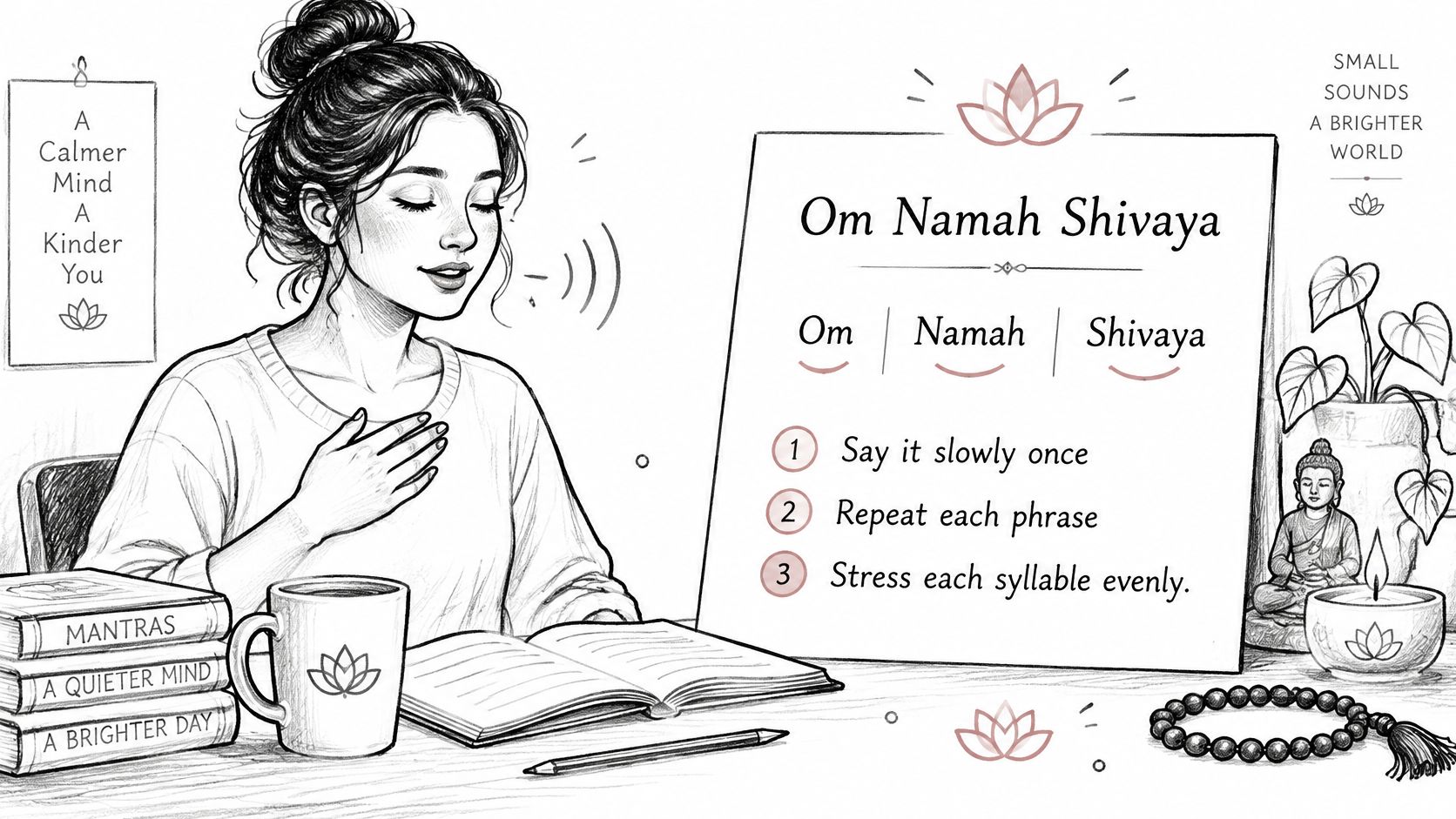
The illustration below depicts a meditation posture; its named mantra belongs to Shiva, not Vishnu, so it isn't a pronunciation guide for these salutations.
The British Library Endangered Archives Programme catalogues a 17th-century CE palm-leaf manuscript titled “Vishnu puja mantra”, consisting of 24 leaves, showing that written Vishnu-mantra practice is centuries old rather than a modern slogan.
An uncertain pronunciation doesn't cancel a sincere sitting. Correct the sound patiently rather than restarting whenever you hesitate.
For a beginner's learning exercise, stay with a single line for a week. Meaning, sound, intention and regularity are separate dimensions of practice: you can improve pronunciation without judging the depth of your devotion.
Avoid treating the English approximation as a permanent substitute for listening. Once the line feels familiar, compare it with your chosen spoken model and adjust gently.
How to Recite the Mantra at Home
Treat recitation as voluntary private prayer, not a clinical treatment or an examination. A clean chair or cushion, washed hands and the chosen line written in a familiar script are enough to begin.
An optional mala provides a tactile way to keep count. For this method, use a 108-bead mala with a larger meru, or marker bead, which you don't cross during counting.
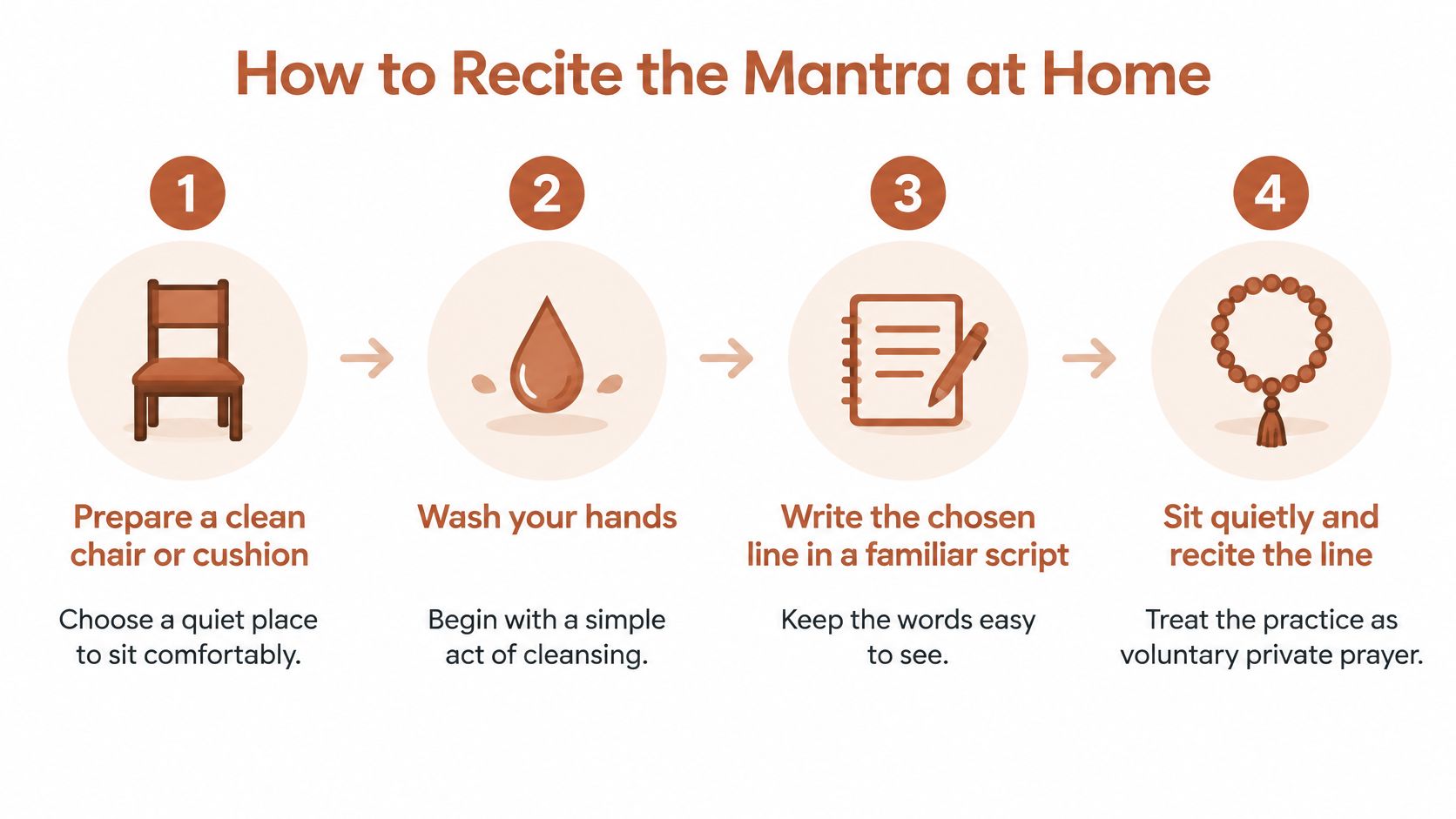
A manageable sequence
- Prepare your place and settle. Wash your hands, place the written line where you can see it, and sit comfortably with your phone aside. Choose a recurring morning or evening moment if your routine allows, so you don't have to negotiate a new time each day.
- Read the line aloud once, then repeat it more softly. This gives you an opportunity to recognise the words before you begin counting; don't squeeze the whole line into an uncomfortable breath.
- Use the mala to support attention. Hold it over the middle finger and advance a bead with the thumb after each complete repetition. The beads take care of the count so you can attend to the salutation rather than maintaining a running total in your head.
- Complete the full round, or choose an honest shorter sitting of 11 or 27 repetitions when time is limited. These are suggested starting counts, not a test of sincerity; don't add hurried repetitions merely to finish a target.
- At the meru, stop rather than passing over it. If you continue, turn the mala and move back in the opposite direction, preserving a clear beginning and end to the round.
- Close with a minute of silence and a brief thanks. The pause lets you finish without immediately reaching for another text or your phone. You don't need a new mantra to make the sitting complete.
- Record the date, count and whether attention felt steadier. Keep this simple notebook for four weeks as a personal observation exercise, not a record of promised results.
Adapt the method to your household
Silent mental repetition is suitable when a partner is sleeping or a housemate is working nearby. You can still attend to the full line internally, rather than shortening it into an indistinct mental sound.
A transliteration is a valid starting point when Sanskrit isn't your household language. Reading the English meaning alongside it can deepen understanding, although a translation and the Sanskrit formula aren't identical forms of recitation.
Formal initiation isn't a universal prerequisite for these familiar salutations, nor is it a legal requirement for private prayer. Some lineages prefer a teacher's guidance for the Gayatri or full Sahasranama, so follow the expectations of the tradition you choose.
For wider devotional context, our guide to prayers in Hinduism places mantra alongside other ways of addressing the divine. That distinction helps prevent the assumption that every household prayer must use beads.
If you arrive feeling hurried, SleepHabits' guide to slow breathing techniques for relaxation offers a separate settling resource. Keep your breathing comfortable during recitation, without imposing breath holds or treating the chant as a breathing exercise.
Tips for Timing Mala and a Quiet Home
Choose a rhythm that survives an ordinary working week. An elaborate dawn arrangement won't serve you well if it leaves you rushed, frustrated or unwilling to begin.
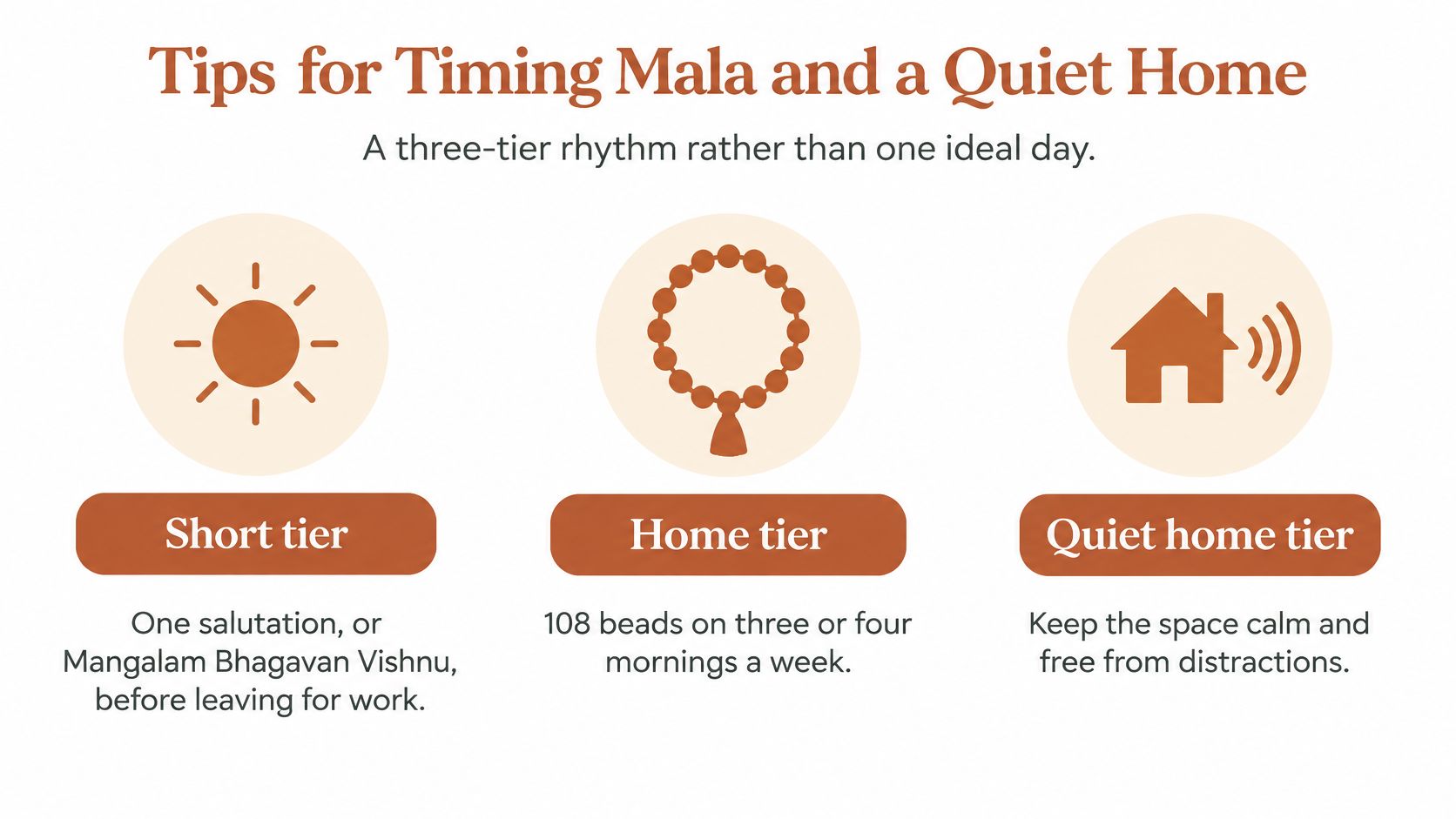
Choose a tier that fits the day
- Short tier. Say a salutation, or Mangalam Bhagavan Vishnu, before leaving for work. Let this be a complete act of remembrance rather than an apology for not doing more.
- Home tier. As a suggested schedule, use the mala on three or four mornings a week and finish. Leave enough room in the morning that you aren't watching the clock throughout.
- Temple tier. Join archana or a homam when you want priest-led worship and instruction. Ask about the service before attending so you know whether you'll listen, respond or participate in offerings.
Early morning is traditional, but a quiet evening is more workable than a repeatedly missed dawn. Shift workers and parents can choose a dependable transition, such as returning home or finishing household tasks.
Hear the verse in a community setting
Shree Bharatiya Mandal publishes Mangalam Bhagavan Vishnu and lists its venue at 103 Union Road, Ashton-under-Lyne, Lancashire, with mandir opening periods of 7:30–8:30 a.m., 11:30 a.m.–12:30 p.m. and 7:00–8:00 p.m. A local visit can offer an opportunity to ask how the verse is sung; confirm current arrangements before travelling.
The Religion Media Centre's Hinduism in the UK factsheet reports a Hindu youth survey of 400 participants, in which 78% reported praying regularly at home. That describes a reported habit, not healing or the effectiveness of a Vishnu mantra.
Household rule: Protect other people's quiet as carefully as your own. Audible prayer shouldn't require everyone nearby to participate.
Care for the beads and shared space
Keep the mala in a clean pouch and off the floor. During the sitting, hold it for counting rather than wearing it, and put it away afterwards instead of leaving it among keys, receipts or food.
Our introduction to Buddhist prayer beads provides comparative context, but Buddhist and Hindu bead practices shouldn't be assumed to share every convention. Use the handling taught within your chosen practice.
Choose a place away from bathroom activity and don't chant over someone else's conversation. If attention fades, shorten the sitting instead of adding a background video.
Parents can share the short verse with children without setting a score. Keep household notes limited to frequency, count and mood, so recording remains less important than the prayer itself.
Fixes When the Practice Falters
Mantra problems and the next change
| What you notice | Likely cause | Change this week |
|---|---|---|
| Syllables blur | Reading too fast from an unfamiliar script | One line, aloud, for seven days |
| A different mantra each morning | No continuity | Stay with the chosen row for four weeks |
| Strain at bead 108 | The count has become a target | Use 11 or 27 and end in silence |
| No shrine in a rented room | Housing limits, not a failed practice | Silent japa on a clean chair |
| 108 names mixed with 1,000 names | Ashtottara confused with Sahasranama | Recite only one list per sitting |
| Hope of a cure or a windfall | Devotional language taken as a guarantee | Keep the prayer and use proper professional help |
These are suggested adjustments, not diagnostic judgements. Rushing and switching often arise because a beginner has taken on more text than they can comfortably recognise.
Reduce the material before increasing the effort. If you can hear the syllables clearly at a slower pace, you have a workable basis for learning; speed adds nothing to that foundation.
Separate a learning problem from a ritual difference
The Shree Bharatiya Mandal Vishnu litany presents 108 numbered invocations using the formula “Om … Namah”, including Vishnu, Lakshmipati, Madhava and Mahavishnu. This Ashtottara is distinct from the 1,000-name Vishnu Sahasranama, so select a complete text rather than splicing the lists together.
A mismatch between texts calls for a clearer choice, not faster reading. Keep the title visible on your printed page or device, particularly if several saved files have similar names.
If your lineage expects initiation for the Gayatri, pause that text and use Om Namo Narayanaya while seeking a priest's advice. Respecting a tradition's teaching arrangements is different from assuming that every beginner must follow an identical procedure.
Devotion doesn't need a performance score. When counting creates strain, simplify the sitting rather than judging yourself by the total.
A night-shift example
Say a nurse works changing night shifts and can't maintain a dawn practice. She chooses 11 repetitions on a clean chair before sleep, leaves the longer hymn aside, and writes the count rather than a claimed result in her notebook.
When her hours change, she keeps the same relationship between prayer and bedtime instead of trying to preserve a clock time. The practical success is that she can continue attentively without sacrificing needed rest.
Children need a different adjustment if shared prayer turns into a competition. Use a single shared verse without a quota, and let an adult model careful listening instead of rewarding the fastest finish.
Financial worry, illness or persistent distress also need responses beyond recitation. A prayer may express hope while you contact an appropriate clinician, counsellor or qualified debt adviser; it shouldn't delay that contact.
Begin This Week Beside a Respected Image
Make a decision you can keep: write Om Namo Narayanaya where you'll see it and use it for a short daily sitting. For the first week, try 11 repetitions and add the mala only when the words feel steady.
If your household already honours an avatar, continuity may matter more than adopting a different formula. Keep the familiar form, whether that's Vasudeva's twelve-syllable salutation or a temple Sahasranama led by a priest.
Keep the image within a living setting
Vishnu recitation needn't become an isolated meditation exercise cut off from family worship. An image may belong within a household's established prayers, festival observances and shared acts of respect.
The UK Hindu Temple Cultural & Community Centre of Nottingham, established in the early 1970s, describes a programme including the 16 Hindu Sanskars, havan and Vedic mantras, and states that its foundation represents Brahma, Vishnu and Shiva. This wider setting helps explain why a Vishnu invocation may accompany rites rather than stand alone.
For a displayed icon, choose a clean, calm shelf or puja corner, at or above seated eye level if the room allows. Don't place it in a bathroom, beside a bin or directly on the floor.
Choose with understanding and care
- Recognise the form. Learn the attributes shown in the sculpture, such as the conch and discus associated with Vishnu. Distinguish an absent attribute from a damaged hand or an unfamiliar regional treatment.
- Prepare the surface. Use a stable shelf with space around the image. Our guide to where to place a Vishnu idol at home offers further placement considerations.
- Keep care simple. Dust gently with a dry, soft cloth. A fresh flower or safely positioned lamp is optional; keep flame, oil and water away from the sculpture.
Our statues are suitable for home shrines, meditation rooms and puja spaces, as well as home décor and collections. Customer feedback includes a Vishnu arriving safely and becoming a welcome presence at home; a customer in Long Island, NY, USA also reported that their Vishnu arrived without a signature and looked perfect.
Neither collecting nor devotion requires an expensive or elaborate setting. Collectors can learn the salutation respectfully, while devotees can choose an image for its recognisable iconography rather than treating a purchase as a condition of prayer.
Begin with the first week's modest count and a shelf you can keep clean and respected. The image gives your attention a place to rest; the daily decision to sit remains yours.
HD Asian Art offers Vishnu sculptures for devotional spaces and collections, with descriptions that help you examine their forms and symbolism. Visit HD Asian Art to compare Vishnu iconography and choose a sculpture suited to the space where you intend to practise.
