



Large Buddha Garden Statue: Buy and Place It
Large Buddha Garden Statue: Buy and Place It
The usual advice is to buy the tallest Buddha the budget allows, then place it on the lawn and call the garden finished. That advice treats scale as a shopping win. In a British garden it is often the mistake that creates a blocked path, a cracked patio, a planning query, or a figure nobody can see.
A large Buddha garden statue has to earn its height from the ground you already have. A figure that reads clearly from a window, a bench, or the gate will do more than a piece so tall it swallows the border and the delivery route. Monumental museum Buddhas show what genuine scale looks like. They are not a domestic shopping target. Drainage, consent, and what you intend the figure to do decide whether it belongs outside at all.
Before you compare catalogues, walk the garden with a tape. Note where you will look from, how wide the gate is, and whether the spot is a quiet corner or a route people use every day. Height is the last number, not the first.
Table of Contents
- Size a Large Buddha Garden Statue to the Garden
- Compare Stone Bronze Resin and Teak
- Place the Buddha with Respect and a Clear View
- How to Install a Large Garden Buddha in the UK
- Protect the Statue from Weather and Theft
- Confirm Access Packaging and the Right Piece
Size a Large Buddha Garden Statue to the Garden
Start with the garden, not the tallest listing. Sightlines decide the role. A path accent is not a courtyard statement, and a courtyard statement is not a public monument.
| Role | Figure height | Viewing distance | Weight character | Clearance |
|---|---|---|---|---|
| Path accent | 60 to 90 cm | 3 to 4 m | Often movable by two people if resin or small teak | Plinth 15 to 30 cm; about 1 m clear in front |
| Lawn focal point | 1.2 to 1.5 m | 6 to 8 m | Stone often 150 to 300 kg; resin often 15 to 40 kg | Plinth 30 to 45 cm; foreground about equal to height |
| Courtyard statement | From 1.8 m | 8 to 12 m | Usually needs a trolley or crane | Engineered base; check gate width and turning space |
| Museum monumental benchmark | 5.78 m | Public stair or hall | Not a garden shopping size | Architectural setting, not a border |
Read the table as a decision, not a wish list. At three to four metres, 60 to 90 centimetres is an accent. Across six to eight metres of lawn, 1.2 to 1.5 metres holds the eye without blocking a path. From 1.8 metres the piece is a courtyard statement. It needs width, an engineered base, and a real delivery route. Keep open ground in front at least equal to the figure's height so planting does not swallow the face.
What monumental actually means
The British Museum's Amitābha Buddha is the useful stop sign. The Arts & Collections account of the statue's restoration records a Chinese figure made in 585 CE, about 1,400 years old, standing 5.78 metres high on its lotus base, nearly 19 feet. Marble, wood, and iron carry surviving traces of gilding and paint. It first stood at Chongguang Temple in what was then Hancui Village, Hebei Province. An inscription names 80 members of the Yi-yi Buddhist society as patrons. After the International Exhibition of Chinese Art at London's Royal Academy, from 28 November 1935 to 7 March 1936, the Chinese Government presented it to the British Museum in 1938. It became a large-scale Buddha on the North Stairs.
That history is the point. A figure at that height was built as architecture and ceremony, not as border décor. If a seller calls a 1.5 metre garden piece monumental, the museum benchmark says otherwise.
Weight before the catalogue
Height photographs well. Weight decides whether the piece can arrive and stay. Say you are choosing a lawn figure around 1.2 metres. Dense stone in that range is often a two-person problem at best and a trolley job in practice, while a hollow resin of similar height can be carried. Teak usually sits between those extremes and must stand off wet soil so the end grain does not rot.
Write four numbers before you compare materials: total height, footprint, estimated weight, and the three sightlines that matter, such as the kitchen window, the bench, and the gate. If the lawn is wide enough that a single figure will look lost, look at layout ideas for larger gardens and place one clear focal point rather than stretching the statue to fill empty grass.
Practical rule: If you cannot name the viewing distance in metres, you are not ready to choose a height.
Compare Stone Bronze Resin and Teak
British wet winters, not a showroom photograph, should pick the material. Water gets into porous stone, freezes, and expands. The result is flaking, salt crust, staining, algae, and moss. Greater mass does not waterproof a porous body. A heavy sandstone figure left in a puddle fails for the same reason a small one does. The base just stays wet for longer.
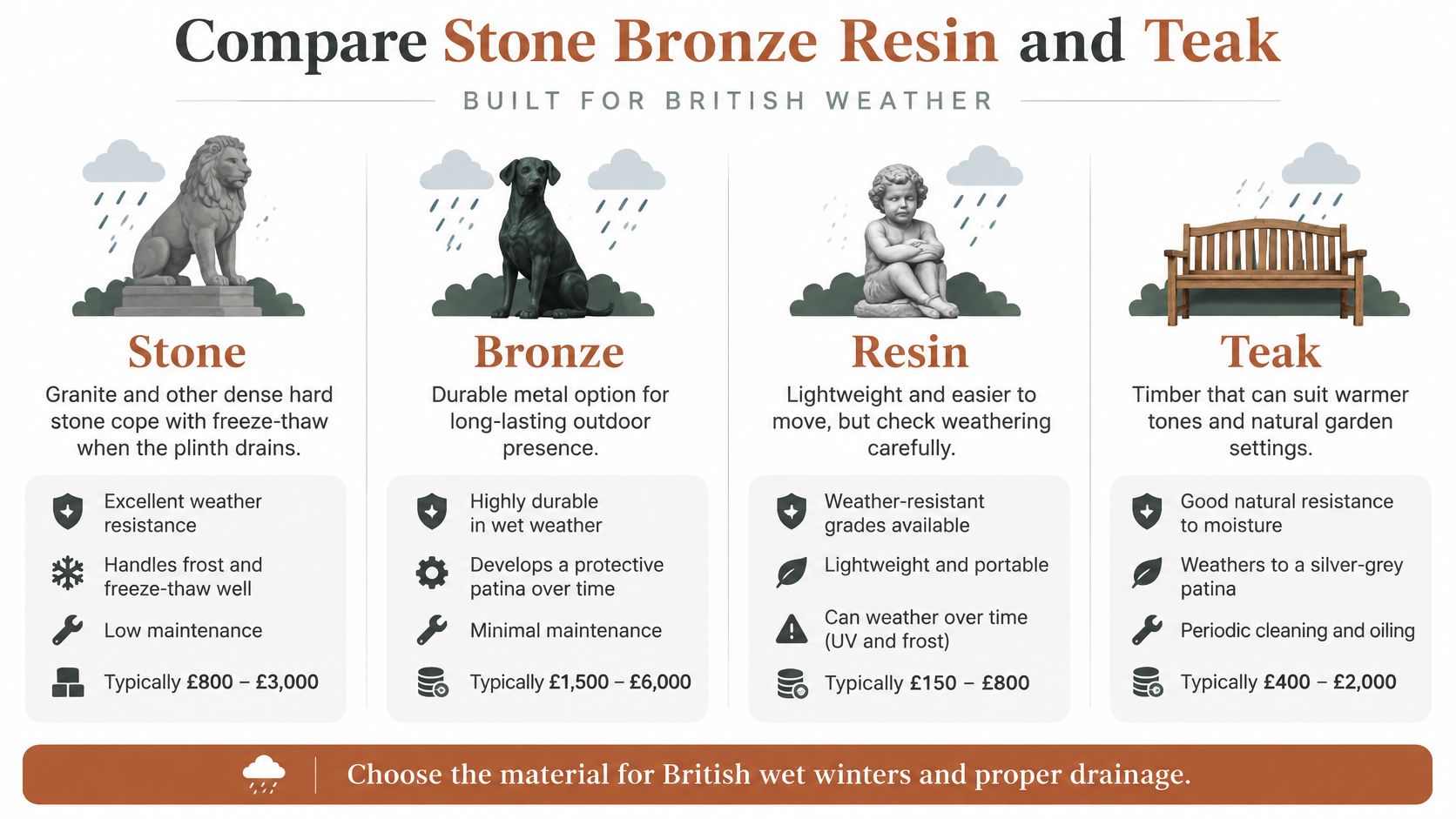
Porous stones such as sandstone, limestone, laterite, and terracotta carry the most risk in wet or freezing conditions. Dense granite or hard stone copes better in a sheltered, well-drained spot. Whatever the material, set the figure on a stable, draining plinth rather than bare soil, and keep it clear of sprinkler spray, gutters, roof runoff, fertiliser, and pool chemicals. An antique or valuable carving deserves a stone conservator's assessment before it goes outside. Sellers who handle Buddha statues for the home, HD Asian Art among them, already advise keeping a figure clean and raised from the floor. Outdoors, a draining plinth applies the same principle to weather instead of clutter.
How the five options behave
| Material | UK outdoor durability | Handling | Main watch-outs |
|---|---|---|---|
| Dense granite or hard stone | Strong if sheltered and drained | Very heavy | Needs an engineered base; do not sit on soil |
| Sandstone, limestone, laterite, terracotta | Poor in prolonged wet and frost | Heavy and porous | Flaking, salt, algae; conservator before outdoor display of antiques |
| Bronze or copper | Strong; patina is expected | Heavy but castable at scale | Anchoring, theft value, surface colour change |
| Outdoor resin or fibreglass | Fair if a quality frost-rated cast | Light | UV fade, cheap skins cracking; easier to steal |
| Teak or dense hardwood | Good off the ground | Moderate | Ground contact rot; greying; confirm a responsible timber source |
Granite and other dense hard stone cope with freeze-thaw when the plinth drains. Use them when the base can be engineered and the gate can take the weight.
Sandstone, limestone, laterite, and terracotta suit a sheltered court, or they stay indoors, if the carving is old. A large limestone piece is still porous limestone. Size does not change the chemistry.
Bronze and copper can carry real scale. Patina is the outdoor finish, not a fault. Ask about the casting, the wall thickness, and how the figure is anchored. A showroom polish will not survive a wet year, and that is normal.
Quality outdoor resin or fibreglass is the honest choice where stone would overload a deck or a raised terrace. Ask what the skin is made of and whether frost is covered. Cheap casts chalk, crack, and fade in ultraviolet light. Light weight also makes theft easier, so anchoring still matters.
Teak and similar dense hardwoods silver in rain. They last when the end grain is off the soil. Oil only if you want to slow greying, not to force a gloss that the weather will strip.
Pick one row, then check the seller's stated weight and finish against your gate width and base. If those two numbers do not fit, a different material at the same height is the better buy.
Place the Buddha with Respect and a Clear View
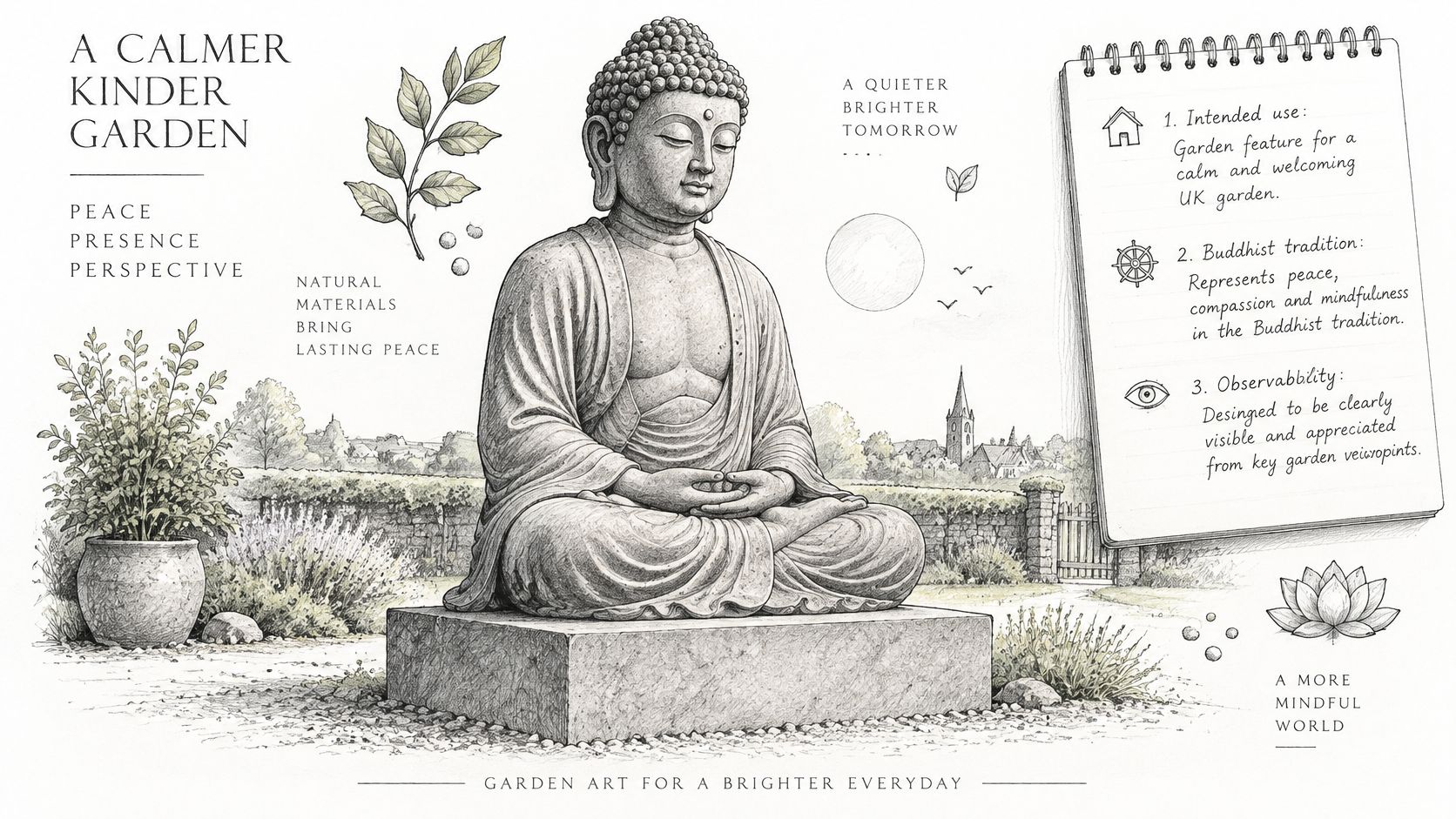
Pose comes after purpose. Write three lines before you choose a mudra: intended use, preferred Buddhist tradition, and how observant the spot should feel. Contemplation, a welcome, and garden art are different jobs. Staging them the same way is how a careful figure ends up beside a bin.
England and Wales recorded 272,508 people identifying as Buddhist in the 2021 Census, equal to 0.5% of residents, according to the Office for National Statistics religion release. In that count, 77.4% of Buddhist respondents were aged 16 to 64, against 62.9% of the overall population, and 55.7% were female. The Office for National Statistics measures affiliation or identification, not daily practice. A garden Buddha can meet a living community. Owning one does not make the garden Buddhist, and a decorative piece should not be dressed up as a shrine.
Match the spot to the use
For contemplation, choose a quiet corner. Raise the figure on a plinth, face it toward the seat, and keep bins, drains, and clutter out of the view. For a welcome, face the figure toward the approach so a visitor meets it rather than walking past its back. A customer in London told us a walking Buddha, very well moulded and finely detailed, looks beautiful in the hall facing visitors. The same logic works outdoors. The face should meet the person who arrives.
Bare soil and a pinched, high-traffic pinch point are poor places. Some practitioners regard a figure on the ground, near rubbish, or where people brush past it as disrespectful. Our own placement advice is the same in plain terms: keep a Buddha clean, raised from the floor, and away from bathrooms, clutter, or anywhere it will be treated casually. A longer walk-through of rooms and outdoor spots sits in our guide on where to put a Buddha statue.
Read the tradition before the thumbnail
Iconography is not one international style.
- Thai Sukhothai walking figures suggest grace in motion. They need space beside the stride so the silhouette stays readable.
- Khmer or Burmese seated figures suggest stillness. A broad plinth and a low, calm planting edge suit them better than a narrow path.
- Chinese and Japanese forms bring their own robes, ushnisha, and hand gestures. A teaching or earth-touching mudra keeps its meaning in a garden, so read it before you buy.
If the seat is a patio rather than a lawn, borrow scale from furniture and shade, not from a taller statue. Practical notes on patio layouts with practical shade help you keep a clear view without parking the figure in full glare or under a dripping gutter.
A landscape figure and a meditation figure should not share the same staging. Say which one you want before you choose the pose.
How to Install a Large Garden Buddha in the UK
A statue that arrives on a lorry and leaves on a crane counts as landscaping. Permanence, hardstanding, lighting, and a sightline from a road can each make the work planning-relevant, so the paperwork comes before the shovel.
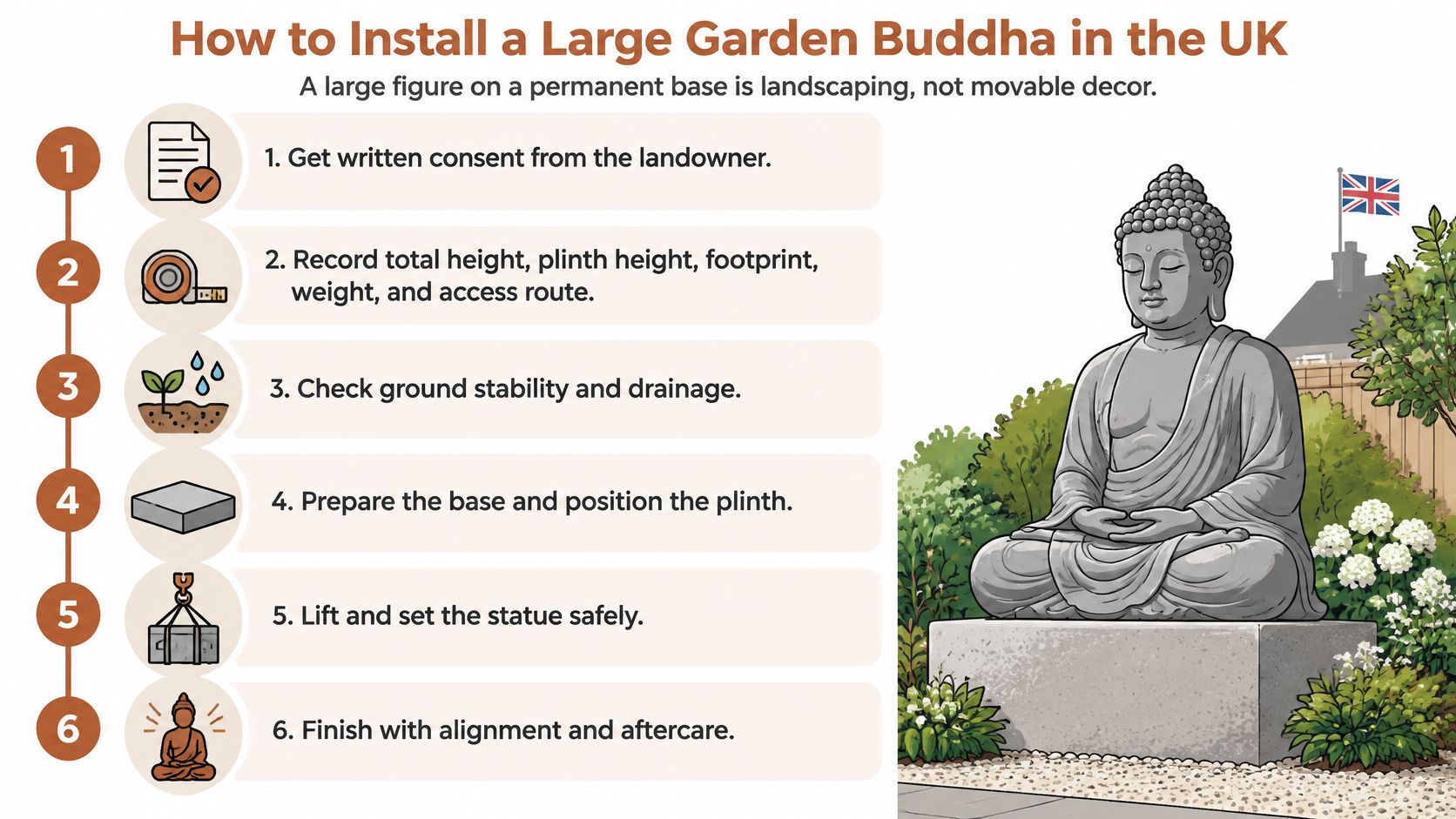
The government guidance on making a planning application sits behind a simple sequence. Councils commonly require planning permission for a new statue or monument, and whether yours qualifies depends on height, how it is fixed, where it stands, and what surrounds it. A figure on a cast foundation beside a listed wall is a different case from a movable ornament on gravel. The final call stays site-specific, so put the proposal to your local planning authority in writing rather than relying on a general rule.
The order that avoids a wasted hole
- Get written landowner consent. A tenant, a shared freeholder, or a management company can stop the job later if this is only a verbal yes.
- Record the measurements. Total height, plinth height, footprint, weight, and distance from highways, trees, and any listed building or its curtilage. Curtilage-listed garden walls and pre-1948 structures can carry the same protection as the house.
- Ask the local planning authority whether you need planning permission, listed-building consent, or a conservation-area review. Do this before excavation, and describe the proposal accurately. A light resin piece that can be lifted and moved answers different questions than a statue fixed to poured concrete.
- Commission a structural engineer for the reinforced base, lifting points, anchors, drainage, and wind-load strategy. Then check for underground utilities, inspection chambers, tree roots, and building footings. Do not fix a heavy statue onto patio slabs. Where a concrete foundation is specified, let it cure for at least seven days before the sculpture arrives.
- Take the contractor's method statement and lifting plan. If permission applies, lodge the consent package before excavation: scaled drawings, a location plan, elevations, a materials specification, contextual photographs, and a perpetual maintenance plan. Long-term care is part of the application, not an afterthought.
- Photograph the condition on installation day. Schedule another inspection after the first freeze-thaw winter, and after any impact.
If the council has not seen a permanent base, do not pour one because a delivery date is already booked.
A frequent pitfall is treating the statue as décor you can shift next spring. Once it has a foundation, illumination, or a sightline from the road, you are in development territory. Ask before you commit to the largest option. A smaller, well-sited figure often clears the practical tests that a courtyard giant fails, and the garden reads calmer for it.
Protect the Statue from Weather and Theft
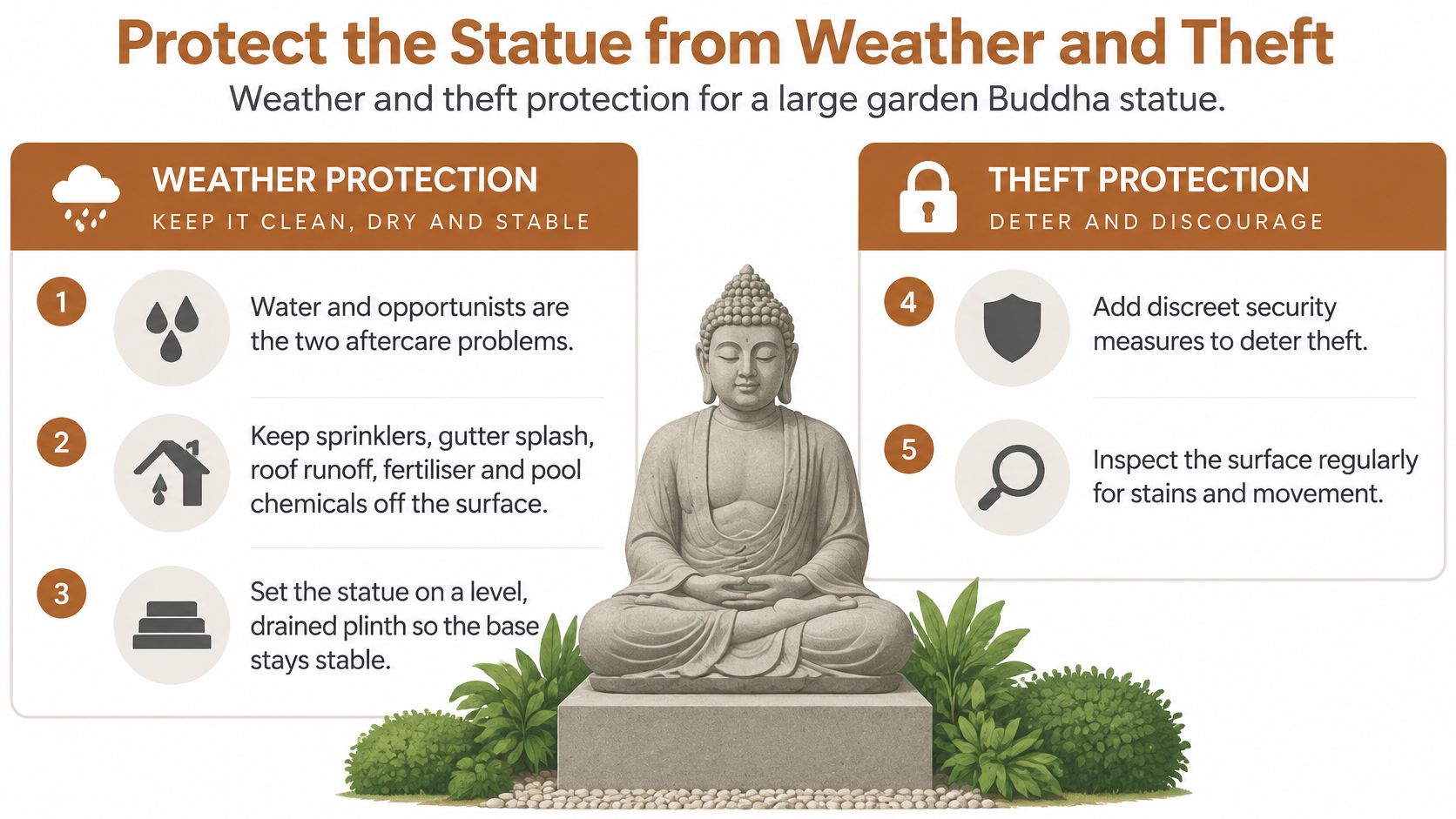
Water and opportunists are the two aftercare problems. They need different habits, and mixing them up leads people to seal a stone "for security" or to leave a valuable bronze unfixed because the plinth looks heavy.
Water on the surface and at the base
Keep sprinklers, gutter splash, roof runoff, fertiliser, and pool chemicals off the surface. Set the statue on a level, drained plinth so the base never sits in a puddle. Splashback against the body does as much harm as rain on the face, because the lower carving stays wet after the head has dried.
Do not pressure-wash. Do not coat porous stone with a random sealant. Do not drill new anchors without a structural check. Do not repoint with hard cement that traps moisture. Test any clean on a hidden patch, then wait to see whether the colour changes. Inspect once a year, and again after a hard frost, for flakes, salt crust, algae, cracks, and loose fixings. A practical cleaning sequence for stone sits in our notes on how to maintain stone garden statues.
Theft is a garden problem, not a Buddha problem
Garden theft is already documented for ordinary ornaments. Research cited by The Co-operative Insurance found that nearly one in ten UK households reported theft of a garden figurine or gnome, while approximately one-fifth of homeowners said items had been stolen from their gardens. 51% did not move garden items indoors at night, and 45% did not move them indoors when going away. Regionally, 16% of homeowners in South West England said a garden figurine had been stolen, compared with 2% of gnome owners in the North West.
That study covers garden ornaments in general, not Buddha statues. It is still a reason to treat a visible, valuable figure as an insured asset.
- Anchor what cannot move. Stone and bronze stay put only if the fixing was designed with the base. A plinth that is merely tall is not a lock.
- Light the approach and check the view from the house. A figure hidden by a high hedge is easier to lift unseen.
- Tell the insurer the agreed value before a loss, not after.
- Move a lighter resin piece under cover while you are away. Stone cannot make that trip, so the anchor and the sightline matter more than plinth height.
A drained base and a named fixing beat a cover that traps damp against the carving all winter.
Confirm Access Packaging and the Right Piece
Pay only when the garden can receive the piece. A beautiful carving that cannot pass the side gate becomes an expensive problem on the pavement.
Measure the narrowest gate, the side passage, and the turning space in metres. Send those widths to the seller with the figure's height, weight, and material. A crate for a figure over a metre needs a level set-down spot that is not the lawn on a wet day. Once the weight passes what two people can steer, the lifting plan must name a trolley, a crane, or a crew. Our notes on how to ship a large bronze Buddha safely set out why limbs, fingers, and the ushnisha need blocking inside the crate so they cannot knock in transit. Ask for photographs of the packed crate before it leaves.
One buyer wrote that the statue was marvelous, and that the parcel was extremely well packaged, with the contents arranged so the figure stayed safe. That is the standard to ask for in writing, not a surprise on delivery day.
Know the figure before the invoice
Confirm whether the piece is antique or contemporary, which regional tradition it follows, and what the pose and hand gesture mean. Do not guess from a thumbnail. We describe each pose and mudra on the piece itself so you can read the symbolism before you purchase, across Buddha statues from Burma, Cambodia, China, India, Indonesia, Japan, Laos, Sri Lanka, and Thailand. Request that written description of pose and provenance before you pay.
Do not schedule delivery onto a permanent base until consent and the engineered base design are agreed. A crate on the drive is the wrong moment to discover the council wanted drawings first.
Measure twice, ask for the packing photos, and keep the written pose notes with the receipt. That is the whole of a careful purchase.
HD Asian Art curates antique and contemporary Buddha statues for collectors, gardens, and quiet interiors, with clear notes on pose and regional style so a large figure is chosen for meaning as well as scale. If you are weighing stone, bronze, or wood for a considered outdoor or hall setting, browse the current sculptures at HD Asian Art and match the piece to the sightline, the base, and the use you have already written down.
