



Lakshmi Statues: Goddess of Wealth in Hindu Sculpture
Lakshmi Statues: Goddess of Wealth in Hindu Sculpture
Most people who search for a Lakshmi statue have no idea how dramatically the iconography varies across regions, periods, and casting traditions. A gilt bronze Lakshmi from South India bears almost no visual resemblance to a sandstone Lakshmi from Rajasthan, yet both depict the same goddess with the same core attributes.
Understanding these differences is the difference between acquiring a piece with genuine devotional and aesthetic power and buying a decorative object that simply looks vaguely Indian. This guide covers the sculptural tradition of Lakshmi in full, so you can choose, display, and understand a goddess of wealth statue with real confidence.
Table of Contents
Quick Takeaways
|
Key Insight |
Explanation |
|---|---|
|
Four arms signal completeness |
Lakshmi is almost always depicted with four arms, each representing a goal of human life: dharma, artha, kama, and moksha. A two-armed Lakshmi is rare and specific to certain regional folk traditions. |
|
Lotus and coins are diagnostic attributes |
The lotus in one or both hands and gold coins falling from an open palm (the varada mudra) are the most reliable iconographic markers of Lakshmi across all regional styles. |
|
Bronze casting quality varies enormously |
South Indian lost-wax bronze (Chola-style) is the benchmark for fine casting. Modern reproductions in cold-cast resin or low-grade brass lack the surface detail and weight that indicate genuine craft quality. |
|
Ashtalakshmi expands the iconography significantly |
The eight forms of Lakshmi, known as Ashtalakshmi, each have distinct attributes. A collector who only knows the standard Mahalakshmi form will miss the full range of what a goddess of wealth statue can represent. |
|
Placement follows traditional Vastu guidelines |
For devotional use, Lakshmi statues are traditionally placed facing north or east, never in a bedroom or on the floor. Spiritual practitioners consistently report this matters to them when selecting a piece. |
|
Owl vs elephant mount indicates different aspects |
When Lakshmi is shown seated on an owl (ulooka vahana), she represents a darker, more austere aspect. The elephant mount or flanking elephants (Gajalakshmi) is the more auspicious, widely recognized form. |
|
Patina on bronze is a quality indicator |
Authentic aged bronzes develop a natural green or dark patina through oxidation. Artificially applied patina looks uniform and flat under close inspection, which is a common issue with mass-produced imports. |
Who Is Lakshmi? Mythology and Iconographic Identity
Lakshmi is the Hindu goddess of wealth, fortune, beauty, and prosperity, and she is among the most widely worshipped deities in the entire Hindu pantheon. She is the consort of Vishnu, the preserver god, which places her at the center of Vaishnavite theology. Her name derives from the Sanskrit root laksha, meaning goal or aim, and from laksana, meaning sign or mark. Both meanings are embedded in her iconography.
The most important mythological event connected to her origin is the Samudra Manthan, the churning of the cosmic ocean described in the Vishnu Purana and the Bhagavata Purana. Lakshmi emerged from the ocean holding a lotus, fully formed and radiant, and immediately took her place beside Vishnu. This origin story explains why water, lotus blossoms, and elephants pouring water over her head appear so consistently in her sculptural representations across centuries and regions.
In practice, her iconography is among the most standardized in Hindu religious art, which makes it possible to identify her correctly even in fragmentary or damaged sculptures. The lotus, the golden coins, the four arms, and the seated or standing posture on a lotus pedestal are present in Lakshmi images from the Gupta period (4th-6th century CE) through to contemporary devotional bronzes.
"Lakshmi is not merely a goddess of material wealth. She embodies Sri, a Sanskrit concept encompassing beauty, grace, radiance, and royal power. To possess Sri is to be blessed in every dimension of life." - Dr. Vasudha Narayanan, University of Florida, Department of Religion
Regional Sculptural Traditions of Lakshmi
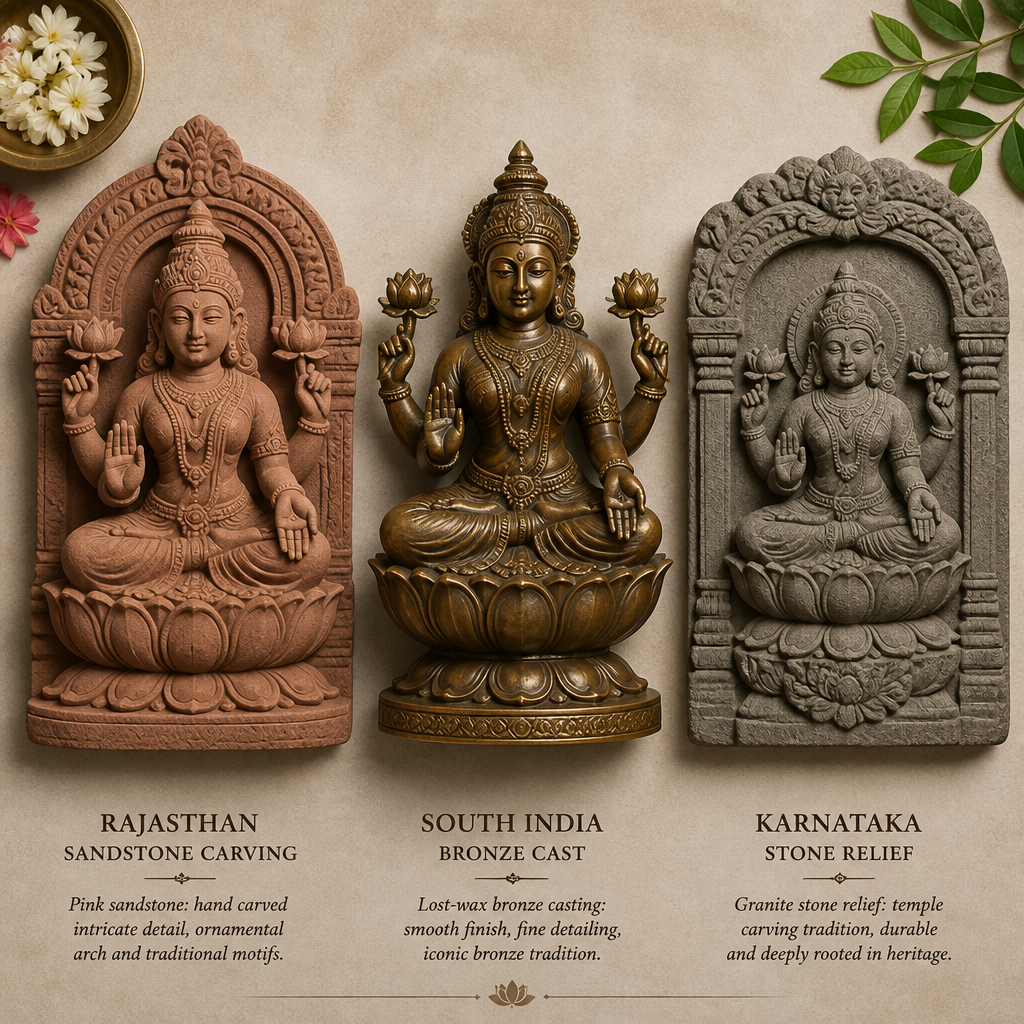
The sculptural traditions of Lakshmi are not monolithic. Each major region of the Indian subcontinent developed its own conventions for rendering her form, and a knowledgeable collector can identify the origin of a Hindu goddess sculpture within a narrow geographic range simply by examining pose, material, decorative vocabulary, and facial typology.
South Indian Bronze Tradition
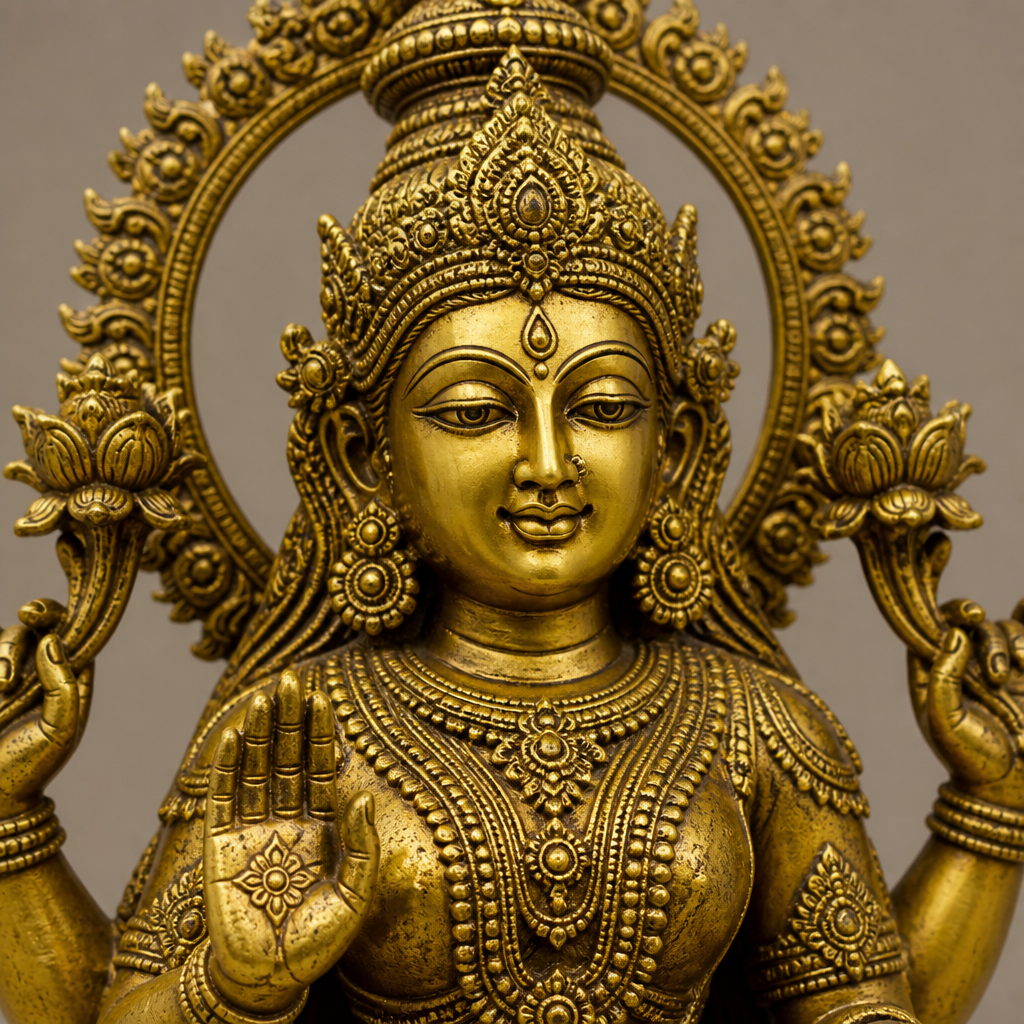
The South Indian bronze tradition, especially the Chola period (9th-13th century CE) casting style from Tamil Nadu, represents the apex of Lakshmi in metal. These bronzes are cast using the lost-wax method, known in Sanskrit as madhucchishtha vidhana. The figures are slender, with elongated limbs, subtle facial modeling, and extraordinary surface detail in jewelry and textile rendering. The Thanjavur (Tanjore) school continued and refined this tradition through the Vijayanagara and Nayaka periods.
Contemporary South Indian bronze workshops in Tamil Nadu still produce pieces using traditional methods, though quality varies significantly between workshops. HD Asian Art sources pieces that reflect this tradition, allowing collectors to access the aesthetic vocabulary of Chola-period sculpture in new, museum-quality castings.
North Indian Stone Sculpture
North Indian Lakshmi sculptures in sandstone, schist, or marble show a markedly different aesthetic. The figures tend to be fuller, with wider hips and shoulders, heavier jewelry, and a more frontal, hieratic pose. Mathura school sculptures from the Kushana period (1st-3rd century CE) are among the earliest clearly identifiable Lakshmi images in stone. Rajasthani marble Lakshmis continue this broader tradition, often richly painted with mineral pigments.
Southeast Asian Interpretations
Hindu goddess sculpture spread throughout Southeast Asia via maritime trade routes, and Lakshmi images appear in Cambodia, Java, and Thailand in forms that blend Indian iconographic conventions with local artistic vocabularies. Khmer Lakshmi sculptures in sandstone have a characteristic stillness and geometric purity distinct from their Indian counterparts. These pieces are particularly significant for collectors interested in the cross-cultural transmission of Hindu religious art.
Reading Lakshmi Iconography: Attributes, Gestures, and Symbols
Being able to read a Lakshmi statue accurately is a skill that separates collectors from casual buyers. Every attribute in a traditional goddess of wealth statue carries specific meaning, and these meanings are encoded in ancient Sanskrit texts on iconography called silpashastras.
The Four Mudras and What They Mean
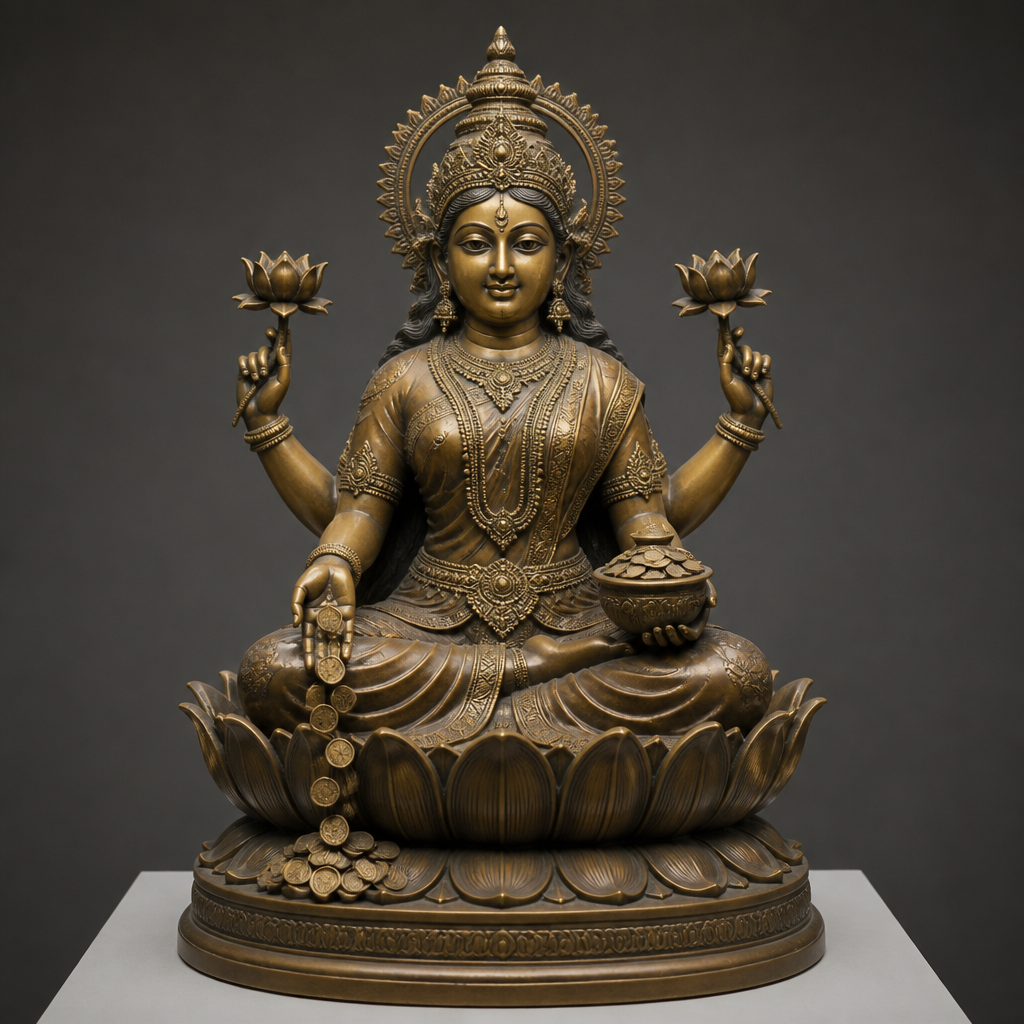
The most common hand gesture configuration in a standard Mahalakshmi image uses the varada mudra (boon-giving gesture, palm facing outward and downward with coins falling) in the lower right hand, the abhaya mudra (protection gesture, palm raised) in the upper right hand, and lotus flowers in both left hands. This specific combination is not arbitrary. It encodes Lakshmi's dual role as protector and bestower of material and spiritual gifts.
A common mistake among buyers is assuming any female Hindu figure holding a lotus is Lakshmi. Saraswati also holds a lotus, but her other attributes (a veena musical instrument, books, white garments, a swan mount) distinguish her clearly. The gold coins and elephant imagery are the reliable distinguishing factors for Lakshmi.
The Significance of Gajalakshmi
The Gajalakshmi form, in which two elephants flank the goddess and pour water over her head, is the most ancient iconographic form of Lakshmi. This image predates her full theological integration into Vaishnavism and appears on coins from the Mauryan period (3rd century BCE). For collectors, a Gajalakshmi composition is iconographically complete and carries the full weight of the tradition's history.
Pro tip: When evaluating any Lakshmi statue, check whether the lotus pedestal is fully rendered. In quality sculptural traditions, the lotus petals are individually carved or cast with visible veining. Flat, schematic lotus bases are a reliable indicator of lower-quality production.
Materials and Craftsmanship in Hindu Goddess Sculpture
The material of a Lakshmi statue is not a secondary consideration. In Hindu theological terms, the material through which a deity is made present matters. The Manasara and Mayamata, two of the primary silpashastras, specify which materials are appropriate for which deities and contexts. Bronze and stone are the prestige materials with millennia of precedent behind them.
Bronze and Brass: Understanding the Difference
Bronze is an alloy of copper and tin. Brass is an alloy of copper and zinc. In traditional South Indian casting, an alloy called panchaloha (five metals) was specified in the texts, combining copper, gold, silver, iron, and lead or tin in prescribed proportions. Modern devotional bronzes rarely conform to this exact specification, but high-quality pieces use a proper copper-tin bronze that ages with depth and character.
Brass produces a brighter, yellower tone and is more commonly used in North Indian devotional objects. Neither is inherently inferior, but they produce very different aesthetic results. A collector buying a South Indian-style Lakshmi should expect bronze; a North Indian-style piece may legitimately be brass.
Stone and Resin: Quality Hierarchy
Carved stone Lakshmi sculptures, particularly in black granite (the material favored in Tamil Nadu temple traditions) or pale sandstone, represent the most demanding craft process. Each piece is unique. Resin cold-cast sculptures can capture surface detail from a master mold but lack the material weight, thermal properties, and unique variation of carved stone or hand-finished bronze.
For collectors and spiritual practitioners who want genuine craft quality, the investment in hand-finished bronze or carved stone is justified. HD Asian Art's collection focuses on this standard, which places it in a different category from mass-market suppliers.
Pro tip: Hold a bronze piece in your hand before buying if at all possible. A properly cast bronze has significant weight relative to its size. A piece that feels light is likely hollow-cast with thin walls, or cast in a lower-density alloy. Weight is an honest proxy for material quality.
Comparison of Lakshmi Statue Types for Collectors and Practitioners
Choosing the right Lakshmi statue depends on your purpose, your existing collection or altar space, and your budget. The table below compares the three primary statue types available to buyers from specialist retailers.
|
Statue Type |
Best For |
Key Considerations |
|---|---|---|
|
South Indian Lost-Wax Bronze (Chola-style) |
Serious collectors, devotional altars, centrepiece display |
Highest detail and craft quality, authentic casting tradition, develops genuine patina over time, heavier and higher cost, sourced primarily from Tamil Nadu workshops |
|
North Indian Marble or Sandstone Carving |
Home altars, statement pieces in interior design, collectors of stone sculpture |
Each piece is unique, cannot be replicated from a mold, reflects Rajasthani or UP carving traditions, fragile compared to bronze, best for indoor placement away from moisture |
|
Southeast Asian Sandstone or Bronze (Khmer or Javanese style) |
Collectors interested in Hindu art outside India, those seeking unusual iconographic variants |
Reflects cross-cultural artistic synthesis, Khmer pieces have a distinctive geometric stillness, iconography may vary from Indian conventions, available in smaller numbers from specialist retailers |
Placing a Lakshmi Statue: Altar, Home, and Display Considerations
The placement of a Lakshmi statue is taken seriously by both spiritual practitioners and interior designers working with sacred objects. For practitioners, these guidelines derive from Vastu Shastra, the ancient Indian system of spatial arrangement that predates modern feng shui and shares some of its underlying logic.
The northeast quadrant of a home is considered the most auspicious placement for any deity statue in Vastu Shastra. For Lakshmi specifically, facing the statue north or east is the most common recommendation. The northeast corner of a room, sometimes called the Ishan corner, is considered the zone of divine energy and is reserved for prayer spaces and altars.
What to Avoid in Placement
Placing a Lakshmi statue on the floor, in a bathroom, or in a bedroom is considered disrespectful in devotional contexts and is consistently avoided by practitioners. The statue should be elevated, ideally on a dedicated altar shelf or platform. If you are not using the statue devotionally but as a collection or decor piece, these restrictions do not apply, but understanding them informs better display decisions regardless.
Display for Collectors
From a purely aesthetic and conservation standpoint, bronze Lakshmi sculptures benefit from consistent indoor humidity levels and indirect light. Direct sunlight accelerates surface oxidation unevenly. Stone pieces should be kept away from moisture to prevent salt crystallization within the stone matrix. A well-lit display cabinet with controlled humidity is the ideal environment for both materials.
What to Look for When Buying a Hindu Goddess Sculpture
Buying a Hindu goddess sculpture from a specialist retailer rather than a general marketplace matters. The difference in sourcing standards, iconographic accuracy, and material quality between a specialist and a general import reseller is significant and directly affects what you receive.
Sourcing and Provenance Standards
A reputable retailer will be able to tell you where a piece was made, by what method, and in what tradition. HD Asian Art sources directly from across Asia, which means the chain between the artisan and the buyer is short and verifiable. Generic import platforms aggregate from wholesale suppliers with no consistent quality or iconographic standards.
Iconographic Accuracy
A correctly rendered Lakshmi should have identifiable attributes as described in the silpashastras. A piece where the hands hold non-traditional objects, where the proportions violate classical tala (measurement unit) systems, or where the facial type does not correspond to any identifiable regional tradition is likely a modern invention with no iconographic grounding.
This matters most to spiritual practitioners, for whom the accuracy of the image is directly related to its devotional efficacy. But it also matters to collectors, because iconographically accurate pieces hold and increase in value more reliably than invented designs.
What Differentiates HD Asian Art from General Retailers
Competitors in this space, including those offering wide catalog breadth, often sacrifice depth of sourcing expertise for catalog volume. HD Asian Art's focus on museum-quality pieces from specific Asian traditions means that each Lakshmi statue in their collection has been selected for iconographic integrity and craft standard, not just visual appeal. For collectors and practitioners who take their acquisition seriously, that specificity is the relevant differentiator.
Frequently Asked Questions
What is the correct number of arms on a Lakshmi statue?
The standard form of Lakshmi has four arms, representing her dominion over the four goals of human life in Hindu philosophy: dharma (righteousness), artha (wealth), kama (desire), and moksha (liberation). Two-armed forms exist in certain regional folk traditions but are less common in classical sculptural contexts.
What is the difference between Mahalakshmi and Ashtalakshmi?
Mahalakshmi is the primary, complete form of Lakshmi worshipped as the supreme goddess of wealth and fortune. Ashtalakshmi refers to the eight specific manifestations of Lakshmi, each presiding over a distinct type of wealth: Adi Lakshmi (primordial), Dhana Lakshmi (monetary), Dhanya Lakshmi (agricultural), Gaja Lakshmi (power and strength), Santana Lakshmi (progeny), Veera Lakshmi (courage), Vidya Lakshmi (knowledge), and Vijaya Lakshmi (victory). Collectors interested in expanding a collection will find Ashtalakshmi sets a logical next step after acquiring a standard Mahalakshmi piece.
Is a Lakshmi statue appropriate as a gift?
Yes. A Lakshmi statue is one of the most widely accepted and auspicious gifts in Hindu cultural contexts, particularly for housewarming occasions, Diwali, weddings, and business openings. The convention of gifting Lakshmi images at Diwali is specifically tied to her association with the festival, during which she is believed to visit homes that are clean, well-lit, and welcoming.
How do I care for a bronze Lakshmi statue?
Dust regularly with a soft dry cloth. Avoid abrasive cleaners, which strip the surface finish and patina. If the piece has developed a natural green patina that you wish to preserve, keep it away from salt air and high humidity. If you prefer a polished surface, a small amount of natural beeswax polish applied with a soft cloth and buffed off maintains the metal without damage. Never submerge a bronze piece in water, as moisture trapped in casting voids causes internal corrosion.
What size Lakshmi statue is appropriate for a home altar?
For a dedicated home altar, a statue between 20cm and 40cm tall is the most practical range. It is large enough to be a clear focal point without overwhelming a typical shelf or altar surface. Larger pieces, above 60cm, are better suited to floor placement or as standalone display objects rather than altar centerpieces. The scale of the statue should be proportionate to the space, and the figure should be the dominant object on the altar surface.
Can a Lakshmi statue be displayed alongside statues of other deities?
Yes. In Hindu theological and domestic practice, Lakshmi is commonly displayed alongside Vishnu (as his consort), Ganesha (as a complementary deity of auspiciousness and beginnings), and Saraswati (particularly during Navaratri and Diwali). The pairing of Ganesha and Lakshmi is the most standard combination in domestic altars across India. Displaying Lakshmi with deities from other traditions, such as Buddhist figures, is a matter of personal preference and is common among collectors who approach their collection aesthetically rather than exclusively devotionally.
If you collect or display Lakshmi statues, share what drew you to this tradition and what you look for when choosing a piece. Your experience adds to the conversation for other collectors and practitioners reading this.
References
