



Identifying Hand Carved Stone Hindu Statues: A Collector's Guide
Identifying Hand Carved Stone Hindu Statues: A Collector's Guide
Learn to identify authentic hand carved stone Hindu statues. Discover iconography, material analysis, authentication methods, and ethical sourcing in this comprehensive Blog post.
Table of Contents
Identifying Hand Carved Stone Hindu Statues: Key Visual Markers
Hand-carved stone Hindu statues bear unmistakable signatures of artisanal craftsmanship: irregular surfaces, varying carving depths, and tool marks that distinguish them from machine-made reproductions. These aren't flaws, they're proof of authenticity.
Understanding Hindu iconography is equally critical. Each deity carries specific attributes, hand gestures, and symbolic elements that identify them. Ganesha appears with an elephant head and curved trunk. Shiva often holds a trident and wears a crescent moon. Parvati carries specific jewelry and poses. These are centuries-old visual codes that collectors must learn to read.
Understanding Hindu Iconography and Deity Attributes
Each Hindu deity presents recognizable symbols allowing trained eyes to identify them instantly. Ganesha, the remover of obstacles, always appears with an elephant head and portly body, typically holding a modaka (sweet) or prayer beads. Shiva appears as an ascetic figure with a third eye on the forehead, holding a trident (trishul), and wearing a crescent moon in his hair.
Regional variations matter significantly. A Balinese interpretation of Ganesha differs from a South Indian temple carving. Balinese versions show more ornamental detail and decorative flourishes reflecting Indonesian traditions. Indian temple sculptures, particularly from Tamil Nadu or Karnataka, tend toward more austere, geometrically precise carving developed over centuries.
The Shaivite tradition, devotion to Shiva, produced some of the most recognizable stone carvings. Shiva appears in multiple forms: as Nataraja (the cosmic dancer), as Mahadev (the great god), or with his consort Parvati. Nataraja statues show Shiva mid-dance with one leg raised and fire circling the figure, a dynamic pose requiring exceptional carving skill.
Recognizing Sacred Symbols and Vahana (Divine Mounts)
Every major Hindu deity rides a vahana, a divine mount serving as both spiritual companion and symbolic representation of power. Ganesha rides a mouse or rat. Shiva's vahana is Nandi, the sacred bull. Durga rides a tiger. Brahma rides a swan. These are essential iconographic elements confirming a statue's identity and authenticity.
Nandi, Shiva's mount, appears frequently in temple sculptures and private collections. A genuine Nandi statue shows a muscular bull with a curved hump, often decorated with ornamental blankets or bells. The carving quality of the vahana itself indicates the artisan's skill level.
Sacred symbols carved into or around the main figure provide additional authentication clues. The om symbol, the swastika (an ancient Hindu symbol of auspiciousness), lotus flowers, and geometric patterns all appear in traditional carvings following specific proportions and placements. Modern reproductions often place symbols incorrectly or render them with inconsistent proportions.
Signs of Hand Carving on Stone: Chisel Marks and Artisanal Craftsmanship
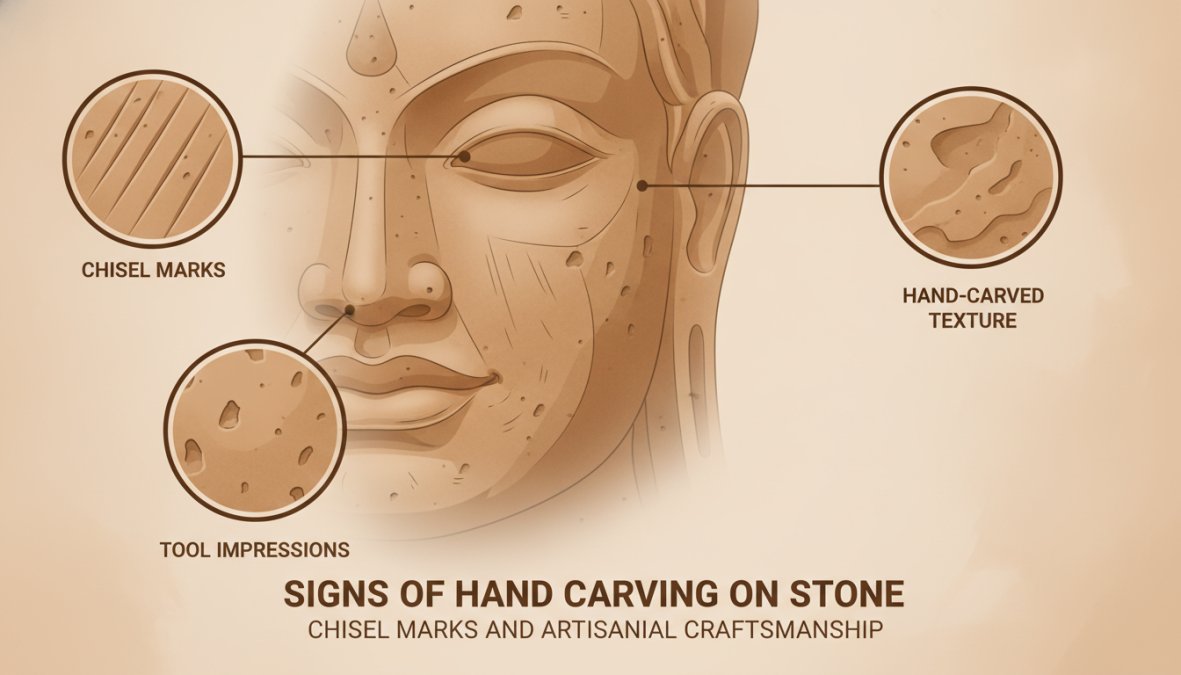
The physical evidence of hand carving tells an unmistakable story that no modern tool can fully replicate. Chisel marks, the small parallel grooves left by hand chisels, appear on authentic pieces in patterns revealing the carver's technique and rhythm.
Identifying Chisel Marks and Tool Impressions
Examining chisel marks requires magnification, a 10x loupe or macro photography reveals what the naked eye misses. Authentic hand-carved pieces show chisel marks varying in depth, spacing, and angle, reflecting the carver's hand movements and the stone's resistance. Softer stones like sandstone show deeper, more pronounced marks. Harder stones like granite show finer, more delicate impressions.
Machine tools create uniform, repetitive patterns. CNC (computer numerical control) carving produces perfectly parallel lines at identical depths. Grinding wheels leave circular scratch patterns. These mechanized signatures are instantly recognizable. A statue with perfectly uniform surface texture across all carved areas almost certainly came from a factory.
Transition zones, where the carver moved from one tool to another or changed technique, provide especially valuable authentication clues. These transitions appear naturally in hand work but are absent or obviously artificial in machine carving. Look for slight changes in surface texture, overlapping tool marks, and areas where the carver corrected mistakes.
Assessing Surface Texture and Hand-Carved Details
Run your hand across a genuine hand-carved statue carefully. The surface texture should feel slightly irregular with micro-variations in smoothness. Some areas are polished smooth where the carver spent extra effort. Others retain subtle tool marks. This variation is natural and expected.
Modern reproductions often over-sand surfaces to achieve artificial uniformity, creating a texture that feels too smooth, almost plastic-like. Genuine antiques show natural wear from centuries, some areas polished by devotional touching, others retaining original carving marks.
Fine details like jewelry, ornaments, and decorative elements reveal carving skill. Authentic temple artisans created elaborate necklaces, earrings, and crowns with remarkable precision. Each link in a necklace is individually carved. Reproductions simplify these details or cast them as flat, undifferentiated surfaces.
Types of Stone Used in Hindu Temple Carvings: Material Analysis
Hindu temple sculptors chose stone based on availability, durability, and workability. Different regions favored different materials, providing important authentication clues.
Granite, Marble, and Sandstone: Properties and Regional Variations
Granite, an igneous rock composed of quartz, feldspar, and mica, was favored in South India, particularly in Karnataka and Tamil Nadu. Granite's extreme hardness made it challenging to carve but resulted in sculptures lasting centuries with minimal deterioration. Granite statues feel heavy and dense with a speckled appearance from visible mineral crystals.
Marble, a metamorphic rock prized for its whiteness and translucency, was used extensively in North India and Kashmir. Marble carves more easily than granite, allowing for finer detail work. Authentic marble pieces show characteristic warmth and slight translucency when held to light. Marble develops a distinctive patina over centuries, a slightly yellowed or cream-colored surface that cannot be artificially replicated convincingly.
Sandstone, a sedimentary rock composed of sand-sized minerals, was widely used across India for temple construction and sculpture. Sandstone is softer and more workable, ideal for detailed carving. However, sandstone weathers more readily, making age assessment easier. Authentic ancient sandstone pieces show significant erosion and weathering.
Regional stone preferences tell a story. Tamil Nadu sculptors worked primarily in granite. Rajasthan artists favored sandstone. Kashmir sculptors preferred marble. If a piece claims to be from a specific region but uses an atypical stone for that region, authentication becomes questionable.
Patina and Weathering Patterns as Dating Indicators
Patina, the surface layer developing over centuries, serves as a powerful authentication tool. Genuine antique stone develops patina through exposure to air, moisture, minerals, and organic growth. This process cannot be rushed or artificially replicated convincingly.
Authentic sandstone pieces show specific weathering patterns. Softer mineral components erode faster than harder ones, creating a slightly pitted surface. Iron compounds oxidize, creating rust-colored staining. Lichen and moss growth leave traces. These patterns follow natural physics, water flows downward, so erosion is heavier on upper surfaces.
Marble develops distinctive yellowing over centuries with possible hairline cracks from temperature fluctuations. Granite's extreme hardness means it weathers very slowly, showing minimal surface change but possible discoloration from iron staining or lichen growth.
How to Tell If a Stone Statue Is Authentic: Scientific Authentication
Beyond visual inspection, scientific methods provide objective authentication data.
Provenance Documentation and Historical Context
Provenance, the documented history of an object, serves as the gold standard for authentication. A statue with clear provenance, including documentation of previous owners, acquisition dates, and exhibition history, carries significantly more credibility than an undocumented piece.
Legitimate provenance includes purchase receipts from established dealers, museum documentation, published references in academic works or auction catalogs, and export certificates from the country of origin.
Historical context matters. A statue claiming to be from the Chola dynasty (9th-13th centuries) should show stylistic characteristics consistent with that period. Chola sculptures are known for dynamic poses, intricate jewelry, and technical sophistication. A "Chola" piece showing crude carving or stylistic inconsistencies warrants skepticism.
Distinguishing Antique Originals from Modern Reproductions
Modern reproductions have become increasingly sophisticated, but several techniques help distinguish them from genuine antiques.
Thermoluminescence (TL) testing measures radiation accumulated in stone over time. Stylistic analysis by experts trained in Hindu iconography provides reliable authentication by identifying inconsistencies suggesting modern creation. Surface examination using scanning electron microscopy (SEM) reveals details invisible to the naked eye, showing whether patina is natural or artificial and whether tool marks are consistent with historical techniques.
| Authentication Method | Cost | Time Required | Reliability | Best For |
|---|---|---|---|---|
| Visual examination | Free | Minutes | Moderate | Initial screening |
| Provenance research | Variable | Days-weeks | High | Documented pieces |
| Expert stylistic analysis | $200-500 | Days | High | Period/regional identification |
| Thermoluminescence testing | $300-600 | 2-3 weeks | Moderate | Age confirmation |
| Scanning electron microscopy | $500-1000 | 1-2 weeks | High | Surface analysis |
Mudras and Hand Gestures: Spiritual Symbolism in Stone
Mudras, hand gestures carrying specific spiritual meanings, form a visual language in Hindu sculpture. The Abhaya mudra (fear-not gesture) shows an open palm facing outward, conveying protection and reassurance. The Varada mudra (boon-granting gesture) shows the hand open and lowered, representing generosity and blessing. The Dhyana mudra (meditation gesture) shows both hands in the lap, palms facing upward, indicating deep meditation.
Authentic temple sculptures render mudras with anatomical precision. The fingers are positioned correctly, and hand angles match the gesture's spiritual meaning. Specific deities favor specific mudras. Shiva often appears in Dhyana mudra. Ganesha frequently uses Abhaya or Varada mudras. Deviations from these conventions suggest either non-traditional regional variation or modern invention.
The complexity of mudra carving indicates the sculptor's skill and knowledge. Simple, crude hand gestures suggest either a novice sculptor or modern mass production. Sophisticated mudras with anatomically correct finger positioning indicate trained temple artisans.
Ethical Sourcing and Legal Provenance: Protecting Cultural Heritage
Acquiring hand-carved Hindu statues responsibly requires understanding the legal and ethical landscape. India's Antiquities and Art Treasures Act of 1972 prohibits export of artifacts more than 100 years old without government permission. UNESCO conventions further restrict international trade in cultural property.
Ethical sourcing means purchasing from reputable dealers who can document provenance, verifying that pieces were legally exported, and avoiding pieces with questionable acquisition histories. Collectors seeking authentic hand-carved pieces should prioritize dealers providing complete provenance documentation and explaining the legal status of each piece. This protects both the collector and the cultural heritage these statues represent.
Regional Styles and Temple Traditions: Balinese vs. Indian Sculpture
Hindu sculpture traditions vary significantly across geographic regions. Balinese sculpture shows distinct characteristics differentiating it from Indian temple carving. Balinese pieces often feature more ornamental detail, elaborate jewelry, and decorative flourishes. The stone work tends toward higher relief with figures projecting more dramatically from the background.
South Indian temple sculpture, particularly from Tamil Nadu and Karnataka, emphasizes geometric precision and spiritual intensity. Figures tend toward more austere rendering with less ornamental detail. The carving is often deeper and more dramatic, creating strong shadows that enhance spiritual presence.
North Indian sculpture, particularly from Rajasthan and Uttar Pradesh, shows different characteristics. Northern pieces often incorporate more narrative elements with multiple figures or scenes depicted together. The style tends toward more delicate detail work, particularly in jewelry.
Understanding these regional traditions helps authenticate pieces and place them within specific artistic contexts.
Care and Maintenance of Hand Carved Stone Hindu Statues
Proper care preserves these precious pieces for future generations. Avoid direct sunlight, which causes uneven fading and surface degradation. Maintain stable temperature (around 65-70°F) and moderate humidity (40-50%).
Cleaning stone statues requires caution. Never use harsh chemicals, pressure washers, or abrasive scrubbing. For light cleaning, use soft brushes and distilled water only. Always test cleaning methods on inconspicuous areas first.
Handling requires care. Always support the piece from below when moving it. Never grasp arms, legs, or other projections. Wear clean gloves to prevent oils from your hands damaging the surface.
Avoid placing statues near heating vents, air conditioning units, or windows where temperature and humidity fluctuate. If a piece shows active deterioration, consult a professional conservator rather than attempting amateur repairs.
Insurance documentation protects your investment. Photograph each piece from multiple angles, document any damage or restoration, and maintain provenance records.
Acquiring authentic hand-carved Hindu statues connects you to centuries of spiritual and artistic tradition. When you understand chisel marks, iconographic conventions, stone types, and regional variations, you transform from casual buyer to informed collector. HD Asian Art specializes in carefully curated hand-carved Buddhist and Hindu statues with documented provenance and ethical sourcing, providing complete documentation and supporting traditional artisan techniques.
Frequently Asked Questions
How can you tell if a stone statue is hand-carved versus machine-made?
Hand-carved statues display irregular chisel marks, subtle asymmetries, and varied tool impressions across the surface. Machine-made pieces show uniform, repetitive patterns and perfectly smooth surfaces without natural variation. Examine the fine details, hand-carved work exhibits intentional artisanal imperfections, while machine carving produces mechanical precision. Look for evidence of individual craftsman technique in areas like facial features, folds of fabric, and ornamental details. Authentic hand-carved Hindu statues reveal the artist's personal touch through inconsistent depths and angles.
What types of stone are most commonly used in authentic Hindu temple carvings?
Granite, marble, and sandstone dominate traditional Hindu temple sculpture. Granite offers durability and is favored in South Indian temples; marble provides a refined surface ideal for intricate deity details; sandstone, softer and easier to carve, appears frequently in North Indian temple architecture. Regional preferences vary, Balinese artisans traditionally use volcanic stone, while Indian craftsmen select based on local availability and spiritual tradition. Each material develops distinct patina patterns over centuries, helping authenticate antique pieces. Understanding regional stone preferences is essential for identifying authentic hand-carved Hindu statues from specific temple traditions.
What are the key signs of aging on antique hand-carved stone Hindu statues?
Authentic aging appears as natural patina buildup, weathering patterns consistent with climate exposure, and lichen or mineral deposits in carved crevices. Look for rounded edges on originally sharp details, surface pitting from centuries of environmental exposure, and color variations from uneven weathering. Genuine antique statues show wear patterns that match their purported origin region, tropical climates leave different marks than temperate zones. Be cautious of artificially aged surfaces, which appear uniform and lack the irregular, organic patterns of true weathering. Provenance documentation supporting the statue's historical timeline strengthens authentication.
How do mudras and deity iconography help identify hand-carved Hindu statues?
Mudras, sacred hand gestures, are distinctive identifiers for specific deities and spiritual traditions. Ganesha displays the abhaya mudra (protection gesture), while Shiva often appears in meditation posture. Deity attributes like Nandi (the sacred bull vahana), specific ayudha (weapons), and iconographic symbols confirm identity and tradition. Hand-carved statues reveal these mudras through subtle finger positioning and palm orientation that reflect artisanal skill. Studying Hindu iconography allows collectors to verify authenticity and understand the spiritual symbolism embedded in temple-inspired sculpture, distinguishing genuine pieces from reproductions lacking proper iconographic detail.
