



How to Identify Antique Khmer Sandstone: Authentication Guide
Understanding Khmer Sandstone Sculpture Fundamentals
Identifying antique Khmer sandstone requires understanding the historical, material, and artistic context that defines authentic pieces from the Angkorian period. Authenticity hinges on whether a piece's style, proportions, and execution align with documented artistic practices from specific eras.
Khmer sandstone sculpture represents one of Southeast Asia's most refined artistic traditions, emerging from the Khmer Empire during the Angkorian period (roughly 802-1431 CE), when master carvers blended Hindu and Buddhist iconography into a distinctive artistic language. The material itself tells part of the story: authentic Khmer sandstone differs fundamentally from modern reproductions in its mineral composition, porosity, and weathering characteristics, physical properties that cannot be easily replicated.
Historical Context and Angkorian Periods
The Angkorian period produced distinct sculptural styles across roughly six centuries. Early Angkorian works (9th-10th centuries) display different proportions, iconographic elements, and carving techniques than later pieces from the 12th-13th centuries. Bayon period sculptures (late 12th-early 13th centuries) represent the height of Khmer artistic achievement, featuring specific proportions in facial features, body dimensions, and drapery folds that became codified during this era.
Understanding iconography is equally crucial. Hindu deities like Shiva and Vishnu appear alongside Buddhist figures in authentic Khmer sculpture. The specific hand gestures (mudras), styling of crowns and jewelry, and treatment of religious symbols all changed across different periods. A sculpture showing anachronistic combinations, such as Lakshmi with Bayon-period proportions but pre-Angkorian Phnom Da iconographic elements, signals a modern fabrication.
Material Composition and Lithic Characteristics
Authentic Khmer sandstone comes from specific geological formations in Cambodia. The stone is typically quartz-rich with varying grain sizes depending on quarry source, creating moderate porosity, specific hardness characteristics, and predictable weathering patterns in tropical climates. Modern reproductions often use sandstone from different sources, sometimes non-Asian stone treated to appear aged.
Lithic analysis, the scientific study of stone composition, provides objective verification. X-ray fluorescence and thin-section microscopy can identify elemental composition and mineral structure, revealing whether the stone matches known Khmer quarry sources or represents a modern substitute.

Physical Characteristics of Authentic Khmer Sandstone
Porosity and Surface Finish
Authentic Khmer sandstone exhibits moderate to high porosity, allowing water to penetrate the surface and create the distinctive patina that collectors recognize as authentic aging. The surface finish varies based on the stone's original quality and the carver's skill. Fine-grained sandstone allows sharper detail; coarser sandstone produces slightly softer edges. Both are authentic.
Modern reproductions often display unnaturally uniform surface texture because they're created from freshly quarried stone or artificially aged material. Run your hand across an authentic piece: the surface feels slightly granular but not rough, with subtle variations in texture reflecting genuine weathering rather than uniform artificial aging.
Sculptural Proportions and Iconography
Khmer sculptors followed established proportional systems for depicting deities. The relationship between head size and body length, facial feature spacing, and hand and foot treatment follow rules that changed subtly across periods. An authentic Bayon-period Bodhisattva displays specific proportions in the face, cheekbones, chin shape, and eye placement that differ from pre-Angkorian or later works.
Forgers often mix iconographic elements incorrectly, pairing a Bayon-period facial style with pre-Angkorian hand gestures or crown styles. Free-standing sculptures present additional authentication challenges: the back and sides of authentic pieces show the same attention to detail as the front, because these sculptures were viewed from multiple angles in temple settings. Modern reproductions sometimes neglect the rear surface.
Analyzing Khmer Sandstone Patina Analysis for Authenticity
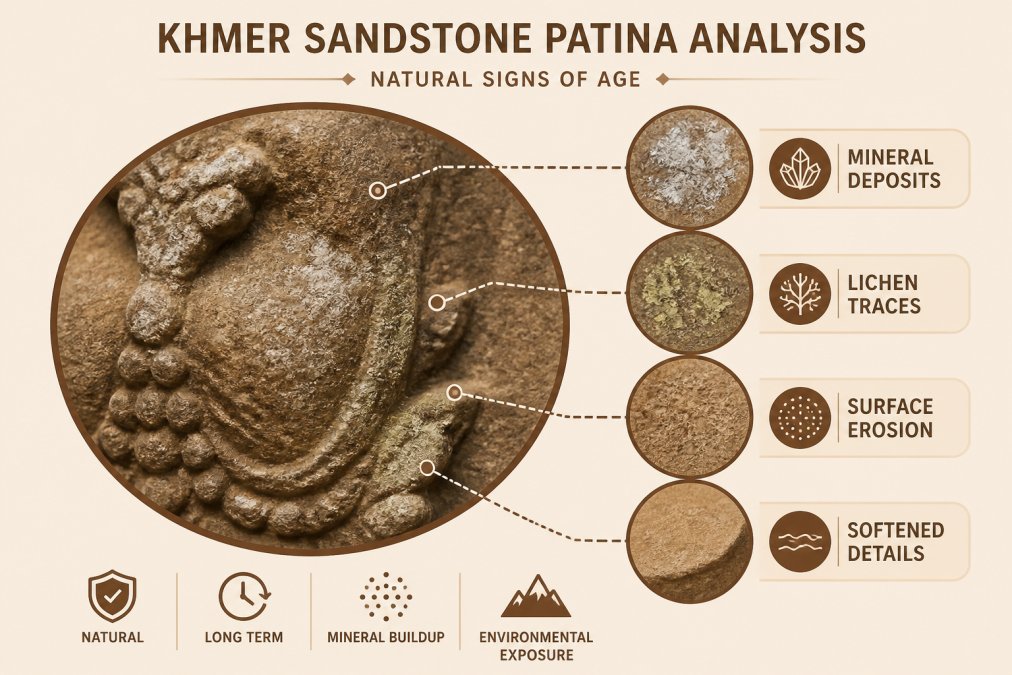
The patina, accumulated weathering, mineral deposits, and biological growth, provides one of the most reliable indicators of age. Authentic patina develops over centuries through specific natural processes that artificial aging techniques cannot fully replicate.
Natural Weathering Patterns
Authentic Khmer sandstone exposed to tropical conditions develops predictable weathering patterns. Water moving through the stone's pores dissolves certain minerals while depositing others, creating color variations and surface texture changes. Iron oxide produces rust-colored staining; manganese oxide creates dark streaks. Weathering follows the stone's natural grain structure and porosity variations, with softer mineral inclusions eroding faster than harder components.
Examine patina distribution carefully. On authentic pieces, weathering is heavier in areas exposed to water flow and lighter in protected recesses. Color variations follow logical patterns based on the sculpture's orientation and drainage characteristics. Artificial aging often appears more uniformly distributed because the process is applied mechanically rather than developing naturally over time.
Artificial Aging Techniques in Fakes
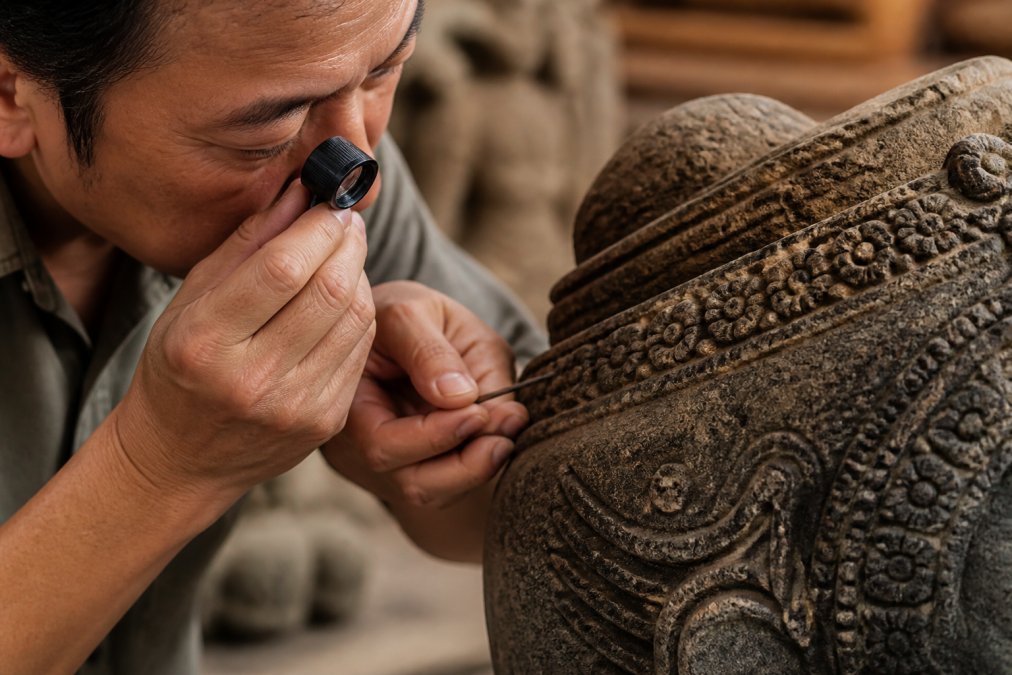
Modern forgers employ chemical treatments, acid washes, and soil burial to artificially age sandstone. However, artificial aging lacks the depth of genuine weathering. Real patina penetrates the stone's surface as minerals migrate through pores; artificial treatments remain largely superficial. Under magnification, genuine patina has settled into the stone's texture, while artificial aging sits on top of it.
The color palette of artificial aging often appears too uniform or too vibrant. Genuine tropical weathering produces subtle, complex color variations, rust tones mixed with grays, blacks from manganese oxide, earth tones from clay deposits. Artificially induced biological growth appears random because the aging process doesn't replicate the selective conditions that real organisms require.
Identifying Fake Khmer Artifacts: Common Forgery Methods
Tool Marks and Carving Techniques
Authentic Khmer carving shows evidence of hand tools, chisels, gouges, and rasps, used by skilled artisans. These tools leave characteristic marks: sharp chisels create clean, defined edges; rasps create parallel linear marks. The depth and angle vary based on the carver's technique and the stone's hardness.
Modern reproductions often display tool marks that are too uniform or too shallow. Electric tools and power carving equipment produce different mark patterns than hand tools. Examine transition points where different surfaces meet: on authentic pieces, these show the carver's deliberate technique. Forged pieces sometimes display inconsistent transitions, suggesting unfamiliar tools or learning processes.
Modern Reproduction Red Flags
Overly sharp edges on raised areas signal recent carving; authentic pieces show rounded edges from centuries of weathering. Uniform color across the entire surface suggests modern origin, as authentic pieces display color variation reflecting different mineral compositions and weathering rates.
The smell of fresh stone or chemical treatments indicates recent creation. Examine the base and protected areas: authentic sculptures show less patina in protected areas, but still show some aging. If the base appears nearly pristine while exposed areas are heavily weathered, the piece may be recently carved and selectively aged.
Inconsistent iconography is a major red flag. A sculpture combining iconographic elements from different periods signals a forger who didn't fully understand Khmer artistic conventions.
Verifying Provenance and Archaeological Context
Provenance, the documented ownership and location history of an artwork, provides crucial authentication information. Request complete provenance documentation before purchasing, including photographs from previous collections, museum exhibition records, and expert attributions. Gaps in provenance warrant caution.
Archaeological context matters tremendously. Sculptures excavated from known temple sites like Banteay Chhmar, Phnom Da, or Angkor Wat carry authentication weight. Pieces with unknown origin or vague descriptions lack this verification.
The legal and ethical acquisition history is increasingly important. Many countries, including Cambodia, have implemented export restrictions on cultural artifacts. New acquisitions should come from sellers who can verify legal origin and compliance with current regulations.
At HD Asian Art, we prioritize provenance verification and ethical sourcing. Our carefully curated collection includes pieces with documented histories and proper export documentation. When you purchase from us, you're acquiring a sculpture with verifiable background that supports your confidence in authenticity.
Scientific Testing and Expert Authentication Methods
Modern authentication employs scientific methods providing objective verification beyond visual inspection. Thermoluminescence (TL) dating measures radiation accumulated in clay minerals since the stone was last heated. Ancient sandstone contains measurable radiation; when stone is freshly quarried and carved, this radiation resets. Over centuries, it accumulates predictably, allowing determination of whether a piece is genuinely ancient or recently carved.
X-ray fluorescence (XRF) analysis identifies elemental composition non-invasively, revealing whether the stone matches known Khmer quarry sources or represents a modern substitute. Petrographic analysis, microscopic examination of the stone's mineral structure, provides detailed information about origin and history. Stable isotope analysis examines isotope ratios that vary based on geological origin and environmental conditions.
Seek expert authentication before making significant purchases. Reputable dealers and museums can recommend qualified experts specializing in Khmer sculpture authentication.
Preservation and Maintenance of Antique Khmer Pieces
Store sculptures in stable environmental conditions. Avoid extreme temperature fluctuations and humidity changes, which cause the stone to expand and contract. A moderate temperature (60-75°F) with relative humidity between 40-60% provides ideal conditions.
Handle pieces with care, wearing cotton gloves to prevent skin oils from damaging the surface. Support the piece from below rather than grasping protruding elements. Never use acidic cleaners, abrasive scrubbing, or high-pressure water. If cleaning is necessary, use only distilled water and soft natural-fiber brushes. Many collectors prefer leaving patina intact, as it's part of the piece's authenticity.
Avoid direct sunlight exposure, which fades surface colors and causes uneven weathering. Display pieces in interior locations with controlled lighting. Document your piece thoroughly with photographs from multiple angles, recorded inscriptions, and maintained provenance documentation.
Authenticating antique Khmer sandstone requires combining visual analysis, historical knowledge, material understanding, and scientific verification. The effort you invest in learning these authentication methods protects your collection and ensures you're acquiring genuine sculptures with real historical value. At HD Asian Art, we apply rigorous authentication standards to every piece in our collection, ensuring that when you acquire a sculpture from us, you're investing in authenticity, provenance, and the refined spiritual presence these masterworks bring to your meditation space or curated home sanctuary. Browse our authenticated collection with confidence, knowing each piece carries the verification and care that serious collectors deserve.
Frequently Asked Questions
What are the key physical characteristics of authentic Khmer sandstone?
Authentic Khmer sandstone exhibits specific mineral composition with visible quartz grains, consistent porosity throughout, and natural weathering patterns from centuries of exposure. The stone typically shows fine to medium grain structure, with color ranging from warm buff to golden tones. Authentic pieces display uneven surface finish consistent with hand-carving techniques from the Angkorian period, and the patina develops organically over centuries rather than appearing uniform or artificially applied.
How does patina analysis help identify antique Khmer sculptures?
Patina on authentic Khmer sandstone develops through natural mineral accumulation, biological growth, and chemical weathering over centuries. Genuine pieces show patina that penetrates surface crevices unevenly, with darker deposits in recessed areas and lighter exposure on raised features. Artificial aging attempts typically create uniform surface coatings that sit on top of the stone rather than integrating into the material. Examining patina depth, consistency, and distribution patterns reveals whether a piece has genuinely aged or been artificially treated to appear older.
What are common signs that a Khmer artifact is a modern replica?
Modern replicas often display tool marks inconsistent with historical carving methods—typically too uniform or showing evidence of power tools rather than hand chisels. The stone may feel unnaturally smooth or have suspiciously perfect symmetry. Artificial aging produces patina that flakes or washes away easily, lacks depth in crevices, or appears painted on. Missing provenance documentation, overly perfect condition for supposedly ancient pieces, and anatomical proportions that don't match known Angkorian artistic styles are additional red flags indicating a reproduction rather than an authentic antique.
How important is provenance when authenticating Khmer sandstone?
Provenance is essential for establishing legitimacy and ethical acquisition of Khmer sculptures. Documentation tracing ownership history, museum records, archaeological context, and export permits provides verifiable evidence of authenticity and legal status. Pieces without clear provenance carry higher risk of being looted artifacts or modern fakes. Reputable sources maintain detailed records of acquisition, previous ownership, and archaeological significance. When evaluating a piece, request documentation of its history—gaps in provenance or vague claims about origins should raise concerns about both authenticity and ethical sourcing.
