



Hindu Deity Statues: Major Gods, Goddesses and Symbolism
Hindu Deity Statues: Major Gods, Goddesses and Symbolism
Most people who encounter Hindu deity statues for the first time recognise their visual power immediately but struggle to read them. The multiple arms, the weapons, the animals, the gestures, the colours - all of it is a precise visual language developed over more than two thousand years of sculptural tradition across India, Southeast Asia, and beyond.
Understanding that language transforms a beautiful object into something far more meaningful, whether you are building a home altar, adding to a serious collection, or simply trying to understand what you are looking at. This guide covers the major deities represented in Asian Hindu sculpture, what each one symbolises, and how regional artistic traditions shaped their depictions.
Table of Contents
Quick Takeaways
|
Key Insight |
Explanation |
|---|---|
|
Every attribute is intentional |
Each weapon, animal, hand gesture (mudra), and posture in a Hindu deity statue carries specific theological meaning rooted in ancient Sanskrit texts called the Agamas and Shilpashastras. |
|
Ganesh always comes first |
In Hindu practice, Ganesh is invoked before any ritual or new undertaking. A Ganesh statue at the entrance of a home or altar is standard across all Hindu traditions, not just one regional school. |
|
Shiva has more iconographic forms than any other deity |
From the serene Shiva Lingam to the ferocious Bhairava to the dancing Nataraja, Shiva sculpture spans a wider range of artistic expression than Vishnu or Brahma combined. |
|
Southeast Asian Hindu art blends local traditions |
Cambodian, Javanese, and Thai Hindu sculptures often fuse indigenous aesthetics with Indian iconography, producing forms that are unmistakably regional while remaining theologically coherent. |
|
The goddess is not one figure but many |
Durga, Kali, Lakshmi, Saraswati, and Parvati are distinct deities with separate iconographies, yet all are understood in Hindu theology as expressions of a single cosmic feminine principle called Shakti. |
|
Material and finish carry meaning |
Bronze, stone, and gilded wood are not interchangeable choices. Regional sculptural traditions assigned specific materials to specific deities, a practice that museum-quality Asian Hindu sculptures continue to reflect. |
|
Number of arms indicates supernatural power |
Two arms indicate a deity in a peaceful, approachable form. Four, six, eight, or more arms signal a deity in a cosmic or warrior aspect, capable of performing multiple divine functions simultaneously. |
Why Iconography Matters in Hindu Religious Art
Hindu religious art is not decorative in the Western sense of the word. It is a theological document. The ancient Indian texts known as the Shilpashastras prescribed precise rules for how each deity must be depicted: the number of arms, the objects held in each hand, the vehicle (vahana) the deity rides, the colour of the skin, the posture, and even the expression on the face. A sculptor who deviated from these rules was not being creative. He was making an error that rendered the image ritually deficient.
This means that when you are looking at a well-made Hindu deity statue, you are reading a text. Every element communicates something specific about the deity's nature, powers, and relationship to the devotee.
In practice, collectors who learn to read this iconographic language find it transforms how they evaluate sculptures. An image that looked merely beautiful before becomes evidence of a sculptor's theological knowledge, regional training, and technical mastery.
Pro tip: When evaluating any Hindu deity statue for purchase, check whether the iconographic attributes are correctly rendered. A four-armed Vishnu should hold the conch (shankha), discus (chakra), mace (gada), and lotus (padma) in the correct sequence of hands. Errors in this sequence suggest a commercial reproduction rather than a work made within a living sculptural tradition.
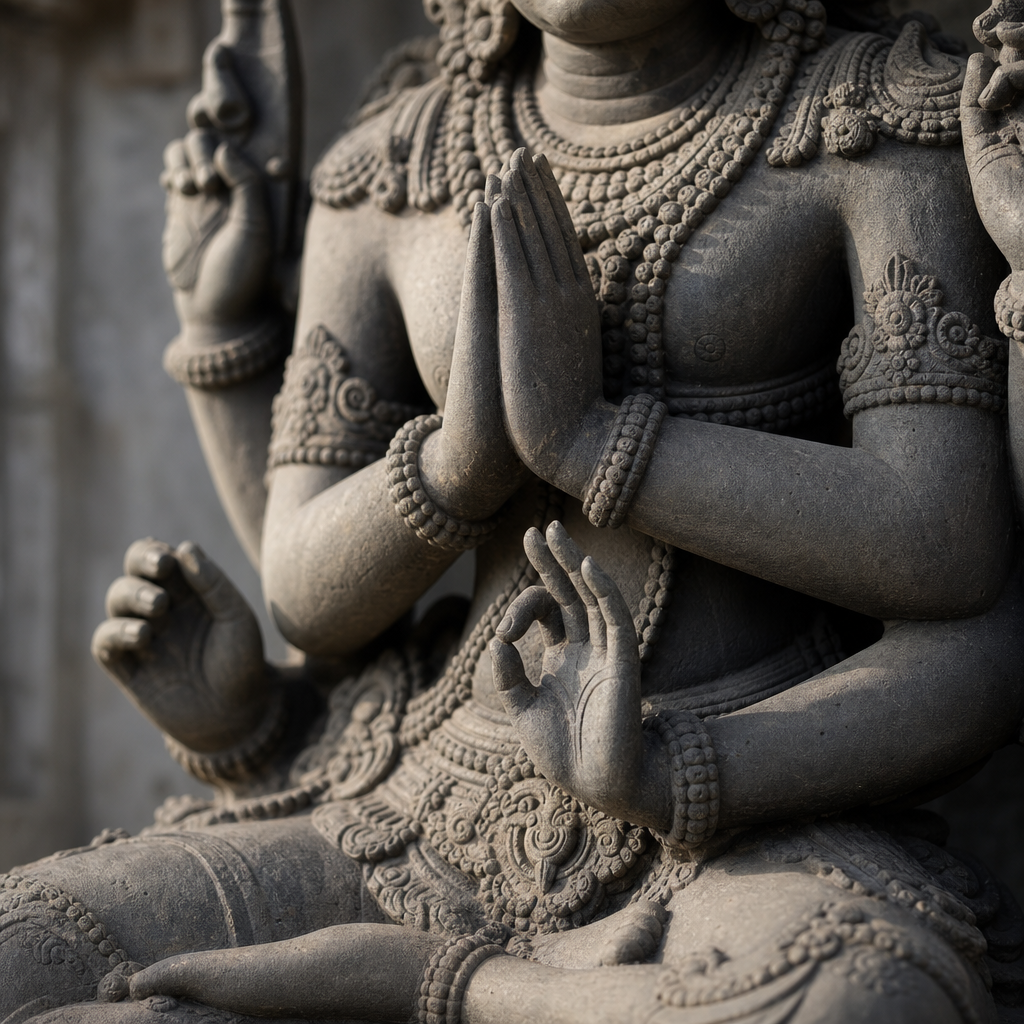
Shiva: The Destroyer, the Ascetic, the Cosmic Dancer
Shiva is one of the three principal deities of Hinduism, alongside Brahma and Vishnu, and he is the one most richly represented in Asian sculpture. His roles are apparently contradictory: he is both the destroyer of the universe and its regenerator, both a fierce ascetic who renounces the world and a devoted husband, both terrifying and deeply compassionate. This complexity makes Shiva sculpture some of the most visually and conceptually challenging work in the entire tradition of Hindu religious art.
Nataraja: Shiva as Cosmic Dancer
The Nataraja form, which depicts Shiva dancing within a ring of fire, is one of the most recognisable images in all of Asian art. The dance, called the Ananda Tandava or Dance of Bliss, represents the five cosmic acts: creation, preservation, destruction, concealment, and liberation. Each element of the sculpture encodes one of these acts. The upper right hand holds a small drum (damaru) whose sound represents creation. The upper left hand holds a flame representing destruction.
The dwarf figure beneath Shiva's foot is Apasmara, the demon of ignorance. Shiva's dance suppresses ignorance, which is why this form became one of the most important images in Hindu temple sculpture, particularly in South India under the Chola dynasty between the 9th and 13th centuries CE.
Shiva Lingam: Abstract Representation of Cosmic Power
The Shiva Lingam is an aniconic form, a cylindrical shaft set within a circular base (the yoni), representing the inseparable union of masculine and feminine cosmic principles. Many collectors are initially surprised to find that this abstract form predates most of the figurative Shiva sculptures by centuries. Archaeological evidence from the Indus Valley civilisation, dated to around 2500 BCE, includes objects that scholars interpret as proto-lingam forms.
In ritual practice, the Lingam is considered the most direct form of Shiva worship. A stone or bronze Lingam placed on a home altar is not a lesser image. It is, in traditional Hindu understanding, the most complete one.
Identifying Shiva in Sculptural Form
Key identifying attributes include the crescent moon in the matted hair (jata), the Ganges river flowing from the hair, the third eye on the forehead, a serpent as a garland, the trident (trishula) as a weapon, and the bull Nandi as the vahana. Not every depiction includes all of these, but the third eye and trident together are almost always sufficient to identify Shiva.
Vishnu and His Avatars in Asian Sculpture
Vishnu is the preserver of the universe, the deity who descends to Earth in physical form whenever cosmic order (dharma) is threatened. These descents are called avatars, and the most important of them, Rama and Krishna, became independent objects of devotion with their own sculptural traditions spanning thousands of years and dozens of regional styles.
Standard Vishnu Iconography
A standing Vishnu in his standard four-armed form is called Chaturbhuja Vishnu. The four hands hold a conch (shankha), a discus (Sudarshana Chakra), a mace (Kaumodaki), and a lotus (padma). He wears a tall cylindrical crown called a kirita and typically stands on a lotus pedestal. His skin is traditionally depicted as dark blue or black, representing the infinite sky and the cosmic ocean.
The eagle Garuda is Vishnu's vahana. A sculpture that shows a deity standing on or accompanied by Garuda, or that depicts a figure with eagle-wing attributes, can almost always be identified as Vishnu or a Vishnu-related deity.
Krishna and Rama in Sculpture
Krishna sculptures are immediately identifiable by the flute, which Krishna holds in the classic Tribhanga posture, a three-point bend of the body that conveys relaxed grace. The cowherd imagery, including the peacock feather in the crown and cattle in the background, is characteristic of the pastoral (Vrindavana) aspect of Krishna.
Rama is typically shown holding a bow and accompanied by his wife Sita and his devoted companion Hanuman. Southeast Asian Rama sculptures, particularly from Cambodia and Thailand, often depict scenes from the Ramayana in elaborate carved relief panels rather than standalone statues.
Ganesh: The Remover of Obstacles
A Ganesh statue is the single most widely owned Hindu deity statue in the world, and for good reason. Ganesh is the deity of beginnings, the remover of obstacles, the patron of arts and sciences, and the lord of intellect. He is invoked before every religious ceremony, every new business venture, every journey, and every creative project. His image appears at the entrance of Hindu temples, homes, and businesses across Asia and increasingly across Europe and the Americas.
Reading Ganesh Iconography
The elephant head is Ganesh's most obvious identifier, but the details matter considerably. The single tusk (the other is broken) is held in one hand or placed on the ground beside him. The large ears represent his ability to hear all prayers. The round belly is associated with abundance and the containment of the entire universe. The mouse (mooshika) at his feet or serving as his vehicle represents the ego that must be tamed before wisdom can emerge.
The position of the trunk carries specific meaning. A trunk curved to the left is associated with the Ida nadi, the left energy channel in yogic tradition, and is considered easier to worship. A trunk curved to the right is associated with the Pingala nadi and the solar current, and is considered more powerful but more demanding in terms of ritual observance. For home altars, left-trunk Ganesh statues are almost universally recommended by practitioners.
Ganesh is typically depicted with four arms, though two-armed and six-armed forms exist. Common objects in his hands include a modaka (sweet dumpling representing the sweetness of spiritual realisation), an axe (to cut through obstacles), a noose (to capture difficulties), and the broken tusk itself.
Pro tip: When placing a Ganesh statue in your home or on an altar, face him toward the main entrance of the room. The traditional placement is threshold-facing, reflecting his role as guardian of doorways and new beginnings.
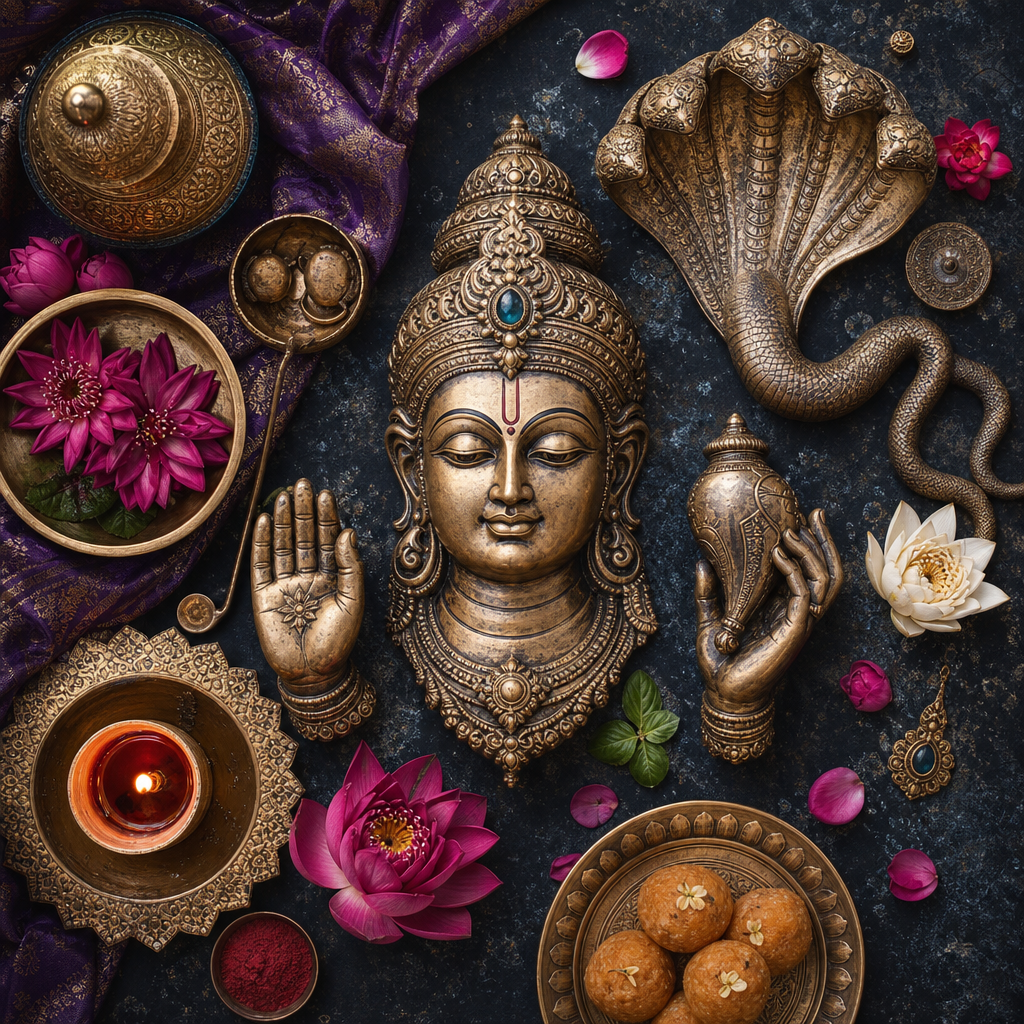
Hindu Goddess Sculptures: Durga, Lakshmi, Saraswati, and Kali
The Hindu goddesses represent one of the most visually diverse and philosophically rich categories in all of Asian religious art. Each of the major goddesses has her own iconography, her own vahana, her own weapons and attributes, and her own specific domain of power. Collectors who approach Hindu goddess sculptures expecting a uniform category quickly discover that the differences between them are as significant as the differences between any two male deities.
Durga: The Warrior Goddess
Durga is the supreme goddess in her warrior aspect, the embodiment of divine power mobilised against evil. She is almost always depicted with multiple arms, typically eight or ten, each holding a weapon gifted to her by a different male deity when they were unable to defeat the buffalo demon Mahishasura themselves. This origin story makes Durga the only deity in the tradition who simultaneously wields the weapons of Shiva, Vishnu, Indra, Agama, Yama, and others.
Her vahana is the lion or tiger, and she is almost always depicted in a triumphant posture, often with one foot pressing down on the demon. Her expression is fierce but controlled. She is not chaotic. She is purposeful power.
Lakshmi: The Goddess of Wealth and Fortune
Lakshmi is Vishnu's consort and the goddess of wealth, fortune, beauty, and abundance. Her iconography is deliberate in its gentleness. She sits or stands on a lotus, typically with two elephants pouring water over her from either side (the Gaja-Lakshmi form). Her hands are in the Abhaya mudra (reassurance) and Varada mudra (gift-giving). Gold coins flow from her lower right hand.
In Southeast Asian Hindu art, Lakshmi sculptures from Java and Bali often show strong Indian influence while incorporating distinctly local decorative detail in the crown, jewelry, and base ornamentation.
Saraswati: Goddess of Knowledge and the Arts
Saraswati is the goddess of knowledge, music, art, speech, and learning. She is depicted as serene and fair-skinned, dressed in white, seated on a white lotus or a swan. Her most important attribute is the veena, a stringed instrument she plays, which represents the harmony of knowledge and creativity. She also holds a book of sacred texts (Vedas) and prayer beads.
Her vahana is the white swan, a symbol of discernment, the ability to separate milk from water just as wisdom separates truth from illusion.
Kali: Fierce Goddess of Time and Transformation
Kali is the most misunderstood of all Hindu goddesses in Western contexts. She is not a goddess of death in the sense of annihilation. She is the goddess of time, transformation, and the destruction of ego. Her terrifying iconography, dark skin, wild hair, protruding tongue, garland of skulls, and severed heads held in her hands, represents the annihilation of everything that prevents spiritual liberation.
In practice, Kali is worshipped with tremendous devotion by spiritual practitioners precisely because of her fierce aspect. She destroys illusions. Kali sculpture from Bengal, where her worship is most intense, tends toward the dramatic and dynamic, while South Indian depictions are somewhat more contained in pose.
Regional Variations in Asian Hindu Sculptures
The same deity can look strikingly different depending on where the sculpture was made. This is one of the most fascinating aspects of collecting Asian Hindu sculptures, and one of the clearest markers of authenticity and quality.
Indian Sculptural Traditions
South Indian bronze casting, particularly from the Chola period, represents the technical and aesthetic peak of Hindu sculptural art. Chola bronzes use the lost-wax (cire perdue) method to achieve fluid, organic forms with fine detail in the jewellery and textiles. North Indian sculpture, particularly in stone from Rajasthan and Madhya Pradesh, tends toward more elaborately decorated surfaces with sensuous proportions influenced by the Gupta period ideal of divine beauty.
Cambodian Hindu Sculpture
The Khmer empire (802 to 1431 CE) produced some of the most impressive Hindu sculpture outside India. Angkor Wat is essentially a Hindu cosmological diagram in stone, its towers representing Mount Meru, the axis of the universe in both Hindu and Buddhist cosmology. Khmer Vishnu and Shiva sculptures tend toward a powerful, broad-shouldered solidity with distinctly Khmer facial features: a wide, slightly smiling mouth, flattened nose, and almond-shaped eyes.
Balinese and Javanese Hindu Sculpture
Bali remains the only Hindu-majority island in Indonesia, and its sculptural tradition is vibrantly alive. Balinese Hindu sculptures blend Shaivite and Vaishnavite iconography with strong local animist influences, producing deity images of remarkable decorative complexity. Javanese Hindu sculpture from the Majapahit period (13th to 16th centuries) shows strong Indian Gupta influence filtered through centuries of local adaptation.
"The Hindu iconographic tradition is one of the most sophisticated visual theological systems ever developed. Each image is a precise map of metaphysical reality, not a picture of a supernatural being." - Stella Kramrisch, art historian and former curator of Indian Art at the Philadelphia Museum of Art
Comparing Shiva, Vishnu, and Devi Iconography
|
Feature |
Shiva |
Vishnu |
Devi (Durga, Lakshmi, Kali) |
|---|---|---|---|
|
Primary cosmic role |
Destruction and regeneration |
Preservation and restoration of dharma |
Shakti, the activating energy of the cosmos |
|
Key weapon or attribute |
Trident (trishula), drum (damaru) |
Discus (Sudarshana Chakra), conch (shankha) |
Multiple weapons (Durga), lotus and coins (Lakshmi), sword and skull (Kali) |
|
Vehicle (vahana) |
Bull (Nandi) |
Eagle (Garuda) |
Lion or tiger (Durga), owl (Lakshmi), jackal (Kali) |
|
Colour symbolism |
White ash-smeared, blue throat |
Dark blue or black skin |
Golden (Lakshmi), dark blue-black (Kali, Durga) |
|
Most common sculptural form |
Nataraja, Lingam, seated yogi |
Standing Chaturbhuja, Vishnu on Garuda |
Mahishasura Mardini (Durga), seated Lakshmi, standing Kali |
|
Dominant regional tradition |
South India (Chola bronze), Nepal |
North India, Cambodia (Khmer) |
Bengal (Kali, Durga), South India and Java (Lakshmi) |
Choosing a Hindu Deity Statue for Your Space or Collection
The first question to answer is not which deity you prefer aesthetically but which deity is appropriate for your intention. This is not superstition. It is the practical application of a sophisticated system of symbolic correspondence that the Hindu sculptural tradition was built to serve.
For a home entrance or business threshold, a Ganesh statue is the clear choice. This is not a matter of personal taste. Ganesh is the guardian of thresholds across all Hindu traditions and regional schools. A bronze or stone Ganesh positioned at the entrance of a home or business aligns with over two thousand years of lived devotional practice.
For a meditation or altar space focused on transformation and spiritual practice, Shiva sculpture in the Nataraja or meditating form is appropriate. For practitioners focused on abundance, prosperity, and domestic harmony, a Lakshmi statue placed in the home's prosperity corner (northeast in Vastu Shastra, the traditional Indian system of spatial arrangement) is standard.
For collectors whose interest is primarily art historical rather than devotional, the regional origin and period of the sculpture matters more than the specific deity depicted. A well-preserved Khmer sandstone Vishnu from the 11th century CE is significant regardless of its subject because of what it demonstrates about the sculptural achievements of the Angkor period.
In practice, the most common mistake buyers make is prioritising size over iconographic correctness. A large but poorly rendered Ganesh statue, where the trunk direction is ambiguous or the modaka is absent, is less valuable and less meaningful than a smaller, correctly rendered one. Quality of execution within the correct iconographic framework is the standard that distinguishes museum-quality Hindu religious art from commercial reproduction.
At HD Asian Art, the Hindu deity statues are sourced from across the major sculptural traditions of Asia, including India, Cambodia, Indonesia, and Thailand, with a commitment to iconographic correctness that collectors and practitioners can verify against the classical textual standards. This is the meaningful distinction between a specialist retailer and a generic home decor supplier.
Frequently Asked Questions
What is the difference between Hindu deity statues from India and those from Southeast Asia?
Indian Hindu deity statues follow the iconographic rules prescribed in the Shilpashastras most strictly, and the finest Indian examples, particularly Chola bronzes from South India, are benchmarks of technical achievement. Southeast Asian Hindu sculptures, including Khmer, Javanese, and Balinese pieces, follow the same core iconography but filter it through local aesthetic traditions, producing forms with distinctly regional facial features, decorative sensibilities, and material choices. Neither is inferior. They represent parallel lineages of the same sacred art tradition.
How do I identify which Hindu deity a statue represents?
Start with the most distinctive attribute. An elephant head means Ganesh. A trident or third eye means Shiva. A conch and discus together mean Vishnu. Multiple arms holding weapons on a lion or tiger means Durga. A veena and white clothes mean Saraswati. Gold coins flowing from the hand and flanking elephants mean Lakshmi. A garland of skulls, protruding tongue, and dark skin mean Kali. In most cases, two or three attributes together are enough for a confident identification.
Does the material of a Hindu deity statue affect its spiritual significance?
Yes, according to traditional Hindu practice. The Agamas specify preferred materials for each deity. Shiva Lingams are traditionally made of stone, particularly black granite or the self-manifested swayambhu stones. Vishnu images in South India were traditionally cast in Panchaloha, a five-metal alloy. Bronze and gilded wood are both liturgically acceptable materials for most deities. Gold and silver are the most ritually elevated but practically limited to temple use. For home altars and collections, high-quality stone and bronze are the materials with the longest documented history of sacred use.
Is it appropriate for non-Hindus to own Hindu deity statues?
This is a question that provokes genuine debate within Hindu communities, and it deserves a direct answer. The mainstream position among Hindu scholars and practitioners is that genuine reverence and informed appreciation are what matter, not religious affiliation. What is considered disrespectful is placement in inappropriate locations (bathrooms, on the floor, positioned lower than the worshipper's eye level during seated use), treating the statue purely as ornament with no acknowledgment of its sacred character, or allowing it to deteriorate. Collectors and practitioners from all backgrounds who treat Hindu deity statues with informed respect are generally welcomed by the tradition.
What is the significance of hand gestures (mudras) in Hindu deity statues?
Mudras are one of the most precise elements of Hindu iconography. The Abhaya mudra, an open right hand raised with the palm facing outward, means protection and reassurance. The Varada mudra, an open right hand pointing downward, means gift-giving and generosity. The Dhyana mudra, both hands resting in the lap one on the other with palms upward, indicates meditation. The Vitarka mudra, with the thumb and index finger touching to form a circle, indicates teaching and discussion of the dharma. Knowing these four mudras will allow you to read the emotional and theological register of almost any Hindu deity statue correctly.
Are Hindu goddess sculptures appropriate for home altars, or only for temples?
Hindu goddess sculptures are entirely appropriate for home altars, and in many regions of India and Southeast Asia, domestic goddess worship predates formal temple culture. Lakshmi is among the most commonly worshipped deities in Hindu homes precisely because her domain includes domestic prosperity and harmony. Durga, Saraswati, and even Kali are regularly worshipped in home settings. The key requirement is that the image be treated with reverence: placed on a clean, elevated surface, not cluttered with unrelated objects, and ideally acknowledged with a regular practice, however simple.
If you have experience with Hindu deity statues in your home, altar, or collection, share what you have noticed about the role iconographic accuracy plays in your relationship with the piece.
We would love your feedback and any insights you would share with others. What perspective would you add?
References
