



Chinese Buddha Statues: Tang to Ming Dynasty Guide
Chinese Buddha Statues: Tang to Ming Dynasty Guide
Few collecting categories reward serious study as richly as Chinese Buddha statues. A Tang dynasty sandstone Bodhisattva excavated from a Sichuan cave temple and a Ming dynasty gilt bronze Shakyamuni sitting in a London auction room can look superficially similar to the untrained eye, yet they represent radically different periods of patronage, iconography, and casting technique.
The differences are not cosmetic. They determine authenticity, value, and the spiritual weight an object carries into your home or altar. This guide cuts through the generalities to give collectors and practitioners precise, actionable knowledge about two of China's greatest Buddhist art periods.
Table of Contents
Quick Takeaways
|
Key Insight |
Explanation |
|---|---|
|
Tang dynasty figures show full, rounded facial features |
Tang sculptors deliberately moved away from elongated Northern Wei proportions, reflecting cosmopolitan Tang confidence and Indian Gupta influence absorbed via the Silk Road. |
|
Ming gilt bronzes have a distinctive warm, reddish-gold surface |
Ming craftsmen applied mercury-amalgam gilding fired at high temperatures, producing a depth of gold tone that modern electroplating cannot replicate. |
|
The Xuande period (1426-1435) is the most coveted Ming benchmark |
Imperial Xuande bronzes set proportional and quality standards that later Ming workshops consciously imitated, making period attribution critical for valuation. |
|
Chinese Buddha statues often bear sealed bases |
A copper or brass base plate sealed with solder and containing consecration deposits is a strong indicator of authentic devotional use rather than purely decorative production. |
|
Tang stone sculptures survive more commonly than Tang bronzes |
The 845 CE Huichang Suppression ordered the melting of Buddhist bronze images across China, making Tang stone and dry-lacquer figures the more survivable Tang format. |
|
Tibetan-influenced Ming bronzes differ from Han Chinese Ming bronzes |
The Yongle and Xuande courts produced Tibetan-style bronzes as diplomatic gifts, featuring Vajrayana iconography and a slightly different alloy composition compared to Han-style court bronzes. |
|
Provenance documentation adds measurable value |
Christie's and Sotheby's auction records consistently show that documented pre-1970 collection history can increase hammer prices by 30 to 60 percent for Chinese Buddhist bronzes. |
Tang Dynasty Buddhist Art: The Imperial Zenith
The Tang dynasty (618 to 907 CE) represents the moment when Chinese Buddhist sculpture achieved full artistic maturity. Emperor Taizong's patronage and the state-sponsored translation projects of the monk Xuanzang brought Sanskrit texts, Indian sculptural models, and Central Asian aesthetic ideas directly into Chang'an workshops. The result was a synthesis that looked unlike anything produced in China before.
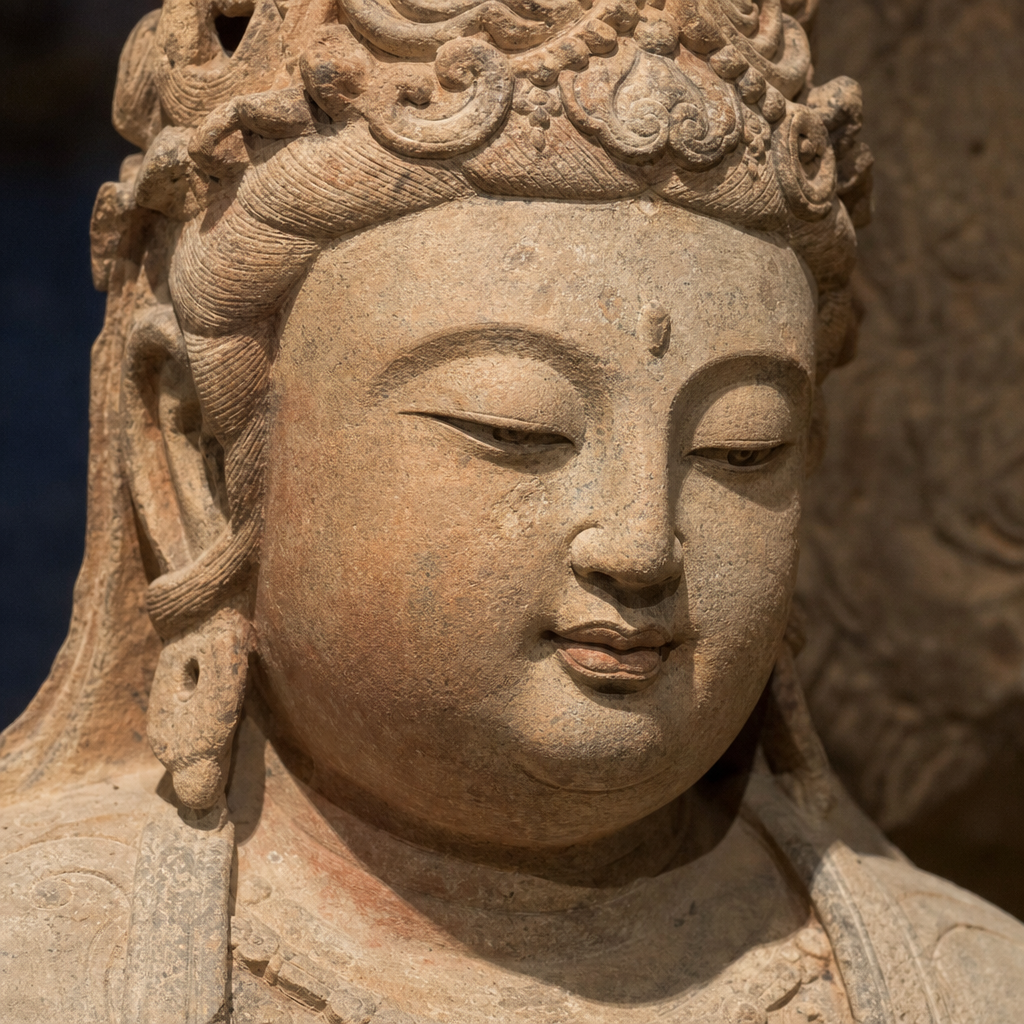
Tang figures are identifiable by several consistent characteristics. The face is broad, serene, and fleshy, with a rounded chin and heavy-lidded eyes that convey meditative absorption rather than rigid authority. The body beneath the robe is palpably three-dimensional, a quality inherited from late Gupta sculpture that Tang artists absorbed via Gandharan and Central Asian relay points. Drapery falls in natural, slightly clinging folds rather than the schematic wire-like ridges of earlier Northern Wei work.
Materials Used in Tang Buddhist Sculpture
Tang sculptors worked in stone, dry lacquer, and bronze. Stone carvings, particularly in limestone and sandstone, dominate surviving Tang output because of the Huichang Suppression of 845 CE, which destroyed thousands of bronze images across the empire. The cave temple complexes at Longmen near Luoyang preserve the most spectacular in-situ Tang stone carving, including the Fengxian Temple group commissioned under Empress Wu Zetian around 675 CE.
Dry-lacquer figures, called jiazhu in Chinese, were made by building up layers of lacquer-soaked cloth over a clay armature, then removing the clay to leave a hollow, lightweight shell. This technique produced remarkably lifelike surfaces and allowed transportability that stone could not offer. Several museum-quality dry-lacquer Tang Bodhisattvas survive in the collections of the Tokyo National Museum and the Metropolitan Museum of Art.
Pro tip: When examining a purported Tang stone Buddha, look at the ushnisha, the cranial protuberance on top of the head. In genuine Tang work it is smoothly integrated into the skull form with no abrupt join. Later copies frequently show a mechanical, almost plug-like ushnisha that sits awkwardly on the head rather than emerging from it.
Iconographic Priorities in Tang Buddhist Art
The Tang court favored Mahayana figures: Shakyamuni Buddha, Amitabha (the Buddha of the Western Pure Land), Vairocana (the Cosmic Buddha), and the great Bodhisattvas Guanyin, Manjushri, and Samantabhadra. Esoteric Buddhism (Mijiao) arrived in China in the early eighth century through masters like Subhakarasimha and Vajrabodhi, introducing multi-armed tantric deities that became popular in late Tang court circles.
The hand gesture, or mudra, is your first diagnostic. Seated Tang Buddhas most commonly display bhumisparsha mudra (earth-touching, right hand pointing down toward the ground) or dhyana mudra (meditation, both hands resting in the lap). Amitabha in Pure Land contexts uses vitarka mudra (teaching gesture, fingers raised with thumb and forefinger touching). Any statue claiming to be Tang that shows iconographic combinations that only became standard in the Song or later periods deserves serious scrutiny.
From Tang to Song: The Bridge Centuries
The collapse of the Tang and the Five Dynasties interregnum (907 to 960 CE) disrupted imperial patronage but did not end Buddhist sculpture production. Regional workshops in Fujian, Zhejiang, and Hebei continued working, often developing local styles that fed into the Song dynasty aesthetic.
Song dynasty (960 to 1279 CE) Buddhist sculpture moved toward greater naturalism and emotional warmth. The famous Water Moon Guanyin type, seated in a relaxed royal ease posture with one knee raised, became the signature Song Bodhisattva image. These figures in painted wood, sometimes over a meter tall, were produced in extraordinary numbers and survive in far greater quantity than Tang works of comparable quality.
The Song period matters to collectors at HD Asian Art's level because it produced many of the carved wooden Buddha types that influenced Japanese Kamakura sculpture and because Song ceramic sculpture, particularly the white-glazed Guanyin figures from Dehua in Fujian, established a formal vocabulary that Ming workshops inherited directly.
Ming Dynasty Gilt Bronze Buddha: The Collector's Benchmark
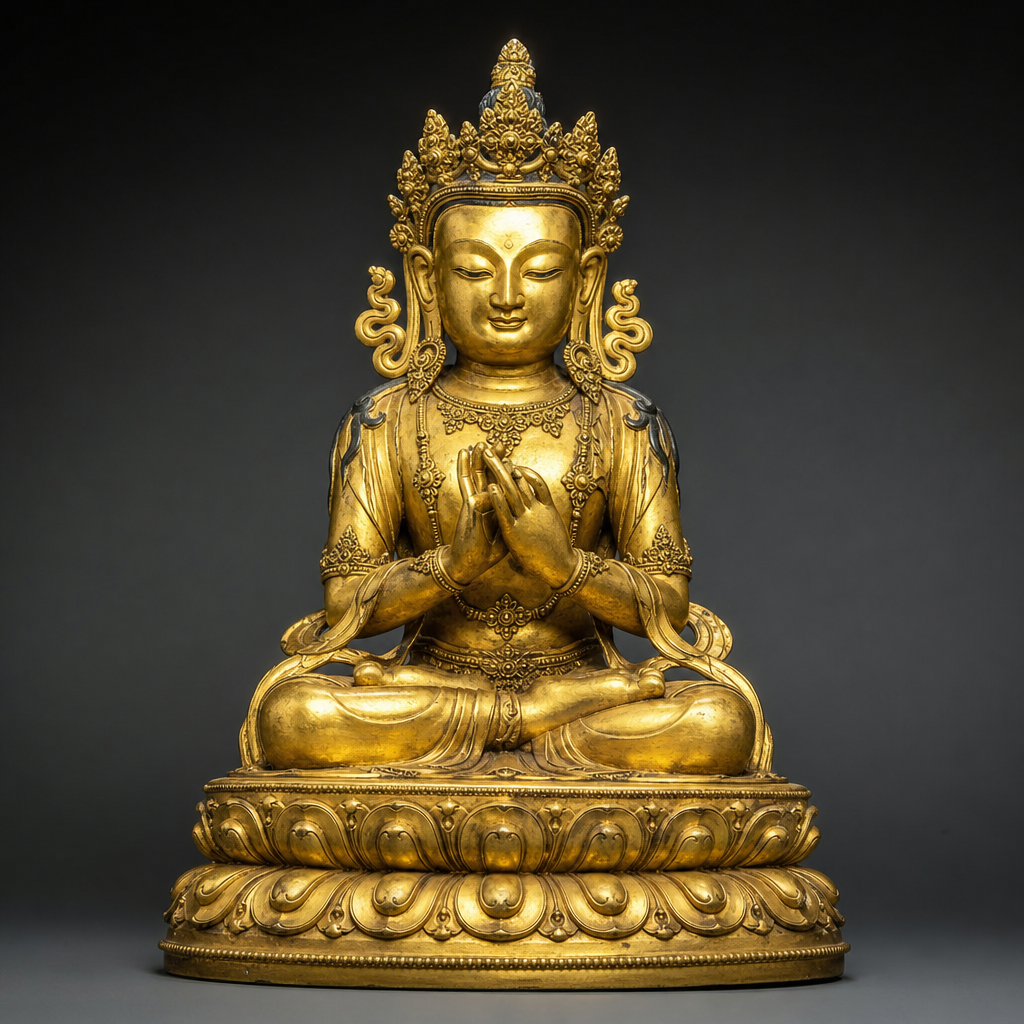
The Ming dynasty gilt bronze Buddha is the piece that most serious collectors of Chinese Buddhist art eventually pursue. The reasons are practical as well as aesthetic: Ming bronzes survive in substantial numbers compared to Tang bronzes, their quality range is well-documented, and the scholarship on attributing them to specific periods and workshops is more developed than for almost any other category of Chinese Buddhist sculpture.
The Ming dynasty ran from 1368 to 1644 CE, but for Buddhist bronzes the critical period is the early fifteenth century under the Yongle (1402 to 1424) and Xuande (1426 to 1435) emperors. Both rulers were personally devout Buddhists and maintained close diplomatic and religious ties with Tibetan Buddhist hierarchs. The imperial workshops in Beijing, the Yuyong Jian (Imperial Household Department workshops), produced bronzes to the highest standards of alloy composition, casting precision, and fire gilding.
Identifying a Genuine Yongle or Xuande Bronze
Authentic Yongle and Xuande bronzes share several measurable characteristics. The alloy is high in copper with controlled additions of tin and lead, producing a dense, slightly reddish metal that takes gilding uniformly. The casting is crisp: fine details like the hair curls (representing the ushnisha) and the incised textile patterns on robes are sharply defined, not blurred by excessive polishing or later reworking.
The lotus throne, almost always present on imperial Ming figures, is a key diagnostic. Yongle lotus thrones have large, rounded petals with a single incised groove running up each petal's center. Xuande petals tend to be slightly more elongated and pointed, with more elaborate incised decoration within each petal. Later Ming workshop copies often have flat, perfunctory petals that lack the dimensional quality of the originals.
Pro tip: The base plate on a Ming gilt bronze is not a minor detail. Imperial pieces have their base plates sealed with solder and often carry an inscription. A missing or replacement base plate on a piece claimed to be Yongle or Xuande is a serious red flag. The consecration deposits inside, when intact, can sometimes be dated by specialist laboratories, providing objective evidence for or against an early Ming attribution.
Later Ming Workshop Production
By the mid to late Ming period, Buddhist bronze production had spread well beyond the imperial workshops in Beijing. Fujian province became a major center, producing the famous blanc-de-Chine Dehua porcelain Guanyin figures alongside bronze equivalents. Yunnan in southwestern China developed a regional bronze tradition with recognizable stylistic quirks including slightly elongated faces and distinctive decorative borders on thrones.
Later Ming bronzes are not inferior objects simply because they are not imperial. A well-cast, devotionally used Fujian workshop Buddha from the late sixteenth century is a significant piece with real artistic and spiritual presence. The collecting mistake is paying imperial-period prices for workshop pieces, not buying workshop pieces in themselves.
Reading the Iconography: What Every Gesture and Attribute Tells You
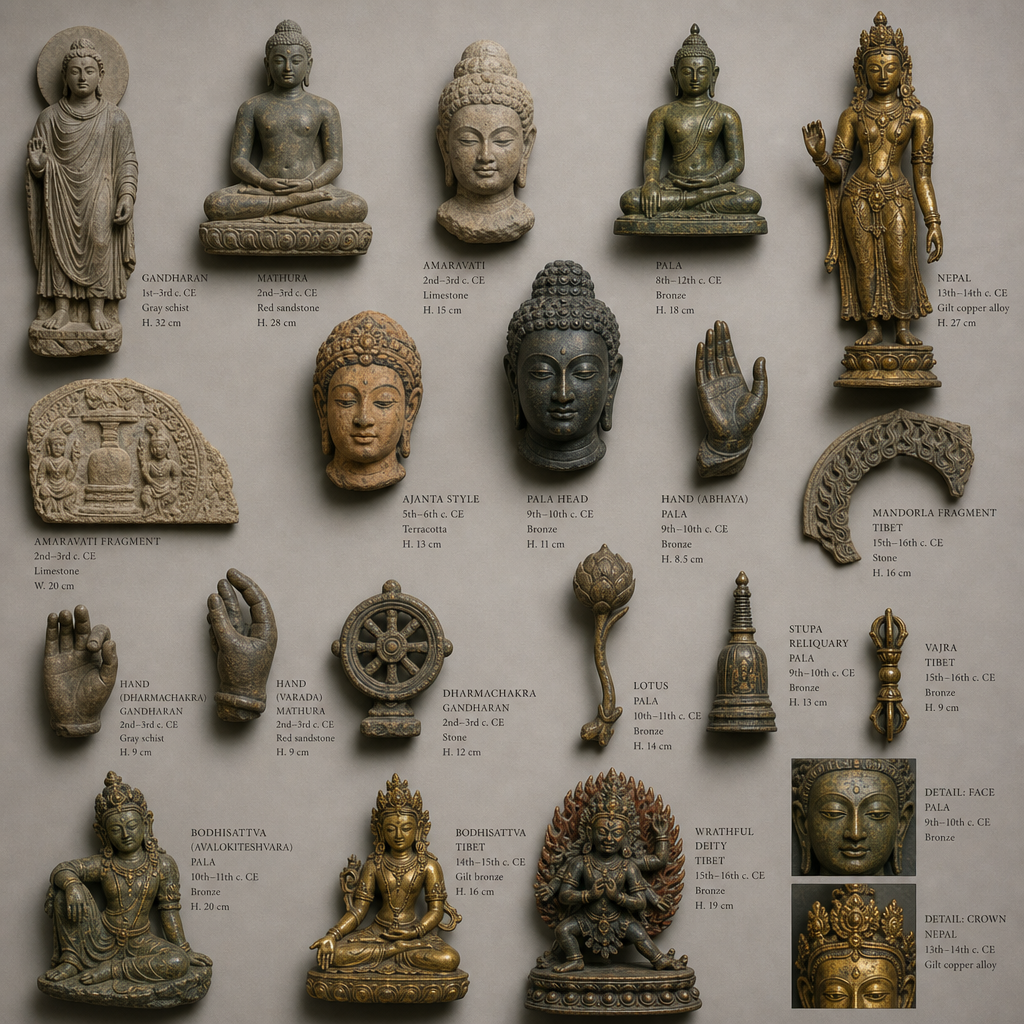
A common mistake among new collectors is treating iconography as decoration. In Buddhist art, every element is a statement of identity and function. Misreading a mudra or an attribute means misidentifying the deity, which matters both for accurate purchasing and for appropriate devotional use.
The Five Major Buddhas in Chinese Sculpture
Chinese Buddhist sculpture most frequently depicts Shakyamuni, the historical Buddha; Amitabha, the Buddha of the Western Pure Land; Vairocana, the Cosmic or Dharma-body Buddha; Maitreya, the future Buddha; and Medicine Buddha (Bhaisajyaguru), identified by the medicine bowl he holds in his left hand. Each has a standard iconographic signature, though regional workshops sometimes blurred these distinctions.
Shakyamuni is shown either in bhumisparsha mudra (the earth-touching gesture of enlightenment) or in dhyana mudra (meditation). Amitabha uses dhyana mudra with a small lotus flower or a small figure of Guanyin in his crown. Vairocana uses dharmachakra mudra (turning the wheel of the law), with both hands raised and the index finger of the right hand enclosed by the left fist. Getting these distinctions right is non-negotiable for an accurate collection.
Bodhisattvas in Chinese Buddhist Art
Guanyin is the most prolifically depicted figure in Chinese Buddhist sculpture across all periods. In Tang and Song work, Guanyin is often depicted as male or gender-ambiguous, consistent with the Indian Avalokiteshvara original. By the Ming period, Guanyin had become thoroughly feminized in popular Chinese devotion, appearing as a graceful woman in white robes, often holding a willow branch and a vase.
Manjushri is identified by his sword (cutting through ignorance) and the lotus supporting a scripture. Samantabhadra rides a white elephant. Ksitigarbha, enormously popular in Chinese folk Buddhism, is depicted as a monk with a staff and a wish-fulfilling jewel, acting as a guide for souls in the underworld. Any Chinese temple altar is likely to have Ksitigarbha prominently placed, and a quality Ming or Qing bronze Ksitigarbha is a meaningful collecting find.
"The history of Chinese Buddhist sculpture is inseparable from the history of Chinese statecraft. Every major stylistic shift corresponds not just to aesthetic preference but to changes in political patronage, diplomatic contact, and doctrinal emphasis." - Sherman Lee, former Director of the Cleveland Museum of Art, writing on Chinese Buddhist art in the museum's bulletin.
Comparison of Chinese Buddhist Art Periods
|
Feature |
Tang Dynasty (618 to 907 CE) |
Ming Dynasty (1368 to 1644 CE) |
|---|---|---|
|
Primary materials |
Stone, dry lacquer, bronze (fewer survivors due to 845 CE suppression) |
Gilt bronze, wood, Dehua porcelain |
|
Facial type |
Broad, rounded, fleshy, heavy-lidded eyes, serene expression |
More refined and elongated, particularly in early Ming imperial pieces, softer in late Ming workshop output |
|
Gilding technique |
Fire gilding on bronze where bronzes survive; stone generally unpainted or traces of pigment |
Mercury-amalgam fire gilding on bronze, producing a warm reddish-gold depth |
|
Dominant iconography |
Shakyamuni, Amitabha, Vairocana, Guanyin, esoteric tantric figures in late Tang |
Tibetan-style Vajrayana figures from imperial workshops, feminized Guanyin, Ksitigarbha widely popular |
|
Collector availability |
Rare, primarily in major museum collections; occasional regional pieces in specialist trade |
Available in the specialist market; imperial pieces extremely rare and expensive, workshop pieces accessible |
|
Attribution complexity |
High: limited comparative material, many later copies of Tang prototypes |
Moderate to high: strong scholarly literature exists but copies and later casts are numerous |
Collecting and Authenticity: What Actually Matters
The market for Chinese Buddhist art is large and the number of reproductions, later casts, and outright forgeries is significant. This is not a reason to avoid the field. It is a reason to develop specific knowledge before spending serious money.
Key Authenticity Markers for Ming Gilt Bronzes
In practice, the single most reliable authenticity indicator for a Ming gilt bronze is the quality and depth of the fire gilding. Mercury-amalgam gilding applied to a heated bronze surface penetrates the metal slightly, creating a surface that has texture and warmth under raking light. Modern electroplating sits on top of the surface like a coat of paint, looking flat and slightly plastic in quality even at first glance.
Casting seams are another diagnostic. Pre-modern Chinese casting left seams that were hand-worked with files and chisels, leaving slightly irregular, tool-marked surfaces. Modern sand-cast reproductions often show mechanically uniform seams or no seam evidence at all if they are taken from molds made from originals. Patina inside recessed areas, between the lotus petals of a throne or in the folds of a robe, should show natural accumulation, not applied chemical staining.
The Provenance Question
Since the 1970 UNESCO Convention on cultural property, responsible collecting of Chinese Buddhist art requires documented provenance showing that a piece left China before 1970 or was legally exported after that date. This is not just an ethical position. It is a practical one. Auction houses including Christie's, Bonhams, and Sotheby's now require provenance documentation, and pieces without it face increasing difficulty entering major sales.
At HD Asian Art, the collection of museum-quality Buddhist sculpture includes pieces with transparent sourcing. When purchasing any significant Chinese Buddha statue, always ask directly about provenance documentation and request it in writing. A reputable specialist will have this information ready. Hesitation or vagueness on this point is itself a signal worth noting.
The data consistently shows that the market segment for well-documented, authentically sourced Chinese Buddhist art has strengthened over the past decade even as broader art market conditions fluctuated. Collectors who built holdings with serious attention to provenance have outperformed those who prioritized visual impact over documentation.
What to Realistically Expect at Different Price Points
For collectors working with moderate budgets, genuine Ming workshop bronzes (as distinct from imperial-grade pieces) and high-quality Qing dynasty bronzes in the Ming style represent the most accessible entry points into authentic Chinese Buddhist sculpture. These pieces were produced in large numbers, are well-studied in the scholarly literature, and carry real devotional and artistic significance.
Period Tang stone fragments, including relief-carved panels from cave temples and individual figure heads, occasionally appear in specialist sales and represent a different kind of collecting. A Tang limestone Bodhisattva head with documented provenance is a significant art-historical object regardless of its incomplete state.
Pro tip: Before purchasing a Chinese Buddhist bronze above any significant price threshold, request X-ray fluorescence (XRF) analysis of the metal alloy composition. The alloy composition of Ming bronzes is reasonably well-documented in the scientific literature, and results that fall outside expected ranges for the claimed period should trigger serious re-evaluation of the attribution.
Frequently Asked Questions
What makes Tang dynasty Buddhist art different from earlier Chinese Buddhist sculpture?
Tang Buddhist sculpture absorbed direct influence from Indian Gupta-period sculpture through Central Asian and Silk Road contact. This produced figures with fuller, more naturalistic bodies and faces compared to the flatter, more stylized images of the Northern Wei or Sui periods. Tang figures have a physical warmth and a sense of volume under their robes that earlier Chinese Buddhist sculpture rarely achieves.
How can I tell if a Ming dynasty gilt bronze is genuine fire-gilded rather than electroplated?
Look at the gilding under raking light. Genuine mercury-amalgam fire gilding has depth and slight texture, a warm reddish-gold tone, and shows wear patterns consistent with centuries of handling and ritual use (burnished high points, slightly darker recesses). Electroplating looks uniformly bright, slightly plastic, and shows wear that reveals a different colored base metal sharply rather than gradually.
What is the Xuande period and why does it matter so much for Ming Buddhist bronzes?
The Xuande period (1426 to 1435) represents the peak of imperial Ming bronze production under Emperor Xuande, a ruler personally engaged in the arts. Imperial workshop bronzes from this period set the standard for alloy quality, casting precision, and gilding depth. They are benchmarks against which all later Ming workshop production is measured, and genuine Xuande imperial bronzes command prices that reflect their art-historical significance.
Are Chinese Buddha statues appropriate for home altars used by non-Buddhist practitioners?
Many people who collect and live with Chinese Buddha statues are not practicing Buddhists. The objects carry cultural and aesthetic significance that extends well beyond religious practice. That said, understanding the iconography and devotional history of a piece deepens the experience of living with it considerably, and treating these objects with basic respect for their origin as devotional objects is simply a reasonable standard of cultural awareness.
What is the difference between a Tibetan-style Ming bronze and a Han Chinese-style Ming bronze?
Tibetan-style Ming bronzes, produced primarily under the Yongle and Xuande emperors as gifts for Tibetan Buddhist hierarchs, show Vajrayana iconography including multiple arms, wrathful deities, and specific Tibetan throne and crown designs. The figures tend to be more stylized and frontal. Han Chinese-style Ming bronzes follow Chinese Mahayana iconographic conventions with simpler, more naturalistic figures and throne designs derived from Chinese rather than Tibetan decorative traditions.
How does the 1970 UNESCO Convention affect buying Chinese Buddhist art today?
The 1970 UNESCO Convention on the Means of Prohibiting and Preventing the Illicit Import, Export and Transfer of Ownership of Cultural Property is now the standard baseline for ethical collecting. Major auction houses and serious specialist dealers require documented provenance showing a piece left its country of origin before 1970 or was legally exported after that date. Buying pieces without this documentation creates legal risk and directly supports illicit excavation and trafficking of cultural heritage.
What is your experience with collecting Chinese Buddhist sculpture? Have you found particular period attributions to be consistently misrepresented in the specialist market? Share your perspective below.
References
