



Buddhist Home Altar: Essential Elements & Layout Guide
Buddhist Home Altar: Essential Elements & Layout Guide
Most people setting up a Buddhist home altar for the first time make the same mistake: they buy a beautiful Buddha statue, place it on a shelf, and wonder why the space feels incomplete. A home altar is not simply decoration. It is a structured focal point for daily practice, and every element from the direction it faces to the objects placed upon it carries meaning rooted in centuries of tradition.
This guide walks you through the essential components, correct layout principles, and practical choices that make the difference between a genuine shrine and a decorative arrangement.
Table of Contents
Quick Takeaways
|
Key Insight |
Explanation |
|---|---|
|
Location determines energy and consistency |
Place the altar at eye level or higher, in a clean, quiet area. A dedicated corner of a bedroom or living room works well. Avoid kitchens, bathrooms, and high-traffic hallways. |
|
The Buddha statue is the altar's anchor |
Choose a statue whose mudra (hand gesture) reflects your practice goal. Bhumisparsha (earth-touching) is standard; Dhyana (meditation) suits mindfulness practice. |
|
Offerings should be fresh and intentional |
Water bowls, fresh flowers, incense, a candle or lamp, and fruit are the traditional five offerings. Replace them regularly to maintain sincerity in the practice. |
|
Tradition determines layout variation |
Theravada, Mahayana, and Vajrayana altars differ significantly in statues, colors, and objects used. Know your tradition before purchasing additional items. |
|
Height communicates respect |
The Buddha image must always be the highest object on the altar. Nothing should be placed above the Buddha's head, including overhead shelving. |
|
Quality matters more than quantity |
One museum-quality sculpture creates more devotional focus than several cheap reproductions. Invest in a single well-crafted piece before expanding the altar. |
|
The altar is a practice tool, not a showpiece |
An altar that supports daily sitting, chanting, or prayer must be practically accessible. Keep the surface uncluttered so it invites use, not admiration. |
Why a Home Altar Matters for Daily Practice
Buddhist teachers across Theravada, Mahayana, and Vajrayana lineages consistently emphasize the same point: the physical environment shapes the quality of practice. A designated altar gives your mind a reliable cue that sitting down in front of it means it is time to practice. This is not superstition. It is how habit formation works. The visual anchor of a well-arranged shrine reduces the mental negotiation that often prevents people from sitting.
In practice, households with a dedicated altar tend to maintain more consistent daily practice than those without one. The altar is a commitment made visible. It also serves a secondary function for anyone in the household or visiting, communicating that this space is taken seriously.
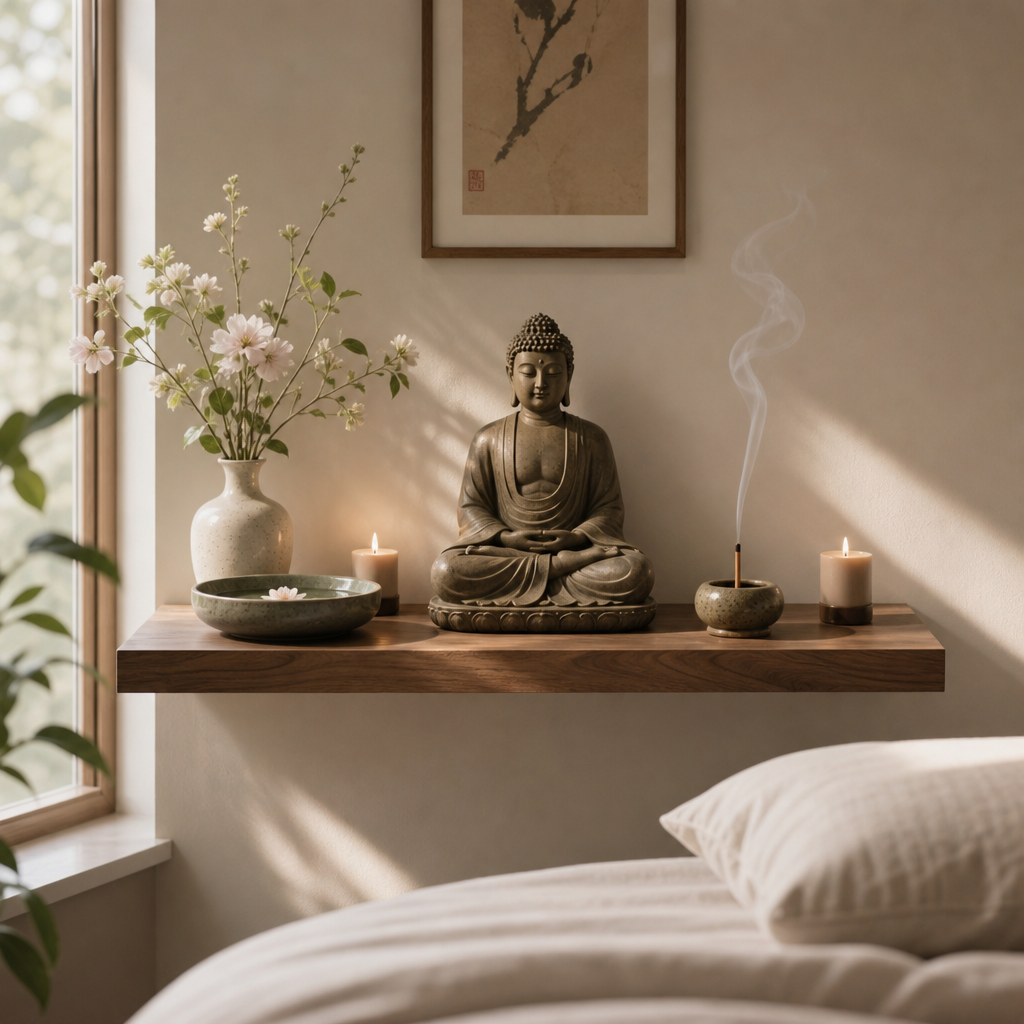
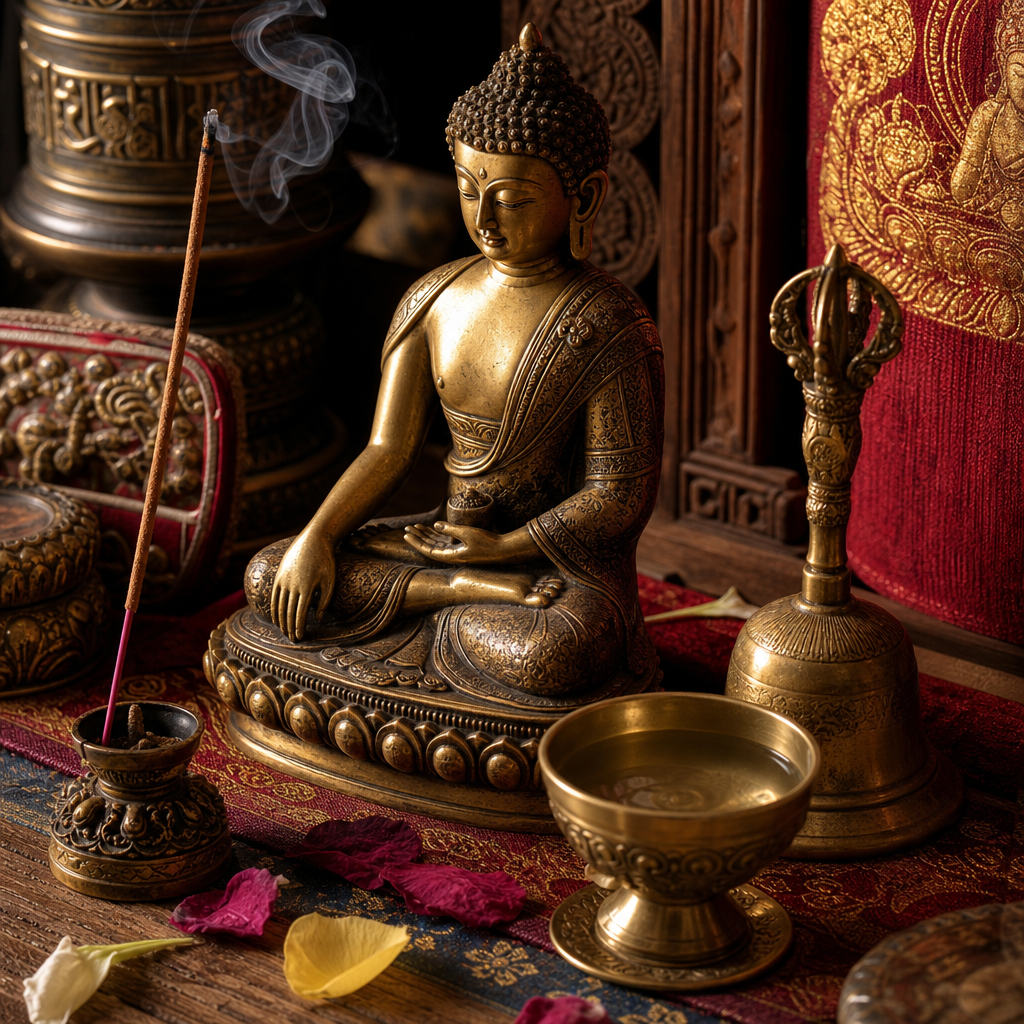
The altar does not need to be large. Some of the most powerful shrines are compact, single-shelf arrangements. What matters is that every object on it is there deliberately, that it is kept clean, and that you actually use it.
Choosing the Right Location in Your Home
Location is the most consequential decision you will make, and it is also where most people go wrong. The common error is treating the altar as wall decor, placing it wherever there is empty space. The correct approach starts with function: where will you actually sit and practice?
Rooms That Work and Rooms That Do Not
A bedroom altar is entirely acceptable in most traditions, provided the area is kept clean and respectful. A dedicated meditation room is ideal but rarely practical. The living room works well if there is a corner that can be separated visually from television and social activity.
Kitchens and bathrooms are universally avoided. They are associated with bodily functions and impurity in virtually every Asian Buddhist tradition. Hallways and entryways are problematic because foot traffic and doors disrupt the stillness the altar is meant to anchor.
Height, Direction, and Positioning
Position the altar so the Buddha image sits at or above eye level when you are seated on the floor or on a meditation cushion. This is not a rigid rule in every tradition, but it is the most widely observed guideline. Placing the Buddha below your eye level during practice is considered disrespectful in Theravada and most East Asian schools.
Many practitioners orient the altar to face east, reflecting the direction of the Buddha's enlightenment and sunrise as a symbol of awakening. North-facing altars are common in Tibetan practice. South-facing is generally avoided in Chinese Buddhist households. That said, if your room layout does not allow your preferred orientation, use the best available option and do not let perfect be the enemy of good.
Pro tip: Before you buy a single item, sit in the potential altar space for five minutes with your eyes closed. If the spot feels genuinely quiet and you can imagine sitting there daily, it is the right location. If something about it feels disrupted or distracting, trust that instinct.
Essential Elements of a Buddhist Altar
Traditional Buddhist altars across Asia share a core set of elements. The specific forms vary by tradition and country, but the underlying categories remain consistent. Understanding what each element represents helps you make informed choices rather than arbitrary ones.
The Buddha Image
The central statue or image of the Buddha is the altar's most important element. This is the object around which everything else is arranged. In Theravada practice, a single Shakyamuni Buddha in the Bhumisparsha mudra is standard. Mahayana altars may include bodhisattvas such as Guanyin or Manjushri. Tibetan altars often feature Amitabha, Tara, or lineage teachers alongside the Buddha.
The statue's material matters. Bronze, brass, and stone sculptures carry a different quality of presence than resin reproductions. If you are purchasing a statue intended for daily practice rather than decoration, museum-quality casting or hand-carving is worth the investment. HD Asian Art sources pieces directly from Burma, Thailand, Cambodia, India, and other countries of origin, which means you are getting craftsmanship made within the living tradition rather than a factory copy.
The Five Traditional Offerings
Most Theravada and Mahayana traditions recognize five standard offerings: water, flowers, incense, light (a candle or lamp), and food or fruit. Each represents a training: generosity, beauty, purification of speech, wisdom, and sustenance of practice. Tibetan altars extend this to seven or eight bowls representing additional offerings including music and perfume.
Fresh offerings communicate sincerity. Artificial flowers and electric candles are widely used for practical reasons, but fresh water changed daily and real incense burned during practice are the minimum that most teachers recommend for an active shrine.
Incense Holder and Incense
Incense purifies the space and marks the transition into practice time. A quality incense burner or holder is essential and should be stable enough to hold sticks or coil incense safely. Sandalwood, agarwood (oud), and lotus varieties are traditional. Tibetan incense uses a distinct blend of herbs and juniper that differs significantly from East Asian styles.
Candle or Butter Lamp
Light represents wisdom illuminating darkness. A single candle in a holder is sufficient. Many practitioners use a traditional butter lamp, particularly in Tibetan or Nepalese practice. The lamp should never be left burning unattended.
Bell and Dorje (Vajrayana Altars)
If your practice is Tibetan Buddhist, a bell and dorje (vajra) are essential ritual objects placed on the altar surface. The bell represents wisdom; the dorje represents compassion and method. These are placed in front of the central statue, never above it.
Prayer Beads and Texts
Mala beads used for practice can be stored on or beside the altar when not in use. Dharma texts and prayer books may be placed on the altar surface but should never be placed below the statue or under other objects. Treat texts with the same respect as the image itself.
Layout and Arrangement Principles
Arrangement follows a clear hierarchy. The Buddha image occupies the highest central position. Everything else is arranged symmetrically below and around it. Symmetry communicates balance and signals to the mind that this space is ordered, which supports a settled quality in meditation.
A Standard Three-Tier Layout
The most practical format for a home altar uses three levels, which can be created with a dedicated altar table, a small shelf unit, or stacked platforms.
-
Top tier: Buddha statue, image, or thangka painting as the central focal point.
-
Middle tier: Incense holder, candle or lamp, and water bowls or offering cups arranged symmetrically on either side.
-
Bottom tier: Flowers in vases, fruit offerings, prayer beads, and ritual objects like bell and dorje if applicable.
If you are working with a single flat surface, replicate the vertical hierarchy horizontally by placing the statue at the back-center and arranging offerings in a gentle arc in front of it. The incense holder typically sits directly in front of the statue.
Colors and Altar Cloth
An altar cloth beneath the statue and offerings creates a defined sacred boundary. Gold and saffron are universally appropriate. White is used in Chinese Pure Land practice. Tibetan altars frequently use brocade fabric in red, gold, or blue. Avoid black cloth, which is associated with mourning in most Asian Buddhist cultures.
Pro tip: Keep a small dedicated cleaning cloth beside the altar and wipe the surface before adding fresh offerings each morning. This act of cleaning is itself a practice, not a chore. It sets the intention before you sit.
Choosing Your Buddha Statue
Choosing a statue well is one of the most important decisions in building a home shrine Buddhist practitioners will actually use. The statue should reflect your tradition, your practice intention, and the scale of your altar space.
Mudras and Their Meanings
Each hand gesture of the Buddha conveys a specific meaning and connects to a particular quality or teaching. Selecting the right mudra for your practice intention is not decorative preference. It is a devotional choice.
|
Mudra |
Meaning |
Best Suited For |
|---|---|---|
|
Bhumisparsha (Earth-touching) |
Moment of enlightenment; calling the earth to witness |
General practice; Theravada altars; Tibetan shrines |
|
Dhyana (Meditation) |
Deep meditative absorption; stillness |
Mindfulness and samadhi practice |
|
Abhaya (Protection) |
Fearlessness; refuge; blessing |
Household protection; walking Buddha forms common in Thai tradition |
|
Varada (Generosity) |
Giving; compassion; fulfillment of wishes |
Altars emphasizing Dana practice or compassion cultivation |
|
Vitarka (Teaching) |
Transmission of the Dharma |
Study-oriented practice; Zen and Chan altars |
Statue Size Relative to Altar Space
A statue that is too small for the altar space looks lost and creates no devotional focus. A statue that is too large overwhelms the space and leaves no room for offerings. A practical rule: the statue's height should be between one-third and one-half of the altar surface's total depth. On a surface 60 cm deep, a statue between 20 and 30 cm tall is proportionally correct.
Country of Origin and Stylistic Tradition
Each country of origin produces sculptures with distinct stylistic characteristics that reflect local Buddhist traditions. A Thai bronze carries the elongated flame-shaped ushnisha and serene facial expression of Theravada iconography. A Burmese alabaster figure has smoother, more rounded features. A Chinese Tang Dynasty-style Guanyin has fluid drapery and a more elongated form than her South Asian counterparts.
Choose a statue whose regional style resonates with your own practice tradition. A Zen practitioner with a Tibetan-style thangka and a Thai bronze on the same altar is mixing traditions without meaning, which tends to produce an aesthetically and energetically muddled space. Consistency in tradition is more powerful than eclecticism.
Altar Styles by Buddhist Tradition
A common mistake is assuming all Buddhist altars look the same. They do not. The differences across traditions are substantial, and building an altar without understanding your own tradition results in a generic arrangement that serves no tradition particularly well.
Theravada Altar
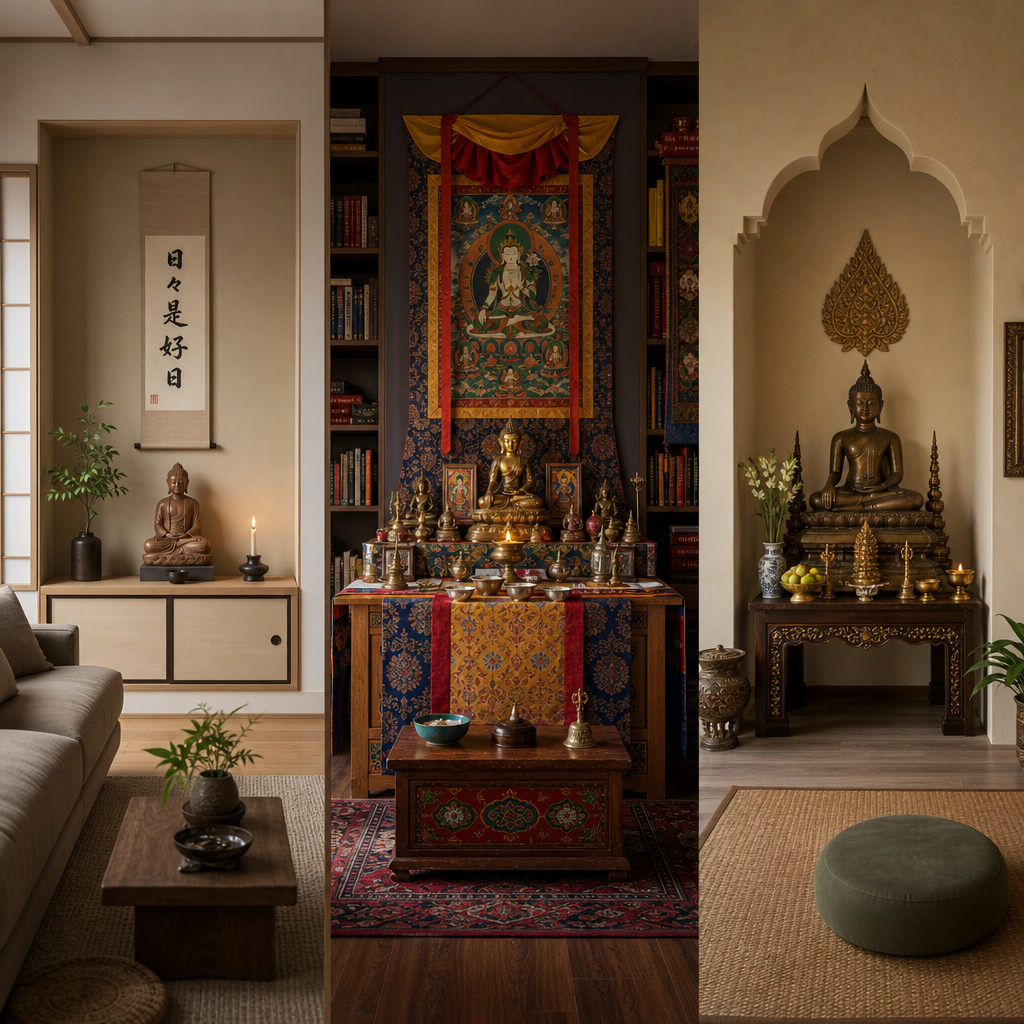
Found in Sri Lankan, Thai, Burmese, Cambodian, and Laotian households, the Theravada altar is typically simple and direct. A single Shakyamuni Buddha image is central. Offerings of water, flowers, incense, and light are arranged in front. No bodhisattvas are included on a strictly orthodox altar. White and gold predominate. The aesthetic is restrained and clear.
Mahayana Altar
East Asian Mahayana altars, from Chinese, Japanese, Korean, and Vietnamese traditions, are more elaborate. The Buddha is often accompanied by bodhisattvas on either side, typically Guanyin (Avalokitesvara) and Dizang (Ksitigarbha) in Chinese practice, or Fugen and Monju in Japanese Zen. Incense is burned in a large central burner. Lacquered altar furniture is traditional. Colors tend toward deep reds and golds.
Vajrayana (Tibetan) Altar
Tibetan Buddhist altars are the most visually complex. Seven or eight offering bowls are arranged symmetrically in front of the central image. Thangka paintings hang above or behind the statues. Multiple images representing the Buddha, teachers, protectors, and yidam deities are often present. Ritual objects including dorje, bell, torma (offering cakes), and sometimes a ritual drum are placed on the surface. Colors are vivid: reds, golds, deep blues, and greens.
"The shrine is not a decoration. It is a reminder. Every object on it points back to the practice, and the practice points back to the mind." Ajahn Chah, Thai Forest Tradition teacher and one of the most influential Theravada masters of the 20th century.
Common Mistakes to Avoid
After years of working with Buddhist art and speaking with practitioners at every level of experience, certain errors appear repeatedly. Knowing them in advance saves considerable time and money.
Placing the Altar Too Low
Placing the Buddha image below eye level during seated practice is the most common structural error. It communicates inadvertent disrespect and disrupts the devotional quality of the space. If your only available surface is low, raise the statue on a wooden platform or pedestal before adding any other items.
Overcrowding the Surface
More objects do not create more sacredness. A cluttered altar is harder to clean, harder to use, and harder to sit in front of with a settled mind. Start with the minimum: one statue, one incense holder, one candle, and one vase of flowers. Add elements only when each addition has a clear purpose in your practice.
Buying Low-Quality Reproductions
Mass-produced resin statues lack the craftsmanship, historical grounding, and material integrity of properly made sculptures. A single high-quality bronze or stone figure from a country of origin maintains its presence and meaning over decades. Resin reproductions fade, chip, and carry none of the artistic tradition of the culture that developed these iconographic forms. This is a long-term investment in your practice environment, not a purchase to economize on.
Mixing Traditions Without Knowledge
A Ganesh statue beside a Zen Buddha beside a Tibetan deity is not syncretic wisdom. It is confusion given physical form. If you are drawn to multiple traditions, learn about each one separately before combining elements on a single altar. Or use dedicated spaces for each tradition if your home allows it.
Neglecting Maintenance
An altar with dead flowers, ash-covered surfaces, and dusty statues communicates the opposite of what an altar is meant to represent. Daily or weekly maintenance is not optional. Wiping the surface, replacing water, removing spent incense ash, and refreshing flowers are acts of practice in themselves. Schedule them like you would schedule a sitting session.
Frequently Asked Questions
Does a Buddhist home altar need to be consecrated or blessed by a monk?
In Theravada traditions, having a monk or senior practitioner bless the altar and statue is traditional and considered beneficial, but it is not strictly required for the altar to be functional. Many practitioners begin using their altar immediately and arrange a formal blessing when they have access to a monastery or teacher. In Zen traditions, formal consecration is less emphasized than sincere practice. In Tibetan Buddhism, the practice of rab-ne (consecration) is more formally observed for statues intended for regular ritual use, and practitioners are encouraged to seek this from a qualified lama.
Can I place a Buddhist altar in my bedroom?
Yes. Placing an altar in the bedroom is widely practiced across Asia and is considered acceptable in most traditions, provided the area around it is kept clean and treated with respect. Some teachers recommend avoiding placing the altar directly opposite the foot of the bed, where it may be viewed during sleep in ways that are considered disrespectful. A corner of the bedroom or a position that can be partially screened when not in use is a practical solution.
What is the correct direction for a Buddhist altar to face?
East is the most widely recommended direction, associated with the rising sun and the direction Shakyamuni faced during his enlightenment. Many Chinese Buddhist households orient the altar to face south. Tibetan practice often uses the north. The most honest answer is that the direction matters less than consistency and daily use. If your room layout forces you to orient the altar westward, this is not a practice obstacle. Use the best available option.
How many Buddha statues can I have on one altar?
There is no maximum number, but more is not better. A single well-chosen statue creates clearer devotional focus than five statues of varying quality competing for attention. If your tradition calls for multiple figures, as Mahayana and Vajrayana altars often do, arrange them with clear hierarchy: the main Buddha or deity in the center and highest position, with attendant figures flanking at a slightly lower level. The altar setup should read as organized, not accumulated.
What should I do with old or damaged altar items?
Damaged statues, particularly those with broken heads or limbs, should not remain on an active altar. In most traditions, they are respectfully retired by wrapping them in clean cloth and either burying them in clean ground, placing them at the base of a tree, or consulting a local monastery about proper disposal. Do not simply discard a Buddha image in regular rubbish. Old altar cloths, incense holders, and offering bowls can be cleaned, stored, or passed on to other practitioners.
Is it disrespectful to use Buddhist statues purely as home decor without practicing?
This is a question practitioners and collectors debate regularly. The short answer: most Buddhist teachers do not condemn decorative use, but they distinguish between a decorative object and an altar. If you are placing a Buddha statue as an aesthetic piece without engaging in any practice, it functions as art and cultural appreciation, which is legitimate. Where it becomes problematic, according to traditional teaching, is if the object is treated carelessly, placed in a disrespectful location such as a bathroom, or positioned below feet level such as on a floor. Treat the statue with basic respect regardless of your intention, and the question mostly resolves itself.
Can I include Hindu deity statues alongside Buddha on the same altar?
Historically, Buddhist and Hindu iconography shared space in many South and Southeast Asian traditions. Figures like Brahma and Indra appear as protectors in Buddhist cosmology, and Ganesha is venerated in some Buddhist lineages in Japan and Tibet. That said, mixing traditions requires knowledge of why you are making each choice. A Ganesha figure placed beside a Buddha because you find both appealing aesthetically is not the same as a Tibetan Buddhist including a protector deity with understood symbolic purpose. If you are new to either tradition, build understanding before building a composite altar.
If you have set up a Buddhist home altar and have questions about which statue or offering objects are right for your tradition, share your experience in the comments below. Your specific situation may help others navigating the same decisions.
