


Best Buddhism Stack Exchange Alternatives for 2026
Best Buddhism Stack Exchange Alternatives for 2026
The strongest alternatives to Buddhism Stack Exchange are NewBuddhist.com, DharmaPaths.com, Dhamma Wheel, Dharma Wheel, SuttaCentral Discussion, and BuddhaNet. Each platform serves a distinct purpose, from open community forums to curated doctrinal libraries.
Key platforms at a glance:
- NewBuddhist.com — Non-sectarian, open discussion forum; welcomes practitioners from all traditions
- DharmaPaths.com — Broad comparative forum; sub-forums cover Theravada, Mahayana, Vajrayana, and cross-tradition comparisons with Taoism and Abrahamic mysticism
- Dhamma Wheel — Theravada-focused; moderator-vetted posts protect doctrinal integrity
- Dharma Wheel — Mahayana and Vajrayana focus; structured sub-forums by school
- SuttaCentral Discussion — Doctrinally narrow; rewards active personal engagement over quick Q&A
- BuddhaNet — Non-sectarian Q&A library curated by Venerable S. Dhammika; static, authoritative content rather than live discussion
What makes each major Buddhist forum different from Stack Exchange?
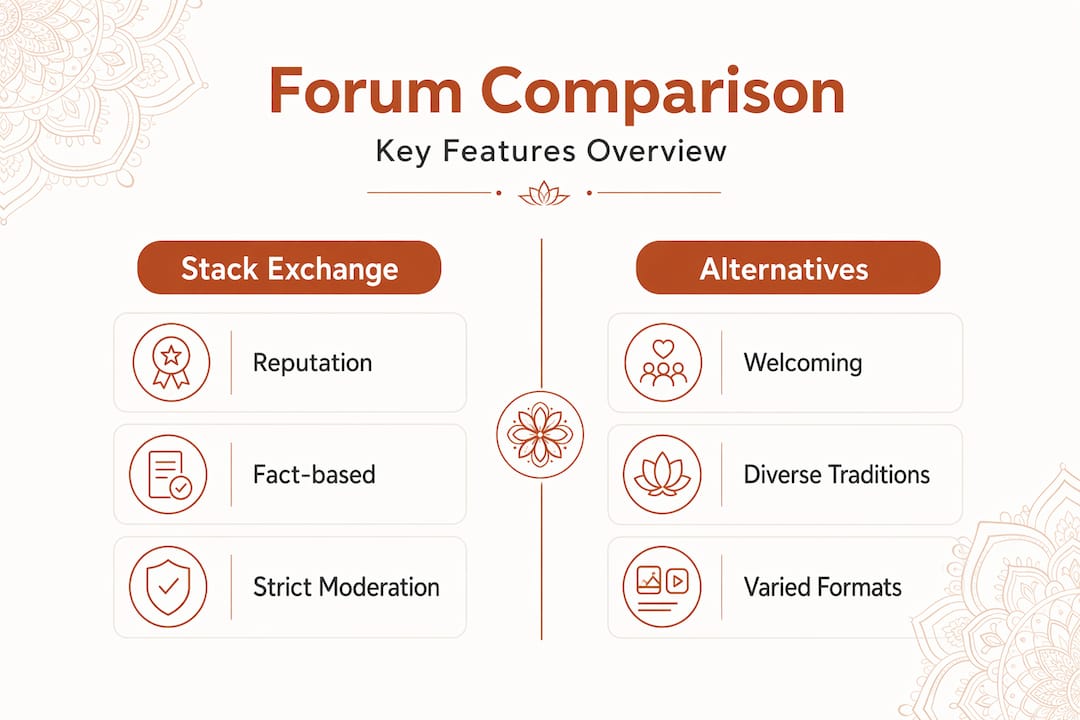
Buddhism Stack Exchange runs on a reputation-based, fact-finding model where answers require citations and community votes. The forums listed above operate differently. Most prioritize community cohesion, lineage alignment, and ongoing dialogue over verifiable one-answer threads.
| Forum | Community culture | Moderation and posting policies | Tradition inclusivity | Discussion format |
|---|---|---|---|---|
| NewBuddhist.com | Virtual Sangha, open welcome | Light moderation; community-driven | Non-sectarian, all traditions | Open forum threads |
| DharmaPaths.com | Comparative, philosophical | Polite debate encouraged | Multi-tradition, cross-philosophy | Sub-forums by topic |
| Dhamma Wheel | Committed practitioner base | Moderator vetting; orthodoxy enforced | Theravada-focused | Threaded discussion |
| Dharma Wheel | Scholarly, tradition-specific | Structured by school | Mahayana and Vajrayana | Sub-forums by school |
| SuttaCentral Discussion | Engaged, doctrinally serious | Active moderation; narrow doctrinal scope | Early Buddhist texts focus | Forum threads |
| BuddhaNet | Reference-oriented | Expert-curated; no live posting | Non-sectarian | Static Q&A library |
NewBuddhist.com suits practitioners who want a welcoming, low-barrier entry point. The site has roots in the older E-Sangha community, and several of its moderators carry that shared history forward.
DharmaPaths.com goes wider than most Buddhist forums. Its sub-forums compare Dharmic traditions against world philosophies, including Taoism and Abrahamic mysticism, making it useful for readers who approach Buddhism from a comparative religion angle. It is also formally associated with Dhamma Wheel and Dharma Wheel, sharing infrastructure across the network.

Dhamma Wheel is one of the most established Theravada forums online, with longtime moderators and an active, committed user base. Posts go through moderator review to prevent off-topic or non-orthodox content from diluting discussions. That vetting process keeps threads focused but can slow entry for new participants.
Dharma Wheel mirrors the Dhamma Wheel structure but covers Mahayana and Vajrayana Buddhism. Sub-forums are organized by school, so a practitioner interested in Tibetan Vajrayana can find dedicated threads without wading through Zen or Pure Land content.
SuttaCentral Discussion (discourse.suttacentral.net) connects directly to the SuttaCentral canon database. Its community tends toward early Buddhist texts and Pali scholarship. Transactional Q&A posts get less traction here; members who engage consistently and personally get more from the community.
BuddhaNet functions as a reference library rather than a live forum. Its “Good Questions, Good Answers” section, written with Venerable S. Dhammika, covers foundational Buddhist topics across traditions. BuddhaNet does not endorse any single tradition, and its content represents a broad range of schools without favoring one.
How do community culture and moderation differ across these platforms?
The sharpest divide in Buddhist online communities sits between Stack Exchange’s academic, citation-driven culture and the social, lineage-oriented culture of independent forums. Stack Exchange rewards verifiable answers. Forums reward sustained participation and community trust.
- Reputation systems vs. relationship building: Stack Exchange ranks answers by votes and citations. Forums like Dhamma Wheel and SuttaCentral Discussion build trust through consistent posting history and demonstrated respect for the tradition.
- Entry vetting: Dhamma Wheel and SuttaCentral Discussion use moderator approval for new posts or threads. This protects theological integrity but means new participants may wait before their contributions appear.
- Sectarian vs. non-sectarian cultures: DharmaPaths.com and BuddhaNet explicitly avoid tradition bias. Dhamma Wheel and Dharma Wheel are tradition-specific by design. NewBuddhist.com sits in the middle, welcoming all traditions while maintaining a general Buddhist identity.
- Social bonding: Independent forums often function as virtual Sanghas. Members develop ongoing relationships, reference shared history, and hold each other accountable to community norms in ways that Stack Exchange’s transactional format does not support.
These cultural differences shape what kind of question gets a useful answer. A precise doctrinal question about Pali terminology will do well on Dhamma Wheel or SuttaCentral Discussion. A broad personal question about starting a meditation practice may get warmer, more varied responses on NewBuddhist.com or DharmaPaths.com.
How to choose the right Buddhist forum for your interests
Selecting the right platform comes down to three factors: your tradition, your preferred interaction style, and how much moderation structure you want.
- Tradition focus: If your practice is Theravada, Dhamma Wheel offers the deepest community and the most focused content. Mahayana or Vajrayana practitioners will find Dharma Wheel more relevant. For Theravada Buddhist sculpture and iconography discussions, Dhamma Wheel members tend to have strong visual and doctrinal literacy.
- Q&A vs. open discussion: BuddhaNet works best when you need a clear, authoritative answer to a foundational question and do not need live interaction. For ongoing dialogue, any of the forum-based platforms will serve better.
- Moderation preference: Heavily moderated forums like Dhamma Wheel and SuttaCentral Discussion produce cleaner, more focused threads. Lighter moderation on NewBuddhist.com allows more spontaneous conversation but also more variation in post quality.
- Language and accessibility: Most platforms are English-language. BuddhaNet and SuttaCentral offer some multilingual content. Mobile usability varies; SuttaCentral’s Discourse-based forum renders well on mobile, while older phpBB-style forums like Dhamma Wheel are functional but less polished on small screens.
- Privacy: All major forums require registration to post. None publicly list privacy policies prominently, so review each site’s terms before sharing personal practice details.
Pro Tip: Read the “About” and “Rules” pages of any forum before posting. Long-standing communities like Dhamma Wheel carry years of shared norms that are not always obvious from browsing threads alone.
For readers interested in Mahayana Buddhist art traditions, Dharma Wheel’s sub-forums on iconography and school-specific teachings can add useful context alongside visual study.
Expert insights on engagement in Buddhist online communities
Experienced community members consistently point to moderation quality and posting transparency as the clearest indicators of a healthy forum. Clear moderation and posting policies correlate with more productive, sustainable discussions.
- Longstanding moderation teams: Forums with stable, experienced moderators produce more consistent community standards. Dhamma Wheel’s moderation team has roots in the earlier E-Sangha community, giving it institutional memory that newer platforms lack.
- Sectarianism risk: Online Buddhist communities can develop echo chambers, particularly on tradition-specific forums. Veterans advise treating forum consensus as one perspective, not definitive doctrine.
- Reading rules before posting: Forum history and rules pages contain context that threads alone do not reveal. Understanding a forum’s founding culture helps avoid low-effort posts and sectarian friction.
- Cultural sensitivity: Forums connected to specific lineages, such as Dhamma Wheel or SuttaCentral Discussion, expect participants to engage respectfully with that tradition’s framework, even when asking critical questions.
- Sustained engagement: SuttaCentral Discussion rewards members who contribute consistently over time. Transactional visits for quick answers rarely produce satisfying results on doctrinally focused platforms.
The most productive approach across all these platforms is to observe before posting, read pinned threads, and match your question’s depth to the forum’s culture. A well-placed question on the right forum will draw more useful responses than the same question posted broadly.
Key Takeaways
The best Buddhism Stack Exchange alternatives serve distinct needs: tradition-specific forums for deep doctrinal discussion, non-sectarian platforms for open community, and curated libraries for authoritative foundational answers.
| Point | Details |
|---|---|
| Platform variety | Six major alternatives cover Theravada, Mahayana, non-sectarian, and reference formats. |
| Moderation signals quality | Forums with clear posting policies and stable moderator teams produce more reliable discussions. |
| Match forum to tradition | Dhamma Wheel fits Theravada; Dharma Wheel fits Mahayana and Vajrayana; BuddhaNet suits all traditions. |
| Culture before posting | Reading About and Rules pages before participating prevents sectarian friction and low-effort posts. |
| Format shapes engagement | BuddhaNet offers static expert answers; forum-based platforms reward sustained community participation. |
HDAsianArt curates museum-quality Buddhist and Hindu sculptures from Cambodia, Thailand, Indonesia, Sri Lanka, and Vietnam. For collectors whose forum research leads to deeper interest in Buddhist iconography, the HDAsianArt collection includes authenticated bronze, stone, and wood pieces shipped worldwide with insured DHL delivery.