



Bronze Casting in Asian Sculpture: Lost-Wax vs Sand-Cast
Bronze Casting in Asian Sculpture: Lost-Wax vs Sand-Cast
Ask a collector what makes an Asian bronze valuable, and you will hear about age, provenance, and artistry. Few mention the casting method, yet it shapes how crisp a face looks, how evenly the metal sits, and how a piece will age over the centuries. Bronze casting in Asian sculpture is not one technique but several, and the two you will meet most often are lost-wax and sand casting. Knowing how each one works lets you read a statue before you pay for it.
Table of Contents
- Quick Takeaways
- Why Metal Became the Medium for Sacred Images
- The Lost-Wax Process, Step by Step
- Sand Casting: A Different Process With Different Results
- Piece-Mold Casting and Early Asian Foundries
- Telling Casting Methods Apart on a Statue
- Regional Casting Traditions Across Asia
- Buying Advice for Collectors and Altar Decorators
- Frequently Asked Questions
- References
Quick Takeaways
|
Key Insight |
Explanation |
|---|---|
|
Lost-wax captures the most detail |
Fine facial features, jewelry edges, and textures survive because the casting copies a wax original directly. |
|
Sand casting is a different tool |
It suits larger or simpler forms, but surface detail is softer and the finish is often more granular. |
|
Seams point to the mold |
Visible parting lines often mean piece-mold or sand casting, but lost-wax figures can also be assembled from wax sections, so seams alone never settle the question. |
|
Ask how many mold generations separate the piece from its original |
Each copy through another mold softens detail, so a sharp surface usually signals a closer link to the original model. |
|
Judge age by wear, not by shine |
Genuine age shows at edges, in recesses, and where hands have touched the figure, rather than as uniform color or polish. |
|
Method is one factor among several |
Casting quality matters alongside carving, provenance, condition, and documentation from the seller. |
Why Metal Became the Medium for Sacred Images
For centuries, metal has been a preferred material for Asian sculptors who depicted their gods. The exhibition essay Cast for Eternity links this preference to bronze traditions in India, Sri Lanka, the Himalayas, and China, regions that have held significant places in art history for over 2000 years. For a collector, that lineage matters because the casting methods you see today grew out of centuries of workshop practice.

Metal also made practical sense for shrine images. Bronze tolerates handling, humidity, and incense smoke far better than painted wood or fired clay, so a statue could be carried in procession, moved between temples, and placed on a home altar for generations. Sculptors chose bronze because it could hold the fine proportions and iconography that religious guidelines demanded.
The essay notes that Indian writings, though largely philosophical and religious, contain many references to metal objects. The proportion rules written down to guide artist-craftsmen played a central role in shaping Asian bronze culture. As religions spread from India across Asia, many of their metal casting techniques travelled with them, and similar methods appear in the Himalayan regions. Local interpretations of style and modelling still produced clearly different faces, postures, and drapery.
A bronze image records two things at once: the religious rules it was made to follow, and the hands of the workshop that followed them. Learn to read the casting, and you start to read both.
When you handle a bundle of similar figures, look first at the proportion and iconography, then at the surface. Proportion errors usually come from the model, while surface errors usually come from the casting, and separating the two keeps your judgment fair.
The Lost-Wax Process, Step by Step
The essay describes most bronzes in its exhibition as made by the lost form method, known in the West as cire perdue, or lost wax. The shape of the object was first sculpted in hard wax, often over a clay core, and then covered in successive layers of clay. Every stage of the process is designed to carry a wax original into metal without losing its surface.
From Wax Original to Investment Mold
A sculptor typically models the figure in clay, takes a mold from that clay, and then makes a wax replica from the mold. A modern foundry describes the wax as a temporary mold that carries every fine detail forward, from textures to small facial features. Once the wax is complete, it is encased in a ceramic shell that becomes the mold for the metal.
This stage decides how much detail survives. Each time a model is copied through another mold, some sharpness is lost, so a crisp surface usually points to a casting made closer to the original. Ask whether a piece came from an original wax or a later reproduction, because the answer changes how sharp the finished surface should be.
Pro tip: When a seller describes a piece as lost-wax cast, ask how many generations of molds separate it from the original model. A seller who knows the answer is usually a seller who knows the workshop.
Burnout, Pouring, and Breaking Out
Once the ceramic shell hardens, the wax is burned out, leaving a hollow cavity shaped exactly like the original. Molten bronze is poured into that cavity, and after it cools the shell is broken away to reveal the casting. Because the wax and shell are destroyed in the process, each lost-wax casting is essentially a one-off piece.
That single-use nature explains much of the variation you see. Two statues that look identical in a photograph can differ in wall thickness, small surface marks, and detail sharpness, because each one was built around its own destroyed wax. A pair from the same workshop often shows these subtle differences, which is a sign of individual pours rather than a repeated stamp.
Sand Casting: A Different Process With Different Results
Sand casting is the other method you will meet most often, and it is used across a wide range of objects. The Crucible's bronze casting guide lists lost wax, ceramic shell, and sand casting together as methods used to produce sculptures, instruments, medals, and tools. Sand casting belongs to the same family of pouring techniques, but the mold is built very differently.
How a Sand Mold Is Built
In a typical sand mold, a pattern is pressed into packed sand held inside a two-part frame. When the halves are separated, the pattern is removed, the mold is closed, and molten metal fills the cavity. The line where the two halves meet, the parting line, usually remains visible on the finished casting.
Because the pattern can be reused to make new impressions, sand casting suits larger or simpler forms and runs where one exact original is not the priority. The sand mold is broken up to release each casting, but the pattern survives, which keeps the method economical for repeated shapes.
Where Sand Casting Shows Its Limits
Sand grains set a limit on surface detail. Fine elements such as narrow fingers, hair curls, and jewelry edges tend to soften, and recesses can look slightly grainy under raking light. The surface often feels less refined than a lost-wax piece of similar size.
Caswell's guide to lost-wax casting makes the same contrast from a foundry's perspective, noting that lost wax captures every detail where sand casting does not. For a devotional statue where the face carries the meaning, that gap is the main reason collectors should pay attention to method. A sand-cast figure can still be honest work, but it should be judged and priced as a different object.
Piece-Mold Casting and Early Asian Foundries
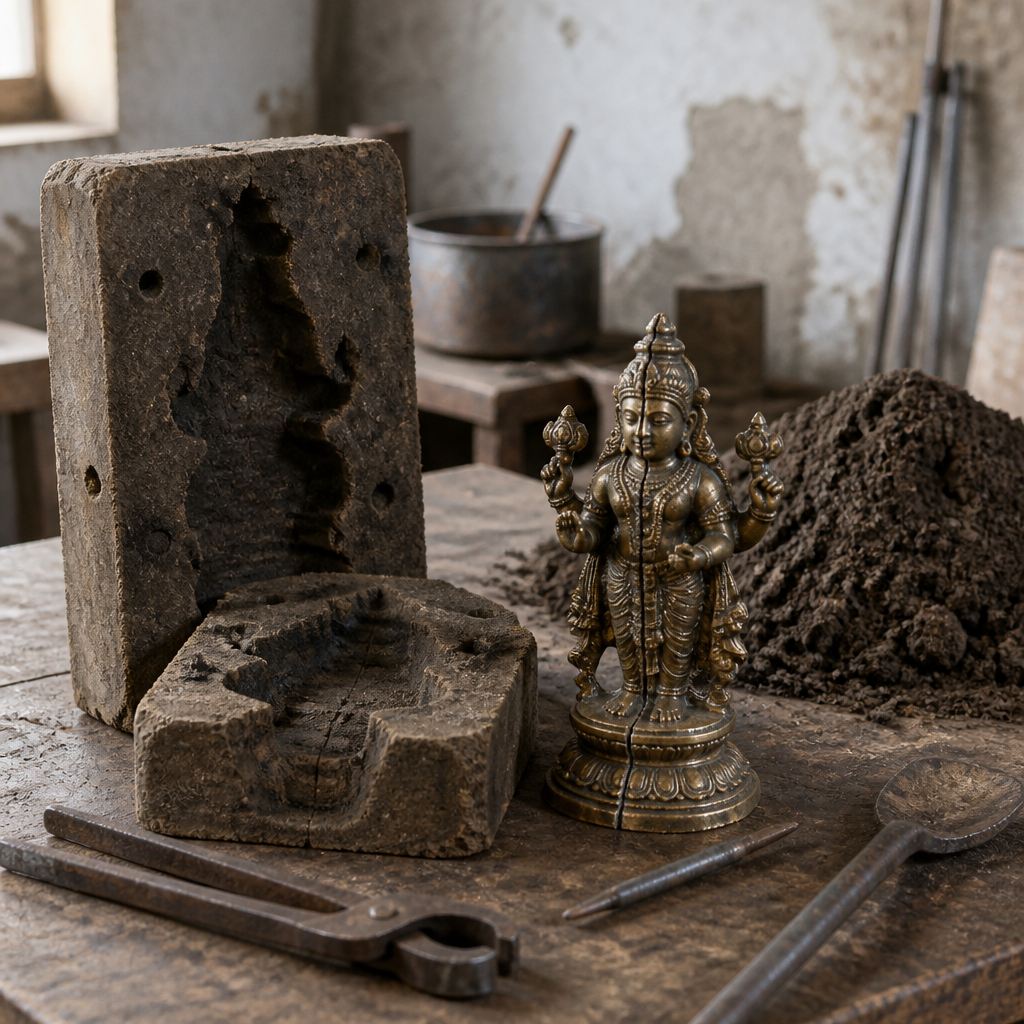
Lost-wax and sand casting are not the whole story. A review of research on lost-wax casting notes that around 2000 BC, Chinese craftsmen began casting bronzes using the piece-mold method, which began China's Bronze Age. Piece molds are built from several sections around a core rather than from a single wax original, so the resulting bronzes often carry visible joins where the sections met.
The essay groups bronze techniques into open, closed, and lost forms according to the periods in which they were introduced. That grouping is useful because it reminds collectors that one region could use several methods across centuries. A method was often chosen for the object type and the workshop, not as a simple marker of quality.
Lost-wax casting also has a long history of its own. One foundry's overview dates the technique in Mesopotamia to roughly 3500 to 3200 BC and describes its later spread to China during the Han Dynasty. Against that backdrop, a bronze can reflect a method that is far older than the workshop that finished it.
Reading Joins Without Jumping to Conclusions
A visible join on an early Chinese bronze is not automatically a warning sign. Piece-mold casting produces seams by design, and those seams can be part of the authentic record of how the object was made. A seam becomes a concern only when it contradicts the rest of the piece, such as a join that cuts through a feature that should be continuous.
In practice, compare the seam with the surface around it. Look for consistent wear along the join, matching tool marks, and patina that runs over the seam rather than stopping at its edge. A seam that has aged with the surface tells you more than the seam alone.
Telling Casting Methods Apart on a Statue
Most collectors cannot cut a statue open to see how it was made, so surface evidence carries the weight. The most useful clues are the sharpness of fine detail, the character of any seams, and the way the surface reacts to light. No single clue settles the question, but together they usually show which method is most likely.
Seams, Parting Lines, and Core Pins
Parting lines run where separate mold sections or frame halves met, so they point toward multi-part molds. Lost-wax figures are often modeled in several pieces and welded together, so a seam on a lost-wax figure is not proof of sand or piece-mold casting. The useful question is whether the seam sits where a workshop would plausibly join sections, or where it looks arbitrary.
Some hollow castings also show small metal pins where the core was held in place, usually in thin areas. Their presence suggests a complex internal structure, but a pin on its own proves nothing about the method. Treat it as one more clue to weigh against the surface.
Surface Detail and Edge Sharpness
Run a magnifier along fine elements such as fingers, eyelids, crown ornaments, and jewelry edges. Lost-wax surfaces usually keep edges crisp and textures distinct, while sand-cast surfaces are softer and more uniform. Edges rounded by genuine handling, rather than by a coarse file, suggest long devotional use.
The table below summarizes how the three approaches tend to read to a buyer. These are tendencies, not rules, so use them as a checklist rather than a verdict.
|
Method |
What You Usually See |
What It Means for Collectors |
|---|---|---|
|
Lost-wax (cire perdue) |
Sharp fine detail, continuous surfaces, occasional internal pins at thin sections |
Best suited to devotional figures where facial and hand detail carries meaning. Each cast is effectively unique. |
|
Sand casting |
Softer detail, slightly grainy recesses, visible parting lines |
Suited to larger or simpler forms. Price and judge it as a different object rather than as lost-wax work. |
|
Piece-mold casting |
Seams by design, sections that meet at joins, strong links to early Chinese bronze |
Authentic seams are part of the record. Check that joins align with surface wear and patina. |
Patina Can Mislead
Patina is the color and sheen that develops on bronze over time, and it can be applied or artificially aged. A rich brown surface can hide a soft casting or a recent repair, so color alone should never decide a purchase. Look beneath the patina at edges and recesses, where wear develops most naturally.
Pro tip: Check the recesses behind the hands, under the chin, and inside the folds of drapery. These areas rarely get polished or restored, so their texture tells you more about the casting than the bright high points do.
Regional Casting Traditions Across Asia
Asian bronze casting is not one tradition with regional branches. The essay traces shared roots to India, with metal casting techniques that spread across Asia alongside Buddhism, Jainism, and Hinduism, and then adapted in each region. A buyer who understands that layering can read a statue as the product of a specific workshop tradition rather than a generic Asian bronze.
Indian Standards and Temple Sculpture
The essay describes the observation of proportion and conformity as central to the development of Asian bronze culture, with written guidance for artist-craftsmen. In practice, a well-made deity image shows carefully balanced measurements that were planned before any metal was poured. When a figure looks wrong in its stance or limb length, the cause is more often the model than the casting.
Himalayan and Tibetan Adaptations
The essay notes that techniques similar to Indian methods were used in the Himalayan regions, and that the exhibition includes bronzes from China via Tibet. Himalayan figures can look distinct, with different modelling of faces and different treatment of ornament, even when they follow the same iconographic rules. A collector who learns to recognize regional modelling will spot a mismatch between a claimed origin and the actual form more quickly.
Southeast Asia, China, and Japan
The essay notes that religions spreading from India carried casting techniques with them, so the same principles appear across much of the continent. For the Southeast Asian and Japanese pieces in our range, the core logic of wax, mold, and pour still applies, but workshop habits vary. The safest approach is to judge each piece on its own surface and documentation, rather than assuming that a region guarantees a method.
Buying Advice for Collectors and Altar Decorators
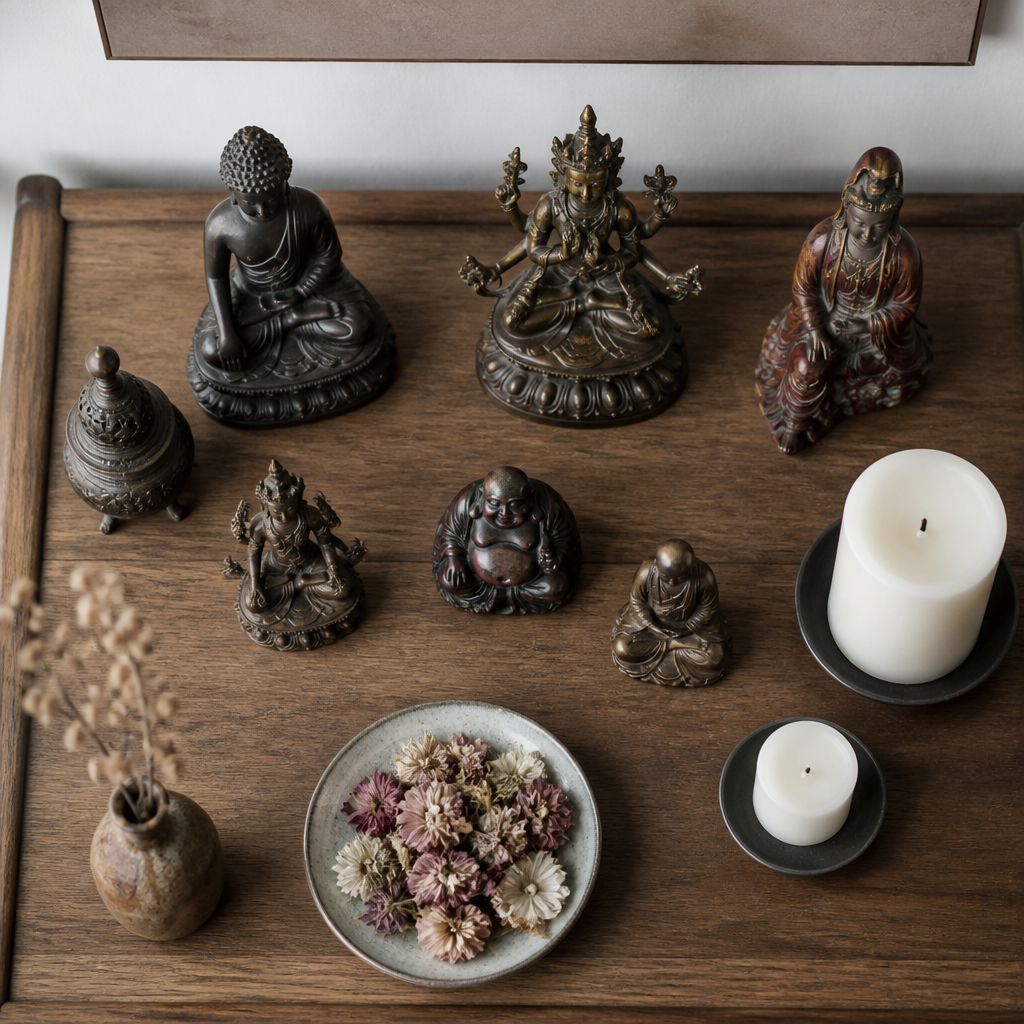
Knowing the casting method changes what you should ask a seller and what you should pay for. Collectors want provenance and workmanship. Altar decorators want a figure that looks right in their space and holds up to daily care. Both groups benefit from a clear account of how the piece was made.
Questions to Ask Before You Buy
Start with the basics: which casting method was used, whether the piece was cast from an original model, and what documentation supports the description. A reputable seller should answer clearly or say they do not know. A vague answer such as traditional bronze tells you very little about how the statue will age or how well it holds detail.
Request close photographs of the face, hands, and base. Those areas show the sharpness of detail and the quality of finishing better than a full-length image taken at a distance. If a seller discourages close images, treat that as information. Shipping should not drive the decision either, so compare the piece itself, not the delivery cost. Our free shipping on orders over £35 applies to the piece you choose, whatever its casting method.
Caring for a Cast Bronze at Home
Dust bronze with a soft brush or dry cloth. Avoid abrasives, harsh chemical cleaners, and polishes designed for household metals, which can strip the patina you are trying to preserve. Keep statues away from direct heat and from places where incense smoke settles on the surface.
Pro tip: Before buying for a home altar, measure the display space and the figure's base, then leave a margin for surrounding objects. Scale affects the final effect more than the casting method does, and a well-cast figure that is too large for its niche rarely looks intentional.
Frequently Asked Questions
Is lost-wax casting always better than sand casting?
Not always, but for fine detail it is usually the stronger method. Lost wax copies a wax original closely, which suits faces, hands, and jewelry. Sand casting suits larger or simpler forms, so judge the piece by its intended use and surface quality.
How can I tell whether a bronze was lost-wax cast?
Look for crisp fine detail, continuous surfaces, and wear that matches the patina. No single feature is conclusive, because lost-wax figures can be assembled from sections. Combine what you see with the seller's documentation before you decide.
Does a visible seam mean a statue is fake?
No. Piece-mold and sand-cast bronzes often show parting lines, and those lines can be part of an authentic casting record. A seam only raises concern when it contradicts the surface around it, such as cutting through a feature that should be continuous.
What does cire perdue mean?
Cire perdue is the French term for lost wax, the method in which a wax model is replaced by molten metal. The exhibition essay uses this term to describe most of the bronzes it shows.
Can I clean a cast bronze Buddha at home?
Yes, but keep it gentle. Dust with a soft brush or dry cloth, and avoid abrasives and strong chemical cleaners, which can damage the patina and the surface detail you are trying to protect.
Does the casting method change the value of a bronze?
It can, but method is rarely the only factor. Provenance, age, condition, and the quality of the carving and finishing usually matter as much or more, so weigh the casting method alongside those.
Tell us in the comments which casting clue helped you judge a bronze, or which question about how a statue was made you still cannot answer.
References
-
Exhibition essay on lost-form bronze casting across India, Sri Lanka, the Himalayas, and China
-
Review of research history on lost-wax casting, including early Chinese piece-mold bronzes
-
Guide comparing lost wax, ceramic shell, and sand casting for bronze objects
