



Advanced Mudras for Spiritual Growth: A 2026 Guide
Advanced Mudras for Spiritual Growth: A 2026 Guide
Table of Contents
- Advanced Mudras for Spiritual Growth: Where to Begin
- Yoga Mudras for Meditation: Five Advanced Gestures With Instructions
- Mudras for Chakra Balancing: Matching Gesture to Center
- How to Practice Mudra Yoga: A 12-Week Progression Plan
- Meditation Mudra Techniques: Combining Hand Position, Breath, and Focus
- Safety, Accessibility, and Limits of Advanced Practice
- Frequently Asked Questions
Advanced Mudras for Spiritual Growth: Where to Begin
Advanced mudras for spiritual growth are deliberate hand gestures held with precise finger position, breath control, and focused intention for extended periods.
A 2022 paper by S. N. Kumar and colleagues proposed combining yoga mudras with breathing exercises to support immunity and ease respiratory issues, though the authors did not report measured outcomes.
Below, we show you exactly how to hold each gesture, how long to practice, and how to track progress week by week.
How Advanced Practice Differs From Beginner Hand Gestures
Beginner practice teaches you the shapes. Advanced practice teaches you what to do once the shape feels easy.
Three things change as you progress:
- Duration. Holds stretch from 5 minutes to 20 minutes or more.
- Breath. You pair each gesture with a set breathing pattern, such as a longer exhale.
- Intention. You direct focus to a specific chakra, element, or quality of mind.
A common mistake is rushing this shift. Most people add new gestures before they can hold one comfortably for 10 minutes. The result is a scattered practice with no depth.
Yoga Mudras for Meditation: Five Advanced Gestures With Instructions
These five gestures form the core of an advanced practice. Each entry below gives you the exact hand position, the breath pattern, the hold time, the focus point, and the modification to use if the shape strains your hands.
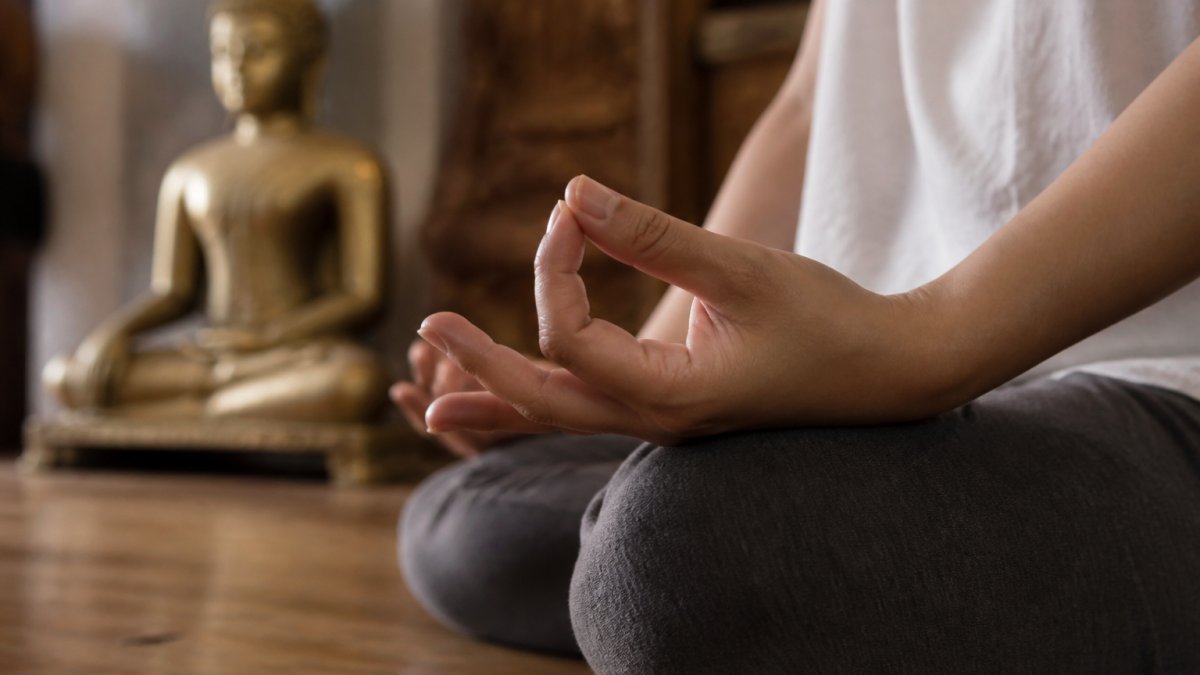
1. Dhyana Mudra, Settled Awareness
- Hand position: Both palms face up in the lap, right hand resting on the left, thumbs lightly touching at the tips to form a shallow bowl.
- Breath: Natural breath, no counting. Let the inhale and exhale find their own length.
- Hold: 10 to 20 minutes.
- Focus: The point where the thumbs meet. When attention drifts, return to that contact.
2. Chin Mudra, Calm and Release
- Hand position: Thumb and index finger touch at the tips to form a circle. The middle, ring, and little fingers stay straight and relaxed. Palms face up on the knees.
- Breath: Exhale roughly twice as long as the inhale. A common starting ratio is a 4-count inhale and an 8-count exhale.
- Hold: 5 to 15 minutes.
- Focus: The release at the end of each exhale.
3. Adi Mudra, Grounding
- Hand position: The thumb folds across the base of the index finger, and the remaining fingers curl loosely over the thumb to form a soft fist. Palms rest face down on the thighs.
- Breath: Gentle inhale through the nose, slightly longer than the exhale.
- Hold: 5 to 10 minutes to start, building to 15.
- Focus: The base of the spine and the contact of the hands on the thighs.
4. Vajra Mudra, Steady Focus
- Hand position: Thumb and index finger form a circle, as in Chin mudra, but the three remaining fingers stay pressed together and upright. Palms face up.
- Breath: Even breath, equal inhale and exhale, counted to the same number.
- Hold: 10 to 20 minutes.
- Focus: A single point, the breath at the nostrils or a fixed spot on the floor.
5. Bhairava Mudra, Letting Go
- Hand position: Palms face down on the knees. Thumbs and index fingers touch at the tips, and the other fingers extend outward.
- Breath: Long, slow exhale, longer than the inhale, with no pause between cycles.
- Hold: 5 to 15 minutes.
- Focus: The sensation of the hands pressing lightly into the knees.
How to Hold Any of These Correctly
- Sit with a tall spine, either cross-legged or in a chair with both feet flat.
- Rest your hands on your knees or in your lap, palms facing up or down as the gesture requires.
- Touch the fingers lightly. Press only enough to feel contact, a white knuckle grip is a sign you are forcing it.
- Close your eyes and settle your breath for one minute before you commit to the shape.
- Hold the gesture for the duration listed, or shorter if the hands complain.
- Release slowly and sit still for one minute before moving.
What to expect: a quieter mind and a sense of steady attention that lingers after you finish. Most practitioners notice the effect builds over weeks, not sessions.
Which Gesture to Start With
If you are new to advanced holds, start with Adi mudra, it is the gentlest on the joints and the easiest to sustain. Move to Chin or Vajra once you can hold Adi for 10 minutes without adjusting. Save Bhairava and Dhyana for when your breath is already steady, since both reward a settled mind more than they create one.
Mudras for Chakra Balancing: Matching Gesture to Center
Mudras for chakra balancing work by pairing a hand position with a specific energy center and a matching intention. The gesture becomes a physical reminder of where you want your attention to rest.
- Root center: Adi mudra, focus on stability and safety.
- Heart center: Chin mudra, focus on openness and emotional balance.
- Throat center: Vajra mudra, focus on clear expression.
- Third eye center: Dhyana mudra, focus on inner awareness.
Many practitioners find that one center responds more strongly than the others. Start there. Forcing attention onto a center that feels flat rarely produces anything useful.
How to Practice Mudra Yoga: A 12-Week Progression Plan
Learning how to practice mudra yoga well comes down to one rule: build slowly. This 12-week plan moves you from short holds to longer sessions with breath and focus layered in. Each phase lasts four weeks, and each week adds one small change rather than a new gesture.
| Phase | Weeks | Session Length | Gestures | Focus |
|---|---|---|---|---|
| Foundation | 1-4 | 5-10 minutes | One gesture | Natural breath, stable posture |
| Breath | 5-8 | 10-15 minutes | Two gestures | Set breath ratio, longer exhale |
| Integration | 9-12 | 15-20 minutes | Three gestures | Chakra or element focus, sustained attention |
Phase 1: Foundation (Weeks 1-4)
- Week 1: Adi mudra, 5 minutes, natural breath. Sit at the same time each day.
- Week 2: Adi mudra, 7 minutes. Add a one-minute settling period before you form the gesture.
- Week 3: Adi mudra, 10 minutes. Notice where your attention goes when it drifts.
- Week 4: Adi mudra, 10 minutes, plus a second short session of 5 minutes if the hands feel fine.
Reflection prompt: What changed in your mood or attention between the first minute and the last?
Phase 2: Breath (Weeks 5-8)
- Week 5: Add Chin mudra. Alternate Adi and Chin across the week, 10 minutes each.
- Week 6: Hold Chin mudra for 12 minutes with a 4-count inhale and 6-count exhale.
- Week 7: Extend the exhale to 8 counts. Keep the inhale at 4.
- Week 8: Hold each gesture for 15 minutes, one per session, with the breath ratio you find steadiest.
Reflection prompt: Which breath ratio felt sustainable, and which one made you restless?
Phase 3: Integration (Weeks 9-12)
- Week 9: Add Vajra mudra. Rotate through Adi, Chin, and Vajra, 15 minutes each.
- Week 10: Pair each gesture with a focus point, root center for Adi, heart center for Chin, third eye for Vajra.
- Week 11: Hold a single gesture for 20 minutes with a steady breath and a fixed focus.
- Week 12: Choose the gesture that felt strongest and make it your daily practice. Reduce the others to occasional use.
Reflection prompt: Which combination of gesture, breath, and focus produced the steadiest attention?
Tracking Your Practice: A Simple Log
- Date and time of session
- Mudra held
- Duration in minutes
- Breath pattern used
Review the log every four weeks. Patterns show up fast, and they tell you more than memory ever will. A common pattern is that the first two weeks of a new phase feel harder than the last two, that is normal, and it is not a reason to add a new gesture early.
When to Slow Down
If a phase feels rushed, repeat the week instead of moving forward. There is no penalty for spending six weeks in Foundation. The plan is a guide, not a deadline, and the practitioners who progress fastest are usually the ones who repeated a week rather than skipped one.
Meditation Mudra Techniques: Combining Hand Position, Breath, and Focus
Meditation mudra techniques link three elements: a steady hand position, a controlled breath, and a single point of focus. Drop any one of the three and the practice loses its edge.
Here is how we would structure a 15-minute session:
- Minutes 1-3: Settle the body and let the breath find its rhythm.
- Minutes 4-12: Hold the gesture with your chosen breath pattern.
- Minutes 13-15: Release the gesture and rest in stillness.
If your mind wanders, return to the sensation in your fingertips. That contact point is always there, and it pulls you back without effort.
Safety, Accessibility, and Limits of Advanced Practice
Anyone with hand, wrist, or joint concerns should check with a doctor before long holds. Discomfort in the fingers is a signal to stop, not push through.
A few honest limits:
- Mudras are a contemplative practice, not a medical treatment.
- The 2022 study by Kumar and colleagues proposed benefits but reported no measured outcomes.
- Hand shapes can be adapted for limited mobility. Use one hand if needed.
Tradition matters here too. These gestures come from yoga and Buddhist practice, passed down through lineages rather than invented. Treating them as a quick fix misses what makes them work.
Frequently Asked Questions
How long should you hold a mudra during meditation?
Start with 5-10 minutes per gesture and build toward 15-20 minutes as your hands and shoulders adjust. Advanced mudras for spiritual growth reward consistency more than duration, so daily short sessions beat occasional long ones. If your fingers cramp, release the hand position, shake out the tension, and resume. Many practitioners pair each hold with slow, even breathing, counting four counts in and six counts out.
Can beginners practice advanced mudras?
Yes, with a slower pace. Advanced mudras are not secret or restricted; they simply require steadier finger position, longer holds, and coordinated breath. Begin with one gesture at a time, holding it for 5 minutes before adding another. Practitioners with hand arthritis or wrist injuries should shorten holds and avoid gestures that force the fingers into uncomfortable positions, since the goal is relaxed focus, not strain.
How do you combine mudras with breathing and meditation?
Set the hand position first, then settle the breath. Inhale through the nose for a count of four, hold briefly, and exhale for a count of six while keeping the fingers still. A 2022 paper by S. N. Kumar and colleagues proposed combining yoga mudras with breathing exercises, though the supplied results did not report measured outcomes. Use the breath as the anchor and let the gesture support inner awareness rather than dominate your attention.
What are the mudras for each chakra?
Common pairings include Gyan mudra for the root and sacral centers, Prana mudra for the solar plexus, Anahata or Hridaya mudra for the heart, Vishuddha-focused gestures such as Shuni mudra for the throat, and Hakini mudra for the third eye. Mudras for chakra balancing work best when you hold one gesture at a time, direct attention to the corresponding area, and keep a steady breath. Tradition assigns these pairings; treat them as a framework for practice, not a fixed rule.
Building a practice that actually holds takes patience, and the space you practice in shapes how consistent you stay. At HD Asian Art, we curate Buddhist and Hindu statues and Southeast Asian sculptures that turn a corner of a room into a place you want to sit. Our pieces are handpicked, we offer free shipping, and each one is chosen to anchor a meditation space with real presence. Browse the collection and give your practice a focal point worth returning to.
