



Thai Buddha Statue: Five Postures and Their Meanings
Thai Buddha Statue: Five Postures and Their Meanings
Most people who purchase a Thai Buddha statue choose one based on appearance alone. That is a missed opportunity. Each posture in Thai Buddhist iconography communicates a specific moment in the Buddha's life, a distinct spiritual quality, and a particular intention for the space it occupies.
Selecting the wrong posture for your altar, meditation room, or collection is not just an aesthetic misstep. It reflects a misunderstanding of one of the most sophisticated visual languages in Theravada Buddhist art. This guide gives you the knowledge to choose deliberately.
Table of Contents
Quick Takeaways
|
Key Insight |
Explanation |
|---|---|
|
Posture encodes meaning |
Every Thai Buddha statue posture corresponds to a specific moment in Siddhartha's life and a spiritual quality such as protection, meditation, or enlightenment. |
|
Bhumisparsha is the most iconic |
The Earth-Touching posture, with the right hand pointing toward the ground, depicts the moment of enlightenment and is the most reproduced form in Thai Buddhist art. |
|
The Reclining posture is not about rest |
The Reclining Buddha depicts the Buddha entering Parinirvana, the final release from the cycle of rebirth. It is a symbol of liberation, not relaxation. |
|
Abhaya mudra signals protection |
A statue with one or both hands raised, palm facing outward, represents the gesture of fearlessness and is used in the Standing posture common across Thai temples. |
|
Dhyana mudra is for meditation spaces |
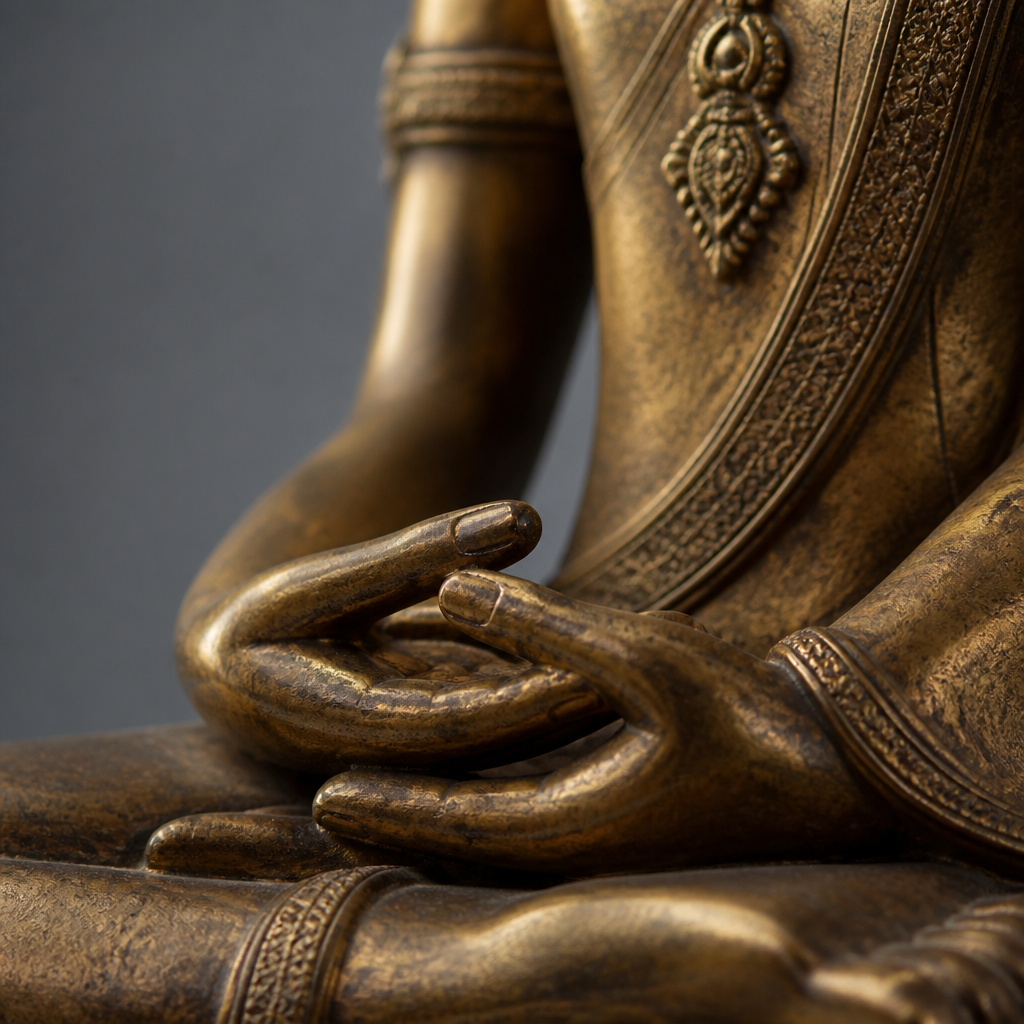
Both hands resting in the lap with palms facing up indicate deep meditative absorption. This is the posture best suited to personal meditation altars. |
|
Thai and Cambodian styles overlap historically |
Much Thai iconography developed from contact with Khmer artistic traditions. Collectors should understand this lineage when assessing provenance and stylistic authenticity. |
|
Material and finish affect ritual appropriateness |
In Theravada practice, bronze and stone are considered more appropriate for formal altars than resin. Museum-quality pieces sourced from Thailand or Burma carry greater devotional authority. |
Why Posture Matters More Than Appearance
Thai Buddhist iconography is not decorative in origin. It is doctrinal. Every element of a Thai Buddha statue, from the position of the hands to the angle of the feet, was codified over centuries by monastic communities who used these images as teaching tools. A seated figure with hands in the lap teaches something different from a seated figure with the right hand touching the earth, even if both are made from the same bronze and finished to the same standard.
In practice, most Western buyers focus on size, material, and finish. Posture is treated as a secondary concern. This creates collections and altars that are visually coherent but spiritually mismatched. A collector who places a Reclining Buddha, which represents final liberation, in a business entrance is communicating something unintended.
Understanding Buddha postures meaning allows you to build a collection with intention. It also deepens your appreciation of each piece as an object of art history, not just decor.
The Five Core Postures of Thai Buddha Statues
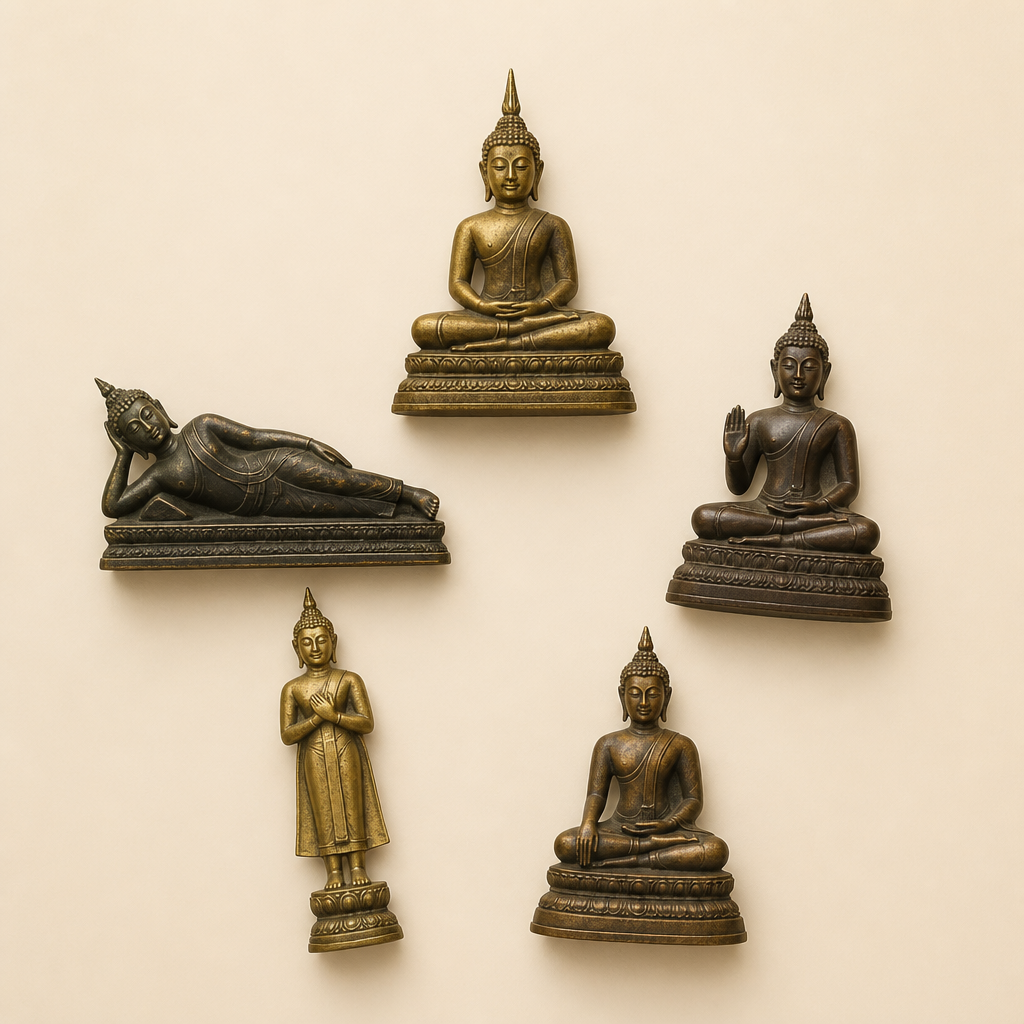
Thai iconographic tradition recognizes dozens of specific poses across its formal canon, but five postures dominate both temple art and private collections. Each is defined by the position of the body and the specific hand gesture, known as a mudra, that accompanies it.
Bhumisparsha: The Earth-Touching Posture
This is the defining image of Theravada Buddhist art. The Buddha is seated with legs crossed, the left hand resting in the lap palm up, and the right hand draped over the right knee with fingers pointing toward the earth. This gesture, called Bhumisparsha mudra, commemorates the precise moment when Siddhartha Gautama called the earth to witness his enlightenment under the Bodhi tree.
In Thai temple iconography, this posture is almost universally the primary image installed in the ordination hall. For collectors and practitioners, this is the posture most appropriate for a central altar position. It carries the full weight of the enlightenment narrative and represents awakening, resolve, and unshakeable presence.
Dhyana: The Meditation Posture
The Buddha is seated in full or half lotus with both hands resting in the lap, right hand over left, palms facing upward. This is Dhyana mudra, the gesture of deep meditative concentration. It depicts the Buddha before enlightenment, absorbed in samadhi.
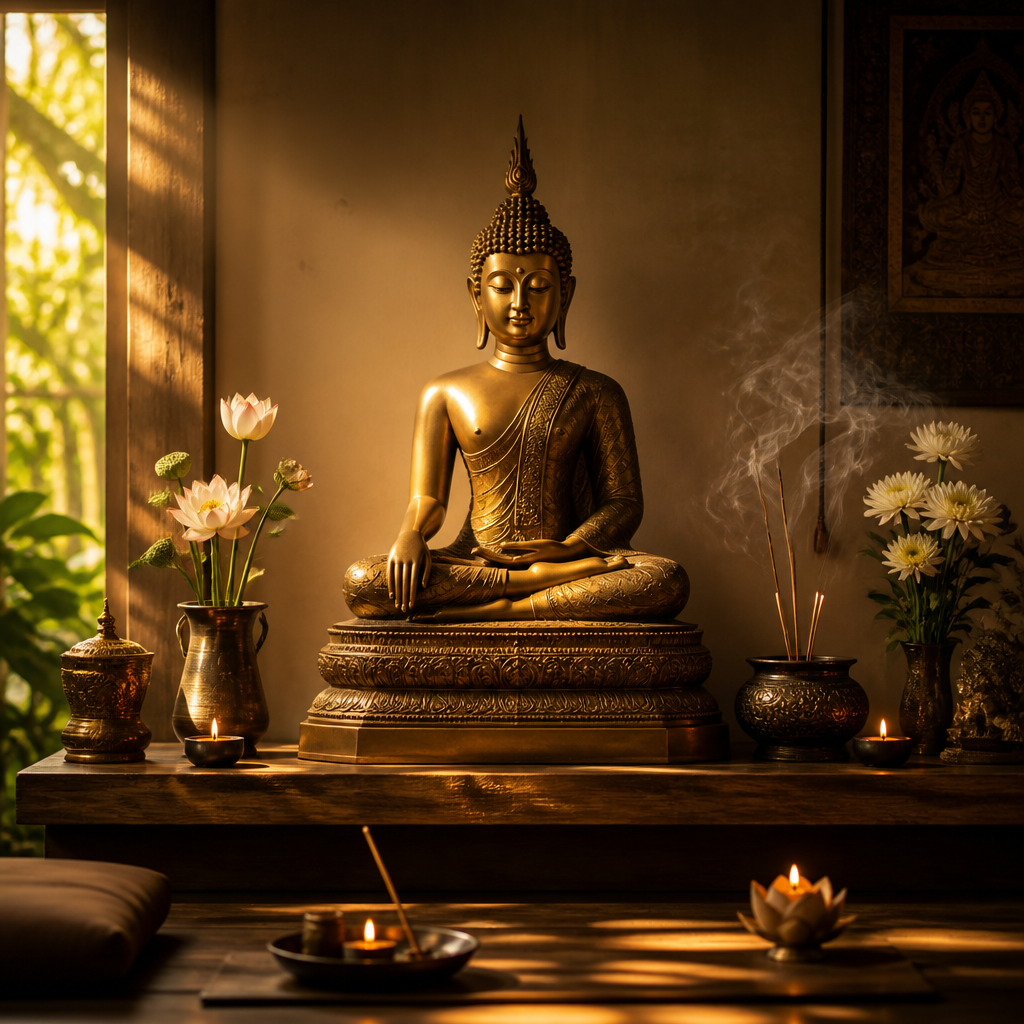
This posture is ideal for personal meditation rooms and home altars where the intention is to support a sitting practice. The visual cue of stillness and inward focus creates an environment that reinforces the practitioner's own effort.
Abhaya: The Protection Posture
Typically rendered as a standing figure with the right hand raised and the palm facing outward, Abhaya mudra translates as the gesture of fearlessness or no-fear. This posture appears frequently in Thai Buddhist art as the Walking Buddha, particularly the graceful striding figures associated with Sukhothai-period sculpture from the 13th and 14th centuries.
The Abhaya gesture is associated with protection, peace, and the dispelling of fear. It is a strong choice for entranceways, reception spaces, and areas where one seeks to establish a calm, welcoming atmosphere.
Vitarka: The Teaching Posture
Vitarka mudra depicts the Buddha in the act of teaching. The hand is raised with the thumb and index finger touching to form a circle, representing the turning of the wheel of the Dharma. In Thai sculpture, this posture often appears in narrative temple friezes depicting the Buddha's first sermon at Deer Park in Sarnath.
For collectors interested in Theravada Buddhist art as a historical and doctrinal tradition, this posture is one of the most intellectually rich. It places the statue explicitly within the teaching lineage of Buddhism rather than in a purely devotional context.
Parinirvana: The Reclining Posture
The Reclining Buddha is one of the most visually distinctive forms in all of Buddhist art. The figure lies on its right side, head resting on the right hand, feet together, in a posture of complete stillness. This image depicts the Buddha's Parinirvana, the moment of final passing and complete liberation from the cycle of rebirth.
A common mistake is to interpret this figure as sleeping or resting. That misreading trivializes one of Buddhism's most profound theological concepts. The Reclining Buddha is a statement about the ultimate goal of the path. It belongs in spaces where that depth is understood and honored.
"The image of the Buddha is not merely an aesthetic object. It is a mirror held up to the practitioner's own potential for awakening." - Bhikkhu Bodhi, scholar and translator of the Pali Canon, in foreword remarks to the Majjhima Nikaya translation (Wisdom Publications)
Theravada Buddhist Art and Thai Iconographic Tradition
Thailand is one of the world's oldest continuously practicing Theravada Buddhist nations. The Theravada tradition, which claims the most direct lineage to the original Pali Canon teachings of the Buddha, reached mainland Southeast Asia via Sri Lanka between the 11th and 13th centuries CE. It became the dominant religious framework of the Sukhothai and Ayutthaya kingdoms, both of which produced some of the most refined Buddhist sculpture in Asia.
Theravada Buddhist art is notably different from Mahayana Buddhist art in its iconographic priorities. Where Mahayana traditions produced extensive pantheons of Bodhisattvas and celestial Buddhas, Theravada iconography focuses almost exclusively on the historical Buddha, Siddhartha Gautama. This means that Thai Buddhist statues carry a narrower but more concentrated doctrinal vocabulary.
The Sukhothai period (roughly 1238 to 1438 CE) is considered the golden age of Thai Buddhist sculpture. Sukhothai artisans developed the distinctive flame-shaped ushnisha (the protrusion on the crown of the Buddha's head), the sinuous walking posture, and a particular softness of facial expression that distinguishes Thai sculpture from the more architecturally rigid forms of Khmer art to the east.
Later periods, including the Ayutthaya and Bangkok (Rattanakosin) periods, introduced greater ornamentation and royal iconographic elements. Collectors evaluating pieces for a serious collection should understand which period's aesthetic they are working with, since this affects both the visual character and the historical significance of the piece.
Pro tip: When evaluating a Thai Buddha statue for authenticity and period, examine the ushnisha. A genuine Sukhothai-influenced piece features a flame-shaped finial. Ayutthaya-period pieces often show a lotus bud or pointed crown. Bangkok-period statues frequently include jeweled regalia, reflecting the influence of royal court aesthetics.
Comparing the Five Postures: A Practical Reference
The table below summarizes the five core postures, their Sanskrit or Pali names, their spiritual meaning, and their most appropriate placement. Use this as a reference when selecting a piece for your altar, collection, or living space.
|
Posture Name |
Spiritual Meaning |
Best Placement |
|---|---|---|
|
Bhumisparsha (Earth-Touching) |
Enlightenment, unshakeable resolve, calling earth as witness |
Central altar, meditation room, living room focal point |
|
Dhyana (Meditation) |
Deep meditative concentration, inner stillness, samadhi |
Personal meditation space, study, bedroom altar |
|
Abhaya (Protection, Standing) |
Fearlessness, peace, protection from harm |
Entrance, hallway, reception area, garden |
|
Vitarka (Teaching) |
Dharma transmission, wisdom, the turning of the wheel |
Library, teaching space, collection display |
|
Parinirvana (Reclining) |
Final liberation, release from rebirth, ultimate peace |
Temple-inspired spaces, dedicated shrine rooms |
How to Choose the Right Posture for Your Space or Collection
The decision is not purely aesthetic. It is a question of what quality you want present in a space and what relationship you have, or want to develop, with the tradition the statue represents.
For Spiritual Practitioners
If you maintain a home altar for daily practice, the Bhumisparsha or Dhyana posture will serve you best as the primary image. The Earth-Touching posture places the narrative of awakening at the center of your practice. The Meditation posture invites stillness and supports sitting meditation directly.
For practitioners who work specifically with loving-kindness or metta meditation, a Standing Abhaya figure creates a powerful visual reminder of the protective and peace-generating qualities of the practice.
For Collectors and Art Historians
A serious collection should aim to represent at least three of the five postures. This gives you a meaningful cross-section of the iconographic vocabulary. Prioritize pieces where the craftsmanship of the mudra is precise. A poorly rendered hand gesture undermines the entire doctrinal meaning of the piece.
When sourcing from HD Asian Art, the advantage is access to museum-quality pieces sourced directly from Thailand and Burma, with the material authenticity that generic retailers cannot match. Bronze and stone statues carry a different weight, both literally and symbolically, than resin reproductions.
For Home Decorators
If your primary interest is creating a visually coherent and culturally respectful space, choose a single posture that aligns with the room's function. A meditation room calls for Dhyana. A welcoming entrance calls for Abhaya. A dining or gathering space benefits from the serene authority of Bhumisparsha.
Pro tip: Avoid placing any Buddha statue in a bathroom or on the floor directly. Both placements are considered disrespectful in Theravada tradition. A statue placed at or above eye level, on a dedicated surface, communicates respect for the tradition regardless of whether you are a practicing Buddhist.
Common Mistakes When Buying a Thai Buddha Statue
In practice, the same errors appear repeatedly among first-time and even experienced buyers. Knowing these mistakes in advance saves both money and disappointment.
The most common mistake is conflating Thai and Chinese Buddha iconography. The rotund, laughing figure many Western buyers associate with Buddhism is Budai, a Chinese folkloric figure. He is not the historical Buddha and has no place in Theravada Buddhist art. A genuine Thai Buddha statue is lean, composed, and calm.
A second mistake is buying a Reclining Buddha as a decorative piece without understanding its meaning. This posture, as noted above, represents final liberation and death. Placing it in a bedroom or kitchen without awareness of this is a meaningful error for anyone who cares about engaging with the tradition honestly.
Third, buyers frequently underestimate the importance of scale. A small figurine on a crowded shelf carries almost none of the presence of a properly sized and positioned statue on a clear altar surface. The physical environment in which a statue is placed determines how much of its intended quality actually registers in the space.
Finally, the material matters. Resin pieces can be visually convincing, but they lack the weight and durability of bronze or stone. For a collection intended to last and to carry genuine value, sourcing museum-quality bronze or carved stone pieces from a specialist retailer is the more defensible long-term decision.
Frequently Asked Questions
What does a Thai Buddha statue with the right hand touching the earth mean?
This is the Bhumisparsha mudra, or Earth-Touching gesture, and it depicts the moment of the Buddha's enlightenment under the Bodhi tree. The gesture calls the earth itself to bear witness to his awakening. It is the most common and doctrinally significant posture in Theravada Buddhist art, and the one most frequently found as the primary image in Thai temple ordination halls.
Is it disrespectful to display a Thai Buddha statue as home decor?
Displaying a Buddhist statue as part of a home environment is widely accepted, including by Buddhist teachers, provided the placement is respectful. This means placing the statue above floor level, ideally at or above eye level, on a clean and dedicated surface. Placing a statue in a bathroom, on the ground, or in a cluttered space is generally considered disrespectful to the tradition.
What is the difference between Thai and Cambodian Buddha statues?
Thai and Cambodian Buddhist sculpture share historical roots in Khmer artistic traditions, but they diverged significantly after the Sukhothai period. Thai statues, especially from the Sukhothai era, are characterized by graceful, elongated forms, soft facial expressions, and the distinctive flame-shaped ushnisha. Cambodian or Khmer figures tend to have more angular, architecturally structured faces and elaborate headdresses. The two traditions represent distinct artistic lineages even when depicting the same postures.
What does the Reclining Buddha actually represent?
The Reclining Buddha represents the Buddha's Parinirvana, the moment of his final passing and complete liberation from the cycle of rebirth. It is one of Buddhism's most theologically significant images and should not be interpreted as the Buddha sleeping or resting. In Theravada doctrine, Parinirvana is the ultimate goal of the spiritual path, making this posture one of the most profound in the entire iconographic tradition.
Which posture is best for a meditation altar?
The Dhyana (Meditation) posture, with both hands resting in the lap palms up, is the most appropriate for a personal meditation altar. It visually reinforces the quality of stillness and inward absorption that characterizes sitting practice. The Bhumisparsha posture is also an excellent choice if you want to anchor your practice in the narrative of awakening rather than the act of meditation itself.
How do I identify a genuine Sukhothai-style Thai Buddha statue?
Sukhothai-style statues are identifiable by several key features: a flame-shaped finial on top of the ushnisha, a slender and elongated body, a smooth and serene facial expression with arched brows, a slightly smiling mouth, and, in standing figures, a sinuous posture suggesting fluid movement. The casting quality is typically very fine. Any piece claiming Sukhothai-period style should display these characteristics consistently across its design.
Does the material of a Thai Buddha statue affect its spiritual significance?
In Theravada practice, bronze has been the dominant material for cast Buddha images for over a thousand years and carries strong traditional authority. Stone, particularly sandstone and granite, is also used in temple settings. For home altars and serious collections, bronze and stone are considered more appropriate than resin or plaster. That said, the posture and mudra carry the primary doctrinal meaning. A well-executed resin piece in the correct posture is more meaningful than a poorly cast bronze in an ambiguous one.
If you have a Thai Buddha statue in your home or collection, we would love to hear which posture you chose and what drew you to it. Share your experience in the comments.
