



Provenance of Antique Khmer Sculptures: A Collector's Guide
Provenance of Antique Khmer Sculptures: A Collector's Guide
Table of Contents
Why Provenance Matters for Khmer Sculptures
The provenance of antique Khmer sculptures determines whether you own a genuine artifact or an expensive replica. Collectors who skip provenance verification face legal seizure, financial loss, and the moral burden of possessing looted cultural property. Khmer sculptures command premium prices because of their historical significance, creating a market flooded with falsely aged reproductions and undocumented pieces removed through illicit channels. A collector purchasing without provenance verification risks acquiring stolen property that authorities can seize at any time.
HD Asian Art recognizes that ethical collecting begins with transparency. When you purchase from a source that documents provenance thoroughly, you protect your investment and respect the cultural heritage these objects represent.
Historical Context: The Angkorian Period and Beyond
Khmer sculpture spans more than a millennium of artistic evolution, from the Pre-Angkorian period through the classical Angkorian era. Each period developed distinct stylistic characteristics essential for authenticating pieces.
Pre-Angkorian and Phnom Da Styles
The Pre-Angkorian period (roughly 500-800 CE) represents the earliest phase of Khmer artistic development, showing strong Indian influence while establishing distinctly Khmer characteristics. Phnom Da sculptures typically feature simplified forms, frontal presentation, and spiritual directness, worked primarily in sandstone depicting Hindu deities. These earliest Khmer sculptures are relatively rare and command exceptional prices, making them targets for forgery. Falsely aged reproductions are common because simplified forms are easier to replicate than later technical complexity. Collectors pursuing Pre-Angkorian work should demand extensive documentation and scientific dating verification.
Indian Civilization Influence on Khmer Art
Indian artistic traditions shaped Khmer sculpture fundamentally. Early Khmer artisans absorbed Indian iconographic conventions, sculptural techniques, and aesthetic principles, then adapted them to create distinctly Cambodian visual language. Understanding this Indian influence helps distinguish authentic pieces from modern imitations. Forgers lacking deep knowledge of Indian artistic traditions often mishandle iconographic details or fail to achieve the technical refinement characterizing genuine Khmer work.
:::pro tip The most convincing forgeries get major stylistic elements right but fail in subtle details, how a deity's fingers are positioned, how fabric drapes, or proportional relationships between head and body. These details are harder to research and replicate than overall form. :::
Understanding Looted Cambodian Antiquities and Repatriation
Cambodia's archaeological heritage suffered catastrophic loss during the 20th century. Systematic looting, particularly during the Khmer Rouge period and subsequent civil conflict, removed thousands of sculptures from temples and archaeological sites.
The Illicit Trafficking Problem
Illicit trafficking of Khmer sculptures remains persistent in the antiquities market. Smuggling networks operate across Southeast Asia, moving pieces from archaeological sites through intermediaries and dealers to international buyers. Local villagers near sites remove pieces and sell to local dealers, who connect with larger smuggling operations transporting pieces across borders. By the time a sculpture reaches a Western collector, its trail has been deliberately obscured. Collectors purchasing without demanding complete provenance documentation unknowingly support this trafficking. A sculpture with provenance gaps raises the possibility of illicit origin.
Cultural Property and Repatriation Efforts
Repatriation of looted Cambodian antiquities has become increasingly aggressive over two decades. Cambodia's government, working with international organizations and law enforcement, has successfully recovered hundreds of pieces. These repatriation efforts signal a clear shift in how the international community views cultural property. Pieces acquired decades ago with minimal documentation are now vulnerable to seizure and forced return. The 1970 UNESCO Convention, which Cambodia ratified, provides the foundation for recovery efforts.
This enforcement environment makes provenance documentation more valuable. A sculpture with clear, documented ownership history and legal export documentation is protected from repatriation claims. A piece with gaps or questionable provenance is vulnerable regardless of possession length.
Khmer Art Authentication: Materials, Techniques, and Stylistic Analysis
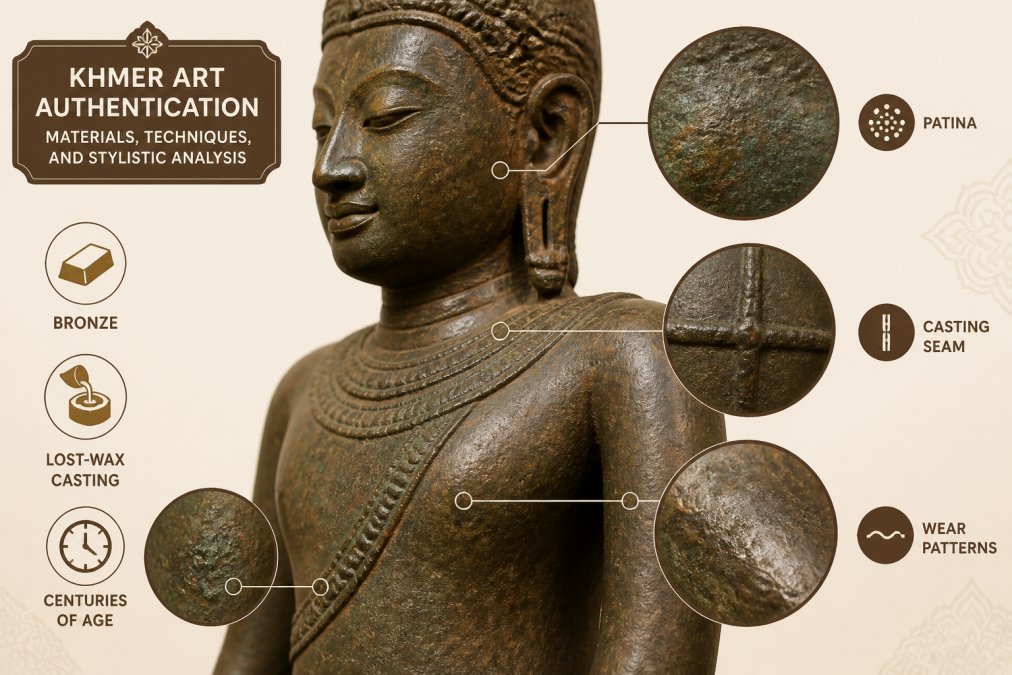
Authenticating Khmer sculptures requires understanding materials, techniques, and stylistic evolution. Forgers understanding surface appearance often fail when examined for material composition and manufacturing methods.
Bronze Foundry Work vs. Stone Carving
Khmer sculptors worked in both stone and bronze, producing dramatically different results. Stone carving involves subtractive work removing material to reveal final form. Bronze foundry work involves casting molten metal into molds. These processes leave distinctive traces. Stone sculptures show chisel marks and tool impressions with patina developing over centuries through weathering and mineral accumulation. Bronze sculptures show casting seams and pour marks with characteristic surface texture and patina developing differently than stone.
Forgers often fail understanding these material-specific characteristics. A falsely aged bronze might show stone-carving tool marks. Bronze foundry technique requires substantial expertise, creating molds capturing intricate detail and pouring molten bronze without flaws demands skill developed over years.
Identifying Falsely Aged Artifacts
Falsely aged artifacts represent the most sophisticated forgeries. These pieces use genuine materials and techniques but are artificially aged to appear ancient. Authentic stone patina develops slowly over centuries through mineral deposition and biological growth, producing specific color patterns reflecting the stone's mineral composition and local environment. Artificially aging stone involves chemical treatments or burial in specific soil conditions, typically producing inconsistent results with uniform appearance rather than natural variation.
Bronze patina develops through oxidation and corrosion showing specific color progression from bright copper tones to blue-green malachite. Artificial patina created through chemical processes often appears uniform and removes more easily than authentic patina. Detecting falsely aged artifacts requires examining multiple characteristics simultaneously, no single test is conclusive, but combined material analysis, stylistic evaluation, and technical examination typically reveals forgeries.
:::pro tip Forgers focus on convincing surface appearance. They often neglect internal consistency, how the piece was manufactured, material relationships, and whether construction methods match the claimed period. This is where authenticity verification succeeds. :::
Step-by-Step Provenance Verification Checklist
Verifying provenance requires systematic documentation review and research.
| Verification Step | What to Look For | Red Flags |
|---|---|---|
| Ownership history | Documented chain of ownership from acquisition to present | Gaps in ownership, anonymous sellers, undocumented transfers |
| Export documentation | Legal permits showing lawful removal from Cambodia | Missing export permits, permits from wrong country, undated documents |
| Import records | U.S. customs documentation showing legal entry | No import records, entry through third countries without documentation |
| Archaeological context | Documentation of discovery site and excavation details | "Found by local villagers," vague location, no excavation records |
| Previous publication | References in scholarly articles, museum catalogs, exhibition records | Never published, not referenced in academic literature |
| Acquisition source | Established dealer, auction house, or museum provenance | Private sale from unknown source, "estate sale," informal acquisition |
| Expert authentication | Written statements from recognized Khmer art specialists | No expert opinion, vague assessment, opinions from non-specialists |
| Material analysis | Scientific testing confirming age and material composition | No testing, conflicting test results, analysis from unknown lab |
Documentation and Export Permits
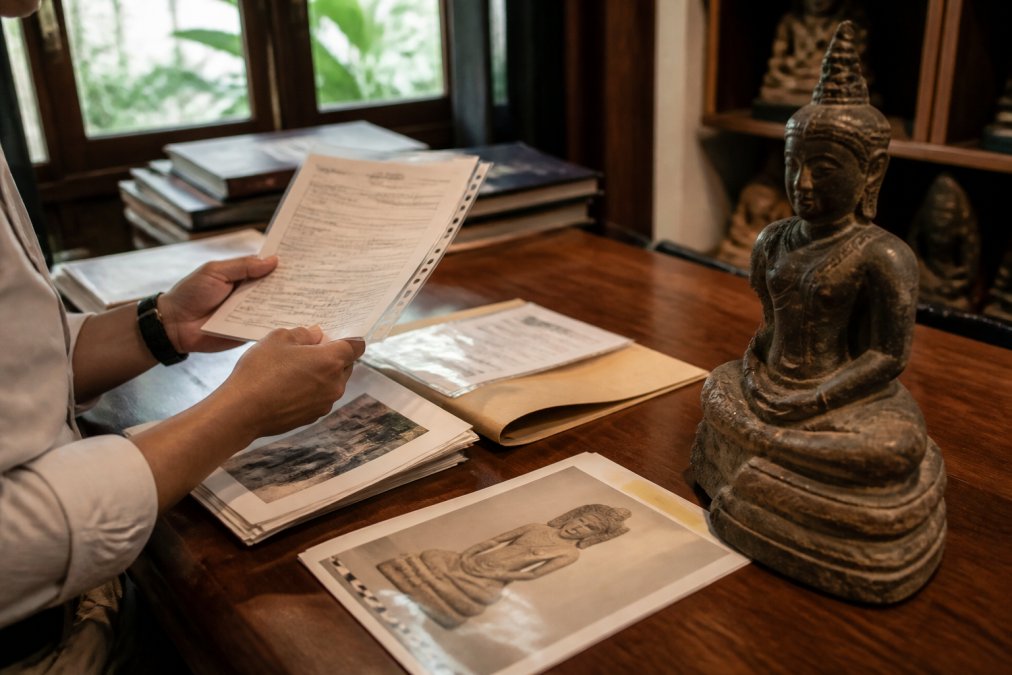
Legal export from Cambodia requires official permits issued by the Cambodian government documenting lawful removal and authorizing export. Export permits typically include specific information: piece description, dimensions, materials, estimated age, and export date, bearing official seals and signatures from Cambodian authorities. The absence of export documentation is a serious red flag suggesting illegal removal. When reviewing permits, verify authenticity by requesting the seller provide additional verification from Cambodian authorities.
Archaeological Context and Discovery Sites
Authentic Khmer sculptures typically come from known archaeological sites like Angkor, Banteay Srei, and Koh Ker, often with excavation records establishing archaeological context. Archaeological context establishes that a piece was discovered in legitimate excavation rather than looted from a temple. Pieces with vague origins like "found by local villagers" are suspect. Some pieces come from temple contexts with documentation establishing the temple of origin and removal circumstances. Pieces with no temple provenance and no archaeological context are particularly vulnerable to legality questions.
Scientific Dating Methods and Artifact Verification
Scientific dating provides objective evidence of sculpture age. Thermoluminescence dating measures accumulated radiation in ceramic materials, indicating how long ago clay was fired. Radiocarbon dating measures carbon-14 decay in organic materials, providing indirect evidence about sculpture age. Stylistic analysis combined with material examination provides another verification form, experts familiar with Khmer sculpture can evaluate whether a piece's style, iconography, and technical execution match the claimed period.
When considering scientific dating, request clear documentation of testing methodology, the laboratory performing analysis, and results with error margins. Reputable laboratories provide detailed reports.
Legal Frameworks for Collectors in the United States
U.S. law establishes specific requirements for antiquities import and ownership. Understanding these frameworks protects collectors from acquiring pieces violating federal law or international agreements.
The 1970 UNESCO Convention and US Import Laws
The Convention on Cultural Property Implementation Act (CPIA), enacted in 1970, implements the UNESCO Convention in U.S. law. This convention establishes that cultural property stolen from a country of origin can be recovered by that country, even if the current owner purchased in good faith. Cambodia ratified the UNESCO Convention, making it eligible for protection under U.S. law. Khmer sculptures removed without legal export authorization are subject to recovery under CPIA. The practical implication is significant: a collector owning a Khmer sculpture without proper export documentation faces losing that piece to a government claim. The length of ownership or price paid does not protect against seizure.
Customs Regulations and Legal Ownership
U.S. Customs and Border Protection actively monitors for smuggled antiquities. Pieces entering without proper documentation can be seized as contraband. The burden of proof rests with the importer to demonstrate legal export from Cambodia and legal U.S. import. For collectors purchasing pieces already in the U.S. market, legal risk is somewhat lower but still present. A piece illegally imported years ago can still be seized if discovered. The safest approach is purchasing only from dealers maintaining complete provenance documentation and demonstrating legal export and import.
Building Your Collection with Confidence
Serious collectors approach Khmer sculpture acquisition as a long-term commitment to authenticity and ethical practice. Start by developing expertise through studying Khmer art history, understanding major periods and stylistic characteristics, and visiting museums with significant Khmer collections. When evaluating specific pieces, apply the provenance verification checklist systematically and be prepared to walk away from pieces lacking adequate documentation.
Work with established dealers specializing in Khmer sculpture and maintaining rigorous documentation standards. HD Asian Art offers a carefully selected collection of Khmer and Southeast Asian sculptures. Browse our authenticated Khmer collection and acquire pieces with confidence in their legal status and cultural significance.
Collecting Khmer sculpture offers profound rewards, connecting with one of Southeast Asia's greatest artistic traditions. The provenance of antique Khmer sculptures determines whether that collection represents genuine cultural stewardship or unwitting participation in ongoing looting. By demanding complete documentation, understanding historical context, and working with ethical dealers, collectors can build with confidence. The UNESCO 1970 Convention on Cultural Property provides the international framework for protecting cultural heritage. U.S. Customs guidance on cultural property seizure outlines federal enforcement mechanisms. Cambodian Ministry of Culture documentation on export permits establishes official legal export requirements. HD Asian Art's commitment to documented provenance and transparent sourcing ensures your collection reflects authentic cultural appreciation rather than participation in illicit trafficking. Browse our authenticated Khmer collection and acquire pieces with confidence in their legal status and cultural significance.
Frequently Asked Questions
Why is provenance important for Khmer sculptures?
Provenance documents the ownership history and origin of a Khmer sculpture, establishing authenticity and legal legitimacy. Pieces with clear provenance command higher values and allow you to collect with confidence. Without provenance, a sculpture may be a modern replica, falsely aged piece, or looted cultural property subject to repatriation claims. Collectors who verify provenance avoid legal complications and support ethical art markets.
What are the legal implications of owning looted Cambodian antiquities in the US?
The 1970 UNESCO Convention, ratified by the United States, prohibits importing undocumented cultural property from signatory nations including Cambodia. Ownership of looted Cambodian antiquities violates federal law and can result in seizure by US Customs and Border Protection, civil forfeiture, and criminal charges. The US government actively repatriates stolen artifacts to Cambodia. Collectors must verify export permits and provenance documentation to ensure legal ownership and avoid liability.
How can I verify the history of a Khmer sculpture?
Request complete provenance documentation from the seller, including ownership records, museum accession numbers, and export permits issued before 1970. Examine stylistic features, material composition, and wear patterns consistent with the claimed period. Consult archaeological databases and institutional records. Have the piece evaluated by an art historian specializing in Southeast Asian sculpture. Scientific dating methods such as thermoluminescence testing can confirm age. Cross-reference with UNESCO's Red List of cultural objects at risk of trafficking.
How do I identify if a Khmer sculpture was illegally exported?
Sculptures exported after Cambodia's 1970 UNESCO Convention ratification require documented export permits from the Cambodian Ministry of Culture. Request evidence of legal export authorization from the seller. Verify the artifact does not appear on UNESCO's Red List or in stolen art databases. Check if the piece matches descriptions of known looted antiquities from archaeological sites like Prasat Chen. Pieces lacking clear provenance documentation before 1970, or those with gaps in ownership history, warrant caution and expert evaluation before purchase.
