



Mantras for Life: How to Choose and Practise Daily
Mantras for Life: How to Choose and Practise Daily
The kettle's boiling, your phone is already lighting up, and you haven't quite caught up with the day. Before reaching for the next notification, you pause and repeat, “Pause, notice, choose.” Nothing outside you changes immediately, but you've given yourself somewhere to place your attention before deciding what to do next.
That's a useful starting point for mantras for life: not words that promise to fix everything, but a practice you can return to. Whether you're drawn to devotional chanting, a personal phrase or the rhythm of breathing, the important questions are what you're repeating, why you've chosen it and how it affects you.
Table of Contents
- What Mantras for Life Are and Why People Use Them
- Popular Mantras for Life and What They Mean
- How to Choose the Right Mantra for You
- Building a Daily Mantra Practice That Sticks
- Using Statues and Altars to Deepen Your Practice
- Staying Consistent and Practising Safely
- Bringing Your Mantra Practice into Everyday Life
What Mantras for Life Are and Why People Use Them
A life mantra is a word, sound or phrase you return to regularly as a focus for attention and meaning. You might repeat it while sitting, before a difficult conversation or when you notice yourself rushing. The repetition matters more than the phrase looking impressive on a notebook cover.
A one-off affirmation usually makes a statement about yourself or your circumstances. A mantra becomes a practice through repeated use. The same words can serve either purpose: “I can respond with care” might be an occasional encouragement or a recurring reminder before answering an emotionally charged message.
A practice with religious roots
In Hindu and Buddhist traditions, mantras belong to religious settings that can include devotion, ritual, teaching and meditation. They aren't motivational slogans in another language. Depending on the tradition, their significance may involve sacred sound, a deity, a particular teaching or guidance received from a teacher.
The broader contemporary expression “life mantra” also includes secular phrases. That's a useful distinction to keep visible: repeating your own values-based sentence can be worthwhile without claiming that it's equivalent to traditional mantra practice.
A useful distinction: You can borrow the method of returning to words without claiming the religious meaning of a tradition you don't practise.
Repeated reflective words aren't unfamiliar in Britain. Historical polling recorded 49% of adults in 1981 and 53% in 1990 taking moments of prayer, meditation, contemplation or something similar, according to the British Religion in Numbers historical polling compendium. Those questions didn't measure Hindu or Buddhist mantra use, so they shouldn't be presented as evidence of it.
What you're actually practising
Think of the phrase as something to return to, rather than something you must force yourself to believe. With “Pause, notice, choose”, you might notice irritation, name it privately and decide not to send a sharp reply. That's a practical use, not proof of a therapeutic effect.
- Attention: Give yourself a recognisable point of return.
- Meaning: Remember a quality you want to express through action.
- Routine: Create a repeatable moment of reflection within an ordinary day.
You don't need an empty mind, an unfamiliar language or a special object to begin. You do need a phrase you can use sincerely, without expecting repetition to remove every uncomfortable feeling.
Popular Mantras for Life and What They Mean
Traditional mantras deserve more than a quick translation. Language, religious setting and pronunciation all contribute to how people understand and use them. The guides below are approximate English sound prompts, not substitutes for listening to a knowledgeable practitioner.
Sacred sounds and devotional phrases
Om is a foundational sacred syllable in Hindu traditions and also appears in Buddhist mantras. It isn't a sentence with a simple English translation; describing it as a sacred sound is more accurate than assigning it a motivational meaning. Try a rounded “ohm”, allowing the sound to close gently into “m”, without straining or forcing a long breath.
Om Mani Padme Hum is a Sanskrit mantra strongly associated with compassion in Tibetan Buddhism and with Avalokiteshvara. “The jewel in the lotus” is a familiar rendering of its central words, but it doesn't exhaust the mantra's religious interpretation. A rough Sanskrit-oriented guide is “ohm mah-nee pud-may hoom”; Tibetan recitation can sound different, particularly around padme, so learn from the community whose practice you're following.
For further context rather than a phrase alone, the gallery's guide to Buddhist mantras offers a starting point for exploring their meanings and use.
Om Namah Shivaya belongs to Shaiva Hindu devotion. Its Sanskrit meaning is commonly rendered “Salutations to Shiva” or “I bow to Shiva”. Say approximately “ohm nuh-muh shi-vaa-yuh”, keeping “sh” soft and the “vaa” open rather than rushing through the name.
Longer invocations and breath-linked practice
The Gayatri mantra is a Sanskrit Vedic invocation, not another short calming phrase. Its meaning is commonly expressed as a contemplation of divine radiance and a prayer that understanding be guided or illuminated. “Guy-uh-tree” approximates the name Gayatri, not the full mantra; because the invocation is longer and traditional recitation involves more than ordinary speech sounds, learn its complete wording and pronunciation with a qualified teacher.
So Hum, also written So'ham, is a Sanskrit phrase commonly translated as “I am That”. It belongs to Hindu contemplative and yogic contexts and is often paired with breathing. “Soh hum”, with a soft “h”, is a practical approximation; beginners can let the words accompany natural breathing rather than altering their breath to fit.
Meaning and intention matter more than anxious perfection, but that doesn't make pronunciation irrelevant. A respectful beginner listens, asks and remains willing to learn.
For readers seeking non-devotional wording around goals, Life Purpose App's success mantras provide a separate resource to consider. Treat such phrases as personal prompts, not translations of sacred formulas.
Popular life mantras at a glance
| Mantra | Tradition | Meaning | Best For |
|---|---|---|---|
| Om | Hindu traditions; also Buddhist use | Sacred syllable, not a literal sentence | Sound-focused practice with context |
| Om Mani Padme Hum | Tibetan Buddhism; Sanskrit wording | Often rendered through the jewel and lotus, associated with compassion | Compassion-oriented Buddhist practice |
| Om Namah Shivaya | Shaiva Hinduism | Salutations to Shiva | Devotional repetition |
| Gayatri mantra | Vedic Hindu tradition | Invocation of divine radiance and illumination | Guided traditional learning |
| So Hum | Hindu contemplative and yogic traditions | I am That | Gentle breath-linked repetition |
How to Choose the Right Mantra for You
Choose words you can live with, not words that seem spiritually impressive. If a phrase conflicts with your beliefs, feels emotionally false or requires an explanation you don't understand, there's no reason to force it.
Britain's spiritual life leaves room for different approaches. A survey of 10,000 UK adults, conducted in December 2024 and January 2025, found that 70% described themselves as spiritual in a broad sense, while 17% were classified as religious, as summarised in the British Religion in Numbers January 2025 bulletin. Those categories aren't a reason to blur religious differences; they're a reason to offer readers genuine choices.
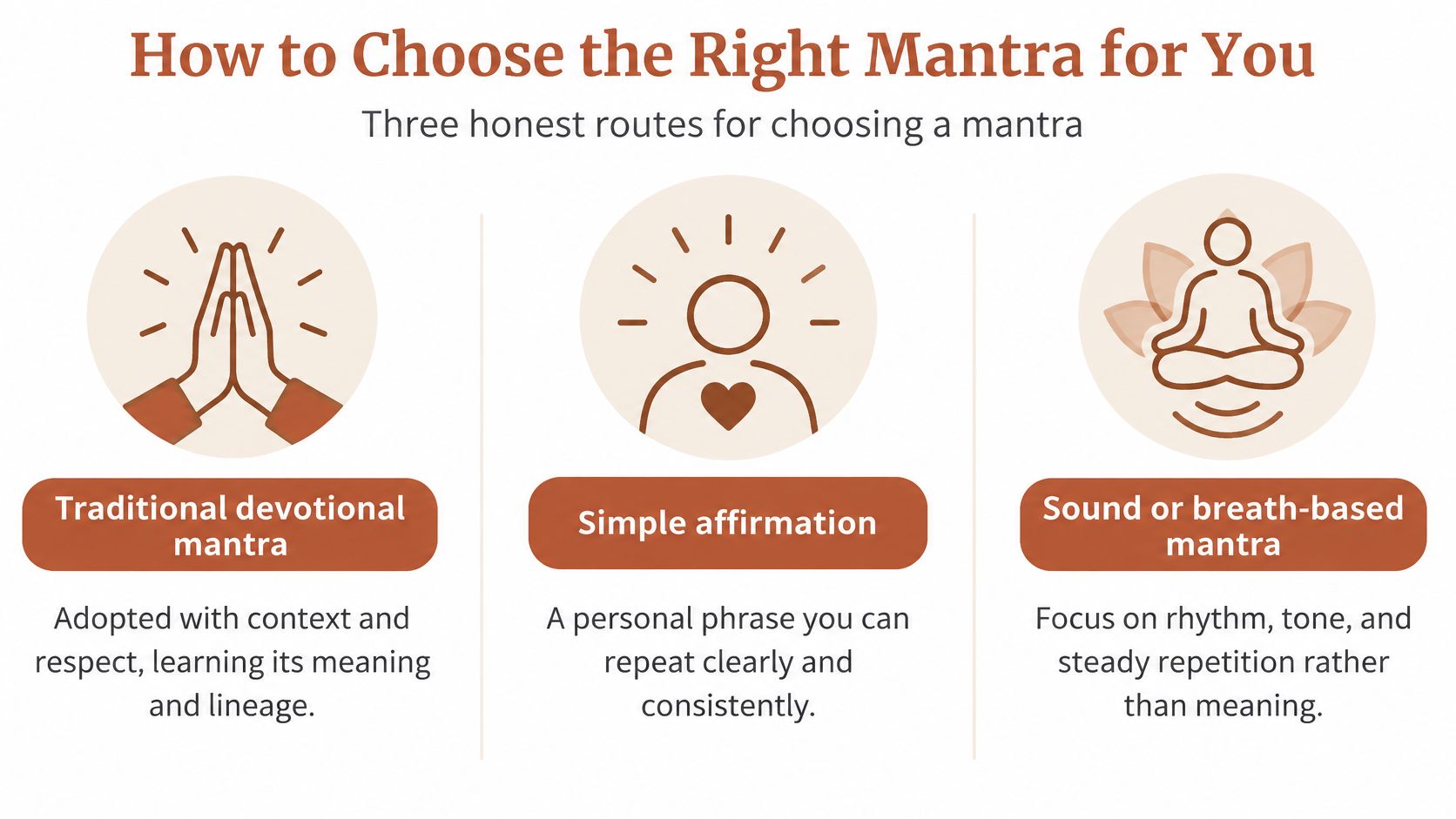
Traditional devotion or personal wording
A traditional devotional mantra makes sense if you want a relationship with its religious meaning, not just its sound. Learn the language, the tradition and whether the practice has particular teaching requirements. Where guidance is needed, ask a teacher or community rather than assuming every publicly available mantra is used in the same way.
A secular values-based phrase starts somewhere different: with the behaviour you want to practise. “Listen before replying” might suit someone who interrupts under pressure. “Firm and kind” might help someone who struggles to set boundaries.
These examples don't claim that you already feel calm or confident. They offer directions you can act on, including when you feel neither.
A quieter alternative
Breath-led repetition may suit you if verbal formulas feel awkward. You could pair “in” and “out” with comfortable breathing, or return to the sensation of breathing without words. The latter is breath awareness rather than a traditional mantra, and there's no need to relabel it.
Avoid treating unfamiliar sacred syllables as meaningless sounds. If you want an approach without religious content, ordinary language or unlabelled breath awareness is clearer.
Before settling on your choice, ask:
- Language: Can I repeat this comfortably and understand what I'm saying?
- Tradition: Do I know where it comes from and whether guidance is appropriate?
- Beliefs: Does it fit my convictions without requiring pretence?
- Emotional response: Does it offer a workable reminder, or make me feel pressured and inadequate?
- Action: What would following this phrase look like in everyday behaviour?
Choose the option that answers those questions best. You're selecting a focus for practice, not making a permanent declaration about your identity.
Building a Daily Mantra Practice That Sticks
Make the first session straightforward enough that you won't need to reorganise your home or your morning. A chair, an undisturbed corner and your chosen phrase are sufficient. Put your phone out of reach unless you're using it as a quiet timer.
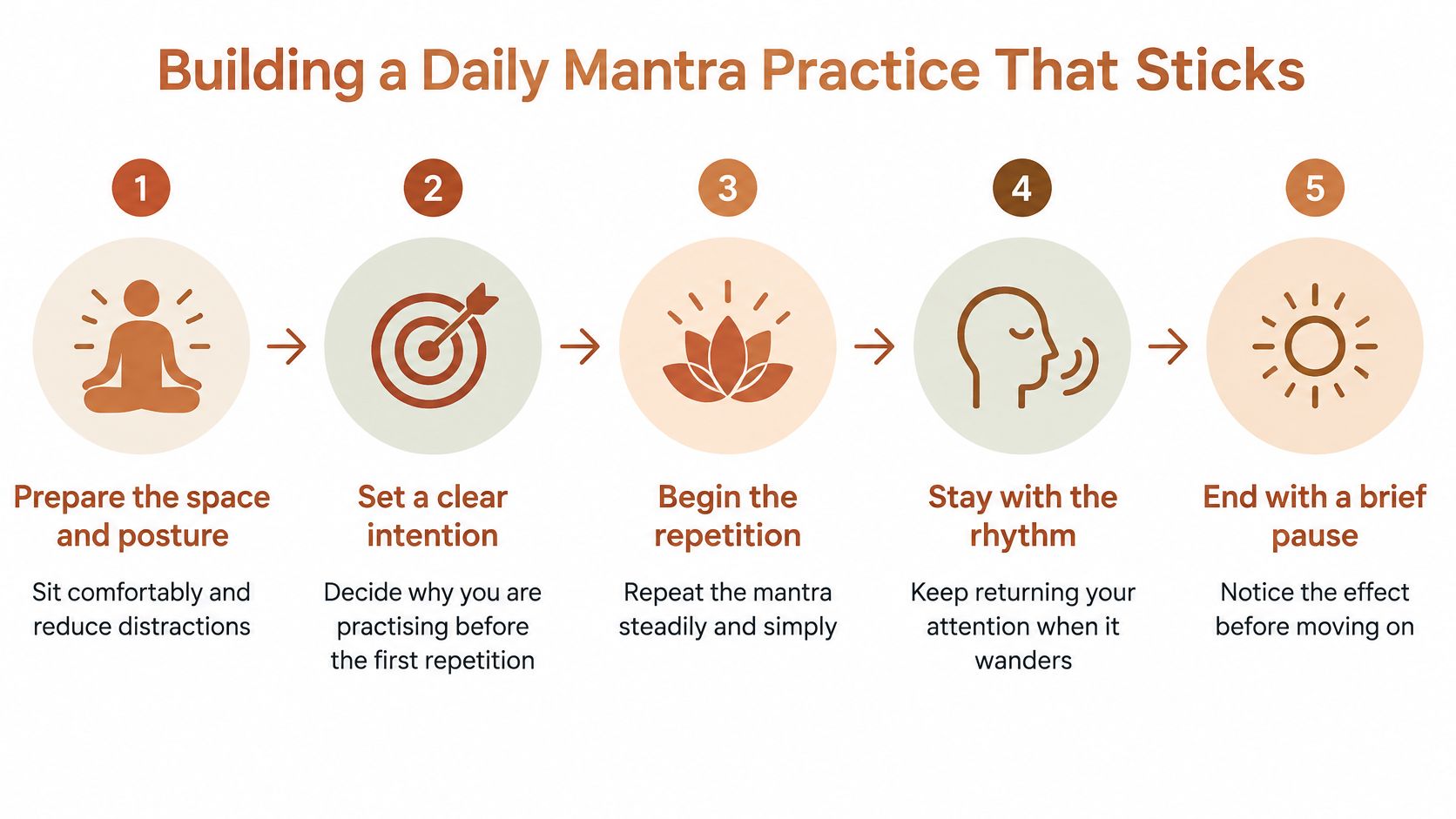
Prepare your posture and intention
Sit with your body supported and your feet resting comfortably, or use a cushion if that suits you. You don't need a formal cross-legged posture. Keep your eyes open with a soft gaze if closing them feels uncomfortable.
Before beginning, name your intention in plain language. “I'm practising returning my attention” is more useful than demanding complete calm. Let the intention describe what you'll do, rather than how you must feel afterwards.
Repeat and return
Repeat the phrase at an unhurried pace. Allow ordinary breathing to continue, and don't force the words into a rigid rhythm. When you notice planning, remembering or irritation, gently resume the phrase without rebuking yourself.
About ten minutes is a reasonable starting experiment, not a required dose or a promise of benefit. The NHS guide to meditation and sleep recognises repeated phrases, sounds and other gentle points of attention as meditation anchors.
A University of St Andrews mindfulness study compared ten- and thirty-minute daily sessions over two weeks and found no significant advantage for the longer sessions; participants completed around seven to eight sessions on average. That's a mindfulness benchmark, not direct proof that every mantra produces the same results.
If beads help you maintain continuity, consult a beginner's guide to mala beads from Kailash Way. The gallery's guide to using prayer beads offers further practical context. Beads are optional, and completing a count shouldn't become another source of pressure.
Close deliberately and record what happened
Let the repetition stop, notice your surroundings and allow a brief transition before standing. Ask whether you feel more settled, unchanged or less comfortable. All are useful observations.
The useful record isn't “Was I good at meditation?” It's “Did I practise, and how did the practice affect me?”
For your starter fortnight, keep the same phrase and attach practice to an existing cue, such as finishing your morning tea. Treat seven sessions across fourteen days as a suggested planning target rather than a research-established prescription. Record completion and a few words about your experience; don't turn the log into a test you can fail.
Using Statues and Altars to Deepen Your Practice
A dedicated focal point can make the decision to practise more concrete. Instead of clearing a different surface each time, you return to a place already associated with reflection. A shelf, a small altar or an uncluttered corner can serve that purpose.
You don't need to buy anything. A meaningful object you already own, or a clean space, may be enough. If you choose religious art, take time to understand what the figure represents rather than selecting solely by colour or size.
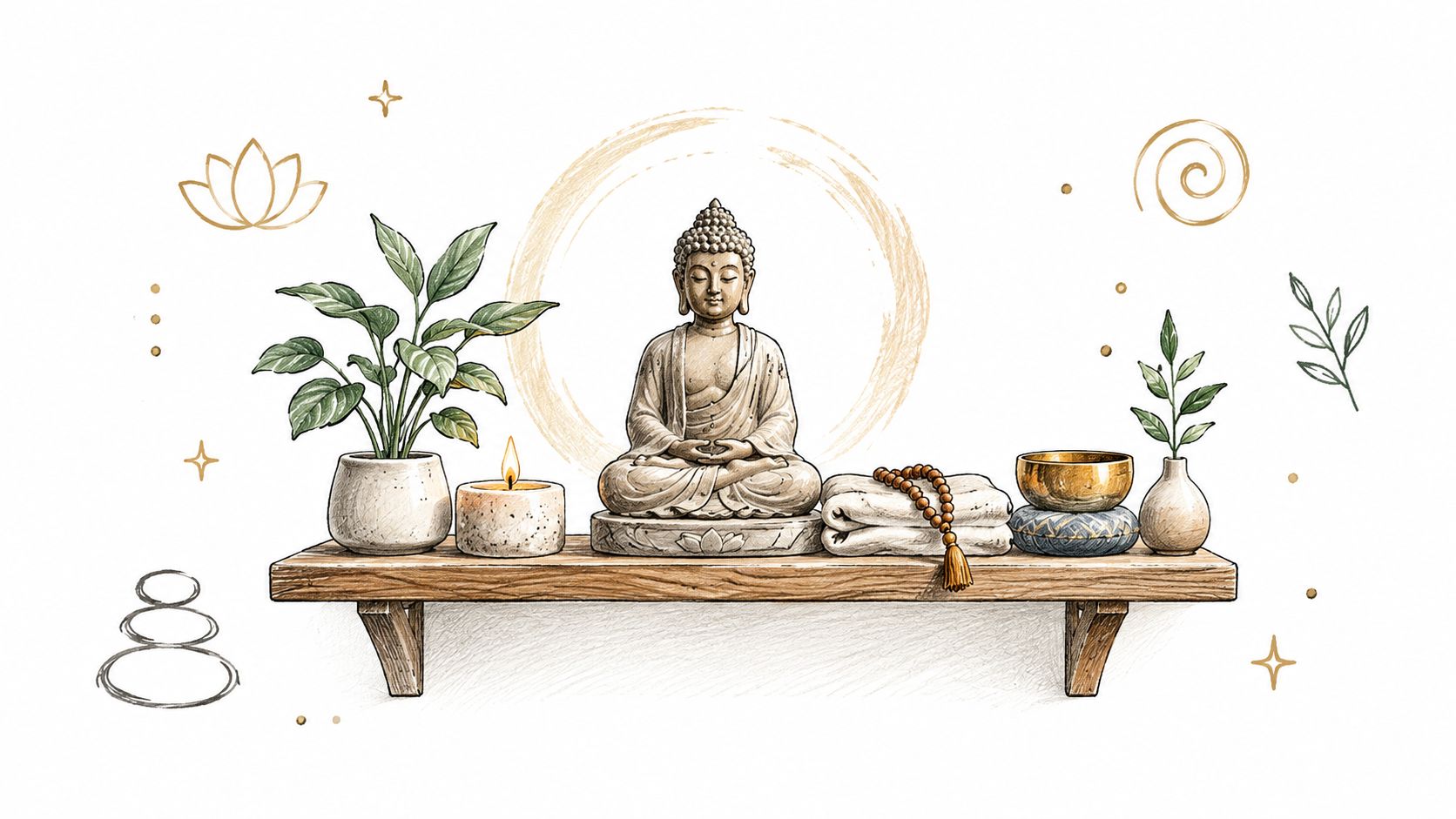
Choose meaning before appearance
A seated Buddha can provide a focus for reflecting on stillness and mindful attention. Look closely at the posture and hand gestures, and ask about their meaning rather than assuming all Buddha images communicate exactly the same teaching.
In Hindu contexts, Ganesha is associated with beginnings and the removal of obstacles, while Shiva is associated with transformation. These are religious figures, not interchangeable symbols for personal productivity. A devotional relationship calls for more contextual learning than a purely visual appreciation.
For sourcing, you might consider a specialist gallery, a community recommendation or an existing family piece. HD Asian Art is a UK-based specialist offering Buddhist and Hindu statues, Southeast Asian sculpture and Burmese lacquerware for collectors and private interiors. Its selections provide one option for readers seeking a statue or a lacquerware piece for a reflective setting, with the object's intended use considered individually.
Place objects with care
Respectful placement starts with cleanliness and attention. Customs differ, so ask within the relevant tradition if you're establishing a devotional altar rather than a general meditation corner.
- Raise the focal point: Use a stable shelf or table rather than placing a sacred image directly on the floor.
- Choose the setting: Prefer a calm position away from bathrooms, shoes and household clutter.
- Keep it manageable: Leave enough space to clean and handle objects safely.
- Consider materials: Keep flames, heat and moisture away from sculpture and lacquerware.
This practical guide to setting up a meditation altar at home can help you think through the arrangement.
These practices belong to living communities. The Office for National Statistics' analysis of Census 2021 religion data recorded 272,508 Buddhists and approximately one million Hindus in England and Wales. Treating their sacred imagery thoughtfully means recognising that continuing religious life, not merely appreciating an attractive silhouette.
Staying Consistent and Practising Safely
Learning a contemplative practice and continuing it are different things. In a representative British survey, 15% had learned mindfulness, but only 9% of the full sample were still practising, according to research on mindfulness participation in Britain. These are mindfulness figures, not mantra-specific adherence rates, but they're a useful warning against designing a routine that assumes uninterrupted enthusiasm.
Make room for lapses
On a difficult day, shorten the practice to a brief pause rather than trying to recover a missed session through extra effort. If you skip it entirely, leave the next opportunity in place. You don't need to restart your identity as a practitioner.
Review your log at the end of the starter period. Look for practical patterns: perhaps bedtime makes you sleepy, the morning is crowded, or a particular phrase feels increasingly uncomfortable.
- Timing problem: Change the cue before extending the session.
- Pressure problem: Stop counting consecutive days and record simple completion instead.
- Meaning problem: Reconsider wording that feels false, punitive or emotionally demanding.
- Comfort problem: Adjust posture, keep your eyes open or choose a non-meditative activity.
Safety comes before consistency: Continuing through worsening distress isn't evidence of commitment.
Know what the evidence doesn't promise
A mantra is a reflective habit, not a substitute for clinical assessment or treatment. A systematic review indexed by the University of York found low or insufficient evidence for mantra-meditation programmes improving psychological stress or wellbeing, and insufficient evidence that they outperform active alternatives.
That doesn't mean nobody finds repetition valuable. It means personal usefulness and demonstrated treatment effectiveness are different claims. Likewise, the NHS explanation of mindfulness describes a broader practice and its clinical context; it shouldn't be read as an endorsement of every independently chosen mantra.
The Mental Health Foundation's mindfulness guide reports that approximately 8% of people who try meditation experience adverse effects, including increased anxiety, depression or stress. That estimate concerns meditation broadly, not every form of repetition.
If practice increases anxiety, intrusive thoughts, detachment or distress, stop or modify it. Open your eyes, orient yourself to the room and choose an ordinary grounding activity if that feels helpful. Seek NHS or qualified clinical support when symptoms persist, become severe or interfere with daily life; don't use a mantra to postpone needed care.
Bringing Your Mantra Practice into Everyday Life
A workable practice brings together a phrase you understand, a realistic opportunity to repeat it and an environment that doesn't make starting unnecessarily difficult. Use the starter routine as an experiment, then review what you experienced. You're looking for something sustainable and appropriate, not a flawless performance.
The phrase also needs a relationship with your behaviour. If your chosen words concern compassion, ask how you speak when someone inconveniences you. If they concern steadiness, notice whether you can pause before reacting without pretending that anger or uncertainty has disappeared.
Let the words guide a small action
During a commute or while waiting in a queue, a shortened personal phrase can provide a discreet reminder. “Listen” might be enough before a difficult conversation. “Choose” might interrupt the moment when you're about to agree to something you don't have the capacity to do.
Keep your attention on the demands of the situation. Don't close your eyes or become absorbed in repetition while driving, cycling or crossing a road. A useful everyday reminder should support appropriate engagement, not draw you away from it.
Traditional devotional mantras need their own care. If you're learning within a religious community, follow its guidance about how and where to use the practice rather than automatically shortening a sacred formula for convenience.
Make a concrete beginning
This week, write your chosen phrase somewhere private and add a sentence explaining what it means to you. Identify the ordinary event that will remind you to practise, and prepare the chair or surface you'll use. If a physical focal point would help, choose it for a meaning you understand.
The point of mantras for life is a more deliberate relationship with attention and action. The words matter, but so does what you do after repeating them: listen, rest, set a boundary, ask for help or begin again without self-reproach.
HD Asian Art offers Buddhist and Hindu statues, Southeast Asian sculptures and Burmese lacquerware for home altars, meditation corners and reflective interiors. Visit HD Asian Art to explore pieces by figure and region, and choose a focal point whose meaning you'd like to understand and reflect on in your practice.
