



How to Identify Rare Bodhisattva Sculpture Forms
How to Identify Rare Bodhisattva Sculpture Forms
Rare bodhisattva sculpture forms are defined by a specific combination of iconographic markers: arm count, head configuration, symbolic implements, mounts, adornments, and regional stylistic conventions. Collectors and art historians use these visual codes to distinguish a Thousand-Armed Avalokiteshvara from a Manjushri or a Ksitigarbha, each carrying distinct doctrinal meaning.
The 2026 Seonunsa Ksitigarbha exhibition in Seoul, which united three state-designated Treasure statues for the first time, demonstrated how rare these comparative opportunities are. To identify rare bodhisattva sculpture forms accurately, you need a working knowledge of iconography, historical periods, and physical examination methods.
How to identify rare bodhisattva sculpture forms by iconographic features
Iconography is the primary language of Buddhist sculpture identification. Each bodhisattva carries a fixed set of visual attributes that signal identity, vow, and spiritual function. Reading these attributes correctly separates a rare form from a common one.
Arm count and head configuration are the most immediate identifiers. The Thousand-Armed Avalokiteshvara, known in Sanskrit as Sāhasrabhuja-sāhasranetra Avalokiteśvara, has 40 primary arms multiplied by 25 realms of existence to reach the symbolic total of 1,000 arms and eyes. That multiplication is doctrinal, not decorative. It signals omnipresence and boundless compassion in a single visual formula. Multiple heads, stacked vertically, indicate a bodhisattva whose awareness extends across all directions simultaneously.
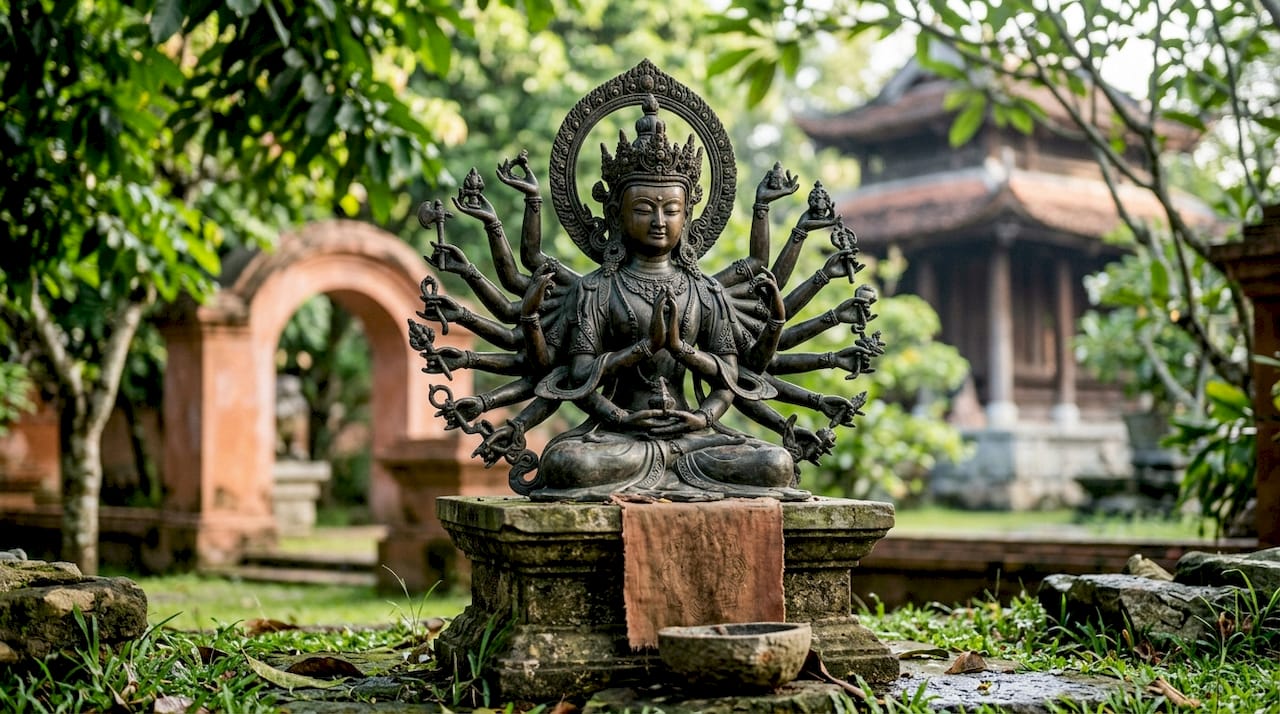
Crowns, hoods, and jewelry narrow identification further. Ksitigarbha statues wear hoods rather than ornate crowns, a feature confirmed by the Seonunsa group, where all three statues share hooded heads and bead ornaments despite differences in material and expression. Avalokiteshvara typically wears an elaborate five-pointed crown containing a small Amitabha Buddha figure. Manjushri carries a flaming sword and a lotus supporting a text. These details are not interchangeable.
Key iconographic markers to check on any bodhisattva sculpture:
- Number of arms: 2, 4, 6, 8, 18, or 40+ arms each correspond to specific forms
- Number of heads: single, triple, or eleven-headed configurations carry distinct identities
- Crown type: five-pointed crown, simple diadem, monk’s hood, or no crown
- Hand implements: sword, lotus, wish-granting jewel, water vessel, or rosary
- Facial expression: serene, wrathful, or compassionate, each tied to specific iconographic traditions
Pro Tip: Examine every hand in a multi-armed sculpture. Rare forms often carry a unique implement in just one of the secondary hands, and that single object can confirm the identification when all other features are ambiguous.
What mounts (vahana) reveal about specific bodhisattva types
Mounts, called vahana in Sanskrit, are among the most reliable tools for identifying rarer bodhisattva forms. A vahana is not a decorative choice. It encodes the bodhisattva’s spiritual domain and doctrinal lineage.
| Bodhisattva | Mount (Vahana) | Symbolic Meaning |
|---|---|---|
| Samantabhadra | Six-tusked white elephant | Universal virtue and practice |
| Manjushri | Blue lion | Wisdom cutting through ignorance |
| Kshitigarbha | Composite Dīṭhi creature | Earth-realm guardianship |
Samantabhadra’s six-tusked white elephant is one of the most distinctive mounts in Buddhist iconography. The six tusks correspond to the six perfections, or paramitas, making the mount a doctrinal statement in physical form. Manjushri’s blue lion signals the power of wisdom to subdue delusion, the lion representing strength and the blue color representing the sky-like nature of the mind. Kshitigarbha’s Dīṭhi creature is a composite animal specific to his role as protector of beings in the lower realms.
A sculpture showing a bodhisattva seated on an animal mount is almost certainly a named form rather than a generic attendant figure. Generic attendant bodhisattvas stand on lotus pedestals without mounts. When a mount appears, cross-reference it immediately against the three primary vahana types above.
Pro Tip: When a mount is damaged or missing, look for residual attachment points on the base of the sculpture. The position and size of these points often reveal the original mount’s scale and posture, which can still support identification.
How do historical periods and stylistic traits help verify rarity?
Dating a bodhisattva sculpture places it within a regional tradition and confirms whether its features are consistent with known production periods. A statue whose iconography matches one period but whose style matches another signals either a later copy or a genuinely rare transitional work.
Inscribed regnal dates on pedestals provide the most precise dating evidence available. The Kimbell seated Bodhisattva, a Kushan-era “Kapardin” statue, carries an inscription dated to Year 4 of Kanishka’s reign, placing it at 131 CE. That single inscription anchors the sculpture within a specific dynastic and artistic framework. Without it, the statue would require stylistic comparison alone, which introduces interpretive uncertainty.
Korean bodhisattva sculpture offers a clear case study in stylistic evolution across periods. The three Seonunsa Ksitigarbha statues span the late Goryeo to early Joseon periods, showing how the same iconographic type shifts in material, proportion, and expression across roughly two centuries. Goryeo-period bronzes tend toward refined, elongated features. Joseon-period works often show heavier proportions and more austere surface treatment.
| Period | Region | Key Stylistic Traits |
|---|---|---|
| Kushan (1st–3rd century CE) | Gandhara / Northwest India | Greco-Roman drapery, Kapardin topknot |
| Goryeo (918–1392 CE) | Korea | Refined bronze, gilt surfaces, serene expression |
| Joseon (1392–1897 CE) | Korea | Heavier forms, wood and lacquer, austere finish |
| Khmer (9th–15th century CE) | Cambodia | Sandstone, frontal posture, subtle smile |
Provenance and exhibition history add a further layer of verification. A sculpture that appears in a major museum catalog or a documented temple inventory carries a traceable record. The Seonunsa group’s first joint display in Seoul in 2026 created a benchmark for comparative study that did not previously exist in published form. Collectors who can link a sculpture to such records hold a significant authentication advantage. For guidance on dating methods applied to antique Buddhist statues, the HDAsianArt resource on dating antique Thai images provides a practical regional framework.
Step-by-step physical examination for authentication
Physical examination follows a fixed sequence. Skipping steps or reordering them increases the risk of misidentification. The process applies equally to bronze, stone, and wood sculptures.
- Assess the material. Identify whether the sculpture is bronze, stone, lacquer, or wood. Each material has period-specific production centers and aging characteristics.
- Examine the patina. Bronze statues develop a greenish or brownish film called patina or verdigris over time. Uniform, artificially applied patina is a red flag. Authentic aging shows uneven distribution, heavier in recessed areas.
- Read the posture. Seated, standing, or dancing postures each carry specific iconographic meanings. Posture and mudra are fundamental to Buddhist sculpture identification. A seated posture with legs in full lotus signals meditation; a standing posture with one hand raised signals protection or teaching.
- Identify the mudra. The hand gesture narrows the identification to a specific function or vow. The vitarka mudra (teaching gesture) differs from the abhaya mudra (protection gesture) by the position of the fingers.
- Check inscriptions. Look at the base, the back of the pedestal, and the interior cavity of hollow bronzes. Regnal dates, donor names, and workshop marks all contribute to dating and provenance.
- Cross-reference iconography. Match arm count, head count, crown type, and implements against established iconographic catalogs. The role of Avalokiteshvara in Buddhist art provides a useful reference point for one of the most frequently encountered bodhisattva types.
Common misidentifications to avoid:
- Confusing a multi-armed Avalokiteshvara with a Vajrayana deity. Bodhisattvas wear princely jewelry; wrathful deities wear skulls and animal skins.
- Mistaking a Ksitigarbha for a monk figure. Ksitigarbha wears a hood and carries a staff with rings, not a monk’s plain robe and bowl.
- Identifying a generic attendant as a named bodhisattva. Attendants lack the specific implements and mounts that define named forms.
For bronze authentication specifically, the HDAsianArt guide on authenticating antique bronzes covers casting methods and surface analysis in detail.
Key Takeaways
Identifying rare bodhisattva sculpture forms requires cross-referencing iconographic markers, mounts, period stylistics, and physical evidence in a fixed sequence.
| Point | Details |
|---|---|
| Iconographic markers are primary | Arm count, head count, crown type, and hand implements identify specific bodhisattva forms. |
| Mounts confirm rarer identities | Vahana such as the six-tusked elephant or blue lion narrow identification to named bodhisattvas. |
| Period style verifies authenticity | Matching stylistic traits to known regional periods confirms whether a sculpture is genuine or a later copy. |
| Inscriptions provide precise dating | Regnal dates on pedestals, as seen on the Kimbell Bodhisattva, anchor sculptures to specific historical moments. |
| Physical examination follows a sequence | Patina, posture, mudra, and inscriptions must be assessed in order to avoid common misidentifications. |
What I have learned from years of studying rare bodhisattva groups
The Seonunsa Ksitigarbha exhibition in 2026 confirmed something I had long suspected: the most instructive moments in Buddhist sculpture identification come from direct comparison, not from catalogs alone. Standing in front of three state-designated Treasure statues from the same temple, spanning the Goryeo and Joseon periods, the differences in proportion and surface treatment became immediately legible in a way that photographs never fully convey.
The single most underestimated skill in this field is reading negative space. What a bodhisattva does not carry matters as much as what it does. A figure without a mount, without a crown, and without secondary arms is almost certainly not a named rare form. Collectors who chase rarity without first building a baseline understanding of standard forms consistently overpay for attendant figures and misidentify common types.
Interdisciplinary knowledge has become non-negotiable. Epigraphers, textile historians, and metallurgists each contribute evidence that pure art historians miss. The Kimbell Bodhisattva’s precise date of 131 CE came from an inscription, not from stylistic analysis. Digital archives and high-resolution imaging have made cross-institutional comparison faster, but the interpretive work still requires direct handling and a broad scholarly network.
Rare bodhisattva statues are conventionally found enshrined in groups, which means a lone statue with unique features deserves extra scrutiny, not automatic elevation to rare status. The rarity lies in the iconographic specificity, not in the isolation.
— James, HDAsianArt.com
Rare bodhisattva sculptures at HDAsianArt
HDAsianArt specializes in antique and traditional Asian Buddhist sculptures, including rare bodhisattva statues from Cambodia, Thailand, Indonesia, Sri Lanka, and beyond. Each piece in the collection is individually researched and authenticated by experts, with detailed iconographic descriptions and provenance notes.
Collectors and art historians looking for authenticated rare forms will find bronze, stone, and wood bodhisattva sculptures with full documentation at HDAsianArt. The collection includes a Javanese Avalokiteshvara bodhisattva statue from Indonesia, representing one of the rarer regional traditions in Southeast Asian Buddhist art. Worldwide insured DHL shipping and museum-quality presentation make HDAsianArt a reliable source for serious collectors.
FAQ
What makes a bodhisattva sculpture “rare”?
A bodhisattva sculpture is rare when it depicts a specific named form with complete iconographic attributes, belongs to a documented historical period, and has a traceable provenance. Sculptures showing unusual arm configurations, regional vahana, or inscribed dates are particularly significant.
How do I distinguish Avalokiteshvara from other bodhisattvas?
Avalokiteshvara carries a small Amitabha Buddha figure in the crown and often holds a lotus or water vessel. The Thousand-Armed form has 40 primary arms, each with an eye on the palm, conceptually multiplied to 1,000.
Why do Ksitigarbha statues look different from other bodhisattvas?
Ksitigarbha wears a monk’s hood rather than an ornate crown and carries a staff with rings. The Seonunsa group shows that even within this single type, material and expression vary significantly across the Goryeo and Joseon periods.
Can patina alone authenticate a bronze bodhisattva?
Patina is one indicator, not a definitive proof. Authentic aging shows uneven verdigris concentrated in recessed areas. Patina must be assessed alongside casting method, iconographic accuracy, and any available inscriptions for a reliable authentication.
What is the best starting point for identifying an unknown bodhisattva sculpture?
Start with arm count and crown type. These two features eliminate the majority of misidentifications immediately. Then check for a mount, identify any hand implements, and cross-reference the combination against established iconographic standards for the suspected regional tradition.
