



Hanuman Indian God: Story, Symbols and Worship Explained
Hanuman Indian God: Story, Symbols and Worship Explained
Why does one Hanuman statue carry a mountain on its palm, another raise a mace, and a third kneel with empty, folded hands? If Hanuman were only the "monkey god" of popular shorthand, those differences would be decoration. They're the opposite. Each pose is an argument about who he is.
Read three images side by side and you're reading three claims. The epic servant who crosses an ocean for someone else's wife. The warrior whose burning tail lights up a city. The household protector whose small bronze sits in a kitchen alcove and receives vermilion on a Tuesday. Same figure, different work.
Getting those claims right matters whether you're writing a museum label, choosing a statue for a shrine, or answering a child who wants to know why a god has a tail. The Hanuman Indian god is best understood in three places at once: scripture, sculpture and living worship.
Table of Contents
- Who Hanuman Is in Hindu Tradition
- Is Hanuman a God, Hero or Devotee?
- The Ramayana Episodes That Define Hanuman
- Reading Hanuman's Attributes in Sculpture
- How Hanuman Is Worshipped in Homes and Temples
- Identifying a Hanuman Statue by Region, Date and Size
- Common Questions About Hanuman, Monkeys and Many Gods
Who Hanuman Is in Hindu Tradition
Hanuman is a major Hindu deity, honoured for devotion, strength, courage and selfless service, and remembered above all as the devoted servant of Rama in the Ramayana. Hindus approach him in several registers at once: a divine figure who can be worshipped in his own right, the hero of an epic, and the model of a life spent on someone else's good. Those registers overlap rather than compete, which is why every short definition feels slightly incomplete.
The British Museum's record for Hanuman supplies the specifics: a Hindu male deity, general of the monkey king Sugriva, who aids Rama in rescuing Sita from the demon Ravana in Lanka, and who is sometimes regarded as the son of Vayu, the god of wind. Role, lineage and relationships in a single entry. That's a far more useful starting point than a description of his face.
| Attribute | Traditional account | Source |
|---|---|---|
| Army | General of the monkey king Sugriva | British Museum |
| Central deed | Aids Rama in rescuing Sita from Ravana in Lanka | British Museum |
| Parentage | Sometimes regarded as the son of Vayu, the god of wind | British Museum |
| Core qualities | Devotion, strength, courage and selfless service | Hindu devotional tradition |
| Form in sculpture | Monkey-faced or human figure with tail, often holding a mace or club | British Museum bronzes from Maharashtra |
Two things are worth flagging before the detail. First, the Ramayana isn't one book. It exists in Sanskrit, Tamil, Bengali, Awadhi and dozens of regional retellings, and they differ on episodes and emphasis, though not on Hanuman's core role. Second, the qualities in that table are devotional language rather than neutral description. Devotees use them the way you'd describe a person you trust completely.
Monkey god is the shorthand nearly everyone meets first, and it's thin. It describes a form and says nothing about function: who he serves, what he protects, why a household keeps his image near a door. Hold the table as a checklist instead. Each row turns up in sculpture as a recognisable feature, and recognising that feature is most of what identifying a Hanuman image involves.
Is Hanuman a God, Hero or Devotee?
The phrase "monkey god" is where most explanations of Hanuman stop, and it's exactly where understanding tends to stall. The Hounslow project report on Hinduism in religious education found that teachers and families commonly identified "Hanuman is a monkey god" among the misconceptions they meet, alongside questions about animal worship, the Ramayana, Hindu symbols and the existence of many deities. The same report found that 97% of respondents considered learning about Hinduism important, while 93% said Hinduism was not offered at GCSE level.
The distance between those two figures is the whole problem. Demand is high and structured teaching is scarce, so the labels people reach for are the ones they absorbed casually. "Monkey god" survives because nobody has replaced it with anything more accurate.
Hanuman is better understood as several figures held inside one image. A vanara, a forest being of the epic, with a monkey's face, a tail and a powerful human body. Rama's servant and companion, whose loyalty carries the emotional weight of the Ramayana. A warrior whose strength turns the war in Lanka. A protector whom householders invoke against fear and misfortune. And an independent folk deity with his own shrines, his own days and his own devotees.
| Understanding | Emphasis | Where it is most visible |
|---|---|---|
| Vanara, a forest being | His animal-like nature within the epic | Ramayana retellings |
| Rama's servant and companion | Loyalty and selfless service | Vaishnava devotion |
| Warrior | Courage and battle prowess | Lanka war scenes |
| Protector | Guarding devotees and households | Home shrines and temple images |
| Independent folk deity | Popular worship apart from Rama | Village and regional shrines |
Museum interpretation tends to hold two of these together. The V&A describes Hanuman as a model of humility and devotion to Rama, and in the same breath notes his independent popular worship and his association with physical strength. That's the honest position: a devotee who became a deity in his own right, with neither half cancelling the other.
For captions and listings: name the relationship the image shows. "Hanuman, devotee of Rama" and "Hanuman, remover of obstacles" point a reader at different figures, even when the statue is the same size, material and date.
Traditions differ on whether "god", "demigod", "hero" or "devotee" is the right word, and in practice the words overlap. A devotee can be divine. A hero can be worshipped. Choose the label that fits the object in front of you, and leave room for the others rather than forcing a single answer.
The Ramayana Episodes That Define Hanuman
A handful of episodes do most of the work in Hanuman's imagery. Knowing them in order makes unfamiliar sculpture legible, because artists choose a moment rather than a man.
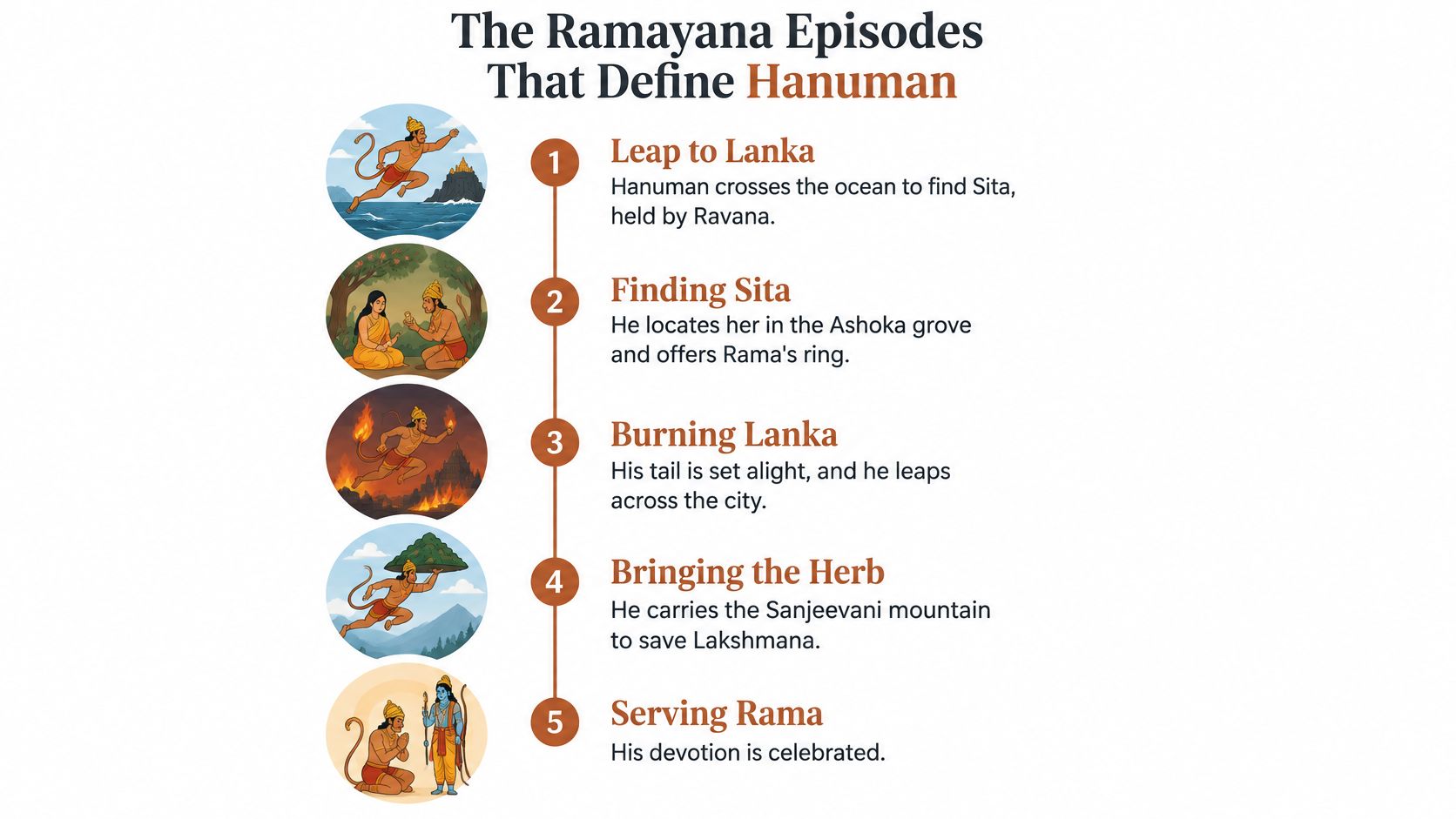
The leap to Lanka. Sita, Rama's wife, is held captive by Ravana in Lanka, across the sea. Hanuman crosses the ocean in a single bound, a feat no one else in the vanara army can manage. In images the leap shows a figure suspended over water, sometimes with a city or a mountain beneath him.
Finding Sita in the Ashoka grove. He locates her in Ravana's garden, comforts her and gives her Rama's ring as proof that he has come from her husband. The ring is tiny and often lost, so a figure of Hanuman kneeling with one hand extended toward a seated woman usually carries this scene.
Burning Lanka. Captured, he allows his tail to be set alight, then uses the fire to damage the city before escaping. Look for a bound figure, a flaming tail and rooftops. Artists enjoy this episode because it lets them paint movement and flame into a single frame.
The healing mountain. During the war Lakshmana is wounded and needs a herb Hanuman can't identify, so he carries an entire mountain bearing the herbs back to the battlefield. This is the most recognisable Hanuman attribute in any collection, and the easiest to misread.
Service after victory. The war ends, Rama is restored, and Hanuman returns to serving him. No throne, no reward. Devotion is the point of the story rather than its epilogue.
Why the props carry the meaning
Regional retellings add their own episodes. Bengali, Tamil and Awadhi versions expand the epic in different directions, and some include adventures, such as a rescue from the underworld, that Valmiki's Sanskrit text doesn't contain. That's how living epics work. A statue isn't wrong because it shows a scene your edition lacks.
A mountain overhead means the herb episode, not a landscape. Fire means Lanka. A ring means the grove. Those three signs resolve most ambiguous Hanuman images before you look at style, date or region.
When an unfamiliar figure arrives, look for the mountain first, then fire, then the ring. The prop tells you which scene the artist chose, and the scene tells you which aspect of Hanuman the object was made to keep in view.
Reading Hanuman's Attributes in Sculpture
In Hindu sculpture, Hanuman's attributes do a precise job: they encode a narrative function rather than merely identifying a figure with a monkey's face. The British Museum's late-19th-century painting from Tamil Nadu shows how much one image can carry. Hanuman stands in the dynamic pratyalidha stance with the herb-bearing mountain raised overhead, the opposite arm lifted, the expression fierce, and armour, jewellery and a bell-decorated tail completing the figure. Martial readiness and restorative power in a single frame, which is exactly the combination the Lanka episode supplies.
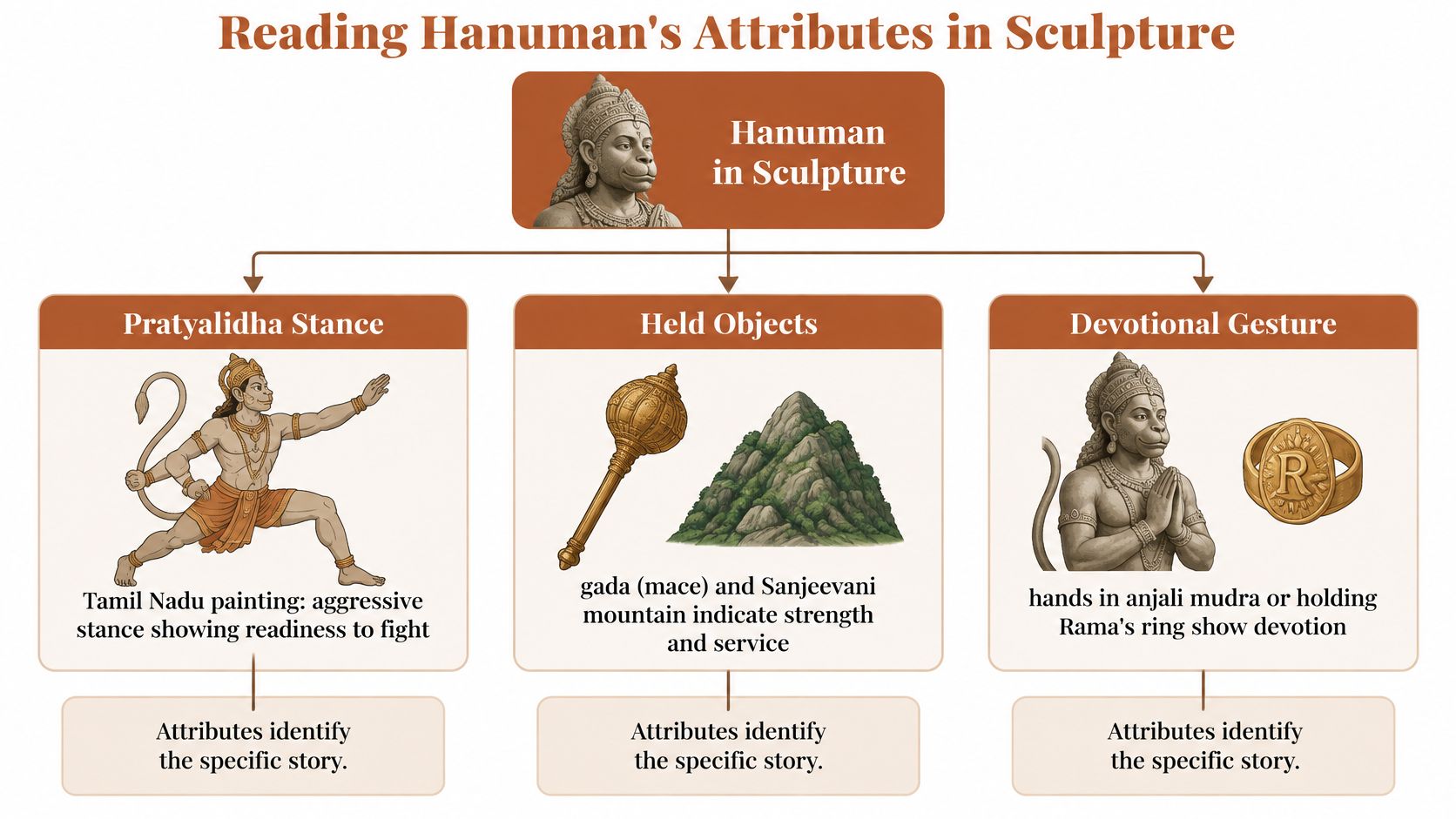
| Attribute or pose | What it signifies | Where it is seen |
|---|---|---|
| Mountain carried overhead | Healing and restorative power | Lanka war episode with the healing herbs |
| Mace or club | Strength and readiness for battle | Bronze holding a club, Maharashtra, British Museum |
| Tail raised or passing over the head | Martial energy and protection | Bronze with tail over the head, Maharashtra, British Museum |
| Folded hands (anjali) | Humility and devotion | Devotional standing figures |
| Opened chest revealing Rama and Sita | Total devotion to Rama | Devotional images |
| Pratyalidha stance | Dynamic, ready action | Narrative paintings and sculptures |
Read the table as a set of variables, not a tick-list. A mace and a mountain say different things about the same strength: the mace is force held ready, the mountain is force spent on someone else's survival. Folded hands say something else again, placing the figure in relation to a god rather than in the middle of a battle.
Tail position is the detail that separates near-identical pieces. Within one museum collection, two Maharashtra bronzes of similar size and date diverge precisely there, one with its tail passing over its head and one holding a club. Carving conventions repeat inside a workshop, so small variations become the fastest way to tell two objects apart.
A reading order that works
- Posture first. Standing, kneeling, striding or leaping tells you the register before any prop does.
- Attributes second. Mountain, club, ring, folded hands or opened chest narrows the meaning to a scene or an aspect.
- Region and style third. The Tamil Nadu convention isn't the Maharashtrian one, and mixing them produces descriptions that read as guesswork.
For a closer look at one of the most expressive variants, our guide to the symbolism of Hanuman with arms spread wide traces how an open, commanding gesture shifts the reading of a whole figure.
Work through that sequence before writing a caption or a product description. It takes two minutes and stops the most common error in Hanuman listings, which is describing an episode as if it were a mood.
How Hanuman Is Worshipped in Homes and Temples
Living worship is where Hanuman's images stop being objects and become presences in a household. Community accounts recorded by National Museums Scotland describe worship at home on Tuesdays and Saturdays, fasting, and the use of red and orange as devotional colours. Those details matter to anyone handling a statue, because they explain the staining, the cloth offerings and the wear that devotional use leaves behind.
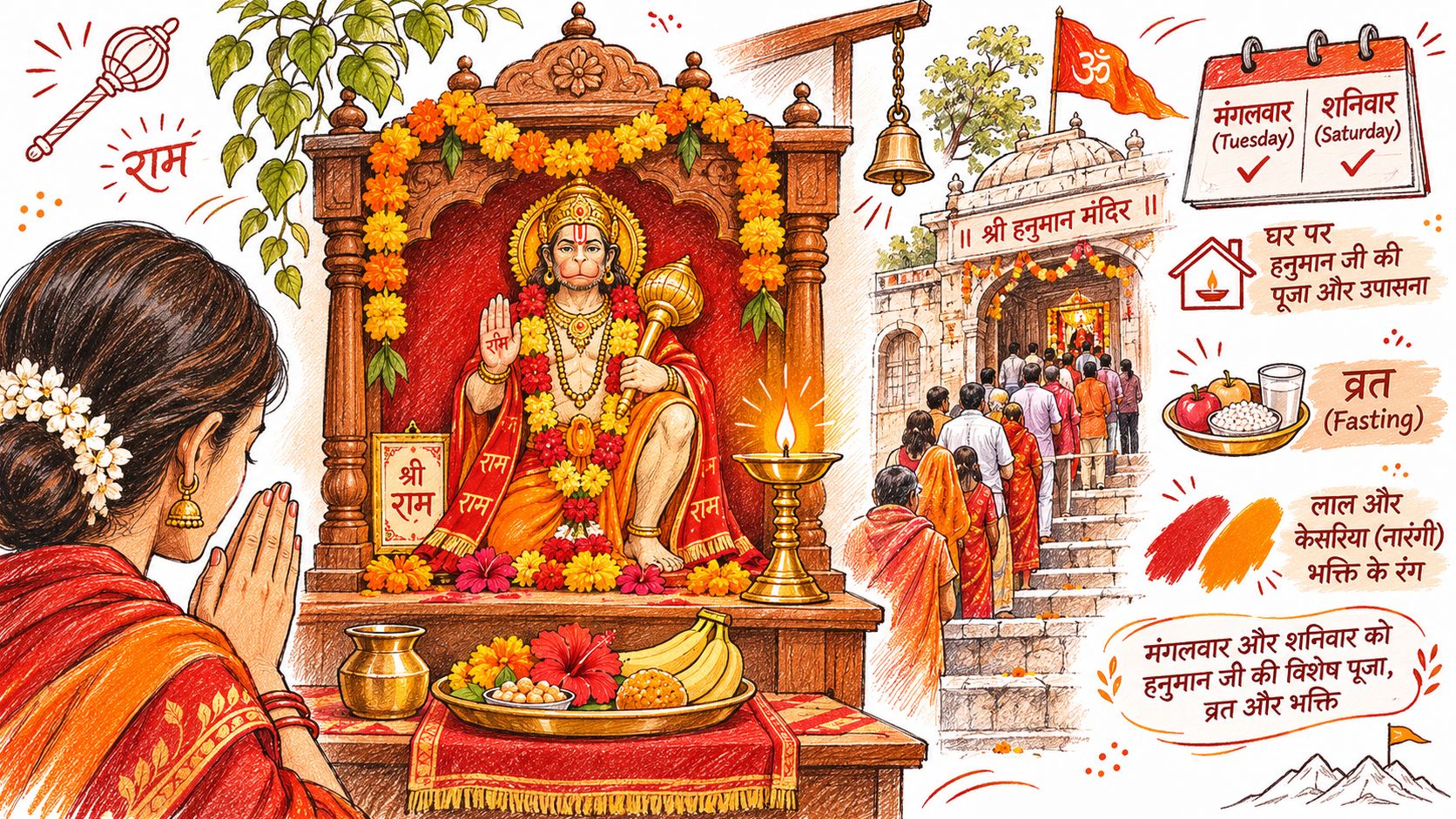
The Hanuman Chalisa is the practice devotees mention first: a forty-verse hymn in Awadhi attributed to Tulsidas, recited in full or in part, especially on those two days and in moments of fear. Knowing the text exists helps you read an object. A statue with pigment traces at the mouth or hands has usually been in contact with recitation and offering rather than sitting on a shelf.
Vermilion and flowers. Sindoor is offered and applied, and the orange colour of many Hanuman images comes partly from that habit. A worshipped bronze may hold pigment deep in the crevices of the carving, and cleaning it away destroys the clearest evidence of use the object has.
Temples and processions. Hanuman shrines often sit within or beside a larger temple, where he is honoured near the main shrine rather than at its centre, and processions carry him through public space. A Thanjavur-style painting in the British Museum shows a banner bearing Hanuman accompanying a chariot centred on Rama, and the museum notes that comparable large paintings were displayed in private puja rooms and religious institutions. One image, two settings: household shrine and street.
Why colour and wear carry evidence
The audience for these practices in Britain isn't small. In the 2021 Census for England and Wales, 1,032,775 usual residents identified their religion as Hindu, or 1.7% of the population, up from 818,000 in 2011, with London recording the highest regional concentration at 5.1%. Hanuman imagery in the UK connects to a substantial living community, not to an antiquarian curiosity.
Householders usually keep an image in a clean, respectful position, often above floor level and facing into the room, and treat it as an object of worship rather than decor. Placement is part of the object's meaning. Move it into a hallway display case and you change what it is.
If you want the short form of the practice, our guide to the mantra of Hanuman sets out Om Hanumate Namah and how recitation with a count is used.
A rule that prevents mistakes: a consecrated, worshipped image isn't interchangeable with a decorative one of the same size. Ask what a piece has been used for before you treat it as a display object.
How a statue has been used shapes what it means, and that has direct consequences for how you describe it.
Identifying a Hanuman Statue by Region, Date and Size
How can two statues of Hanuman differ so much while sharing the same name? Region, period, material, dimensions, posture and collection history all help answer that question. A palm-sized bronze and a temple-scale stone figure may both depict Hanuman, yet their details and uses can be very different.
The British Museum's bronze 1940,0716.320 is from Maharashtra and dated to the 18th century. It is bronze, measures 7.90 cm high, 3.80 cm wide and 3.50 cm deep, and was acquired in 1940. Its tail passes over the head. A second bronze, 1940,0716.317, is from the same region and century, was acquired in the same year, and is described as holding a club.
| Feature | Bronze with tail over head | Bronze with club |
|---|---|---|
| Museum number | 1940,0716.320 | 1940,0716.317 |
| Region and date | Maharashtra, 18th century | Maharashtra, 18th century |
| Height | 7.90 cm | 7.20 cm |
| Width | 3.80 cm | 5.20 cm |
| Depth | 3.50 cm | 3.20 cm |
| Distinguishing attribute | Tail passes over the head | Explicitly holds a club |
| Acquired | 1940 | 1940 |
The measurements show why height alone can mislead. The taller bronze is narrower by 1.40 cm, while the shorter one is wider across the arms. In a display case, width and depth may matter as much as height. Recording all three dimensions makes it easier to judge fit, compare objects, and notice when a listing has rounded its measurements.
Posture and attributes also shape meaning. A figure with a club reads readily as a warrior or protector; a different gesture or held object may place Hanuman in a specific episode or devotional role. When an attachment has been lost, a standing bronze can look like a generic devotional figure even if it originally showed a particular moment. A tray or another held object might have clarified the scene, so a description should distinguish what remains from what is uncertain.
A checklist for any Hanuman object
- Medium: bronze, stone, wood or painting; note pigment or gilding separately.
- Region: record the stated place, such as Maharashtra, Tamil Nadu or Sri Lanka, rather than assuming all conventions are the same.
- Date: give the century and, when known, the period within it.
- Posture: describe whether Hanuman is standing, kneeling, striding or leaping, and state the tail position in words.
- Attributes: say whether each is present, absent or uncertain.
- Dimensions: record height, width and depth together, not height alone.
- Ritual context: describe visible signs of worship, consecration or pigment as evidence, not as a firm conclusion.
- Provenance: include acquisition date, prior collection or auction history when known.
Price can provide context, but it does not identify a statue's religious role or artistic quality. A Hanuman devotional artwork offered at a London auction in 2023 sold for £250 including the buyer's premium. That is one point of reference for devotional and folk art, not a direct measure of museum objects.
Two cautions help keep a description accurate. Age and material alone do not establish whether an object was worshipped: an old bronze is not automatically a ritual image, and a modern statue can be consecrated. Where an attribute is unclear, record the uncertainty. “Holding a club, possibly a mace” is more informative than presenting a guess as certain.
Common Questions About Hanuman, Monkeys and Many Gods
Why is Hanuman shown with a monkey's face, and what does that form tell us about his place in Hindu tradition? Three questions help distinguish the epic figure, the deity in worship and the many ways Hindus understand the divine.
Is Hanuman a monkey god? In the epic, Hanuman is a vanara, a forest being shown with a monkey's face, a tail and a powerful body. His animal form is one part of his identity; his devotion to Rama is central to how the tradition remembers him. Calling him a “monkey god” describes his appearance, but leaves out his roles as devoted servant, warrior and protector.
Do Hindus worship animals? Hanuman is worshipped as a deity through statues, prayers and temple rites. That is distinct from worshipping monkeys as animals. Monkeys near some Hanuman temples may be fed as an act of service. The distinction helps when reading an image: a Hanuman statue represents a deity, while the monkey form is part of his story and symbolism.
Why are there so many Hindu deities? Hindu traditions include many forms of the divine, and devotees may be drawn to a form through personal devotion, family tradition or region. Many understand these forms as expressions of one ultimate reality. A household may give one deity a central place while respecting others. Read more about whether Hindus believe in one god.
The short answers
Hanuman is a vanara revered for his devotion to Rama, and his image carries meanings beyond his animal form. Worship is directed to Hanuman as a deity, not generally to monkeys. The many Hindu deities reflect varied forms and paths of devotion.
Hanuman statues are one of the Hindu deity groups HD Asian Art sells. Each listing states whether a piece is antique, vintage or modern. A statue's posture and attributes can help distinguish Hanuman as servant, warrior or protector, so look closely at the figure rather than relying on the monkey form alone. Visit HD Asian Art to explore Hanuman statues and the wider Hindu sculpture collection.
