



Ganesha Statues: Symbolism, Styles & How to Choose
Ganesha Statues: Symbolism, Styles & How to Choose
Most people who buy a Ganesha statue pick one based on how it looks and call it a day. That approach works fine if you want a decorative ornament, but it misses everything that makes Ganesha iconography genuinely remarkable. The position of the trunk, the objects held in each hand, the material the piece is carved from, and the regional artistic tradition behind it are not cosmetic details.
They are a visual language developed over more than fifteen centuries, and once you learn to read it, every statue you look at tells you something specific. This guide covers that language from the ground up, then helps you make a grounded purchasing decision.
Table of Contents
Quick Takeaways
|
Key Insight |
Explanation |
|---|---|
|
Trunk direction carries specific meaning |
A trunk curving to the left is considered ideal for most households, representing accessibility and everyday blessings. A right-curving trunk is associated with intense spiritual energy and demands stricter ritual observance. |
|
The broken tusk is intentional, not a flaw |
Known as the Ekdanta form, the single broken tusk symbolises sacrifice in pursuit of knowledge. Ganesha broke his own tusk to write the Mahabharata. A statue missing a tusk by accident and one that depicts the Ekdanta iconography are two very different things. |
|
Regional style changes more than aesthetics |
A Javanese Ganesha from the Majapahit period carries Tantric Shaiva symbolism, including a skull motif on the crown, that differs fundamentally from a South Indian Pallava-style piece. Knowing the tradition behind the piece deepens its meaning for collectors. |
|
Bronze is the collector's material for a reason |
Bronze statues made using the lost-wax method can last centuries, develop a beautiful patina over time, and allow for the fine surface detail that iconographic precision requires. Mass-produced resin pieces cannot replicate this. |
|
The modak (sweet) is not decorative filler |
The bowl of sweets held by Ganesha represents the rewards of devotion and the fulfilment of righteous desires. It is one of his most theologically loaded attributes and should be clearly articulated in any quality statue. |
|
Size matters for intended use |
A small bronze Ganesha works well for a personal altar or meditation table. A large stone or bronze piece commands a dedicated garden, entrance, or temple space. Buying the wrong scale is the single most common buyer mistake. |
|
Seated versus dancing versus standing postures signal different energies |
Seated Ganesha conveys stability and meditation. Dancing Ganesha (Nritya Ganapati) expresses joy and creative energy. Standing postures are often associated with protection and readiness to act. Choose the posture that matches your intention. |
Who Is Ganesha and Why Does His Iconography Matter?
Ganesha is the son of Lord Shiva and Parvati, and he occupies a singular position in the Hindu pantheon as the remover of obstacles and the god of new beginnings, wisdom, and prosperity. He is almost always invoked first, before any other deity, at the start of rituals, journeys, or ventures. That primacy is not incidental. It reflects a theological understanding that no endeavour can succeed without first clearing the path, and Ganesha is the one who does the clearing.
What makes him especially interesting from an art collector's perspective is how richly his iconography encodes that theology. Hindu deity sculptures function as visual teaching systems. Every detail, from the direction of the trunk to the objects held in each hand to the position of the vehicle (the rat or mouse), is an intentional expression of divine attributes meant to guide meditation and devotion. A badly cast piece with soft features and undefined attributes is not just aesthetically inferior; it is iconographically incomplete.
For spiritual practitioners, that completeness matters for daily practice. For collectors and antiquities enthusiasts, it is the difference between owning a decorative object and owning a piece that holds genuine cultural and religious meaning. The following sections break down exactly what you should be looking at.
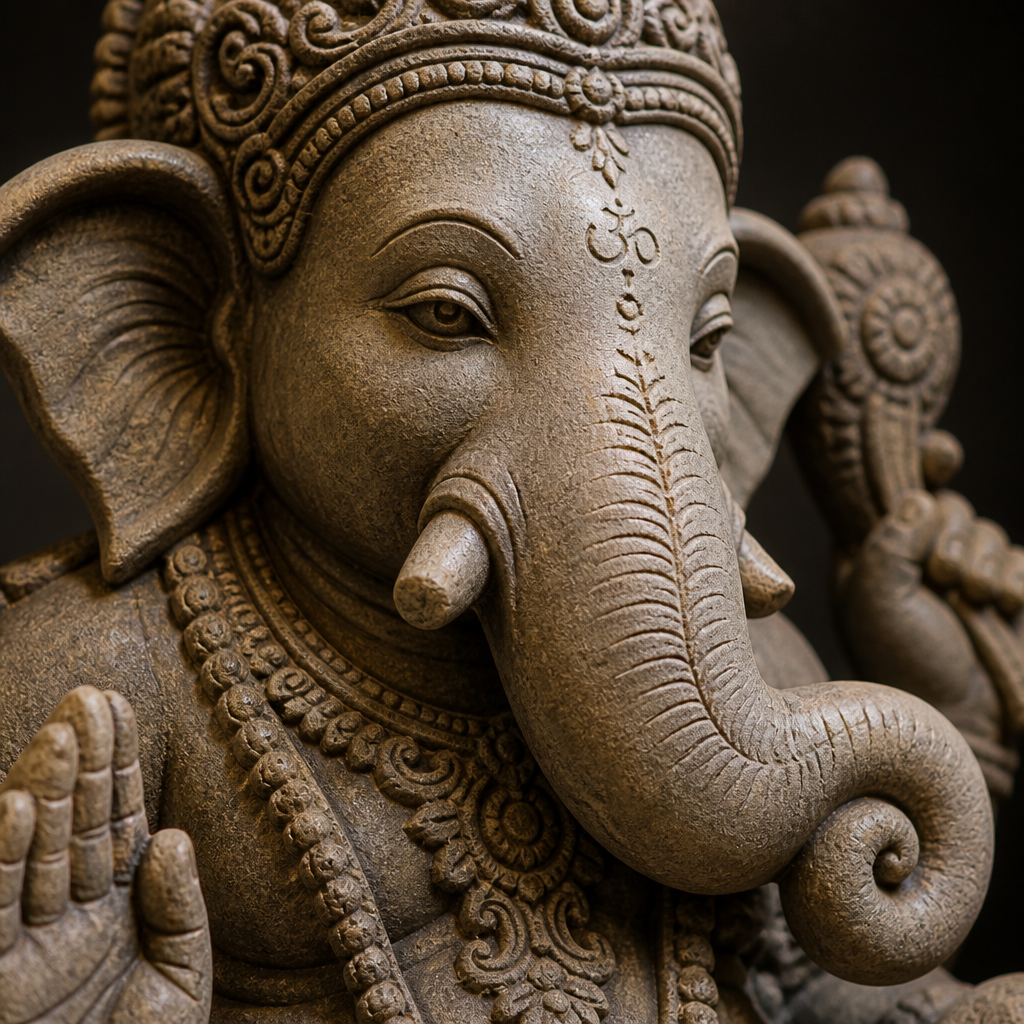
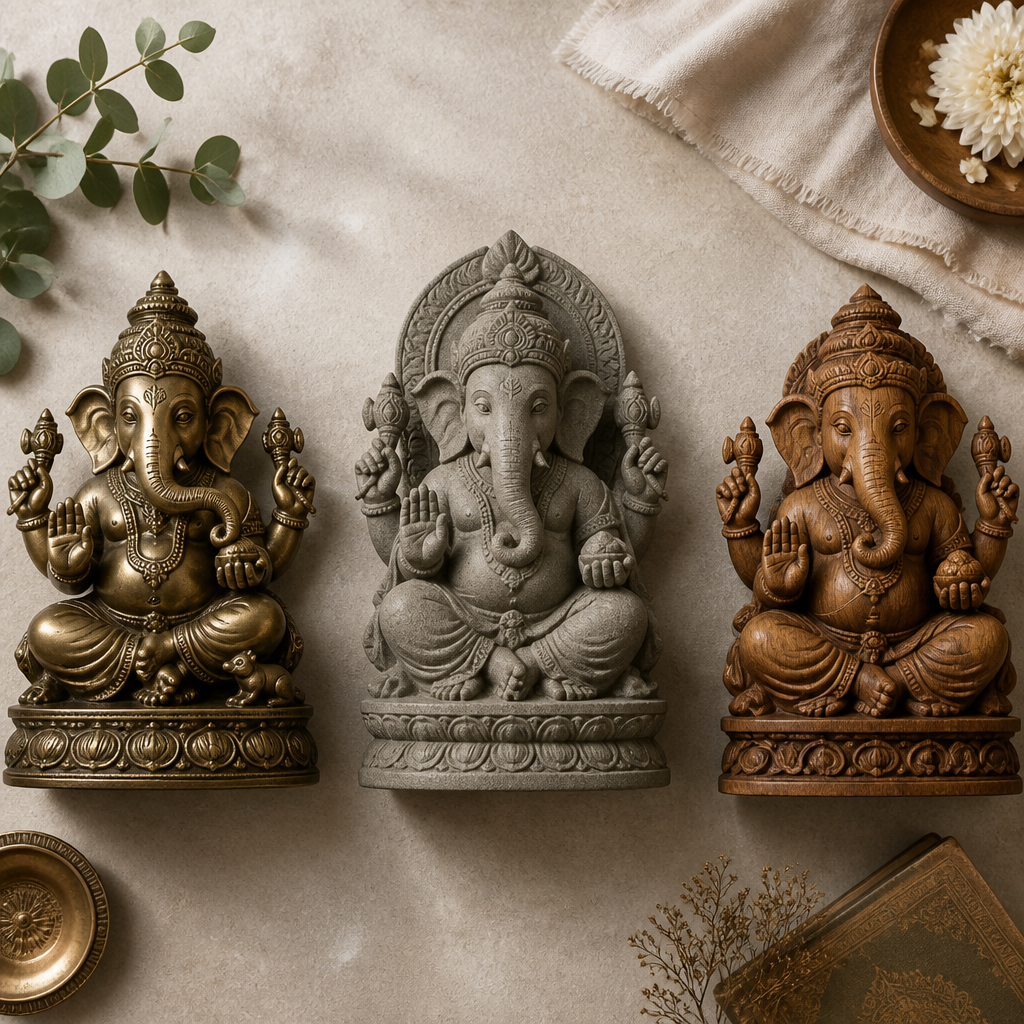
Core Symbolism: Reading Every Feature of a Ganesha Statue
The visual complexity of a Ganesha statue is one of the reasons collectors return to this subject again and again. There is always more to notice. The attributes described below appear across most traditional representations, though their exact configuration varies by regional school and historical period.
The Elephant Head
Ganesha's elephant head is the result of a well-known mythological event in which Lord Shiva, mistaking the young Ganesha for an intruder, beheaded him, and then restored him by replacing his head with that of an elephant. The head itself carries layered symbolism: the large ears represent openness to truth and the ability to listen carefully before acting; the small eyes denote concentration and attention to detail; the trunk, as discussed below, is perhaps the most symbolically rich element in the entire figure.
Trunk Direction: Left, Right, and Raised
The direction of Ganesha's trunk is the first thing any serious buyer should check. A trunk curving to the left is considered the most auspicious choice for home altars and everyday spaces. It is accessible, associated with the lunar, cooling energy of the left side, and does not require strict ritual maintenance. A trunk curving to the right faces the direction of the sun, carries more intense energy, and is traditionally associated with strength, fierce protection, and discipline. Pieces with a right-curving trunk are sometimes considered more demanding in their observance requirements.
A trunk raised upward symbolises blessings, prosperity, and positive energy flow. This form is striking in a statue and works beautifully in a home altar or meditation space. In quality carved pieces, the trunk will also form the outline of the sacred syllable Om when viewed from the correct angle, a detail that distinguishes a carefully executed sculpture from a generic reproduction.
The Broken Tusk (Ekdanta)
One of the most theologically significant features of any Ganesha statue is the broken tusk. According to the tradition associated with the composition of the Mahabharata, Ganesha broke off his own tusk to use as a writing instrument when his pen broke, rather than interrupt the dictation of the sage Vyasa. The broken tusk is therefore a symbol of sacrifice in the service of knowledge, and of the willingness to let go of something precious in pursuit of a higher purpose.
In traditional iconography, Ganesha holds the broken tusk in one hand, sometimes using it as a writing tool or a weapon. It is also called the Ekdanta form, meaning "one-tusked." A statue that depicts this clearly, with one full tusk and one broken one held deliberately in a hand, is representing this iconography intentionally. A statue with a tusk that is merely chipped or damaged in transit is a different matter entirely, and any reputable seller should be transparent about this distinction.
Attributes Held in the Hands
Ganesha typically appears with four arms, and in more elaborate forms, eight. The objects he holds vary across traditions but commonly include:
-
Modak (sweets): The bowl of sweet dumplings represents the rewards of devotion, abundance, and the fulfilment of righteous desires. It is one of Ganesha's most beloved attributes and appears in nearly every traditional representation.
-
Axe (parashu): The axe symbolises the cutting of attachments and the removal of obstacles on the spiritual path. It is a reminder that progress requires letting go of ego and desire.
-
Noose (pasha): The noose captures obstacles and binds difficulties, giving Ganesha the power to contain what threatens the devotee's path.
-
Lotus: The lotus represents purity, enlightenment, and the transcendence of material concerns.
-
Prayer beads: Associated with meditation, devotion, and the counting of sacred repetitions.
In some depictions, Ganesha raises one hand in the abhayamudra, a gesture of the palm facing outward that dispels fear and offers protection. This gesture, when present, is one of the most immediately recognisable signs of a statue crafted according to traditional iconographic principles.
The Vehicle: The Rat or Mouse
Ganesha's vehicle, the small rat or mouse that accompanies him, is not merely a quirky detail. The rat represents all-pervasiveness, the ability to move unseen through every corner of existence. Ganesha's control over the rat is a symbol of a spiritual pursuit to attain self-realisation and grace, the idea that even the most cunning and persistent of forces can be brought under wisdom's command. In high-quality statues, the rat will often appear at Ganesha's feet or alongside him, sometimes looking up at the deity with devoted attention. Its presence and condition are worth examining closely.
Hindu deity iconography functions as a visual teaching system where every detail of a statue contributes to the overall spiritual message. Understanding these symbols helps you select pieces with deeper intention, whether for personal practice or as meaningful additions to your collection.
Regional Styles: How Southeast Asia Transformed Ganesha
One of the most compelling aspects of collecting Hindu deity sculptures is witnessing how the same deity was reimagined across radically different artistic traditions. The Ganesha you find in a Tamil Nadu temple carving and the Ganesha produced during the Majapahit period in Java share the same fundamental iconographic programme, but they look remarkably different and carry different cultural textures.
South Indian Traditions
South Indian Ganesha sculptures, particularly from Tamil Nadu and Karnataka, tend toward detailed surface treatment, multiple arms with precisely articulated attributes, and elaborate crowns. The bronze tradition here, using the lost-wax casting method, produced some of the finest deity sculptures in the world. These pieces reward close examination: the mudras are crisp, the jewelry is intricate, and the facial expression typically balances majesty with gentleness. For collectors interested in classical Hindu iconography at its most technically accomplished, South Indian bronze is the benchmark.
Javanese and Indonesian Interpretations
The Javanese interpretation of Ganesha, particularly from the Central and East Javanese periods associated with Majapahit and Shaiva temple culture, is distinctive enough to constitute its own collecting category. Javanese Ganesha statues typically feature a compact, pot-bellied body with inward-turned soles, an elongated trunk curling to the left, and a tall tiered crown that often incorporates a skull motif reflecting Tantric Shaiva influence. The facial expression tends toward interiority and calm rather than the more dynamically expressive poses of some Indian traditions. These pieces appeal strongly to collectors of Southeast Asian art who are drawn to the synthesis of imported Indian religious forms with local Javanese courtly aesthetics.
Khmer and Thai Ganesha
In the Khmer tradition of Cambodia and in Thai Buddhist-Hindu art, Ganesha appears in forms shaped by local royal patronage and the blending of Hindu and Buddhist religious culture. Thai Ganesha statues often have a more slender, elegant proportioning than their Indian counterparts, with smooth surface treatment and a sense of graceful calm. Khmer pieces, where they survive, are among the most prized in the Southeast Asian art market. For collectors at HD Asian Art, these regional traditions represent an opportunity to build a collection that demonstrates how a single deity's iconography travels and transforms across cultural borders.
Materials Compared: Bronze, Stone, and Wood
The material of a Ganesha statue does more than determine its appearance. It affects durability, the level of iconographic detail achievable, where the piece can be placed, and what it communicates to anyone who looks at it carefully. The table below compares the three primary materials across the criteria that matter most to collectors and practitioners.
|
Material |
Best For |
Key Considerations |
|---|---|---|
|
Bronze (lost-wax cast) |
Collectors, serious practitioners, indoor altars, gift-giving |
Allows the finest detail in mudras, attributes, and surface decoration. Develops a rich patina over time. South Indian bronze is the most technically demanding tradition. Requires a soft cloth for cleaning. Lasts centuries. |
|
Stone (granite, sandstone, marble) |
Garden spaces, outdoor altars, meditation gardens, large statement pieces |
Conveys permanence and grounding energy. Mistakes in carving cannot be corrected, which means authentic handcrafted stone pieces demonstrate real skill. Chisel marks and surface finish reveal whether a piece was carved by hand. Ideal for larger formats. |
|
Wood (rosewood, teak, hardwoods) |
Interior spaces, home altars with a warm aesthetic, smaller personal shrines |
Conveys warmth and organic beauty. Look for dense hardwoods like rosewood or teak. Check the polish quality and proportional balance. May require occasional conditioning. Not suitable for outdoor or high-humidity environments long-term. |
A common mistake among first-time buyers is choosing material based on price alone. A cheap resin reproduction and a hand-carved stone Ganesha cost different amounts for very specific reasons. The carving marks on a genuine stone piece, the weight and surface variation of a proper bronze, and the grain of real hardwood are all physically present in the object. They are what make the piece worth handing down.
Pro tip: When evaluating a bronze Ganesha, check the back of the piece as carefully as the front. Lost-wax bronzes will show fine surface detail and slight organic variation on all surfaces. A hollow, smooth-backed piece with uniform surface texture is almost certainly a modern casting from a mechanical mould, not a handcrafted work.
How to Choose the Right Ganesha Statue for Your Home
The right Ganesha statue depends on three interlocking factors: your primary purpose (daily devotional practice, art collecting, or home decoration), the space available, and the iconographic features that speak to your specific intentions. Getting clear on purpose first prevents the most common buying errors.
For Daily Devotional Practice
If you are establishing an active altar for daily puja, prioritise iconographic completeness over decorative value. You want a statue where the attributes are clearly defined, the trunk direction matches your household tradition, and the scale fits comfortably on your altar surface without dominating it. A mid-range handcrafted bronze or hardwood piece typically serves better than either a mass-produced piece you handle without care or an expensive collector's piece you are afraid to use. The statue should invite interaction, not intimidate.
For Art Collecting and Antiquities
Collectors should approach Ganesha statues with the same rigor applied to any other category of Asian art. Know the regional tradition behind the piece. Ask about the artistic period and stylistic lineage. A genuine Javanese bronze with documented Majapahit-period iconography tells a different story than a modern reproduction of the same form. Look for quality markers: precise mudras, well-articulated attributes, surface patination consistent with age, and provenance transparency from the seller. Businesses that curate pieces with clear iconographic and regional context, as HD Asian Art does with its Indonesian-style Heramba Ganesha and similar specialist pieces, are worth seeking out over generic importers.
For Home Decoration
If your primary goal is to bring beauty and meaning to a living space without necessarily establishing a devotional practice, you have more flexibility in scale and posture. A dancing Ganesha (Nritya Ganapati) works beautifully in a creative workspace. A seated Ganesha with the abhayamudra gesture reads as calm and welcoming in an entrance hall. A large stone Ganesha can anchor a garden. In each case, the piece will carry more presence if the iconographic details are coherent, even if the placement is purely aesthetic.
Pro tip: Resist the impulse to buy the largest piece that fits your budget. Scale mismatch is the most common mistake in Ganesha statue placement. A small, beautifully crafted bronze with crisp attributes has far more presence than an oversized piece with soft, indistinct features. In a domestic setting, a statue between 20 and 40 cm is usually the most versatile range.
Placement and Vastu: Where to Put Your Ganesha
Vastu Shastra, the ancient Indian science of architecture and spatial alignment, offers specific guidance on where to place a Ganesha statue in the home. These are not arbitrary rules. They reflect a coherent system of understanding how directional energy flows through a space, and even if you approach them pragmatically rather than literally, they tend to produce placements that feel intuitively right.
Directional Guidance
According to Vastu principles, a Ganesha idol should be placed facing north, east, or west. The northeast corner of the home, sometimes called Ishan Kona, is considered particularly auspicious. This junction of north and east is regarded as the dwelling place of all deities in Hindu Vastushastra, making it the ideal location for the deity who is first among all others. A north-facing Ganesha at an entrance or in a prayer room is said to attract positive energy and support wisdom, learning, and prosperity.
An east-facing Ganesha near the main entrance is another well-supported placement, particularly in homes where the main door faces east or northeast. The west supports wisdom and clarity according to Vastu logic, and placing Ganesha here can work well for a study or workspace.
What to Avoid
Vastu guidance consistently recommends against placing a Ganesha statue in bathrooms, directly on the floor without elevation, or facing south. A statue placed carelessly, without thought to its orientation or surroundings, undermines both the spiritual intention and the aesthetic effect. Whatever your relationship to Vastu as a system, this principle is easy to honour: treat the placement with the same deliberateness you brought to choosing the piece.
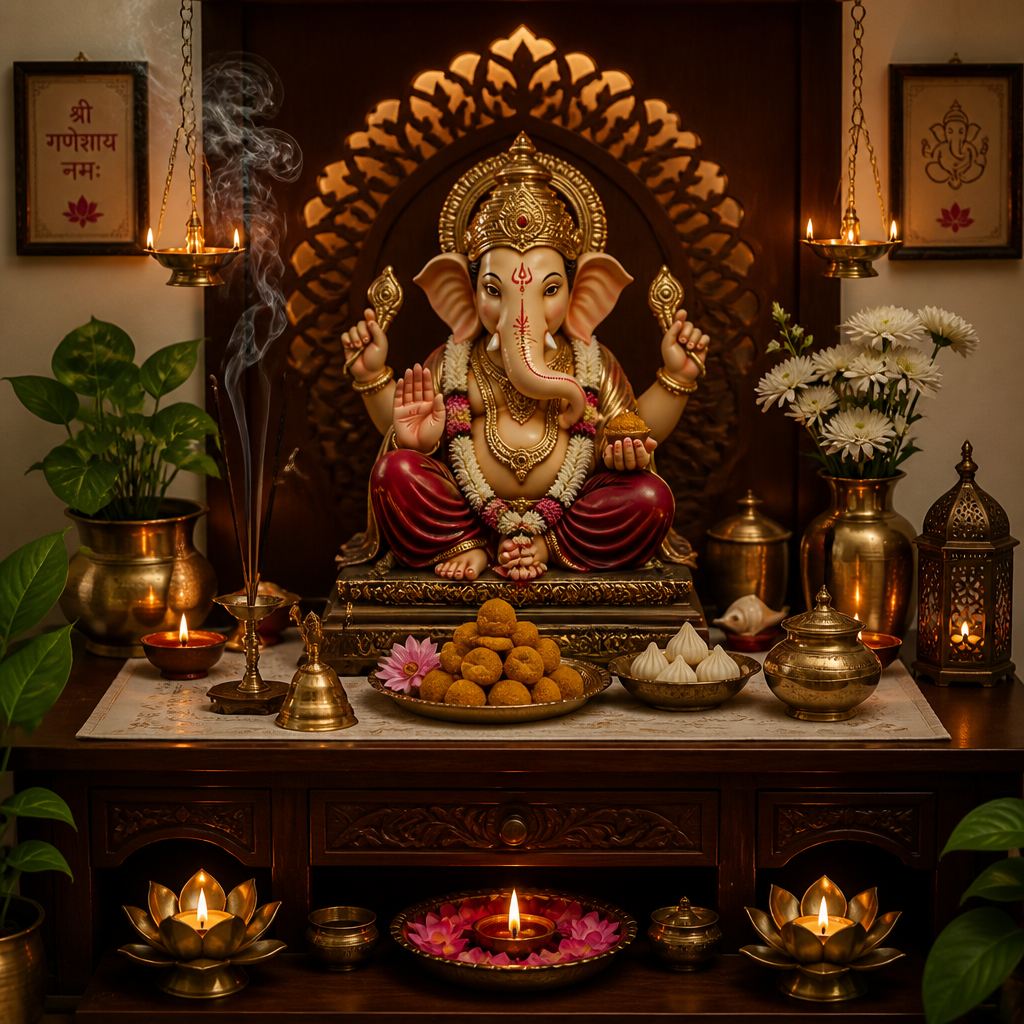
Keep the area around the statue clean and, where practice allows, add simple offerings of fresh flowers, incense, or a small oil lamp. These gestures deepen the relationship between the devotee and the statue without requiring elaborate ritual knowledge. They are also, in practical terms, what makes a devotional space feel lived in rather than merely displayed.
Frequently Asked Questions
Which trunk position is best for a home Ganesha statue?
For most households, a left-curving trunk is the most recommended choice. It is considered accessible and auspicious for everyday use and does not require strict ritual maintenance. A right-curving trunk carries more intense spiritual energy and is traditionally associated with fiercer protection, but it also comes with stricter observance expectations in many traditions. A raised trunk symbolises blessings and positive energy flow and is an excellent choice for a home altar or meditation space.
What is the difference between the Ekdanta and standard Ganesha forms?
The Ekdanta form, meaning "one-tusked," specifically emphasises Ganesha's broken tusk as his defining attribute. In this iconographic form, the broken tusk is held prominently in one hand, directly referencing the story of Ganesha breaking his own tusk to write the Mahabharata. A standard Ganesha statue will also show one full tusk and one broken one, but the Ekdanta form makes this the central visual statement. Collectors interested in iconographic specificity will find the distinction meaningful.
How do I tell a handcrafted Ganesha statue apart from a mass-produced one?
In bronze, look for slight organic variation in the surface texture, precise detail in the mudras and attributes, and a weight consistent with solid casting. A hollow, uniformly smooth piece is almost certainly mechanically produced. In stone, look for visible chisel marks and surface variation. Genuine hand-carving leaves a characteristic texture that machine finishing cannot replicate. In wood, check the grain pattern and the quality of the finish; mass-produced wooden pieces tend to have overly uniform surfaces and imprecise proportions. Always ask the seller about the piece's origin and production method. Reputable specialist retailers will be transparent about this.
What materials are recommended for an outdoor Ganesha statue?
Stone is the strongest choice for outdoor placement. Granite, sandstone, and marble all handle weather exposure well, and a stone Ganesha in a garden or on a patio develops a natural weathered quality over time that adds to its presence. Brass is also durable outdoors but will oxidise more visibly. Wood is generally not recommended for permanent outdoor placement, as exposure to moisture and sunlight accelerates deterioration even in hardwoods. If you want a wooden piece in an outdoor space, ensure it is sheltered from direct rain and treated with appropriate sealant.
Is there a difference between Ganesha statues from different Asian countries?
Yes, and the differences are substantial for anyone interested in art history or regional iconography. South Indian bronze Ganeshas represent one of the most technically demanding traditions in Asian religious art. Javanese Ganeshas from the Majapahit period carry Tantric Shaiva symbolism and a distinctly Indonesian aesthetic that sets them apart from Indian prototypes. Thai and Khmer Ganeshas reflect the blending of Hindu and Buddhist royal culture in Southeast Asia, often with more elegant proportioning and smoother surface treatment. These regional traditions are not simply stylistic variations; they reflect different theological emphases and cultural contexts that give each piece its specific meaning and collector value.
How should I care for a bronze Ganesha statue?
For indoor bronze Ganeshas, regular cleaning with a soft, dry cloth is sufficient for routine maintenance. Avoid abrasive materials or harsh chemicals, which can strip the patina that develops over time and actually adds to the piece's character and value. If you make regular offerings of water, flowers, or incense near the statue, ensure the area around its base stays dry to prevent long-term surface damage. For antique bronze pieces of collector-grade quality, it is worth consulting a specialist conservator before applying any cleaning products, as some treatments can do irreversible damage to aged surfaces.
If you have a Ganesha statue at home or have recently added one to your collection, share what drew you to it and how you have chosen to place it. Your experience might help someone else make a more considered choice.
References
-
Ten symbols of Lord Ganesha in art, explained with iconographic context
-
Ganesha's iconography and the symbolic meanings of his hand-held attributes
-
How to choose and what to look for when buying a wood, stone, or bronze Ganesha statue
-
The meaning and significance behind Lord Ganesha's trunk position directions
-
Ganesha: mythology, attributes, and iconographic tradition explained
