



Buddhist Mudras in Art: Meaning and Symbolism
Buddhist Mudras in Art: Meaning and Symbolism
Table of Contents
What Are Buddhist Mudras in Art?
Buddhist mudras are formalized hand positions that represent different states of consciousness, spiritual teachings, and divine qualities. They function as a sophisticated visual language that has communicated spiritual concepts across Asian cultures for over two thousand years, appearing consistently in sculpture, painting, and religious iconography from ancient Indian stone carvings to contemporary Khmer sculptures.
A single hand position conveys layers of meaning that would otherwise require lengthy explanations. When you see a Buddha statue with palms facing upward in the lap, you're looking at a specific teaching about meditation and inner peace. When the right hand extends outward with palm up, that's a message of compassion and protection. This precision is why mudras became so central to Buddhist art across different regions and time periods.
Origins and Historical Context
The practice of using hand gestures to convey meaning originated in ancient Indian dance and theatrical traditions long before Buddhism formalized them. Early Buddhist teachers adopted and refined these gestures, creating a standardized system that would remain consistent across centuries and cultures. Sanskrit texts from the first century CE document mudras as established spiritual practices.
What made mudras particularly valuable to Buddhist communities was their ability to transcend language barriers. A merchant traveling the Silk Road could encounter a statue in a temple thousands of miles from home and immediately recognize what the hand position meant. This universal language helped Buddhism spread and establish consistent visual practices across vastly different cultures, with mudras appearing in Chinese, Tibetan, Thai, and Japanese Buddhist art while maintaining core symbolic meanings.
How Mudras Function in Buddhist Iconography
In Buddhist visual art, mudras work alongside other symbolic elements to create complete spiritual narratives. The hand position tells you about the Buddha's state of mind or the specific teaching being demonstrated. A Buddha in meditation mudra appears serene and introspective, while a Buddha in teaching mudra seems engaged and active.
Different mudras often appear in combination with specific iconographic elements. A Buddha displaying the Abhaya mudra frequently appears in contexts emphasizing fearlessness and protection. When that same Buddha holds a certain mudra with the left hand while the right hand displays Abhaya, the combination creates a more nuanced teaching. The position of the hands in relation to the Buddha's body, whether resting on the lap, extending outward, or gesturing upward, changes the overall energy and message of the piece.
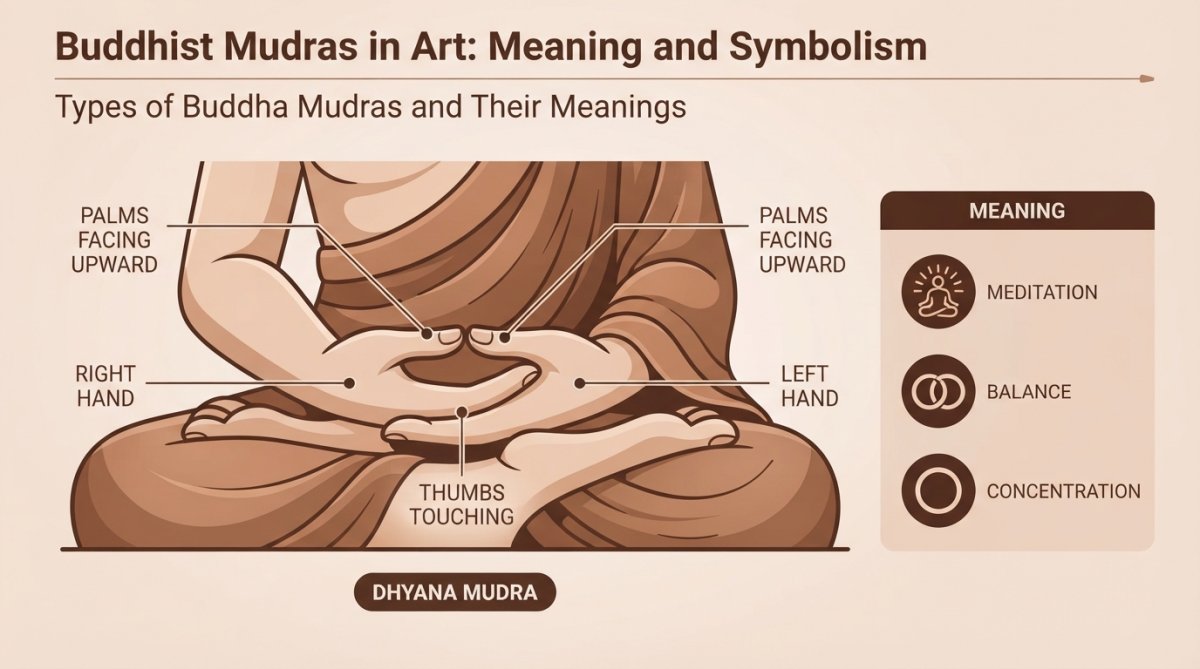
Types of Buddha Mudras and Their Meanings
Buddhist art recognizes several primary mudras that appear repeatedly across traditions and time periods, each carrying distinct spiritual significance.
Dhyana Mudra: The Meditation Gesture
The Dhyana mudra represents deep concentration and the state of perfect meditation. Both hands rest in the lap with palms facing upward, one hand placed on top of the other, symbolizing the unity of wisdom and compassion. This mudra appears most frequently in statues of Shakyamuni Buddha, the historical Buddha who attained enlightenment through meditation. The gesture communicates that meditation is the path to awakening and carries historical weight as a reference to the moment of Buddha's enlightenment.
Abhaya Mudra: The Gesture of Fearlessness
The Abhaya mudra displays the right hand raised to shoulder height with the palm facing outward and fingers extended upward, meaning "fear not" or "have no fear." It communicates protection, reassurance, and the removal of obstacles. This mudra appears frequently in contexts emphasizing compassion and divine protection, and also represents the Buddha's fearlessness in teaching difficult truths despite opposition and skepticism.
Varada Mudra: The Gesture of Offering
The Varada mudra shows the right hand extended downward with palm facing outward and fingers pointing down, symbolizing giving, offering, and the fulfillment of wishes. It represents the Buddha's generosity and willingness to bestow blessings on all beings. Often the Varada mudra appears in combination with other mudras, creating a more complete spiritual message than either gesture alone.
Bhumisparsha Mudra: Calling the Earth to Witness
The Bhumisparsha mudra shows the right hand extended downward with the palm facing inward, fingers pointing down as if touching the earth, while the left hand rests in the lap. This mudra commemorates the moment when Buddha called the earth to witness his enlightenment. According to Buddhist texts, as Buddha sat in meditation, Mara challenged his right to claim enlightenment. Buddha touched the earth, calling it to testify that he had earned his awakening through countless lifetimes of virtue. The mudra grounds enlightenment in physical reality and symbolizes humility alongside spiritual power.
Vitarka Mudra: The Teaching Gesture
The Vitarka mudra shows the right hand raised to shoulder height with the thumb and index finger forming a circle while the remaining fingers extend upward. This mudra represents teaching, discussion, and the transmission of Buddhist wisdom. The circle formed by thumb and index finger symbolizes the wheel of dharma, while extended fingers suggest the flow of wisdom outward to all beings. This mudra appears frequently in sculptures of teaching Buddhas and Bodhisattvas, capturing the moment of active spiritual instruction.
| Mudra | Hand Position | Primary Meaning | Best Context |
|---|---|---|---|
| Dhyana | Both hands in lap, palms up | Meditation, inner peace | Personal meditation spaces |
| Abhaya | Right hand raised, palm out | Fearlessness, protection | Spaces needing reassurance |
| Varada | Right hand extended down, palm out | Generosity, offering | Areas inviting abundance |
| Bhumisparsha | Right hand down, touching earth | Enlightenment, grounding | Spaces emphasizing truth |
| Vitarka | Right hand raised, thumb-index circle | Teaching, wisdom transmission | Learning spaces |
Symbolism of Buddha Statues and Hand Positions
Every element of a Buddha statue contributes to its overall spiritual message. The mudra is one component within a larger symbolic system that includes body posture, facial expression, clothing, and surrounding iconographic elements.
The Role of Right and Left Hands
In Buddhist iconography, the right and left hands often carry different symbolic associations. The right hand typically represents active compassion, teaching, and engagement with the world. The left hand frequently represents wisdom, inner knowledge, and receptivity. When a Buddha displays different mudras with each hand, these dual meanings create a more complete spiritual teaching. Hands positioned symmetrically suggest perfect balance and equanimity, while asymmetrical positioning suggests dynamic engagement and movement.
Mudras Across Different Buddhist Traditions
While core mudras remain consistent across Buddhist traditions, different schools emphasize different gestures. Theravada Buddhism frequently features Buddha in meditation mudras and teaching mudras. Mahayana Buddhism incorporates a wider range of mudras and often depicts Bodhisattvas in complex multi-hand mudra combinations. Tibetan Buddhism developed elaborate mudra systems with hand positions not found in other traditions, often showing deities with multiple arms displaying different mudras simultaneously.
Southeast Asian Buddhism, including Thai, Cambodian, and Laotian traditions, maintains strong connections to earlier Indian Buddhist practices. Khmer sculptures from Cambodia often display mudras with remarkable consistency to Indian Buddhist art, suggesting deep cultural continuity. Yet each tradition developed distinctive artistic styles. Understanding these cross-cultural variations enriches appreciation for Buddhist art, revealing both universal spiritual principles and unique cultural expressions.
Mudras in Meditation Practice and Spiritual Meaning
The meaning of buddhist mudras in art extends beyond visual symbolism into actual spiritual practice. Many Buddhist practitioners use mudras during meditation to deepen their practice and reinforce specific intentions.
How Hand Gestures Support Meditation
When practitioners hold mudras during meditation, the physical gesture supports mental focus and spiritual intention. The hand position creates a subtle feedback loop between body and mind. Holding Dhyana mudra while meditating on compassion creates a coherent physical and mental state. Different mudras activate different aspects of consciousness according to Buddhist understanding. This connection reflects broader Buddhist understanding that body and mind are interdependent aspects of unified experience.
The Connection Between Art and Practice
Buddhist art serves practitioners by providing visual reminders of spiritual states they're cultivating. When you see a Buddha in Dhyana mudra, you're seeing an image of the state you're working toward in your own meditation. The finest Buddhist art communicates something beyond mere representation, a masterfully carved Buddha in meditation mudra seems to embody the actual state of meditation. This is why authentic, well-crafted pieces have a different quality than mass-produced replicas. The artist's own spiritual understanding infuses the work.
Buddhist Iconography Meaning: Reading Mudras in Sculpture and Painting
Learning to recognize mudras transforms how you experience Buddhist art, revealing layers of specific spiritual teaching.
Mudras in Ancient and Classical Buddhist Art
The earliest Buddhist sculptures, created in the Gandhara region around the first century CE, established mudra conventions that remained remarkably stable for centuries. Classical period Buddhist art, created during India's Gupta dynasty (fourth to sixth centuries CE), refined mudra representation to extraordinary levels of sophistication. As Buddhism spread along the Silk Road, different regions adapted mudra representation to their own artistic traditions while maintaining mudra consistency.
Recognizing Mudras in Contemporary Pieces
Contemporary Buddhist art continues the traditions established centuries ago. Modern sculptors and painters still use mudras to communicate spiritual teachings. When examining contemporary Buddhist sculptures, start by observing the hand positions before considering other elements. Contemporary artists sometimes experiment with mudra combinations and interpretations, demonstrating that Buddhist iconography remains a living tradition.
Choosing Buddhist Art: Understanding Mudras for Your Space
When selecting Buddhist art for your home or meditation space, understanding mudras helps you choose pieces that align with your spiritual intentions and needs.
The mudra should resonate with where you are in your spiritual journey. Consider also the artistic tradition and style that appeals to you. The quality of craftsmanship matters significantly, handcrafted pieces created by artisans with deep understanding of Buddhist traditions carry different energy than mass-produced items. Placement within your space affects how the piece functions spiritually. A Buddha statue positioned where you'll see it during meditation practice becomes more active in your spiritual work.
Selecting authentic Buddhist art that genuinely embodies the spiritual qualities you're seeking requires both knowledge and access to truly curated pieces. HD Asian Art specializes in carefully selected Buddhist and Hindu statues, including exceptional Khmer and Southeast Asian sculptures that display mudras with remarkable authenticity and craftsmanship. Whether you're seeking an antique treasure or a contemporary piece created by artisans who understand both technical mastery and spiritual significance, our collection is designed to enhance meditation spaces and create refined spiritual interiors. Browse our curated selection to find the piece that resonates with your practice and brings the peace and artistry of temple-inspired spaces into your home.
Frequently Asked Questions
What are the most common Buddhist mudras and their meanings?
The most widely recognized Buddhist mudras include Dhyana (meditation), Abhaya (fearlessness), Varada (offering), Bhumisparsha (earth-touching), and Vitarka (teaching). Each mudra conveys a specific spiritual message through precise hand and finger positions. Dhyana mudra represents deep meditation and inner peace, while Abhaya mudra signals protection and reassurance. These hand gestures serve as a visual language in Buddhist art, allowing viewers to understand the Buddha's spiritual state and teachings at a glance.
How do mudras in Buddhist art convey spiritual messages?
Buddhist mudras function as symbolic gestures that communicate spiritual concepts without words. Each hand position, finger arrangement, and body posture carries specific meaning rooted in Buddhist philosophy and practice. In sculpture and painting, mudras instantly identify the Buddha's role, whether teaching, meditating, offering blessings, or demonstrating enlightenment. This visual language allows the meaning of Buddhist mudras in art to transcend cultural and linguistic barriers, making spiritual teachings accessible to all viewers regardless of their background or familiarity with Buddhism.
How do mudras in meditation connect to their representation in art?
Mudras in meditation are living practices that practitioners use to focus energy and intention during spiritual practice. The hand gestures depicted in Buddhist statues and paintings reflect these actual meditation techniques. When you see a mudra in artwork, it represents not just a symbolic gesture but an active spiritual practice. This connection between mudras in meditation and their artistic representation creates a bridge between contemplative practice and visual devotion, allowing art to serve as both inspiration and instruction for spiritual seekers.
Are Buddhist mudras the same across all traditions?
While core mudras like Dhyana and Abhaya appear across Theravada, Mahayana, and Vajrayana traditions, their interpretation and emphasis can vary. Some traditions emphasize specific mudras more prominently, and regional artistic styles may depict them with subtle differences. Khmer and Southeast Asian Buddhist art, for example, shows distinctive approaches to mudra representation while maintaining the essential spiritual symbolism. Understanding these variations enriches your appreciation of Buddhist iconography meaning across different cultures and historical periods.
