



How Should a Beginner Arrange a Buddha Statue Altar?
How Should a Beginner Arrange a Buddha Statue Altar?
Quick Summary
To arrange a beginner Buddha statue altar, place the statue centered at the highest point on a stable table above waist level, with offerings like a water bowl arranged in front and below it. Keep the setup minimal: a Buddha image, a clean surface, and one offering are enough to start.
- Pick a quiet, stable corner that gets natural light and stays out of heavy foot traffic.
- Raise the statue on a stand so its base sits above the offering bowls.
- Facing east is common, but choose whichever direction lets you sit comfortably facing the statue.
- Start with essentials only: a statue, stable table, water bowl, and dusting cloth.
- Change the water each morning and wipe the bowl dry before refilling.
Table of Contents
- How to Set Up a Buddhist Altar at Home: First Steps
- Buddha Statue Placement in Home: Height, Direction, and Focus
- What to Put on a Buddhist Altar: The Essential and Optional Items
- Buddhist Altar Offerings for Beginners: Water, Flowers, and More
- Tradition-Specific Guidance: What Not to Mix
- Small-Space and Renter-Friendly Altar Setups
- Daily Care, Safety, and Common Mistakes to Avoid
- Browse Buddha Statues for Your Altar
- Frequently Asked Questions
How to Set Up a Buddhist Altar at Home: First Steps
Setting up a Buddha statue altar at home starts with one decision: pick a quiet, stable spot and build everything else around it.
Below, we walk through the process, from choosing a table to placing offerings and keeping the setup safe. For the full end-to-end walkthrough, see our complete guide to setting up a Buddhist altar at home. Start with the room.
Choose a Quiet, Stable Location
Pick a corner you walk past often but do not use for storage or clutter. A bedroom corner, a living room alcove, or a dedicated meditation nook all work. The spot should feel calm, get some natural light, and stay out of heavy foot traffic.
Avoid placing the altar near a television, a loud kitchen, or a doorway that slams. Stability matters too: the floor or shelf must not wobble when someone walks by.
Select a Table and Prepare the Space
Any sturdy table works as an altar table, from a low wooden bench to a small console. Height matters more than style. The surface should sit above waist level so the statue is never at floor height.
Clear the space completely before you add anything. Wipe the surface, remove clutter, and let the area sit empty for a day if you can. Many practitioners find this pause helps the space feel intentional.
Buddha Statue Placement in Home: Height, Direction, and Focus
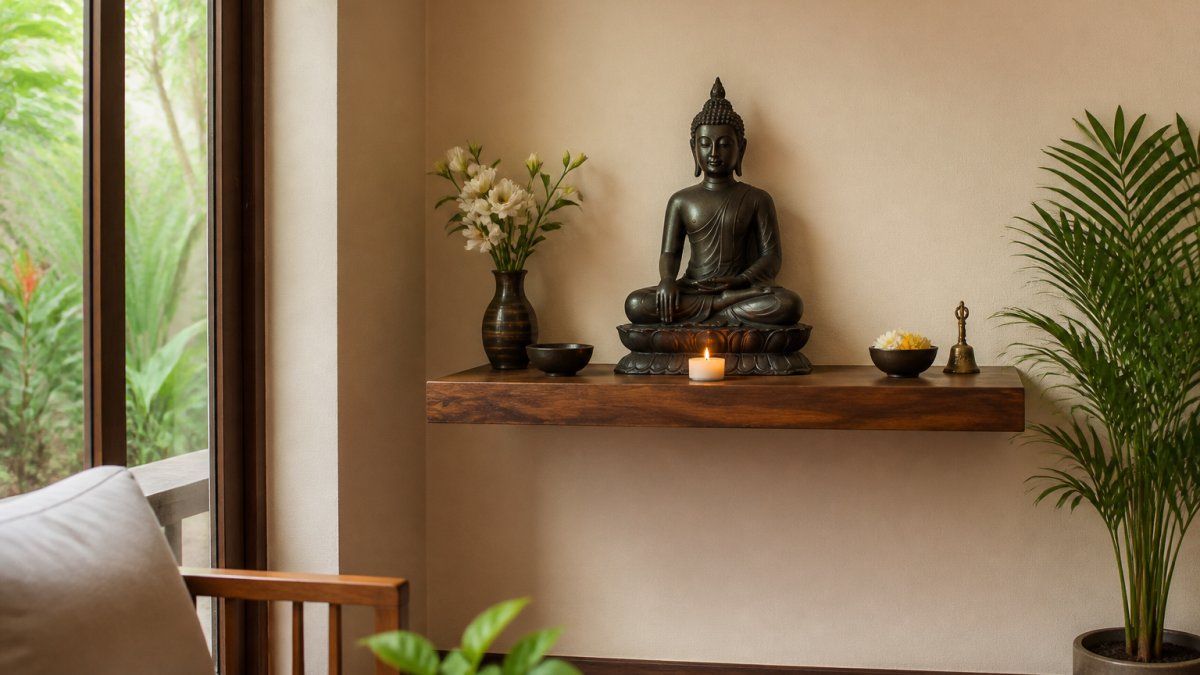
The Buddha statue should sit at the highest point on the altar, centered, and clearly above the offerings. Height signals respect, and centering gives the eye one clear focus. Get this part right and the rest of the arrangement falls into place.
Elevate the Statue Above Offerings
Raise the statue on a small stand, block, or shelf so its base sits above the offering bowls. Sacred objects belong higher than everyday items. Nothing should tower over the Buddha image, including tall candles or vases.
Keep the base stable. A statue that shifts when you light incense undercuts the calm you are building.
Which Direction Should the Statue Face?
Facing east is a common choice in many Buddhist traditions, tied to the sunrise and awakening. Facing the room's entrance is another option, so the statue greets anyone who enters. Neither is a rule. Choose the direction that lets you sit facing the statue comfortably during meditation.
If you are still deciding which figure suits your space, our guide on how to choose a Buddha statue for your home altar covers the main options.
What to Put on a Buddhist Altar: The Essential and Optional Items
A complete beginner altar needs very little: a Buddha image, a clean surface, and one offering. Everything else is optional. This is the part most guides get wrong, loading a first altar with objects that add clutter instead of calm.
Essential items:
- A Buddha statue or framed image as the central focus
- A stable table or shelf
- One offering bowl for water
- A small cloth for dusting
Optional items:
- Fresh flowers in a small vase
- An incense holder and incense
- A candle or small lamp
- A bowl of fruit
- A meditation cushion placed in front
Keep the count low at first. Add one item at a time and notice whether the space still feels calm.
Buddhist Altar Offerings for Beginners: Water, Flowers, and More
Offerings sit in front of and below the statue, arranged in a neat row. Water is the simplest and most traditional starting point. For a deeper look at daily offering practice, read our full guide. Flowers, incense, candles, and fruit can follow as you settle into a routine.
Traditional Offering Meanings
Each offering carries a simple meaning that beginners can hold in mind:
| Offering | Traditional Meaning | Beginner Tip |
|---|---|---|
| Water | Clarity and purity | Change daily; use a small bowl |
| Flowers | Impermanence | Fresh stems; remove wilted blooms |
| Incense | Discipline and calm | One stick; ventilate the room |
| Candle or lamp | Wisdom | Use a battery lamp if fire is a concern |
| Fruit | Gratitude | Keep it fresh; replace when ripe |
Tradition-Specific Guidance: What Not to Mix
Different Buddhist traditions arrange altars in different ways, and mixing them without care can create confusion. The table below gives beginners a side-by-side starting point. Treat it as orientation, not doctrine, a local teacher or community always outranks a general guide.
| Tradition | Typical Focal Point | Common Offerings | Beginner-Friendly Note |
|---|---|---|---|
| Zen | A single Buddha or Bodhisattva statue, often simple | Candle, incense, one water bowl, sometimes a small flower | Spare is the point; fewer objects read as more intentional |
| Tibetan | Statue plus imagery of teachers and lineage figures | Multiple water bowls (often seven), butter lamps, incense | More objects, more upkeep; start with three bowls if seven feels like too much |
| Nichiren | A scroll (Gohonzon) rather than a statue | Water, evergreens, fruit | The scroll is the focus; a statue is not required |
| Pure Land | Amida Buddha image or statue | Water, flowers, incense, sometimes a small lamp | A single image and one offering is a complete setup |
| Theravada | Shakyamuni Buddha statue | Water, flowers, incense, candles | Keep the Buddha image highest and centered |
How to Choose One and Stick With It
Pick the tradition you already practice, the one your local center follows, or, if you have no affiliation, the simplest form that fits your space.
A practical rule: if you are reading a book, following an online teacher, or visiting a center, follow that source's arrangement rather than blending several. When instructions conflict, ask the teacher or community you actually practice with.
What Not to Mix
Stacking objects from three different lineages on one small table usually reads as clutter rather than devotion. The specific things to avoid:
- Combining a Nichiren scroll with a multi-bowl Tibetan offering row on the same surface
- Mixing offering counts (for example, a seven-bowl Tibetan row beside a Zen single bowl) without knowing why each exists
- Adding teacher or lineage imagery from one tradition to a statue setup from another
- Treating one tradition's customs as universal rules for all Buddhists
If you are unsure which tradition fits, keep the arrangement simple and neutral. You can always refine it later once you have a teacher or community to guide you.
Small-Space and Renter-Friendly Altar Setups
A small apartment corner can hold a proper altar. The trick is vertical space and a wall-mounted shelf rather than a full table. A floating shelf at chest height holds a modest statue and one bowl without taking up floor space. Our step-by-step beginner setup for compact altars walks through the details.
Renter-friendly options:
- A wall shelf with removable adhesive strips
- A folding tray table stored between sessions
- A deep windowsill with good light
- A bookshelf top cleared of other items
Daily Care, Safety, and Common Mistakes to Avoid
A few small habits keep an altar clean, safe, and calm. The routines below separate what you do every day from what you do occasionally, so the upkeep never becomes a burden.
Daily Care (Two to Five Minutes)
- Change the water in the bowl each morning and wipe the bowl dry before refilling
- Remove wilted flowers before petals drop onto the surface
- Trim or replace incense ash so the holder stays clean
- Give the statue and table a quick pass with a soft dry cloth
- Straighten the arrangement so the statue stays centered and highest
Occasional Care
- Dust the statue and shelf more thoroughly once a week with a soft, dry cloth
- Wash offering bowls with mild soap and water, then dry them fully before refilling
- Replace fruit when it ripens or softens rather than letting it sit
- Check that the statue base and shelf are still stable and level
Respectfully Managing Offerings
When you remove water, flowers, or fruit, do it calmly and without ceremony, there is no single required method. A common pattern is to pour water onto a plant or outside rather than down a drain, and to compost flowers and fruit. What matters is that the act is done with attention, not that it follows one fixed script.
Fire and Household Safety
An unattended candle near a wooden shelf or loose cloth is the most common safety failure in home altars. Follow these basics:
- Use a stable, non-tipping candle holder and keep flames away from fabric, paper, and curtains
- Never leave a lit candle in an empty room, and extinguish it before you leave the house or go to sleep
- Ventilate the room when burning incense; a window cracked open is usually enough
- Keep incense and candles out of reach of children and pets, or switch to a battery-operated lamp and stick incense in a covered holder
- Place the altar on a stable surface that will not tip if bumped
Common Placement Mistakes
- Setting the statue on the floor
- Letting offerings sit higher than the Buddha image
- Crowding the surface with decorations
- Placing the altar beside a loud appliance or a slamming door
- Putting the altar where pets or children routinely knock into it
Browse Buddha Statues for Your Altar
Building a calm altar starts with one good focal point. HD Asian Art curates Buddhist and Hindu statues, including Khmer and Southeast Asian sculptures, chosen for altars and meditation spaces. We offer free shipping.
Start with a single statue that fits your space, then let the arrangement grow around it. Browse our collection and find the piece that anchors your practice.
Frequently Asked Questions
Where should I place a Buddha statue on a home altar?
Place the Buddha statue at the center and highest point of your altar, above all offerings and other objects. Choose a stable table or shelf in a quiet, clean area, ideally facing east or the room's entrance. Avoid placing the statue on the floor or in a cluttered space. Elevation shows respect and keeps the statue as the focal point, while a stable base prevents accidents.
What should be included on a beginner's Buddhist altar?
Start with a Buddha statue or image as the central focus, then add simple offerings: a water bowl, fresh flowers, incense, and a candle. You can also include a small plant or fruit. Keep the arrangement uncluttered and clean. Optional items like offering bowls or a bell can be added later. The essential elements are a respectful placement and a calm, tidy space.
Can I set up a Buddhist altar without a statue?
Yes, you can use a Buddha image or even a simple drawing as the focal point. The altar's purpose is to support your practice, so the intention and respect matter more than the physical object. If you use a photo or print, frame it and place it at the center, elevated above offerings, just as you would a statue.
How do I create a simple meditation altar at home in a small space?
Use a small wall shelf or the top of a bookshelf as your altar table. Place a modest Buddha statue or image at the center, elevated above a single water bowl and a small candle. Keep the area free of clutter. Choose a corner that is quiet and not in a high-traffic path. Even a 12-inch-wide shelf can hold a meaningful setup.
A quiet corner, a stable table, and one well-chosen statue are enough to begin. If you want a focal point with real presence, HD Asian Art offers curated Buddhist statues, handpicked antique and contemporary pieces, and free shipping to your door. Get started with HD Asian Art and build a meditation space that feels settled from the first day.

