



Brahma Statues: Beauty of Four-Faced Hindu Creator Art
Brahma Statues: Beauty of Four-Faced Hindu Creator Art
Brahma statues occupy one of the most unusual positions in Hindu religious art: the creator god is rarely worshipped in temples, yet his four-faced sculpture form remains one of the most visually commanding and symbolically dense objects a collector can own.
If you have been searching for a Brahma statue and found the market surprisingly thin compared to Ganesha or Vishnu pieces, that scarcity is not accidental. It reflects centuries of theological shifts inside Hinduism itself, and it makes authenticated, high-quality Brahma sculptures genuinely rare acquisitions worth understanding deeply before you buy.
Table of Contents
Quick Takeaways
|
Key Insight |
Explanation |
|---|---|
|
Brahma statues are intentionally rare |
Active Brahma temples are almost nonexistent across India and Southeast Asia, which directly limits the production and survival of devotional Brahma sculpture through history. |
|
The four faces are not decorative choices |
Each of the four faces, called Chaturmukha, corresponds to one of the four Vedas and one of the four cardinal directions, making the sculpture a cosmological map in three dimensions. |
|
Southeast Asian traditions produced the finest Brahma pieces |
Cambodian Khmer and Thai craftsmen created some of the most iconographically complete four-faced Brahma sculptures, often in stone or gilt bronze, between the 9th and 14th centuries. |
|
Material choice signals original purpose |
Stone Brahma sculptures were typically made for temple installation, while bronze and gilt pieces served portable devotional or royal court purposes. |
|
Brahma holds four specific attributes |
The classic iconography shows him holding a water pot (kamandalu), prayer beads (akshamala), a manuscript (the Vedas), and a sacrificial ladle (sruk), each in one of his four hands. |
|
A fifth face tradition exists but is almost never sculpted |
Some textual traditions describe Brahma with five heads, the fifth being destroyed by Shiva. Most sculptures show four, making five-headed examples extremely rare and theologically significant. |
|
Hamsa, the swan, is the authenticating vehicle |
The presence of Brahma's mount, the hamsa (sacred goose or swan), either beneath the figure or as a throne element, is a strong marker of iconographic authenticity in any Brahma statue. |
Who Is Brahma: The Creator God in Hindu Theology
Brahma sits at the apex of the Hindu Trimurti alongside Vishnu the Preserver and Shiva the Destroyer, yet his worship has declined so dramatically that fewer than a handful of major temples are dedicated to him across all of India. The most famous, at Pushkar in Rajasthan, is often cited as practically the only significant active Brahma temple on the subcontinent. This theological demotion, rooted in competing mythological narratives about a curse placed upon Brahma, has made his sculptural tradition far smaller and more specialised than his cosmic rank would suggest.
Understanding this context is essential for any collector. When you acquire a Brahma statue, you are not buying a piece from a mass devotional tradition with thousands of workshops producing similar work across centuries. You are acquiring an object from a deliberately limited iconographic lineage, one that survived primarily in royal commissions, temple program sculptures, and cross-religious syncretic contexts across Southeast Asia.
Brahma's name derives from the Sanskrit root meaning to grow, expand, or to be the totality of existence. In the Puranas, he is described as self-born from a golden cosmic egg or from a lotus emerging from Vishnu's navel, depending on the text. This ambiguity in his origin story is reflected in sculptural programs that often show him in a secondary role even when present, emerging from a lotus pedestal rather than commanding a throne independently.
"Brahma is the most philosophically important and ritually least worshipped of the great Hindu gods, a paradox that defines both his theology and his art." -- Stella Kramrisch, art historian and Hinduism scholar, from her extensive writings on Hindu temple sculpture.
The Four-Faced Form: What Each Face Represents
The defining feature of any four-faced Brahma sculpture is, of course, the Chaturmukha form, four heads arranged symmetrically so that Brahma faces all four cardinal directions simultaneously. This is not artistic whimsy. Each face has a specific cosmological function that any serious collector should be able to identify and articulate.
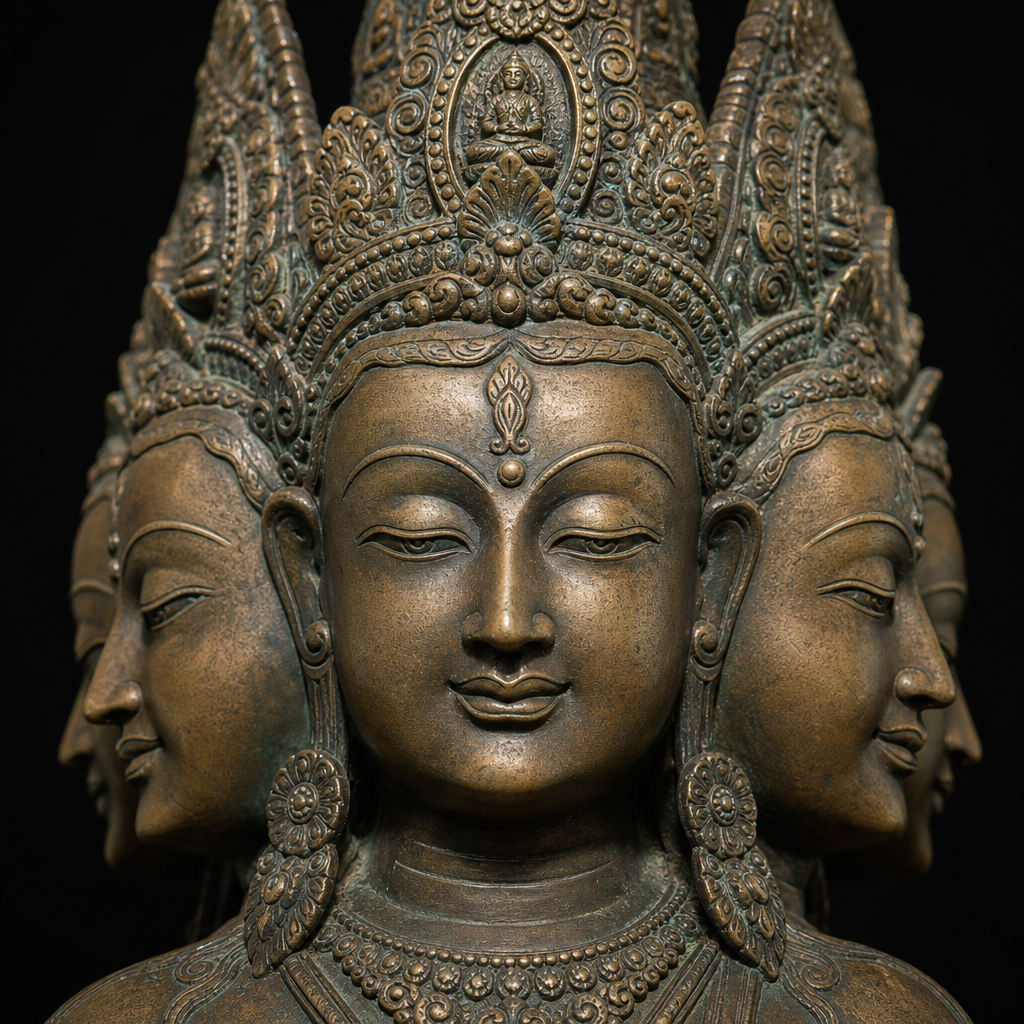
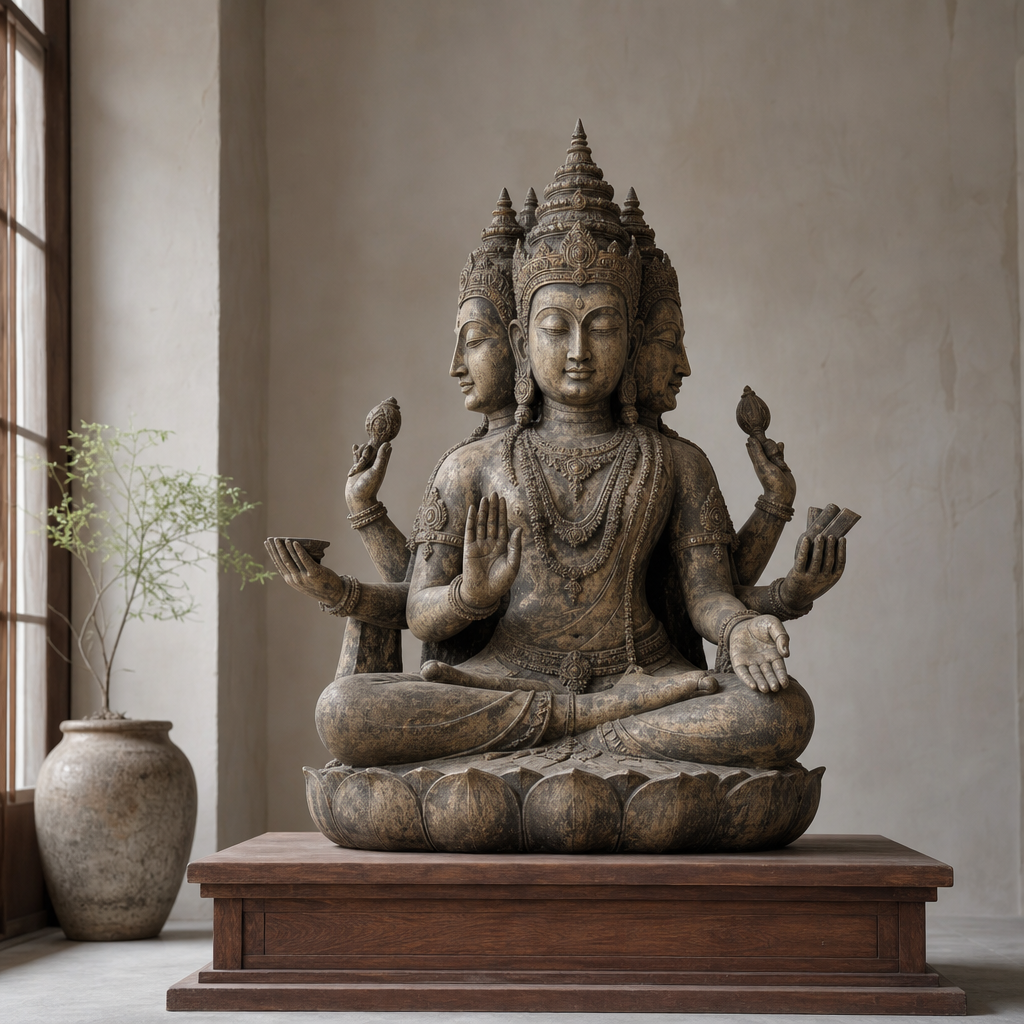
The Four Faces and Their Vedic Correspondences
The eastern face is associated with the Rigveda, the oldest of the four Vedas, and with the colour red in some textual traditions. The southern face corresponds to the Yajurveda and is sometimes depicted with a darker complexion in painted representations. The western face aligns with the Samaveda, and the northern face with the Atharvaveda. Together, the four faces encompass the entirety of Vedic knowledge, which is why Brahma is also called Vedanatha, Lord of the Vedas.
In practice, when examining an actual sculpture, you will rarely be able to distinguish the individual faces by Vedic association through visual cues alone. What matters more for authentication and quality assessment is that all four faces are rendered with equal care and detail. In inferior or later decorative pieces, the rear faces are often rougher in execution than the front-facing one. In a museum-quality four-faced Brahma sculpture, all four heads receive equal attention because the sculptor understood the theological requirement that no direction is secondary.
The Missing Fifth Head
The Shaivite myth about Brahma's fifth head deserves attention because it appears in sculpture as well. According to the Puranas, Brahma originally had five heads and became arrogant, claiming superiority over Shiva. Shiva cut off the fifth head, and the curse against Brahma's worship followed. Some early Gupta-period Indian sculptures show traces or stylistic suggestions of a fifth head, and this detail, when present, adds significant theological layering to the piece.
Pro tip: When evaluating any Brahma piece described as having five heads, request clear photographs from all angles. True five-headed Brahma sculptures are extraordinary rarities. Most claimed examples are either misidentified deities or later reproductions. A dealer who can explain the specific mythological context of a five-headed piece with textual reference is a dealer worth trusting.
Reading a Brahma Statue: A Collector's Iconography Guide
A correctly formed Hindu creator god art piece depicting Brahma follows consistent iconographic rules across regional traditions, and knowing these rules lets you identify authentic pieces and separate them from decorative items that simply have four heads but lack theological grounding.
The Four Attributes and Their Meanings
Brahma is classically depicted with four arms, each holding one of his defining attributes. The kamandalu, a water pot representing the primordial waters from which creation emerged, is his most fundamental attribute. The akshamala, a rosary of prayer beads, indicates his role as a meditating sage-creator. The manuscript, representing the Vedas themselves, confirms his identity as the source of sacred knowledge. The sruk or sacrificial ladle indicates his presidency over Vedic fire rituals, the yajna tradition that sustains cosmic order.
A common mistake among new collectors is assuming that any four-armed, four-headed figure is Brahma. In Shaivite sculpture programs, Sadashiva also appears in a four-faced or five-faced form, called Panchamukha Shiva. The distinguishing attributes matter enormously. Brahma holds domestic and scholarly objects. Shiva holds the trident, the damaru drum, and fire. Confusing the two is the kind of error that affects purchasing decisions significantly.
Brahma's Vehicle: The Hamsa
The hamsa, rendered in Sanskrit as both goose and swan depending on the regional tradition, is Brahma's vahana or divine vehicle. Its presence in a sculpture is one of the clearest markers of iconographic authenticity. In Southeast Asian pieces, particularly Thai and Cambodian examples, the hamsa is often carved with considerable detail as a throne element or base support. In Indian pieces, the hamsa may appear as a smaller figure at the base of the sculpture or implied by the lotus pedestal, which the bird is associated with.
Pro tip: The lotus is shared iconography across Hindu and Buddhist traditions and cannot alone identify a Brahma statue. Always look for the combination of four heads, four arms with the specific attribute set, and either the hamsa or a context within a clearly Brahmanical sculptural program before making an attribution.
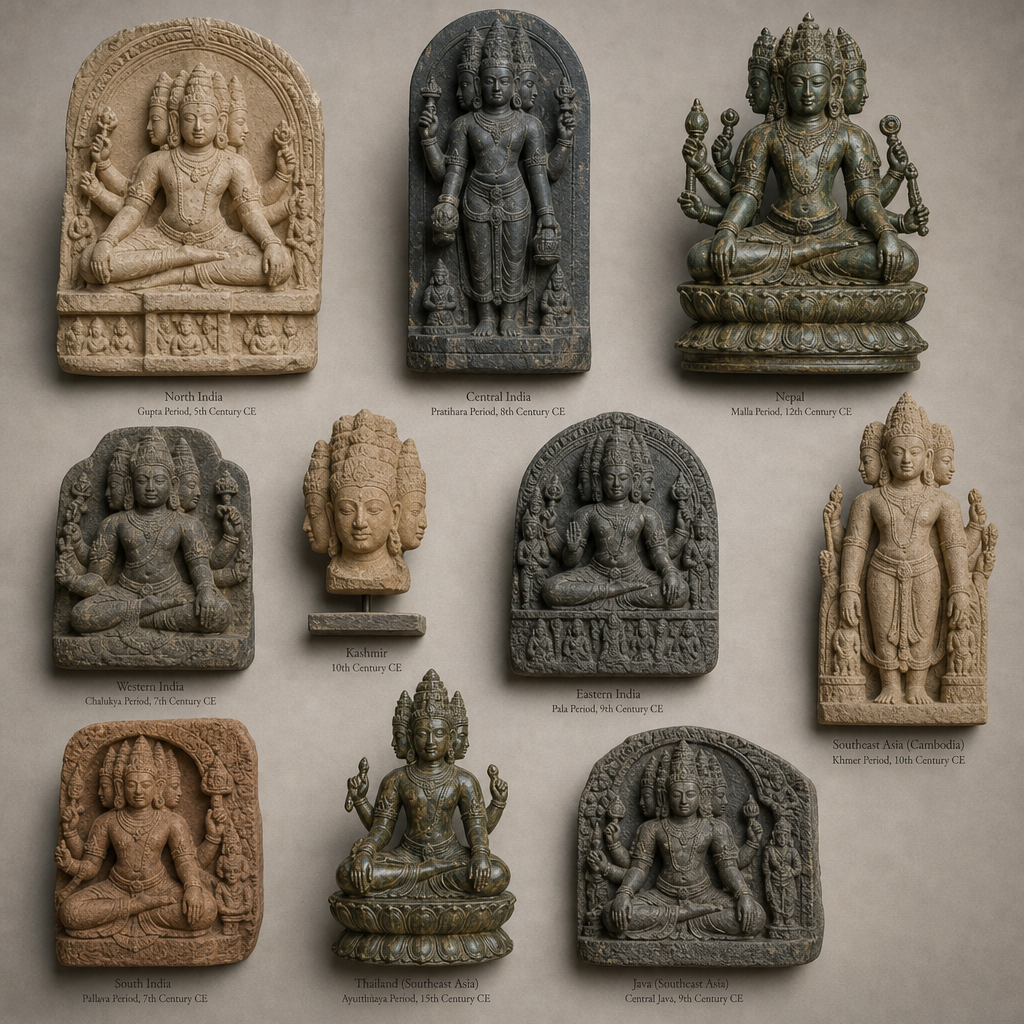
Regional Styles of Four-Faced Brahma Sculpture Across Asia
The geographic range of surviving Brahma sculpture tells a striking story about where Hindu influence embedded most deeply and where it was absorbed into hybrid religious traditions. For collectors sourcing pieces from across Asia, understanding the regional distinctions is essential because they affect both authenticity assessment and pricing.
Indian Brahma Sculpture: Gupta and Medieval Periods
The finest Indian Brahma sculptures date from the Gupta period (4th to 6th centuries CE) and the early medieval period up to roughly the 12th century. Gupta-era pieces from central India show Brahma with a serene, idealised face characteristic of that golden age of Indian sculpture, with attributes held elegantly in naturalistic arms. Stone was the dominant material, and original temple pieces from this period are now almost exclusively in museum collections.
Post-Gupta and Rajput-period bronzes from northern and western India are more accessible to serious private collectors and show Brahma in increasingly formalised poses, often flanked by his consort Saraswati. These pieces follow the Agama texts closely in their attribute arrangement and are among the most iconographically complete Brahma sculptures available outside museum contexts.
Khmer Brahma: Cambodia's Contribution
Angkorian Cambodia produced some of the most powerful Brahma sculptures ever made. Khmer craftsmen working between the 9th and 13th centuries rendered Brahma in sandstone and bronze with a formal authority that reflects the deep integration of Hinduism into Khmer royal ideology. Four-faced Brahma heads, called Chaturmukha lingams when combined with Shiva iconography, were placed at the centre of major temple complexes at Angkor.
The stylistic hallmarks of Khmer Brahma include slightly broader, more square-jawed faces compared to Indian examples, a characteristic headdress with stacked cylindrical elements, and a static frontal pose that emphasises the divine immobility of the creator. Genuine Khmer pieces in private hands are increasingly subject to provenance scrutiny, and any dealer offering Khmer sculpture should provide clear documentation of legal acquisition history.
Thai Brahma: Living Devotion and Active Production
Thailand presents an unusual case in the Brahma sculptural tradition because active devotion to Brahma, often syncretised with the Thai deity Phra Phrom, has continued into the modern period. The famous Erawan Shrine in Bangkok houses a four-faced Brahma image that attracts hundreds of daily worshippers. This living devotional tradition means that Thai Brahma sculpture spans an enormous chronological range from early Dvaravati and Sukhothai pieces to contemporary gilt bronze works still commissioned for sacred purposes.
Thai Brahma figures are typically rendered in gilt bronze, seated in a meditative posture on a lotus throne, with a more benevolent and approachable facial expression than the austere authority of Khmer examples. The gilt finish is traditional and meaningful, not merely decorative. For collectors interested in a Brahma statue that connects to an active living tradition rather than a purely historical one, Thai pieces offer that continuity.
Comparing Brahma Sculpture Traditions: A Direct Comparison
|
Tradition |
Typical Material and Period |
Distinctive Collector Characteristics |
|---|---|---|
|
Indian (Gupta to Medieval) |
Sandstone, schist, bronze; 4th to 12th century CE |
Closest adherence to Sanskrit textual iconography; most academically documented; highest museum presence means fewer pieces in private market; Saraswati often present as consort figure |
|
Khmer Cambodian |
Sandstone, bronze; 9th to 14th century CE |
Monumental formal authority; distinctive headdress forms; provenance documentation essential for legal compliance; often part of larger Trimurti or Chaturmukha lingam programs |
|
Thai (Phra Phrom tradition) |
Gilt bronze, lacquered wood; Sukhothai period to present |
Continuous living tradition; approachable facial type; gilt finish integral to meaning; available in a wider price range; contemporary commissions exist alongside historical pieces |
Display and Placement of a Brahma Statue at Home or on an Altar
Because Brahma faces all four cardinal directions, his statue presents a unique placement challenge that differs from most Hindu deity figures. A Vishnu or Ganesha statue has a clear front face and a natural orientation toward the worshipper. A four-faced Brahma sculpture, by its very nature, has no single front. This is theologically intentional and practically significant for display decisions.
In practice, most collectors and practitioners place a Brahma statue at the centre of an altar or display space precisely because of this omnidirectional quality, allowing the figure to anchor the arrangement rather than face any single direction. East is the traditional sacred direction in Hindu practice, so if space requires choosing one primary viewing angle, the face oriented east is conventionally treated as the principal face.
Altar Context and Adjacent Figures
Brahma works well alongside Saraswati, his consort and the goddess of learning and arts, in a home altar arrangement. A paired Brahma and Saraswati grouping reflects traditional Indian iconographic programs and creates a compositionally complete devotional space. For collectors focused on the Trimurti concept, grouping Brahma with Vishnu and Shiva representations is historically grounded and visually powerful.
For home decorators rather than active practitioners, the four-faced Brahma statue is one of the most architecturally interesting Hindu deity figures available because it reads as a complete sculptural composition from every angle. This 360-degree visual engagement makes it particularly effective as a freestanding sculptural object in a room rather than a wall-mounted or niche piece. A sturdy, appropriately scaled plinth is worth investing in to allow the viewer to move around the sculpture and engage all four faces.
Collecting Brahma Art: What Separates Museum-Quality from Decorative
The market for Hindu creator god art depicting Brahma splits fairly cleanly into two tiers, and understanding which tier you are shopping in prevents both overpaying and disappointment. Museum-quality Brahma sculpture, meaning pieces that could legitimately be exhibited in a serious Asian art context, shares specific characteristics that decorative market pieces do not.
What Museum-Quality Brahma Sculpture Looks Like
First, all four faces are rendered with equal sculptural attention and consistent stylistic execution, suggesting the work of a trained craftsman working within a living iconographic tradition rather than a copyist producing a decorative item. Second, the attributes are correct and complete. Missing or incorrect attributes are a near-certain sign of a later decorative reproduction rather than a devotional or court commission piece. Third, the surface treatment, whether patination on bronze, weathering on stone, or the specific layering of lacquer and gilt on Thai pieces, shows age-appropriate characteristics that are difficult and expensive to fake convincingly on high-quality work.
A common mistake among collectors new to Hindu sculpture is focusing entirely on condition, penalising pieces with minor chips or restorations while overlooking iconographic completeness. In practice, a piece with all four faces intact and all four attributes present but with minor surface wear from age is a far better acquisition than a pristine piece with incorrect attributes or poorly rendered secondary faces. Iconographic integrity and sculptural quality are the primary value drivers in this category.
Sourcing Brahma Statues: What to Look for in a Dealer
A specialised retailer of Asian religious sculpture, particularly one sourcing across multiple countries including Thailand, Cambodia, India, and Indonesia, is positioned to offer Brahma pieces across the full range of regional traditions. Generic home decor retailers or non-specialist antique dealers rarely carry iconographically correct Brahma statues because the knowledge required to source and authenticate them is genuinely specialised. The questions you should ask any dealer include whether they can identify which regional tradition the piece belongs to, whether they can name the specific iconographic features present, and whether they can provide provenance documentation appropriate to the piece's claimed age and origin.
Pro tip: For collectors in the UK, free shipping thresholds from specialist Asian art retailers make it practical to consider multiple pieces together rather than acquiring one at a time. A Brahma statue paired with a complementary piece, whether a Saraswati figure or a Buddhist piece that reflects historical Hindu-Buddhist syncretism in Southeast Asia, creates a more coherent collection than isolated acquisitions and often makes better economic use of shipping minimums.
Frequently Asked Questions
Why are Brahma statues so much rarer than Vishnu or Shiva statues?
The rarity is directly tied to the near-absence of active Brahma temples and devotional lineages. According to the Shiva Purana and Brahma Vaivarta Purana, Brahma was cursed not to be worshipped after an episode of dishonesty toward Shiva. This mythological explanation translated into a real absence of dedicated Brahma temples and therefore a dramatically smaller tradition of Brahma sculpture production compared to Shaivite or Vaishnavite art. The result for collectors is genuine scarcity, not market positioning.
What does the four-faced Brahma sculpture represent spiritually?
The four faces represent Brahma's omniscience and omnipresence as creator of the universe. Because he faces all four directions simultaneously, he perceives and governs all of creation at once. The four faces also correspond to the four Vedas, meaning the sculpture embodies the totality of sacred knowledge. For spiritual practitioners, a four-faced Brahma statue represents the principle of complete awareness, making it a meaningful object for meditation spaces focused on learning, creativity, and the nature of consciousness itself.
How do I tell the difference between a Brahma statue and a four-faced Shiva?
The attributes are the primary distinguishing factor. Brahma holds the kamandalu (water pot), akshamala (rosary), Vedic manuscript, and sacrificial ladle. Shiva's multi-faced form, Panchamukha or Sadashiva, holds the trident, damaru drum, and typically shows one hand in abhaya mudra (protection gesture) and one holding fire. The vehicle also helps: Brahma's hamsa (swan) versus Shiva's Nandi bull. Context within a larger sculptural program matters too, as Shiva's multi-faced form typically appears on lingams in Shaivite temple contexts.
Is it appropriate to display a Brahma statue if I am not Hindu?
This is a question worth taking seriously rather than dismissing. The general consensus among art collectors, Hindu scholars, and interfaith practitioners is that displaying a Brahma statue with genuine respect for its religious meaning is appropriate for non-Hindu collectors, particularly when the piece is displayed with care rather than treated as purely decorative. Treating the statue as a sculptural object worthy of attention and understanding, rather than as a casual accessory, is the meaningful distinction. Many serious collectors of Asian religious art are not practitioners of the traditions they collect from, and that is a long-established and respected position within the field of Asian art history.
Which regional Brahma statue tradition is best for a first-time collector?
Thai Brahma pieces, particularly bronze examples in the Phra Phrom tradition, are the most accessible starting point for first-time collectors of Brahma sculpture. They are more available in the market than Khmer pieces, they connect to a living devotional tradition that provides ongoing context and meaning, they are iconographically consistent and well-documented, and they span a price range that accommodates collectors at different levels of investment. Khmer pieces offer greater historical gravity but carry provenance responsibilities that require more experience to navigate correctly.
What size Brahma statue is appropriate for a home altar versus a decorative display?
For a home altar, a piece between 20 and 45 centimetres in height works practically for most domestic altar spaces, large enough to command visual presence and show iconographic detail clearly, but proportional to typical altar furniture and surrounding objects. For a freestanding sculptural display, larger pieces from 50 centimetres upward make a stronger architectural statement and allow the four-faced form to read fully in three dimensions. The key for four-faced pieces specifically is ensuring the display surface allows 360-degree viewing, which rules out wall niches or corner placements that obscure the rear faces.
Have you collected or displayed a Brahma statue in your home or practice space? We would genuinely like to hear which regional tradition you were drawn to and what influenced your choice.
References
-
The Metropolitan Museum of Art: Asian Art collection and Hindu sculpture scholarship
-
The British Library: South and Southeast Asian manuscript and iconographic resources
-
Smithsonian Freer and Sackler Galleries: South and Southeast Asian art history and research
-
Cambridge University Press: Academic publications on Hindu iconography and Asian art history
-
The Getty: Provenance research resources and Asian art authentication guidance
