


Thai Buddhist Culture: Practices, Art, and History
Thai Buddhist Culture: Practices, Art, and History
Thai Buddhism is defined as the living Theravada tradition practiced by approximately 95% of Thailand’s population, making it the single most influential force in the country’s cultural, ethical, and spiritual life. The formal term is Theravada Buddhism, though “Buddhist Thai” describes how this doctrine plays out as a daily, embodied practice rather than an abstract philosophy.
Thailand supports over 40,000 temples and between 200,000 and 300,000 monks and novices. That scale means Buddhist practice is not a weekend activity. It shapes how Thai people greet each other, how they give, and how they understand suffering and purpose.
What are the core beliefs of Buddhist Thai Theravada practice?
Thai Buddhism rests on three foundational pillars known as the Three Jewels: the Buddha (the awakened teacher), the Dharma (the body of teachings), and the Sangha (the monastic community). Every lay Buddhist in Thailand formally takes refuge in all three. This is not a symbolic gesture. It defines a practitioner’s ethical commitments and daily conduct.
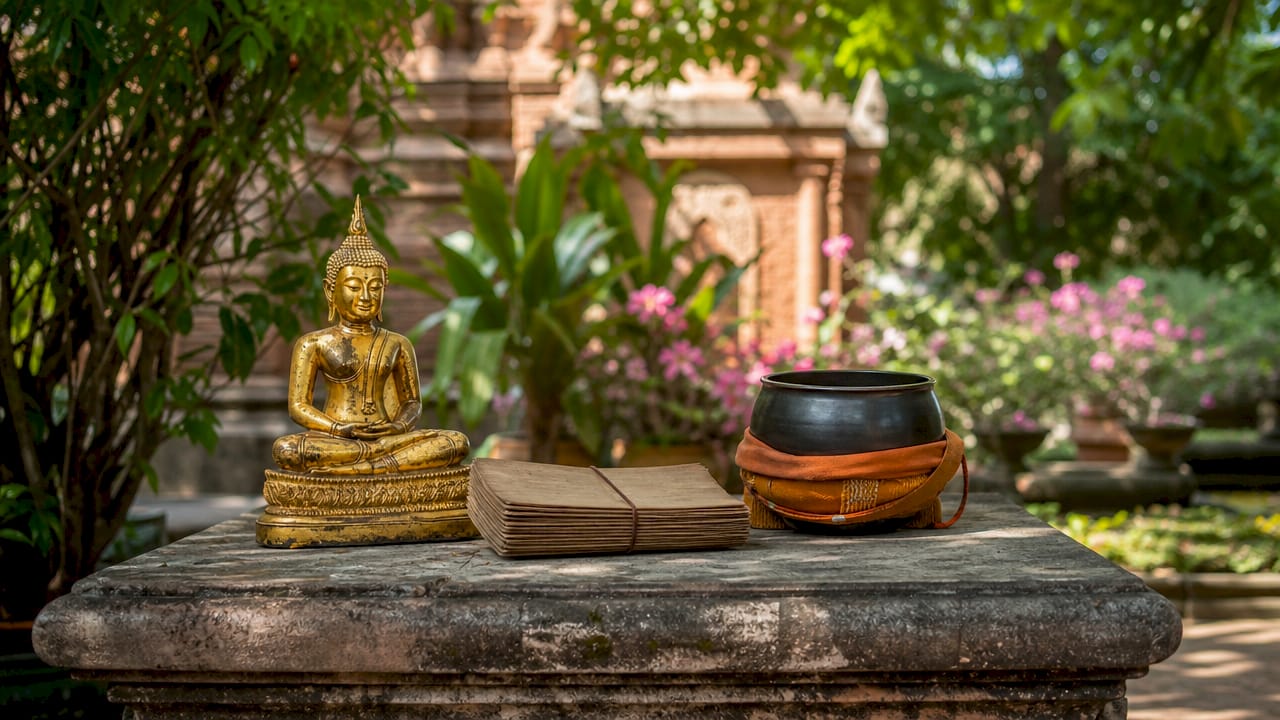
Theravada doctrine, as practiced in Thailand, emphasizes the Pali Canon as the authoritative scriptural source. The Pali Canon contains the earliest recorded teachings of the Buddha and forms the doctrinal backbone of Thai monastic education. This distinguishes Thai Buddhism from Mahayana traditions, which draw on a broader range of Sanskrit texts. For readers interested in how these two traditions diverge visually, the Mahayana art tradition offers a clear contrast in iconography and symbolism.
The core ethical framework for Thai lay practitioners centers on the Five Precepts:
- Abstaining from taking life, including animals
- Abstaining from taking what is not given, meaning no theft
- Abstaining from sexual misconduct
- Abstaining from false speech, including lying and gossip
- Abstaining from intoxicants that cloud the mind
These precepts are not commandments from an external authority. They are training rules that practitioners voluntarily adopt to reduce harm and cultivate mental clarity. Thai Buddhism treats ethics and meditation as inseparable. You cannot develop a stable mind without ethical conduct, and ethical conduct without mental training remains fragile.
One distinction worth understanding: Thai Buddhist culture blends Theravada doctrine with animist and Brahmanical elements. Spirit houses, amulet wearing, and certain royal ceremonies reflect this layering. These are cultural expressions, not core Theravada doctrine. Recognizing that difference helps you engage with Thai religious life more accurately.
How do merit-making and meditation shape everyday Thai Buddhist life?
Merit-making, known in Thai as tam bun, is the central daily practice for lay Buddhists in Thailand. Merit-making activities include offering food to monks at dawn, donating to temples, releasing animals, and participating in seasonal ceremonies such as Songkran and the Rains Residence (Vassa). Each act is understood to generate positive karma that improves one’s present and future circumstances.
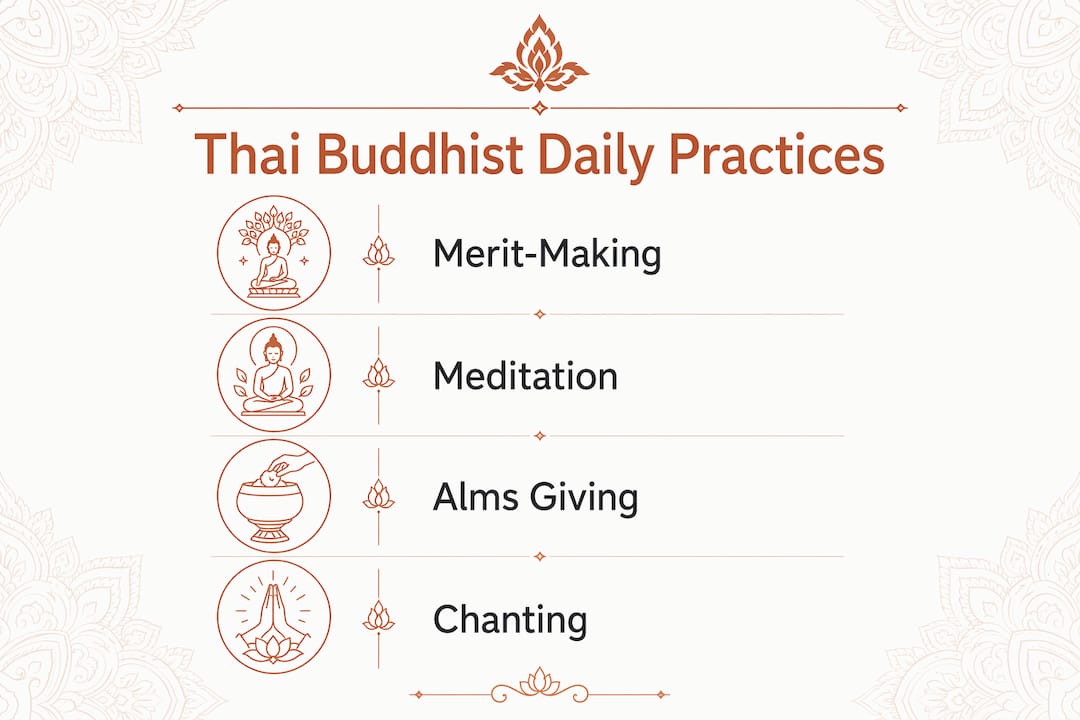
The dawn alms round is the most visible of these practices. Monks walk their routes at sunrise, and lay people line the streets with cooked rice, fruit, and prepared foods. The exchange is deliberate and silent. Monks do not thank donors, and donors do not expect thanks. The act itself is the practice.
Meditation is the other pillar of Thai Buddhist practice. Contemporary research identifies three widely used techniques in Thai Buddhist communities:
- Rising-Falling meditation: Attention is placed on the rise and fall of the abdomen during breathing, a method popularized by the Mahasi Sayadaw tradition and widely taught in Thai vipassana centers.
- Rhythmic Movement meditation: Slow, deliberate walking or hand movements synchronized with breath awareness, used to develop sustained concentration.
- Mindfulness of Breathing (Anapanasati): Direct attention to the breath at the nostrils, one of the oldest techniques in the Pali Canon and the foundation of most Thai forest monastery training.
These three methods have been rated 4.35 out of 5 for quality of life improvement among practitioners. That score reflects genuine, measurable benefit, not anecdotal enthusiasm.
One cultural practice that surprises many visitors involves the interaction protocol between women and monks. Women must never touch a monk or hand items directly to him. Items must be placed on a cloth or surface, or passed through a male intermediary. This rule protects monastic purity under the Vinaya code and is observed strictly across Thailand.
Pro Tip: If you want to participate in alms-giving as a visitor, purchase pre-packaged monk food from vendors near major temples early in the morning. Dress modestly, remove your shoes where required, and observe quietly before joining.
What is the historical development of Thai Buddhism’s monastic structure?
Thai Buddhism is not a static tradition. It has been shaped by royal patronage, reform movements, and deliberate doctrinal revision across centuries. The most significant modern reform came from King Mongkut, who founded the Dhammayuttika Nikaya order in 1833 before ascending the throne. His goal was to strip away folk elements and return Thai monasticism to strict Pali Canon observance. The order received royal endorsement in 1902 and remains one of Thailand’s two official monastic bodies.
The older and larger body is the Maha Nikaya, which encompasses the majority of Thai monks. The two orders differ in certain ritual practices and interpretations of the Vinaya, but both operate under the authority of the Supreme Patriarch and the National Sangha Council.
| Monastic Order | Founded | Orientation | Approximate Size |
|---|---|---|---|
| Maha Nikaya | Pre-reform era | Traditional, majority practice | Largest order in Thailand |
| Dhammayuttika Nikaya | 1833 (King Mongkut) | Strict Pali Canon adherence | Smaller, royally endorsed |
| Dhammakaya tradition | 20th century | Urban, modern organizational methods | Growing urban following |
The Dhammakaya tradition represents a third significant movement. It appeals to Thailand’s urban middle class through modern organizational methods and a controversial teaching about a “true self,” which diverges from classical Theravada’s anattā (no-self) doctrine. Its rise illustrates that Thai Buddhism continues to evolve in response to social and economic change, not just ancient precedent.
Temples historically served as schools, hospitals, and community centers. That function has narrowed in modern Thailand, but major temples still operate monastic schools and social welfare programs. The relationship between the monarchy and the Sangha remains constitutionally significant. The Thai king is expected to be a Buddhist and a protector of the faith.
How does Buddhist art and temple architecture express Thai spiritual identity?
Thai Buddhist art is one of the most recognizable visual traditions in Southeast Asia. The Sukhothai period (13th–15th centuries) produced some of the most refined Buddha images in the world, characterized by flame-shaped ushnisha (the cranial protrusion symbolizing wisdom), elongated facial features, and fluid, walking Buddha poses unique to Thai iconography. These stylistic choices are not decorative. Each element carries doctrinal meaning rooted in Theravada descriptions of the Buddha’s physical marks.
Thai Buddha statues communicate specific teachings through hand gestures called mudras. The most common include:
- Bhumisparsha mudra: Right hand touching the earth, representing the moment of enlightenment
- Dharmachakra mudra: Both hands raised at chest level, representing the first teaching
- Abhaya mudra: One or both hands raised, palm outward, representing protection and fearlessness
- Meditation mudra: Both hands resting in the lap, representing deep concentration
Temple architecture in Thailand follows a consistent spatial logic. Major temples like Wat Pho in Bangkok divide their grounds into two distinct zones: the phutthawat (public devotional area) and the sankhawat (monastic residence and school). This separation is not incidental. It protects monastic practice from constant public interruption while still welcoming lay participation in worship.
| Temple | Type | Defining Feature |
|---|---|---|
| Wat Pho, Bangkok | Historic royal temple | Reclining Buddha, dual public/monastic zones |
| Wat Rong Khun (White Temple), Chiang Rai | Modern private art project | All-white exterior, ongoing construction until 2070 |
| Wat Mahathat, Sukhothai | Ancient ruin | Classic Sukhothai-era stupa and Buddha imagery |
The White Temple (Wat Rong Khun) is a privately funded project by artist Chalermchai Kositpipat, with an investment of 40 million THB and an expected completion date of 2070. It functions as a Buddhist temple but operates outside the traditional monastic system. It shows that Buddhist artistic expression in Thailand remains alive and contested, not frozen in the past.
For collectors and scholars, understanding Thai Buddha styles across historical periods is the foundation for evaluating authenticity, spiritual significance, and artistic quality in any piece.
Key Takeaways
Thai Buddhism is a living Theravada tradition that integrates ethics, meditation, merit-making, monastic structure, and distinctive artistic expression into a single, coherent cultural system.
| Point | Details |
|---|---|
| Theravada foundation | Thai Buddhism follows the Pali Canon, distinguishing it from Mahayana traditions across Asia. |
| Merit-making is central | Daily alms-giving, temple donations, and festival participation form the core of lay Buddhist practice. |
| Meditation has measurable impact | Rising-Falling, Rhythmic Movement, and Mindfulness of Breathing techniques score 4.35 out of 5 for quality of life. |
| Monastic reform shaped the tradition | King Mongkut’s Dhammayuttika Nikaya order in 1833 set the standard for doctrinal purity still observed today. |
| Art encodes doctrine | Thai Buddha mudras and temple spatial design communicate specific Theravada teachings, not just aesthetic choices. |
What I have learned from years of studying Thai Buddhist art and culture
The most common mistake people make when approaching Thai Buddhism is treating it as a museum exhibit. They photograph the temples, admire the statues, and leave without understanding that every object and gesture carries a living doctrinal meaning. A Buddha in the Dharmachakra mudra is not decorative. It represents the first moment the Buddha chose to teach rather than remain silent after his enlightenment. That choice is the reason Buddhism exists at all.
My honest observation after years of working with Thai and Southeast Asian Buddhist art is this: the doctrine and the art are inseparable. You cannot fully appreciate a Sukhothai-period walking Buddha without understanding the Theravada concept of the mahapurisa, the great being whose physical form reflects inner perfection. The art is theology made visible.
For anyone new to Thai Buddhism, I recommend starting with the simplest practice rather than the most complex doctrine. Sit quietly for ten minutes and follow your breath. That single act connects you to a 2,500-year-old tradition more directly than reading any commentary. Then visit a temple, dress respectfully, observe the monks, and watch how lay people interact with the space. You will learn more in one hour of attentive observation than in a week of reading.
One practical point that I cannot stress enough: respect the gender interaction protocols around monks. This is not a suggestion. Violating these rules causes genuine distress to the monastic community and signals a lack of basic cultural awareness. If you are a woman offering something to a monk, place it on the cloth he carries or on a nearby surface. That small act of awareness communicates more respect than any amount of verbal appreciation.
Thai Buddhism rewards patience and humility. Approach it as a living practice, not a cultural curiosity, and it will give you far more than a photograph.
— James, HDAsianArt.com
Authentic Thai and Southeast Asian Buddhist art at HDAsianArt
Thai Buddhist art represents centuries of doctrinal precision expressed in bronze, stone, and wood. For collectors and cultural enthusiasts who want to bring that tradition into their homes, HDAsianArt offers a curated selection of museum-quality pieces sourced from across Southeast Asia.

The collection includes a large antique Thai-style Buddha in the Dharmachakra teaching mudra, standing 84cm tall. Each piece in the HDAsianArt catalog is individually researched, photographed, and described by specialists, with worldwide insured DHL shipping. For those drawn to Bodhisattva iconography from the broader Southeast Asian tradition, the antique Bodhisattva statue collection offers exceptional examples of devotional craftsmanship. Respectful collecting starts with understanding what you are acquiring. HDAsianArt provides that context with every piece.
FAQ
What percentage of Thailand’s population practices Buddhism?
Approximately 95% of Thailand’s population identifies as Buddhist, making Theravada Buddhism the dominant religion and a central organizing force in Thai society.
What is the difference between Maha Nikaya and Dhammayuttika Nikaya?
Maha Nikaya is the older, larger monastic order following traditional Thai practice. Dhammayuttika Nikaya is a reform order founded by King Mongkut in 1833, emphasizing strict adherence to the Pali Canon and receiving royal endorsement in 1902.
What meditation techniques are most common in Thai Buddhism?
The three most widely practiced techniques are Rising-Falling, Rhythmic Movement, and Mindfulness of Breathing. Research rates these methods at 4.35 out of 5 for quality of life improvement among practitioners.
Why can women not hand items directly to Thai monks?
Thai monastic rules derived from the Vinaya code prohibit physical contact between monks and women. Items must be placed on a surface or cloth, or passed through a male intermediary, to preserve monastic purity.
What makes Thai Buddha statues different from other Buddhist traditions?
Thai Buddha imagery, particularly from the Sukhothai period, features a distinctive flame-shaped ushnisha, elongated facial proportions, and a unique walking pose not found in other regional traditions. Each stylistic element encodes a specific Theravada teaching about the Buddha’s nature.
