



Makara in der asiatischen Kunst: Symbolik und wie man sie erkennt
Makara in der asiatischen Kunst: Symbolik und wie man sie erkennt
Makara ist ein hybrides Meeresgeschöpf In der hinduistischen und buddhistischen Mythologie werden Krokodil-, Elefanten- und Fischelemente zu einer einzigen chimären Form kombiniert. Es dient als Wächter heiliger Schwellen, als Vehikel von Fluss- und Meeresgottheiten und ist eines der beständigsten Symbole für Wasser, Fruchtbarkeit und Schutz in der asiatischen religiösen Kunst. Dieser Artikel behandelt die Sanskrit-Etymologie, ikonografische Merkmale und regionale Varianten von Indien nach Java, architektonische Funktionen, Museumsbeispiele und praktische Anleitungen für Sammler bei der Identifizierung von Makara-Motiven.
Inhaltsverzeichnis
Was bedeutet Makara in der asiatischen Kunst?
Das Wort Makara kommt aus dem Sanskrit und wörtlich übersetzt als „Meerestier“ oder „Krokodil“. Es bezeichnet ein Lebewesen, das weder vollständig ein Tier noch ein anderes ist, eine absichtliche Chimäre, deren hybride Anatomie symbolische Bedeutung hat. Die Kreatur erscheint in der südasiatischen Kunst bereits im 1. Jahrhundert v. Chr., wobei Steinreliefs in Barhut zu den frühesten dokumentierten Beispielen gehören.
In der hinduistischen Astrologie ist Makara auch der Name für das Sternzeichen Steinbock, ein Detail, das das Geschöpf mit breiteren kosmologischen Zusammenhängen in Süd- und Südostasien verbindet. Das Cambridge English Dictionary bestätigt diese Gleichwertigkeit direkt.
Wichtige sprachliche und textliche Fakten:
- Sanskrit-Wurzel: Makara (मकर), bedeutet „Meerestier“ oder „Krokodil“
- Früheste Zeugnisse: Steingeländer in Barhut (ca. 100–80 v. Chr.) und der Stupa in Sanchi
- Tierkreisäquivalenz: Makara = Steinbock in der hinduistischen Astrologie
- Verwandte Begriffe: Makaradhvaja („jemand, dessen Flagge einen Makara darstellt“, ein Beiname von Kamadeva); Makarakundalas (Makara-förmige Ohrringe, die von Gottheiten wie Shiva, Vishnu und Surya getragen werden)
- Wörterbucherkennung: Merriam-Webster definiert Makara in der hinduistischen Mythologie als ein Wassermonster, das üblicherweise mit einem krokodilähnlichen Körper und einem antilopenähnlichen Kopf dargestellt wird
Die Tierkreisverbindung ist eine kurze Anmerkung wert. In Jyotisha (hinduistische Astrologie) entspricht Makara Rashi der Zeit der Wintersonnenwende und bringt Assoziationen mit Disziplin, Tiefe und der Grenze des Ozeans mit sich. Diese kosmologische Rolle verstärkt die Schwellensymbolik der Kreatur in der Tempelarchitektur, wo sie die Grenze zwischen gewöhnlichem und heiligem Raum markiert.
Was symbolisiert Makara im Hinduismus und Buddhismus?
Makara hat mehrere sich überschneidende symbolische Rollen, und wenn man sie separat versteht, kann man klären, warum die Kreatur in so vielen verschiedenen rituellen Kontexten auftaucht.
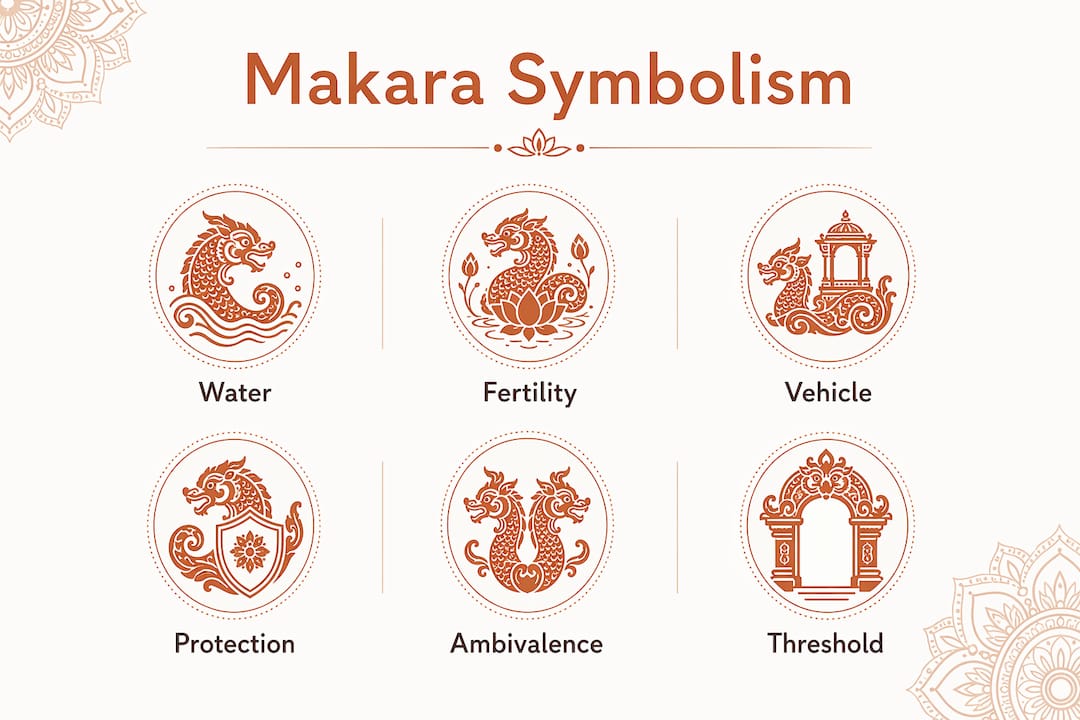
Wasser und Fruchtbarkeit. Die Tradition identifiziert Makara mit Wasser, der Quelle aller Existenz und Fruchtbarkeit. An Quellen, Flussghats und Tempelbecken platziert, signalisieren Makara-Figuren die lebensspendende Kraft des Wassers und seine Verbindung zum Überfluss.
Fahrzeug (Vahana) der Gottheiten. Makara dient als Vahana von Ganga, der Flussgöttin, und von Varuna, dem Gott des Ozeans und der kosmischen Ordnung. In einigen regionalen Traditionen wird Narmada auch auf einer Makara reitend dargestellt. Varuna selbst wird manchmal als weiße Figur dargestellt, die auf der Kreatur sitzt. Diese Assoziationen verankern Makara fest in der göttlichen Herrschaft des Wassers.
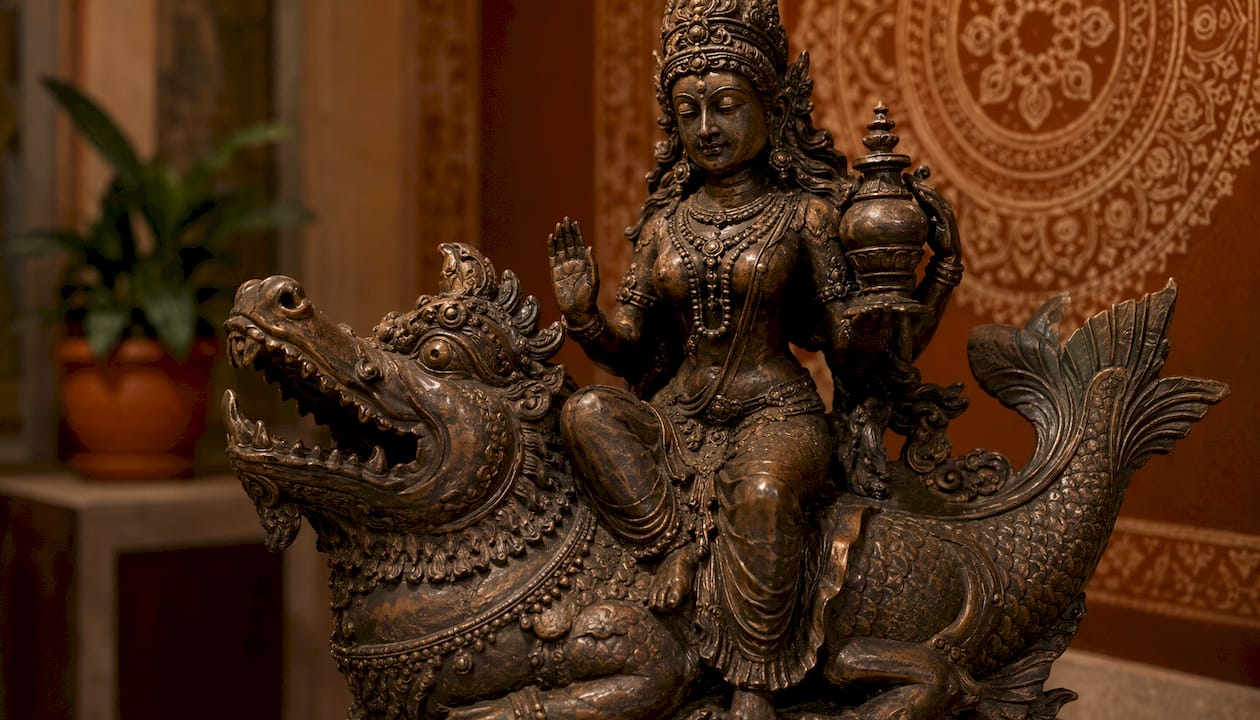
Abzeichen von Kamadeva. Der Liebesgott Kamadeva, der keine eigenen Tempel hat, trägt Makara als sein persönliches Emblem. Sein Beiname Makaradhvaja bedeutet „jemand, dessen Flagge einen Makara darstellt.“ Diese Verbindung verbindet das Geschöpf mit Verlangen, kreativer Energie und der generativen Kraft des Kosmos.
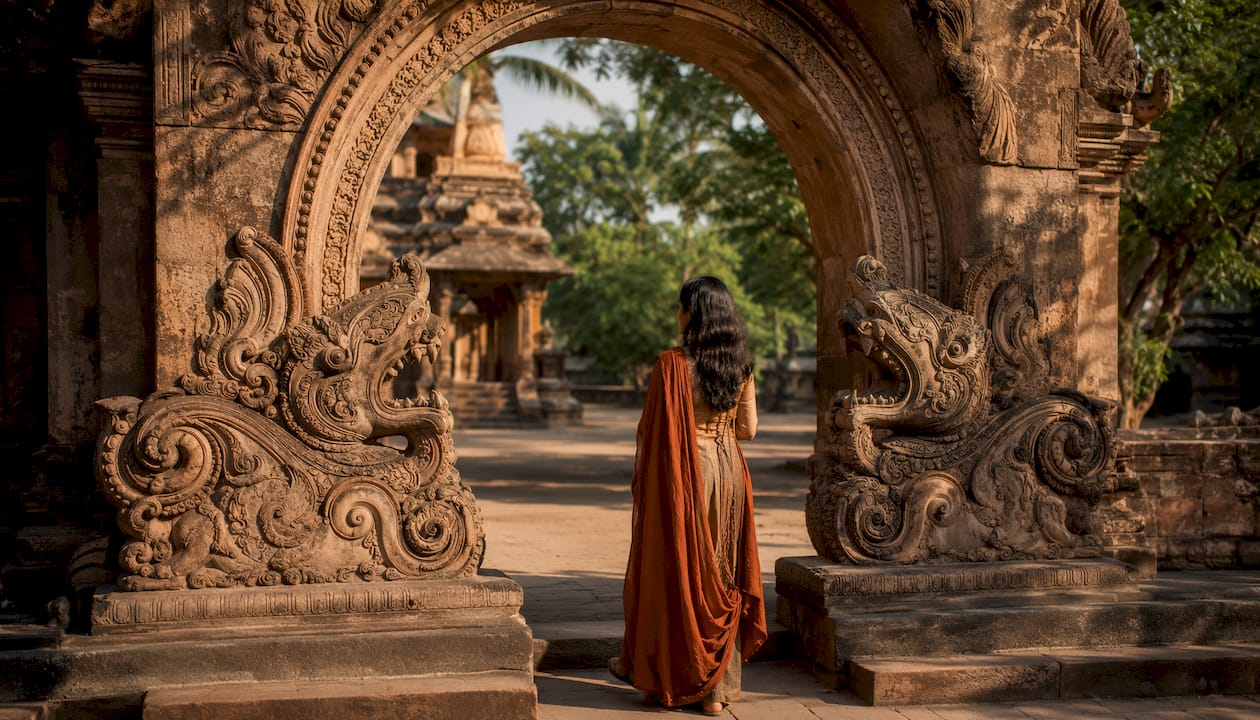
Schwellenwächter. Gelehrte Interpretieren Sie Makara als Grenzsymbol markiert den Übergang vom Profanen zum Heiligen. Makara-Figuren bewachen Tore, Thronsäle und Tempeleingänge. Die psychologische Funktion ist gewollt: Die furchterregende Hybridform der Kreatur signalisiert, dass der Besucher in eine andere Realitätsordnung übertritt.
Ambivalenz: verheißungsvoll und gefährlich. Makara ist nicht rein harmlos. Seine krokodilähnlichen Merkmale bergen eine Bedrohung, und seine Platzierung an der Schwelle dient sowohl als Begrüßung als auch als Warnung. Die Kreatur beschützt diejenigen, die mit der richtigen Absicht eintreten, und signalisiert Gefahren für diejenigen, die dies nicht tun.
In buddhistischen Kontexten wurden Makara-Motive übernommen und adaptiert. Der Stupa in Sanchi, ein UNESCO-Weltkulturerbe, zeigt Makara-Figuren auf seinen Toranas. Buddhistische Kunst gegenüber Sri Lanka, Tibet und Südostasien übernahmen die Rolle des Wächters und des Wassersymbols und veränderten manchmal die visuelle Form der Kreatur, um sie an lokale Konventionen anzupassen.
Woran erkennt man Makara-Ikonographie?
Makaras hybride Anatomie ist der zuverlässigste Identifikator. Kein einzelnes Tier liefert die Vorlage; Die Kreatur ist aus Teilen zusammengesetzt, und die Kombination variiert je nach Region und Epoche.
Charakteristische körperliche Merkmale:
- Krokodil- oder Alligatorschnauze, oft weit geöffnet und klaffend
- Elefantenrüssel oder Stoßzähne ragen aus dem Oberkiefer
- Fischschwanz, manchmal schuppig, nach oben oder außen gewellt
- Gelegentlich: Antilopenbeine, Pfauenschwanzfedern oder Hirschelemente
- Schuppen, die den Körper in vielen indischen und Khmer-Beispielen bedecken
- Auffällige, weit auseinanderstehende Augen (besonders bei späteren javanischen Formen)
Varianten nach Medium:
- Vollständige Skulptur: Freistehende Makara-Figuren aus Stein oder Bronze, oft gepaart an Treppenfüßen oder flankierend zum Eingang eines Schreins
- Sturz-/Torana-Buchstützen: Der Bogen erhebt sich aus den offenen Kiefern eines Makara, gipfelt in einem Kirtimukha (Gesicht der Herrlichkeit) und senkt sich in den Kiefer eines zweiten Makara
- Balustradenhandläufe: Eine Reihe von Makara bildet den Handlauf einer Tempeltreppe, ihre Körper verlaufen über die gesamte Länge des Geländers
- Wasserspeier-/Wasserspeier-Formen: Ausgehöhlte Schnauzen leiten Regenwasser von Dächern weg oder markieren den Ausfluss einer heiligen Quelle
Materialien und Techniken:
Steinschnitzerei ist das gebräuchlichste Medium für architektonische Makara, insbesondere in Sandstein (Indien, Kambodscha) und Andesit (Java). Bronzeguss wurde für tragbare und dekorative Gegenstände, einschließlich Schmuck und Ritualgeräte, verwendet. Holzschnitzereien kommen in Tempeln Sri Lankas und Südostasiens vor. Terrakotta-Makara-Figuren finden sich in früheren indischen Kontexten und als architektonische Ornamente auf Backsteintempeln.
Makaras Bildsprache geht auch über die Skulptur hinaus. Klassische Tanztraditionen Fügen Sie eine Handbewegung namens ein makara-hasta, und das Motiv erscheint auf Schmuck, Textilien und Ritualutensilien. Makara-förmige Ohrringe (Makarakundalas) werden auf großen hinduistischen Gottheiten in Skulpturen und Gemälden dargestellt.
Profi-Tipp: Wenn Sie einen Türsturz oder Bogen untersuchen, suchen Sie nach der Kreatur an beiden unteren Ecken, deren Maul offen ist und nach innen zeigt. Wenn der Bogen in offenen Kiefern und nicht in einer dekorativen Schriftrolle endet, handelt es sich mit ziemlicher Sicherheit um eine Makara-Torana.
Wie verändert sich Makara über Regionen und Zeiträume hinweg?
Die Makara-Motiv migriert Von der indischen Architekturskulptur bis hin zu südostasiatischen und ostasiatischen Kontexten, die sich bei jedem Halt optisch und funktional anpassen. Regionale Stilunterschiede sind so bedeutend, dass ein geschultes Auge ein Objekt oft allein anhand der Form der Makara geografisch einordnen kann.
| Region | Zeitraum | Wichtige visuelle Merkmale | Primäre Verwendung |
|---|---|---|---|
| Indien (Barhut, Sanchi) | 1. Jh. BCE weiter | Krokodilkörper, Elefantenrüssel, Fischschwanz; relativ naturalistisch | Torana-Buchstützen, Stupa-Geländer |
| Süden Indien (Konarak, Tamil Nadu) | 8.–10. Jh. CE | Aufwändige Scroll-Schwänze, integriert mit Kirtimukha | Tempelstürze, Wagenräder |
| Kambodscha/Khmer | — | Stilisiert, stark verziert; in komplexe Sturzprogramme integriert | Torstürze, Balustraden |
| Zentral-Java (Indonesien) | 8.–10. Jh. CE | Naturalistischere Formen; Andesitstein | Tempeleingänge, Wasserspiele |
| Ost-Java (Indonesien) | — | Breitere Augen, J-förmige Zierschnörkel, stark stilisiert | Zierfries, Torpfosten |
| Nepal/Tibet | 10. Jh. CE ab | Integriert in die buddhistische Mandala-Architektur; manchmal abstrahiert | Torana hinter Buddhastatuen, Türen |
| Sri Lanka | Von der Antike an | Herausragend in der singhalesisch-buddhistischen Architektur; gepaart mit Nagas und Garuda | Toranas, Holztüren |
Regionale Hinweise:
- Zentral- vs. Ost-Java: Stilistisches Zeitliniendokument eine deutliche Verschiebung von der naturalistischeren mitteljavanischen Makara des 8.–10. Jahrhunderts zu den kunstvollen, weitäugigen J-Schriftrollenformen Ostjavas. Sammler können diese Details als Herkunftsindikatoren verwenden, wenn sie Querverweise mit Standorttypologien herstellen.
- Khmer Kambodscha: Makara-Stürze in Angkor Wat und Preah Vihear zeigen die Kreatur, die vollständig in narrative Hilfsprogramme integriert ist, oft gepaart mit Naga-Schlangen in einem kombinierten Wächterschema.
- Nepal und Tibet: Makara erscheint auf dem Torana (Bogen) hinter Buddha- und Bodhisattva-Bildern, manchmal abstrahiert in einer dekorativen Schriftrolle. Die Wassersymbolik der Kreatur steht in Verbindung mit tantrischen ikonografischen Programmen. Für einen breiteren Kontext auf tantrische buddhistische Ikonographie, das symbolische Vokabular geht weit über die reine Makara hinaus.
- Ostasiatische Echos: Die Tradition der chimären Meeresbewohner hat moderne bürgerliche Anklänge, am sichtbarsten in Singapurs Merlion, einem Rotfeuerfisch-Hybriden, der auf der gleichen tiefen ikonografischen Logik eines mächtigen, hybriden Wasserwächters basiert.
Wie wird Makara in der Tempelarchitektur verwendet?
Makara fungiert sowohl als Ornament als auch als Struktur im Tempeldesign. Seine Platzierung ist niemals willkürlich; Jeder Ort entspricht einem bestimmten Ritual oder praktischen Zweck.
Torana-Bogen-Buchstützen. Die bekannteste architektonische Nutzung. In einem Hindu-Tempel entspringt der Bogen über dem Schrein einer Gottheit oft dem offenen Maul eines Makara, erhebt sich zu einem Kirtimukha an der Spitze und taucht in das Maul eines zweiten Makara hinab. Der Bogen geht buchstäblich durch den Körper der Kreatur und umrahmt die Gottheit innerhalb einer vom Wächter definierten Zone.
Treppengeländer. Eine Reihe von Makara bildet den Handlauf einer Tempeltreppe. Ihre Körper erstrecken sich über die gesamte Länge des Geländers und haben Köpfe an der Basis. Das Erklimmen der Treppe bedeutet, zwischen zwei Reihen von Wächtern hindurchzugehen. Diese Anordnung ist in Khmer- und javanischen Tempelanlagen üblich.
Regenwasserspeier und Quellausläufe. Makara-Figuren wurden als funktionale Elemente konstruiert: Ausgehöhlte Schnauzen leiten Regenwasser von Tempeldächern oder markieren den Ausfluss einer heiligen Quelle. Ein Makara mit hohler Schnauze ist mit ziemlicher Sicherheit eher ein architektonisches Element als eine Andachtsskulptur, und diese Unterscheidung ist für Sammler bei der Beurteilung der Herkunft von Bedeutung.
Schwellenpsychologie. Gelehrte betrachten die Makara als Grenzsymbol, das den Übergang vom profanen zum heiligen Raum markiert. Das furchteinflößende Erscheinen der Kreatur am Eingang ist kein dekorativer Überschuss; Es ist ein bewusstes Signal, dass der Besucher eine Grenze mit Konsequenzen überschreitet. Diese psychologische Funktion ist in allen hinduistischen und buddhistischen Traditionen und im gesamten geografischen Bereich des Motivs konsistent.
Bemerkenswerte historische Beispiele und Museumsbestände
Die dokumentierte Geschichte der Makara erstreckt sich über mehr als zwei Jahrtausende. Die folgenden Beispiele stellen Schlüsselmomente in dieser Zeitleiste dar und sind in den Sammlungen wichtiger US-amerikanischer Museen zugänglich.
| Beispiel | Datum | Standort/Sammlung | Worauf Sie achten sollten |
|---|---|---|---|
| Barhut-Stupa-Geländer | c. 100–80 v. Chr | Indisches Museum, Kalkutta (Abgüsse/Fotos bei Freer | Sackler) |
| Sanchi Stupa Toranas | c. 1. Jh. Chr. – 1. Jh. v. CE | Sanchi (UNESCO-Weltkulturerbe); Dokumentation bei Freer | Sackler Galleries, Smithsonian |
| Sonnentempel von Konarak | — | Odisha, Indien; Vergleichsbestände bei LACMA | Makara in Wagenradfries und Stürze integriert |
| Khmer-Sturzfragmente | 8.–10. Jh. CE | Das Metropolitan Museum of Art, New York | Stilisierte Makara an den Sturzecken mit Kirtimukha |
| Zentraljavanischer Stein-Makara | 8.–10. Jh. CE | Verschiedene; Vergleichsmaterial bei LACMA und Freer | Sackler |
| Nepalesische Torana | — | Freier | Sackler Galleries, Smithsonian |
Museumsressourcen für US-Forscher:
Die Metropolitan Museum of Art (New York) beherbergt süd- und südostasiatische Skulpturen mit dokumentierten Makara-Motiven, insbesondere in seinen süd- und südostasiatischen Kunstgalerien. Katalogeinträge sind online durchsuchbar und enthalten Herkunftshinweise.
Die Freer|Sackler Galerien (Smithsonian, Washington, D.C.) verfügen über eine der umfangreichsten Sammlungen südasiatischer Architekturfragmente im Land, darunter dokumentierte Torana-Elemente und Vergleichsmaterial für Barhut und Sanchi.
LACMA (Los Angeles County Museum of Art) verfügt über bedeutende süd- und südostasiatische Bestände, darunter Khmer- und javanisches Material, in dem Makara-Motive im architektonischen Kontext auftauchen. Ihr Online-Katalog ist eine praktische Referenz für den regionalen Vergleich.
Für Kunsttraditionen des Mahayana-Buddhismus Diese Museumssammlungen enthalten Makara-Motive und bieten die visuelle Vergleichbarkeit, die erforderlich ist, um ein bestimmtes Objekt in seinen regionalen und chronologischen Kontext zu stellen.
So identifizieren und sammeln Sie Makara-Kunst
Die Identifizierung eines echten Makara-Motivs und die Bewertung des Objekts, das es trägt, erfordert einen strukturierten Ansatz. Die folgende Checkliste befasst sich mit der visuellen Identifizierung, der Zustandsbewertung, der Herkunftsüberprüfung und den rechtlichen Überlegungen in den USA.
1. Checkliste zur visuellen Identifizierung
Bestätigen Sie das Vorhandensein von mindestens drei der folgenden Merkmale: offene Krokodilschnauze, Elefantenrüssel oder Stoßzähne, Fisch- oder Schuppenschwanz, weit auseinanderstehende, hervorstehende Augen, rollender Zierschwanz (Ost-Java), hohle Schnauze (Tüllenfunktion). Eine einzelne Funktion reicht nicht aus; die chimäre Kombination ist der Identifikator.
2. Medienspezifische Zeichen
- Bronze: Achten Sie auf Gussnähte entlang des Körpers, Werkzeugspuren an Detailbereichen (Schuppen, Stoßzähne) und Patina, die mit dem Alter und dem Bestattungskontext übereinstimmen. Eine gleichmäßige grüne Patina auf allen Oberflächen kann auf eine künstliche Alterung hinweisen.
- Stein: Werkzeugmarkierungen sollten mit der Technologie des beanspruchten Zeitraums übereinstimmen. Moderne Nachschnitzarbeiten zeigen oft schärfere und gleichmäßigere Schnitte als Originalarbeiten. Überprüfen Sie, ob zwischen der Karosserie und den reparierten Abschnitten unregelmäßige Witterungseinflüsse vorhanden sind.
- Holz: Die Maserungsrichtung, die Insektenschadensmuster und die Farb- oder Lackschichten sollten durchgehend einheitlich sein. Ersetzte Abschnitte zeigen bei näherer Betrachtung oft unterschiedliche Holzarten.
3. Hohle Schnauze und architektonischer Kontext
Ein Makara mit hohler Schnauze war mit ziemlicher Sicherheit ein architektonisches Wasserspeierelement. Dies wirkt sich auf Wert, Ausstellung und Herkunft aus: Architekturfragmente aus Tempelanlagen erfordern eine sorgfältige Dokumentation ihrer Entfernungsgeschichte.
4. Provenienz und Authentifizierung
- Fordern Sie eine dokumentierte Herkunft an, die möglichst weit zurückreicht, idealerweise vor 1970 (der Maßstab der UNESCO-Konvention für Kulturgut).
- Fragen Sie nach Museumsvergleichen: Kann der Verkäufer auf einen veröffentlichten Katalogeintrag für ein vergleichbares Stück verweisen?
- Bei Bronzeobjekten können Metallzusammensetzungsuntersuchungen (RFA-Analyse) Legierungstypen bestätigen, die mit dem angegebenen Zeitraum und der angegebenen Region übereinstimmen
- Die Kohlenstoffdatierung gilt für organische Materialien (Holz, Lack); Die Thermolumineszenzprüfung gilt für Terrakotta
5. Rechtliche und ethische Überlegungen für US-Sammler
Für Objekte, die bilateralen Kulturgutabkommen zwischen den USA und den Herkunftsländern unterliegen, ist eine Einfuhrdokumentation erforderlich. Kambodscha, Indien, und Indonesien Alle haben Vereinbarungen mit den USA im Rahmen des Convention on Cultural Property Implementation Act. CITES-Beschränkungen gelten, wenn das Objekt Elfenbein enthält (Elefantenstoßzähne sind in manchen Epochen ein häufiges Makara-Merkmal). Bevorzugen Sie Objekte mit vollständiger Exportdokumentation aus dem Herkunftsland und einer klaren Produktkette.
6. Warnsignale für den Zustand
Achten Sie auf: modernes Nachschnitzen abgenutzter Details, unregelmäßige Patina auf der Oberfläche, ersetzte oder wieder angebrachte Teile (insbesondere Schnauzen und Schwänze, die strukturell anfällig sind) und Papierkram, der nicht unabhängig überprüft werden kann.
Profi-Tipp: Fragen Sie den Verkäufer direkt: „Ist dieses Objekt in einem Museumskatalog oder einem veröffentlichten Ausgrabungsbericht aufgeführt?“ Ein seriöser Händler wird entweder die Referenz angeben oder deren Fehlen anerkennen. Vage Antworten zu „Privatsammlungen“ ohne Dokumentation sind ein Warnsignal. Die Leitfaden für buddhistische Kunstsammlungen Bei HDAsianArt wird dieser Überprüfungsprozess ausführlicher behandelt.
Zur Anleitung dazu Ausstellung religiöser buddhistischer Kunst Sobald Sie ein Stück erworben haben, sind die richtige Platzierung und der richtige Kontext ebenso wichtig wie die Authentifizierung.
Dieser Artikel enthält allgemeine Bildungsinformationen, keine rechtliche oder professionelle Beratung. Bestätigen Sie die aktuellen Einfuhrbestimmungen und Kulturgutvorschriften mit einem qualifizierten Anwalt oder den für Ihre spezifische Situation relevanten Richtlinien des US-amerikanischen Zoll- und Grenzschutzes.
Wichtige Erkenntnisse
Makara ist das am häufigsten wiederkehrende Wächtermotiv in der hinduistischen und buddhistischen Tempelkunst, erkennbar an seiner chimären Anatomie und seiner Platzierung an architektonischen Schwellenwerten in ganz Süd- und Südostasien.
| Punkt | Einzelheiten |
|---|---|
| Sanskrit-Definition | Makara bedeutet übersetzt „Meerestier“ oder „Krokodil“ und entspricht in der hinduistischen Astrologie dem Sternzeichen Steinbock. |
| Drei visuelle Hinweise | Eine offene Krokodilschnauze, ein Elefantenrüssel oder Stoßzähne sowie ein Fisch oder Schuppenschwanz kennzeichnen in allen Regionen einen Makara. |
| Primäre symbolische Rollen | Wächter der Schwellen, Vahana von Ganga und Varuna, Insignien von Kamadeva und Symbol für Wasser und Fruchtbarkeit. |
| Regionale Dating-Marker | Zentraljavanische Makaras (8.–10. Jh.) sind naturalistisch; Ostjavanische Formen zeigen größere Augen und J-förmige Schriftrollen. |
| HDAsianArt-Sammelanleitung | HDAsianArt kuratiert authentifizierte Stücke mit dokumentierter Herkunft, Expertenbeschreibungen und versichertem weltweiten Versand für Sammler, die nach verifizierten Objekten suchen. |
Warum Makara für ernsthafte Sammler immer noch wichtig ist
Die Makara ist eines dieser Motive, die anhaltende Aufmerksamkeit belohnen. Die meisten Besucher eines Tempels oder Museums bemerken die Kreatur am Tor und gehen weiter. Sammler, die lange genug innehalten, um die Anatomie, die Platzierung und die regionalen Beugungen zu lesen, stellen fest, dass eine einzelne Makara-Figur ein präzises Gespräch darüber vermitteln kann, wo, wann und zu welchem rituellen Zweck ein Objekt hergestellt wurde.
Was häufig unterschätzt wird, ist der Funktionsumfang der Kreatur. Makara ist nicht nur Dekoration. Es ist ein Wassermanagementgerät, ein kosmologischer Grenzmarker, das Vehikel einer Gottheit und das Emblem eines Liebesgottes, alles in einer Form. Gerade diese Bedeutungsdichte macht es zu einem zuverlässigen Indikator für die Qualität einer Sammlung: Objekte mit Makara-Motiven wurden fast immer für bedeutende rituelle Kontexte und nicht für eine zufällige Produktion hergestellt.
Auch die regionale Variation ist nützlicher, als es zunächst scheint. Der Übergang von naturalistischen zentraljavanischen Formen zu den kunstvollen, weit aufgerissenen ostjavanischen Versionen ist nicht nur eine ästhetische Veränderung; es ist eine chronologische und geografische Signatur. Ein Sammler, der diese Unterscheidung kennt, kann sie mit Herkunftsangaben und veröffentlichten Ausgrabungsaufzeichnungen vergleichen. Diese Art der ikonografischen Kompetenz ist der praktische Nutzen einer sorgfältigen Beschäftigung mit dem Motiv.
Für jeden, der eine Sammlung süd- oder südostasiatischer religiöser Kunst aufbaut, ist die Makara ein guter Ort, um mit der Entwicklung dieser Alphabetisierung zu beginnen. Es erscheint in genügend Regionen, Zeiträumen und Medien, sodass die Verfolgung seiner Variationen ein funktionierendes Wissen über die breitere Tradition aufbauen kann.
Authentifizierte Makara-angrenzende Kunst bei HDAsianArt
Für Sammler, die vom Studium zum Erwerb übergehen möchten, bietet HDAsianArt eine kuratierte Auswahl authentischer antiker und traditioneller asiatischer buddhistischer und hinduistischer Skulpturen von Kambodscha, Thailand, Indonesien, Sri Lanka, Vietnam und darüber hinaus. Jedes Stück wird individuell von Spezialisten recherchiert, fotografiert und beschrieben, mit dokumentierter Herkunft und weltweitem versichertem DHL-Versand.
Zu den javanischen Beständen der Galerie gehören Stücke, die einen direkten Bezug zur Makara-Tradition haben, darunter auch dieses Javanischer Avalokiteshvara-Bodhisattva aus derselben zentraljavanischen Tradition, die einige der naturalistischsten Makara-Skulpturen der Geschichte hervorgebracht hat. Für Sammler, die sich für die breitere Bronzetradition der Region interessieren, ist die antike bronzene Buddhastatue Die Sammlung veranschaulicht die Gussstandards und die Provenienzdokumentation, die HDAsianArt bei jedem Erwerb anwendet. Durchsuchen Sie die vollständige Seite HDAsianArt-Galerie Oder wenden Sie sich direkt an das Team, um eine bestimmte Anschaffung zu besprechen oder Vergleiche für ein Stück anzufordern, das Sie bewerten.
Nützliche Quellen für weitere Recherchen
Museumssammlungen (in den USA zugänglich):
- Das Metropolitan Museum of Art (metmuseum.org): Suchen Sie in der Sammlung süd- und südostasiatischer Kunst nach „makara“ nach dokumentierten Sturzfragmenten und architektonischen Elementen mit Katalognotizen.
- Freer|Sackler Galleries, Smithsonian (freersackler.si.edu): Starke Bestände an südasiatischer Architekturskulptur; Vergleichsmaterial für Barhut-, Sanchi- und nepalesische Toranas mit veröffentlichten Katalogeinträgen.
- LACMA (lacma.org): Die süd- und südostasiatische Sammlung umfasst Khmer- und javanisches Material; Der Online-Katalog ist nach Region und Zeitraum durchsuchbar.
Akademische Quellen:
- Yokochi, Y. (2020). „Makara-Indigenisierung in Zentral- und Ost-Java.“ Zeitschrift für indische und buddhistische Studien, 68(3). Dokumentiert den stilistischen Wandel zwischen mittel- und ostjavanischen Formen anhand datierter Beispiele.
- „Die chimäre Spur: Die Makara und andere zukünftige Verbindungen.“ Asiatische Kunst und Kultur (2022). DOI: 10.1080/17561310.2022.2114674. Frames Makara als Fallstudie zur Motivmigration in Süd- und Südostasien.
- JSTOR (stabil/3250095): Wissenschaftlicher Artikel über rituelle Schwellen und die psychologische Funktion von Grenzmarkierungen in der hinduistischen Tempelarchitektur.
Referenzdefinitionen:
- Merriam-Webster: Der Eintrag „Makara“ bestätigt die Wassermonster-Definition und die Steinbock-Äquivalenz für eine schnelle lexikalische Referenz.
- Wisdom Library (wisdomlib.org): Umfassende Sanskrit-Definition, die Makara-hasta, Makarakundalas und medienübergreifende Erscheinungen abdeckt.
So nutzen Sie diese Quellen: Museumskatalogeinträge bieten die für die Authentifizierung am nützlichsten visuellen Vergleiche. Wissenschaftliche Artikel liefern den regionalen und chronologischen Rahmen, der dabei hilft, ein bestimmtes Objekt zu datieren und zu platzieren. Der Vergleich beider Stücke mit der angeblichen Herkunft eines Stücks ist der zuverlässigste Ansatz, der einem nicht spezialisierten Sammler zur Verfügung steht.
Empfohlen
- Das Mandala in den Händen von Khmer Ganesha: Symbolik und Bedeutung – HD Asian Art
- Die Rolle der Mandorla in der buddhistischen Kunst: Ein Leitfaden für Gelehrte – HD Asian Art
- Die meditierende Hevajra-Skulptur: Symbolik und Bedeutung in Buddhi – HD Asian Art
- Theravada-buddhistische Skulptur für Kunstwissenschaftler erklärt – HD Asian Art
