



Bronze Ganesh Statue
Bronze Ganesh Statue
You're looking at two photographs of a bronze Ganesh statue, or perhaps two figures side by side on a shelf. Both have the familiar elephant head, a warm dark surface and a reassuring weight. One costs more, one looks brighter, and neither listing tells you quite enough to decide. That's the normal starting point, and it's exactly where careful looking helps. Colour, shine and heft can start a conversation, but they can't finish it. What settles a choice is whether iconography, material, construction, condition, documentation and intended use line up.
Table of Contents
- Choosing a Bronze Ganesha Statue with Confidence
- Understanding Bronze Ganesha Forms and Materials
- Reading Ganesha Symbols and Iconographic Details
- Comparing Bronze Casting Methods and Historic Examples
- Inspecting Authenticity, Age and Craftsmanship
- Matching a Bronze Ganesha Statue to Your Purpose
- Protecting the Surface and Structure of Bronze
- Placing, Packing and Importing Your Statue
Choosing a Bronze Ganesha Statue with Confidence
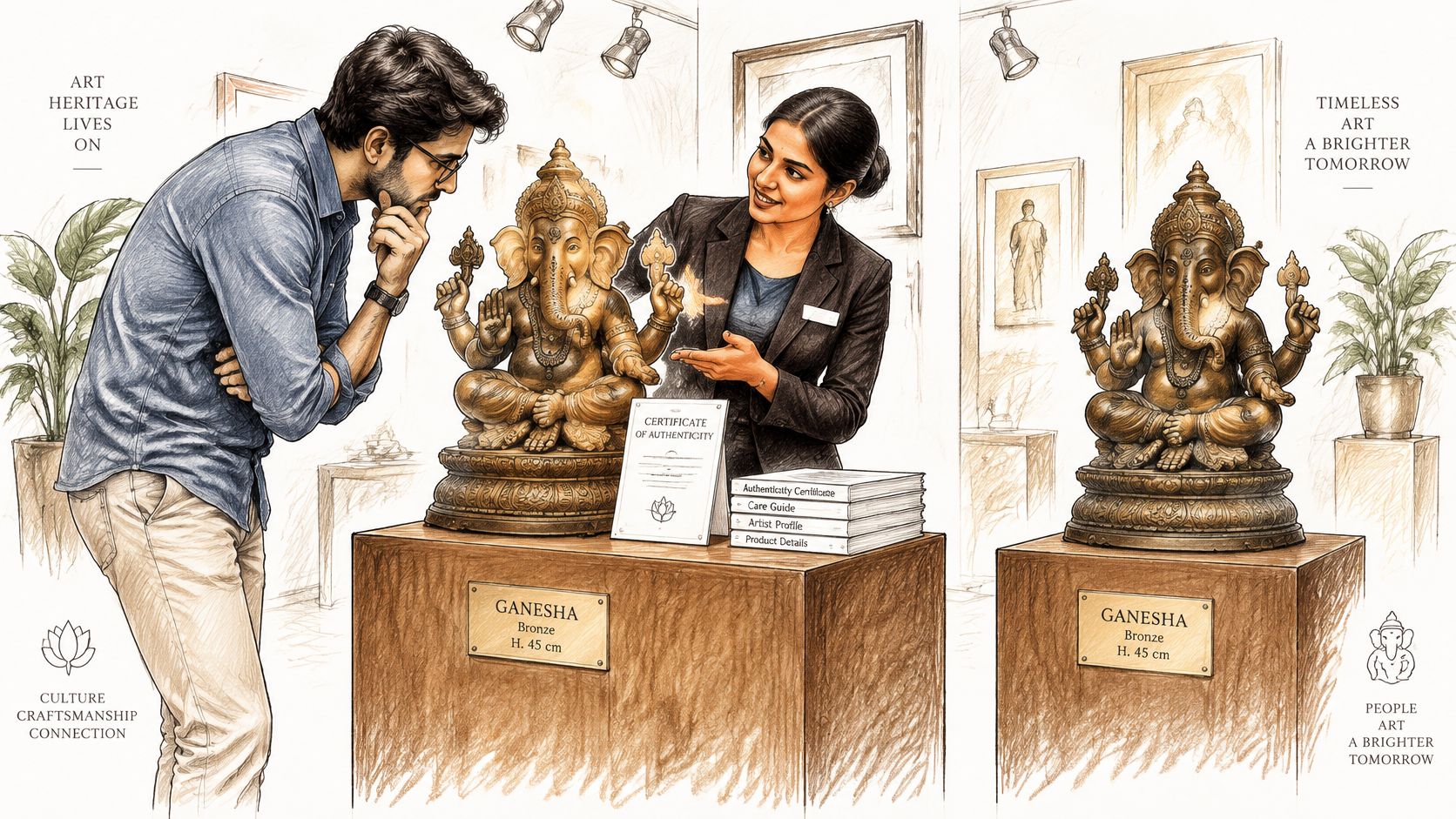
A buyer I often picture has narrowed a long search to two seated figures. The first has a glossy finish and a confident sales description, but no view of the underside, no weight and no note about repairs. The second looks quieter in photographs, yet the seller shows the back, the base and the joins, gives exact measurements and explains that the surface hasn't been polished.
Neither photograph alone proves which piece is older or more authentic. The second listing gives you more to test. You can see whether the base suits your shelf, whether projecting hands look intact and whether the finish matches the description. You're comparing evidence, not just appearance.
What to settle before price
Ask first what the figure is meant to do. A household shrine, a private collection and a museum-style display place different weight on clarity of form, age, rarity and ease of care. A contemporary devotional image may serve daily worship beautifully, while a collector may prioritise documented history even if the surface is worn.
Then work through the object itself. Look at posture and attributes, how it was cast, whether it's solid or hollow, and how its surface has been treated. Check scale against the actual space, not a cropped photograph.
Practical rule: If two figures look alike, favour the one you can describe, measure and document more completely, then decide whether that evidence fits your purpose.
That approach protects households, interior designers and institutions alike. It also prevents a common mistake, treating bronze colour as proof of age, origin or authenticity. A satisfactory purchase aligns what you can observe with what the seller can support, and with the setting where the statue will live. Once those parts agree, price becomes a judgement you can explain rather than a guess you're hoping is right.
Understanding Bronze Ganesha Forms and Materials
Start with recognition before valuation. Ganesha is identified most readily by his elephant head on a human body, but that single feature doesn't tell you which representation you're viewing. Posture, crown, number of arms, objects in the hands and the design of the base all change how a figure reads.
A seated figure often feels settled and frontal, suited to being viewed from one main position. A standing figure has a different balance and silhouette, and a dancing form introduces movement that needs more visual space around it. None is automatically more correct. You're learning to name what you see so you can compare like with like.
Separating four different characteristics
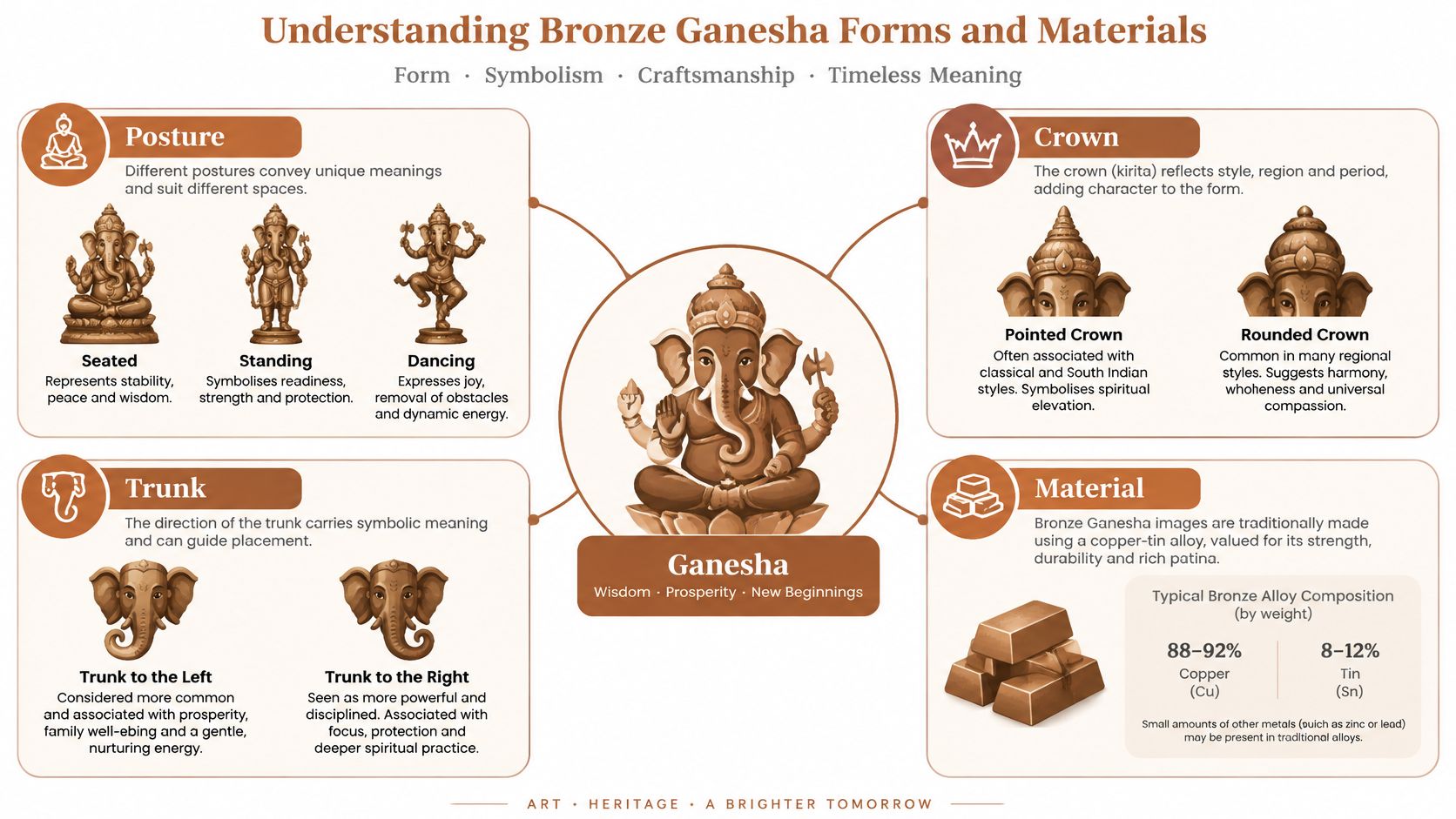
Buyers often run four separate ideas together. Keeping them apart makes a listing much easier to read.
- Material: Bronze is a copper-based alloy, but a bronze-coloured surface doesn't by itself disclose the alloy underneath.
- Casting method: How the mould was made and the metal poured affects detail, joins and whether parts were cast separately.
- Size and construction: Height, width, depth, weight and hollow or solid construction determine stability and handling.
- Patina and finish: Surface colour can result from age, handling, burial, cleaning or deliberate patination after casting.
A seller calling an object a bronze Ganesh statue should be able to support that description. Ask what alloy information is available, how the piece was made and whether the finish is described as natural or applied. If the answer is only that it looks bronze, treat the material claim as unconfirmed rather than false.
Why colour misleads
Freshly cast metal, chemically darkened metal and an older handled surface can share similar tones in a photograph. Lighting can warm a pale alloy or flatten a rich one. Polishing can also remove variation that would otherwise help you read raised and recessed areas.
Look instead for consistency. Does the surface change gradually around the trunk, fingers, crown and ornaments, or does it look uniformly coated? Do recesses hold darker material while high points look gently worn? Those observations don't date the piece, but they give you precise questions. Precise questions are the foundation for every later judgement about age and authenticity.
Reading Ganesha Symbols and Iconographic Details
Close reading begins with description, not interpretation. Count the arms, note what each hand holds, follow the direction of the trunk, and record whether there's a base, an arch or an accompanying animal. Only after you've described the whole composition should you start asking what individual features may signify.
A useful museum example makes this concrete. The Victoria and Albert Museum records a cast-bronze Ganesha made in South India between 1800 and 1875, formed in three pieces as a seated deity, a base and an arch, in its V&A record for the South Indian cast-bronze Ganesha. Its hands hold an axe, noose, sweets and his broken tusk, and the trunk turns to the left, while the rat vehicle commonly associated with Ganesha is absent in that same record.
Reading the whole composition
Notice how much that description does without forcing a single meaning onto every detail. The base and arch aren't background decoration. They frame the deity, affect height and stability and tell you whether parts may have been cast separately. An absent vehicle is also information, because it prompts you to check whether it was never part of the design or has been lost.
Apply the same discipline to any bronze Ganesh statue you're considering:
- Trunk direction: Record left or right from the figure's perspective as the seller defines it, and check photographs agree.
- Held attributes: Identify each object by shape before accepting a named interpretation.
- Arms and hands: Look for replaced fingers, reattached attributes or awkward joins at the wrist.
- Crown and ornaments: Compare detail on the front with the back, where finishing is sometimes plainer.
- Base and arch: Check fit, colour match and whether separate pieces sit securely together.
For a fuller account of how individual attributes are discussed, see this guide to Ganesha's attributes and their symbolic meanings. Use it to enrich your reading, not to assign a date or region from one familiar object.
One recognisable attribute can help identify Ganesha. It cannot, on its own, prove where a statue was made, how old it is or how it was used.
That restraint matters. Traditions vary, makers interpret forms differently and later owners sometimes alter or replace parts. If you can describe a figure accurately, you can speak clearly with a seller, a conservator or another collector. You'll also spot when a listing names a symbol that isn't visible. Good iconographic reading is therefore both cultural respect and practical due diligence.
Comparing Bronze Casting Methods and Historic Examples
A collector who can tell one casting tradition from another reads a bronze the way a registrar reads an object file: layer by layer, claim by claim. Two contrasting reference points make that easier. One is a single documented museum figure with a traceable ownership history. The other is a production tradition whose surviving examples sit in UK public collections.
The documented figure is a copper Ganesha from Tamil Nadu, possibly Coimbatore, dated to the thirteenth century and standing 15.6 inches high with four arms, according to the V&A record for the thirteenth-century Tamil Nadu figure. That record identifies the production method as cire-perdue, or lost-wax casting, and notes purchase by the museum in 1924 from Lilian S. Bradley, widow of former colonial administrator Herbert Bradley.
A documented figure and a processional tradition
| Example | Date and origin | Form | Production | Documented condition or detail |
|---|---|---|---|---|
| Tamil Nadu figure | Thirteenth century, possibly Coimbatore | Standing, four arms, 15.6 inches high | Lost-wax casting in copper | Purchased by the V&A in 1924 and later cited in scholarly cataloguing |
| Chola-period processional Ganesha | Medieval South India, Chola dynasty | Figure cast for temple festival processions | Lost-wax casting in copper alloy | Surviving examples in UK public collections often show softened facial detail consistent with ritual washing and handling |
These two rows answer different questions, and that contrast is the lesson. The V&A figure shows what a single documented object looks like: a stated date, a stated method, a named vendor and an accession trail you can verify. The Chola tradition shows what repeated functional production looks like: related castings made for active use rather than display, whose worn surfaces record how they were carried, bathed and handled over long periods.
What lost-wax casting explains, and what it doesn't
In lost-wax casting, a wax model is encased, the wax is removed and molten metal takes its place. Detail worked into the wax can transfer into metal, which is why the method suits fine modelling. You can follow the sequence step by step in this explanation of lost-wax casting and how bronze statues are made.
Resist the shortcut. Lost-wax describes a method, not a date, since makers have used versions of it across long periods and continue to do so. A recent lost-wax bronze Ganesh statue isn't deceptive because it's recent, and an early casting isn't superior because its surface looks older.
Compare across several dimensions instead. How crisp are the eyes, hands and ornaments? How are separate parts joined? Does the documented history support the stated origin? Does the condition match the claimed history, or does it raise questions? The V&A record above shows what solid documentation contains. A listing that offers none of those elements gives you less to check, which is reason for caution rather than trust.
Inspecting Authenticity, Age and Craftsmanship
A seller sends three glowing photographs, a price that feels urgent and a date stated with confidence. Start slower. Protect the object first, then test the claim: photographs and paperwork, non-destructive observation, specialist analysis only when a material fact remains unresolved. Do not clean, polish or dismantle a bronze Ganesh statue to make it easier to judge.
Historic England advises that bronze-statue treatment should begin with close inspection and discrete cleaning tests, with decisions based on test results rather than appearance alone, in its guidance on maintaining and conserving bronze statues. That sequence fits buying as well as conservation. A bright patch, a heavy feel or a convincing green surface can raise a question; none should answer it alone.
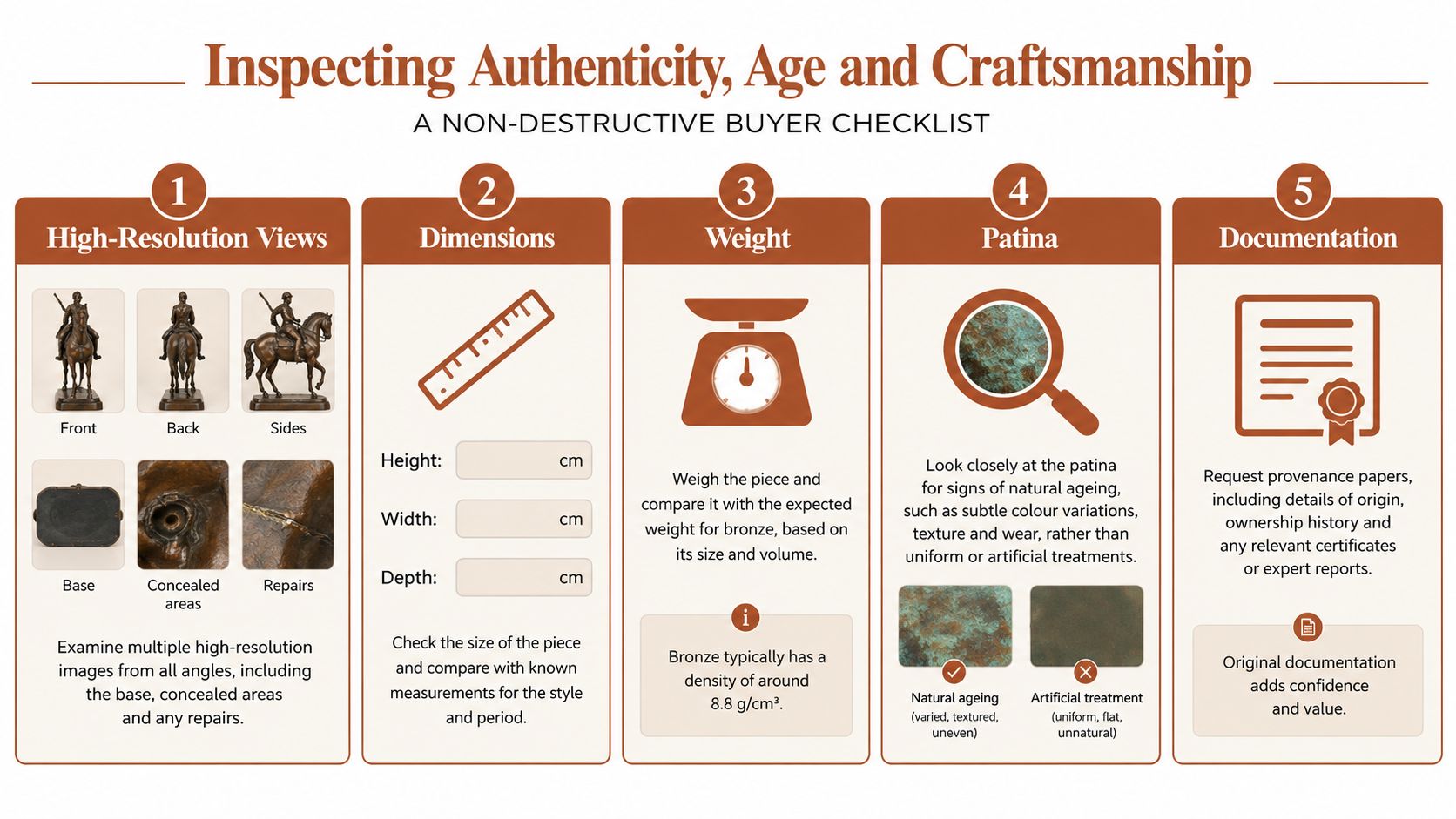
A non-destructive inspection sequence
- Request complete views: Ask for high-resolution images of the front, back, both sides, top, underside, base interior if accessible, joins, repairs and any marks.
- Record measurements: Confirm height, width, depth and weight, and ask whether separate base or arch pieces are included in those figures.
- Examine construction: Look for casting seams, hollow areas, core material visible at openings, separately attached attributes and differences in finish between parts.
- Read the surface slowly: Note patina variation, bright metal at high points, coatings, over-cleaning, filled holes and powdery or cracked areas.
- Check documentation: Ask for provenance, previous ownership where available, maker's marks, condition reports, repair history and alloy disclosure.
Each observation needs context. A seam may reflect the moulding process, a repair or later assembly. Hollow construction can be entirely appropriate and does not make a piece modern or insubstantial. Artificial patination on a contemporary work may be an honest decorative finish, while the same surface described as untouched age would be a problem.
For a UK purchase, ask how the object entered the market: which sale, dealer, export file or collection record supports the story, and whether shipping or import paperwork matches the description. A gap reduces what you can verify. Treat colour and weight as clues; documentation, consistent construction and expert examination carry more evidential force.
When to escalate
Escalation point: If price, claimed age or cultural importance depends on a fact photographs can't establish, pause for independent examination before you pay.
Portable X-ray fluorescence or other metallurgical testing may help identify alloy composition, yet one test alone cannot prove date or origin. A specialist can judge whether tool marks, casting structure and wear form a coherent story. That level of scrutiny is proportionate for a significant purchase, a disputed attribution or an institutional acquisition.
This care matters in a busy market where sculpture can pass quickly through fairs, auction rooms and private hands. Separate four terms in your notes: age is when it was made, authenticity is whether it is what it is claimed to be, attribution is who or where it is assigned to, and decorative appeal is whether you like it. A statue can score highly on one and weakly on another.
Matching a Bronze Ganesha Statue to Your Purpose
Purpose turns inspection notes into a decision. The same bronze Ganesh statue can be right for one buyer and wrong for another without any change in the object. Be honest about whether you're choosing primarily for worship, study, display or a gift, because each purpose rearranges your priorities.
For a devotional setting, iconographic clarity and a settled presence may matter most. You'll view the figure closely and perhaps handle the surrounding area often, so stability and a surface that tolerates ordinary dusting are practical virtues. A contemporary image with clear attributes can meet that need without any claim to antiquity.
Different settings, different evidence
- Private collection: Provenance, condition history and a coherent attribution carry more weight, especially if you may lend, insure or resell the work.
- Museum-style display: Documentation, structural soundness and conservation needs matter alongside visual impact, because the object must withstand sustained scrutiny.
- Interior scheme: Scale, silhouette, base depth and sightline decide whether the figure feels anchored or lost among neighbouring objects.
- Gift: Clear identification, safe packing and straightforward care may matter more than scholarly rarity.
Scale deserves a physical test. Mark the height and footprint with tape where the statue will sit, then view that space from your normal seated or standing position. Photographs routinely flatter depth and hide how a wide arch or projecting trunk changes clearance.
HD Asian Art is one UK-based option where buyers can compare Hindu sculpture by subject and material, alongside other specialist dealers, auction houses and museum shops. Whichever route you use, compare the quality of information as carefully as the objects. A seller who distinguishes a contemporary devotional casting from an antique with scholarly interest helps you choose respectfully.
Don't let popularity make the decision. A smaller, heavily patinated figure may suit a quiet shrine, while a technically refined casting may reward close display. The right match is the one whose documented status, physical condition and maintenance demands fit the life you can give it.
Protecting the Surface and Structure of Bronze
Preventive care should come before polishing or chemical treatment. The British Museum recommends reducing deterioration through controlled storage, display, handling and transport, reserving intervention for access or urgent stabilisation, in its conservation policy on preventive care and treatment. For a private owner, that means your first tools are placement, handling and observation, not a cleaning product.
Place the statue on a stable, non-abrasive plinth or shelf. Lift from the structural base with both hands where size allows, never by the trunk, arms, crown or a held attribute. Use clean nitrile gloves, because skin oils and salts can mark metal and complicate later examination.
Humidity and the UK home
Birmingham Museums Trust specifies a stable target of 40 to 65% relative humidity and recommends limiting change to no more than 10% within 24 hours, in its museum environmental guidance on relative humidity. Treat stability as the goal rather than chasing one exact number every hour. Rapid shifts can stress joins, deposits, wooden supports and fragile surface layers.
Keep a bronze Ganesh statue away from bathrooms, kitchens, radiators, exterior walls prone to condensation and direct humidifier airflow. A small data-logging hygrometer near the object tells you more than a central heating thermostat in another room. Dust gently with a soft, dry method appropriate to a stable surface, following restrained advice such as this guide on cleaning bronze statues without aggressive polishing.
What to avoid and when to stop
Avoid household metal polish, acidic cleaners, abrasive cloths and casual waxing. They can remove intentional patina, blur chased detail and leave residues that obscure evidence. Gilding, inlaid stones, internal armatures and active corrosion raise the stakes further and belong with a qualified conservator.
Keep a dated condition record with photographs, dimensions, weight, repairs and surface changes. If you see powdery green corrosion, damp patches, staining or cracking, isolate the piece from other metals and seek professional assessment. Don't scrub the area away, because the material you remove may be exactly what a conservator needs to diagnose the problem.
Placing, Packing and Importing Your Statue
Choose a clean, calm and structurally stable position that suits both scale and intention. A devotional figure should be easy to approach respectfully, while a collected work needs secure support and enough space to view the sides and back safely. Avoid damp corners, vibrating shelves and places where bags, doors or pets can strike projecting details.
Before any move, photograph the condition and note loose parts, existing cracks and how separate base or arch elements fit. Packing should support the structural base and immobilise the whole object without pressing on the trunk, arms, crown or attributes. If you're sourcing protective material locally, a search for bubblewrap near me can help you find suitable wrapping, but use it as cushioning around a protected surface rather than as a tight binding against fragile patina.
UK import paperwork
Tax treatment depends on classification and documentation. HM Revenue and Customs explains that eligible works of art, antiques and collectors' items can receive a reduced valuation producing an effective import VAT rate of 5% rather than the standard 20%, calculated by applying the standard rate to 25% of the relevant total, in its import VAT guidance for works of art and antiques. Qualifying antiques may fall under heading 9706, while original sculpture can fall under separate artwork classifications, so age alone doesn't settle the code.
Specialist guidance identifies eligible antiques as at least 100 years old and notes that satisfactory evidence may be required to show the object was made in its current form more than a century before importation, in BADA guidance on importing antiques into the UK. Since 1 January 2021, qualifying imports from EU states into mainland Great Britain have sat in the same import VAT framework as imports from elsewhere. Retain invoices, age declarations, provenance records, shipping details and accurate customs descriptions before the statue travels.
Use a final sequence: identify, inspect, verify, document, protect, place and review. On arrival, unpack over a padded surface, compare the object with your pre-delivery photographs and record any change immediately. That habit completes the due diligence you began at the listing.
If you're comparing a bronze Ganesh statue for a shrine, collection or interior, HD Asian Art offers curated Buddhist and Hindu sculpture with detailed listings to support the kind of close looking described here. Browse the collection, check dimensions and iconography against your space and purpose, and choose a figure whose evidence feels as sound as its presence at HD Asian Art.
