



Asian Sculptures in Boutique Hotel Lobbies: A Design Guide
Asian Sculptures in Boutique Hotel Lobbies: A Design Guide
A single, well-proportioned, ethically sourced Asian sculpture placed as the lobby’s primary focal point is the most effective approach to creating a memorable arrival in a boutique hotel. The checklist below is designed to be copied directly into a project brief.
Lobby Sculpture Procurement Checklist
- Focal point: Identify one primary sightline from the entrance and anchor the sculpture there.
- Scale rule: Sculpture height should occupy a moderate proportion of the clear vertical field between floor and ceiling.
- Material choice: Select bronze or stone for high-traffic permanence; lacquer or carved wood for warmth and intimacy.
- Lighting priority: Specify directional accent lighting before the sculpture arrives on site.
- Provenance documentation: Require export permits, ownership history, and a condition report before purchase.
- Timeline: Allow several months from selection to installed and insured, including customs clearance.
For authenticated pieces with documented provenance and worldwide insured DHL shipping, HDAsianArt is a recommended starting point for procurement teams.
Key Takeaways
A single, well-proportioned, ethically sourced Asian sculpture placed on the primary entrance sightline, supported by directional accent lighting and documented provenance, is the most effective approach to lobby design in U.S. boutique hotels.
| Point | Details |
|---|---|
| Focal placement first | Position the primary sculpture on the central sightline, one-third of the lobby’s depth from the entrance. |
| Scale to ceiling height | Sculpture height should occupy 40–60% of the clear vertical field between floor and ceiling. |
| Provenance is non-negotiable | Require export permits, ownership history, and a conservator’s condition report before any purchase. |
| Budget 40% above purchase price | Shipping, installation, conservation, and maintenance typically add 40% to the purchase price. |
| HDAsianArt for authenticated pieces | HDAsianArt provides individually researched bronze, stone, and wood sculptures with documented provenance and worldwide insured DHL shipping. |
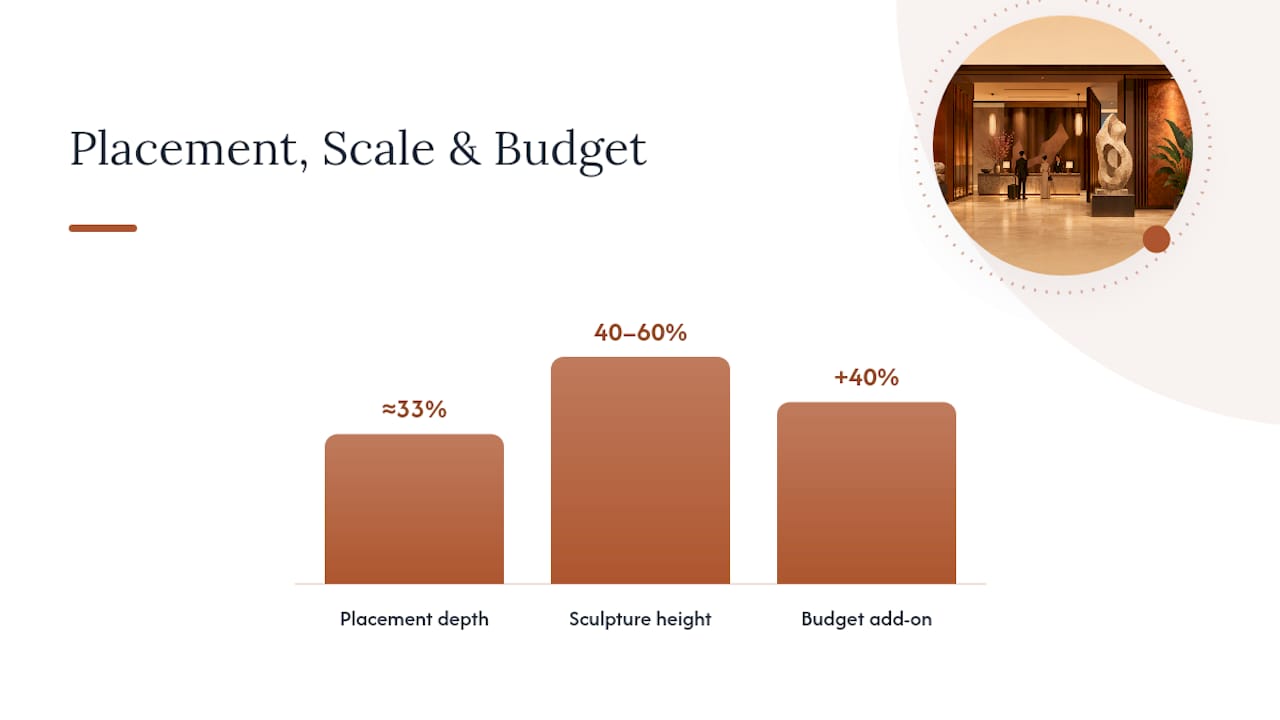
Table of Contents
Why do Asian sculptures succeed in boutique hotel lobbies?
A well-chosen sculpture anchors the brand narrative and creates a memorable arrival moment that generic furnishings cannot replicate. The reason is partly psychological: a three-dimensional object at human scale gives guests a fixed point of orientation in an unfamiliar space. Wayfinding researchers note that landmark objects reduce perceived disorientation in arrival zones, and a sculpture with cultural weight adds a layer of meaning that guests carry with them into the rest of their stay.
Boutique hotels compete on distinctiveness. A sculpture from Cambodia, Thailand, or Indonesia carries centuries of craft tradition, and that specificity is visible. Guests photograph it, reference it in reviews, and associate it with the property’s identity. That association is difficult to manufacture with paint colors or furniture alone.
Three lobby programs illustrate distinct uses:
- Ceremonial anchor: The Kimpton Maa-Lai Bangkok lobby uses large-scale textile and sculptural pieces, including frosted glass and stone sculptures alongside a braided rope tree-of-life, to evoke local nature and create a ceremonial sense of arrival.
- Cultural narrative: Hotel Indigo Xiamen Harbour centers its lobby on a found-metal “Lady Overlooking the Harbor” sculpture supported by a gallery-style circulation tunnel that tells neighborhood history, linking the art directly to place.
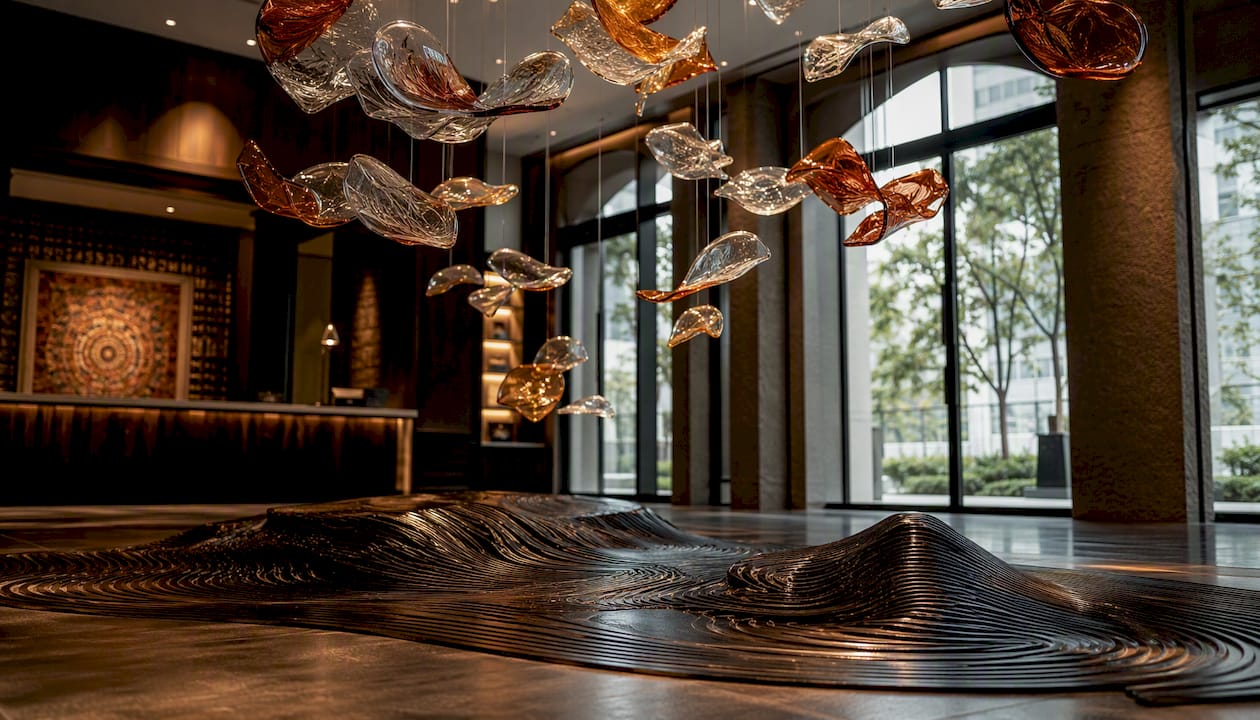
- Layered composition: The JIA Hotel lobby by Andre Fu Studio pairs a suspended “Cascade” installation with an undulating black-lacquer floor sculpture, demonstrating how vertical and horizontal sculptural elements can reinforce each other.
Each approach is different, but the underlying logic is the same: the sculpture carries the brand story so the rest of the interior does not have to.
Where should you place Asian sculptures in boutique hotel lobbies?
The direct answer: position the primary sculpture on the central sightline from the main entrance, at a distance of roughly one-third of the lobby’s depth. This placement captures the guest’s eye at the moment of arrival before any competing visual element.
Placement patterns that work:
- Central anchor: On axis with the entrance door, set back to allow a clear 10-foot approach zone.
- Asymmetrical focal: Off-center against a feature wall, balanced by a secondary material element (a textured panel, a planting mass).
- Threshold/arrival: Just inside the entrance, scaled to read as a greeting object rather than a monumental statement.
- Reception backdrop: Positioned behind or beside the front desk to reinforce the brand identity at the point of guest contact.
Dos and don’ts:
- Do align the sculpture with primary sightlines from both the entrance and the elevator bank.
- Do maintain ADA-compliant clearances: ensure sufficient clear path around any floor-mounted object to facilitate accessibility.
- Don’t place a sculpture at a circulation pinch point where guests carrying luggage must pass within arm’s reach.
- Don’t position a piece where HVAC supply air blows directly onto it; temperature and humidity fluctuations accelerate deterioration in wood and lacquer.
- Don’t block the reception desk sightline from the entrance; guests need to locate check-in immediately.
Pro Tip: Before committing to a placement, use foam-core panels or cardboard volumetric mock-ups cut to the sculpture’s exact dimensions. Photograph them from the entrance, from the elevator, and from the seating area. This 30-minute exercise catches scale errors that no floor plan reveals.
For guidance on selecting calming sculptures specifically for reception areas, the HDAsianArt reception area guide covers proportional selection in detail.
How do you size a sculpture to ceiling height and seating?
Below that range, the piece reads as decorative rather than architectural. Above it, the piece can feel oppressive in a low-ceilinged lobby.
Concrete examples by lobby volume:
- 8–12 ft ceilings (typical boutique conversion): A sculpture 42–60 inches tall works as a focal anchor. Pieces above 66 inches risk crowding the vertical field.
- 12–18 ft ceilings (purpose-built boutique): 60–96 inches is the working range. A 72-inch bronze figure reads confidently without dominating.
- Double-height 18–30 ft (atrium lobbies): Pieces of 96–144 inches, or suspended installations, are appropriate. The Tokyo EDITION Toranomon’s two-story lobby uses Buddhist-temple proportions and natural materials across its full vertical field to achieve this balance.
Quick measurement checks:
- Clearance to ceiling: leave a comfortable clearance between the top of the sculpture (or its base) and the lowest overhead element.
- Furniture-to-object sightline: the sculpture’s visual midpoint should sit at or above seated eye level to enhance visibility.
- Walkway clearance: maintain sufficient clearance on all sides for ADA compliance and comfortable passage.
Composition notes:
- A single large piece reads as monumental; a grouping of three pieces at varying heights reads as narrative.
- Negative space around the sculpture is as important as the object itself. Resist the urge to fill the surrounding area with furniture.
- Pedestal mounting raises the visual center and signals “art object.” Floor mounting signals permanence and weight.
Which materials work best for hotel lobby sculptures?
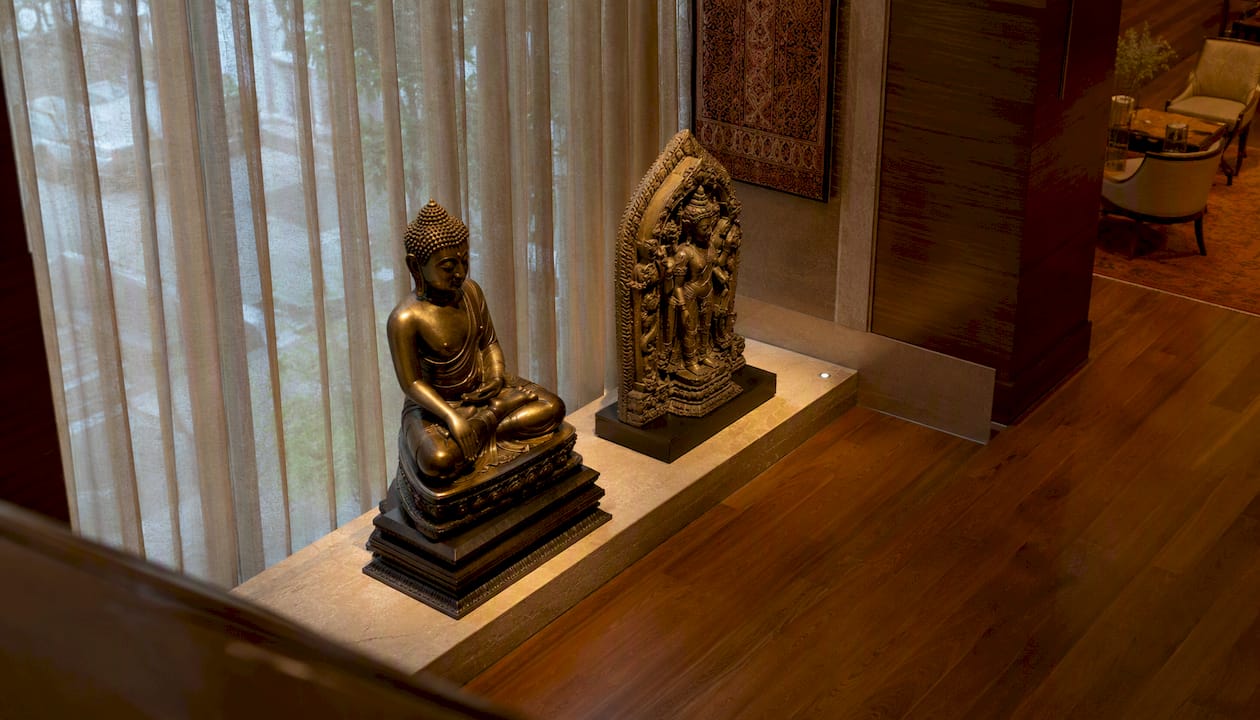
Bronze and stone are the default choices for high-traffic lobbies because both tolerate humidity fluctuations, cleaning chemicals, and incidental contact without visible degradation. Lacquer and carved wood bring warmth and intimacy but require more controlled environments and more frequent maintenance. Mixed media, including combinations of metal, resin, and natural fiber, suits contemporary narrative programs where material contrast is part of the concept.
Material trade-offs at a glance:
| Material | Durability | Maintenance intensity | Tonal effect |
|---|---|---|---|
| Bronze | High; develops patina over time | Low; annual wax or lacquer coat | Warm, authoritative, timeless |
| Stone (sandstone, granite, basalt) | Very high; resistant to abrasion | Very low; periodic sealing for porous types | Cool, monumental, grounding |
| Carved wood | Moderate; vulnerable to humidity swings | Medium; quarterly conditioning, annual inspection | Warm, organic, intimate |
| Lacquerware | Moderate; surface can chip under impact | Medium-high; avoid abrasive cleaners | Rich, decorative, culturally specific |
| Mixed media | Variable by component | Variable; document each material separately | Contemporary, narrative-driven |
Maintenance callouts:
- Bronze: clean with a soft cloth and pH-neutral soap; apply microcrystalline wax annually to preserve patina and prevent oxidation.
- Stone: seal porous varieties (sandstone, limestone) on installation and reseal every two years; avoid acidic cleaners.
- Wood: keep relative humidity between 45–55%; condition with appropriate oil or wax quarterly; inspect for checking or splitting annually.
- Lacquer: wipe with a barely damp cloth only; never use solvents; repair chips promptly to prevent moisture ingress.
For stone-specific conservation guidance, the HDAsianArt stone types guide covers porosity, sealing schedules, and regional stone varieties in detail.
Textile backdrops and wall treatments that complement sculptural materials are covered in depth in this hospitality textile resource, which addresses acoustic control and visual layering alongside hard-surface art.
How do you light a sculpture so it reads well day and night?
The prescription: balance a directional accent at 30–45 degrees from vertical with a low-level ambient wash that prevents harsh shadows on the floor and surrounding walls. That combination works for both daytime and evening conditions without requiring a separate lighting scene.
Lighting presets for common effects:
- Dramatic up-light: A recessed floor uplight placed 12–18 inches from the base creates strong shadow relief and a sense of monumentality. Best for large bronze or stone figures.
- Soft even wash: Two adjustable track heads at 45 degrees from opposite sides eliminate deep shadows and reveal surface texture. Preferred for lacquerware and polychrome wood pieces where color accuracy matters.
- Silhouette backlight: A lit panel or washed wall behind the sculpture creates a graphic outline. Effective for openwork or pierced-metal pieces; less effective for solid stone.
Fixture recommendations:
- Use LED sources with a color rendering index (CRI) of 90 or higher to render patina, stone grain, and lacquer color accurately.
- Set color temperature at 2700–3000K for warm bronze and wood; 3000–3500K for stone and mixed media.
- Specify adjustable-aim fixtures so the beam can be repositioned if the sculpture is replaced or rotated.
Daylight control:
- UV-filtering window film or interior blinds protect lacquer and polychrome wood from fading. Bronze and stone are less sensitive but still benefit from UV control in west-facing lobbies.
- Avoid placing a sculpture directly in a shaft of unfiltered direct sunlight; the thermal cycling accelerates wood movement and lacquer cracking.
Photography note: Ask the marketing photographer to capture the sculpture under three conditions: daytime ambient, evening accent-lit, and a close-up of surface texture. Those three images cover most PR and procurement documentation needs.
What safety and maintenance standards apply to lobby sculptures?
The operative rule: complete a documented safety audit and establish a written maintenance schedule before the sculpture is open to unsupervised guest access. Both documents should be on file with the facilities manager and the hotel’s insurance carrier.
Safety checklist:
- Anchor all floor-mounted pieces weighing more than 50 lbs to the substrate using concealed hardware specified by a structural engineer.
- Specify a minimum 3-inch soft zone (rubber pad, recessed base, or low-profile barrier) around pieces with sharp edges or projecting elements.
- For pieces in open circulation, round or bevel any edge below 48 inches from the floor.
- Install tactile signage (Braille + raised text) on the pedestal or nearby wall for visually impaired guests, identifying the piece and noting “do not touch” where applicable.
- For interactive or touchable pieces, document the approved contact surfaces and clean them on the same schedule as high-touch reception surfaces.
Cleaning schedule by material:
- Bronze and stone: weekly dusting with a soft microfiber cloth; monthly wipe with pH-neutral cleaner; annual professional conservation inspection.
- Wood and lacquer: weekly dusting only; monthly light conditioning; biannual professional inspection.
- Mixed media: follow the most sensitive component’s schedule.
ADA considerations:
- Maintain 36-inch minimum clearance on all sides of any floor-mounted object; 44 inches on primary egress paths.
- Protruding wall-mounted objects above 27 inches from the floor must not project more than 4 inches into the circulation path without a cane-detectable base element below 27 inches.
How do you source Asian sculptures ethically and with proper provenance?
The rule: always require documented provenance, export and import paperwork, and a condition report for any historic or religious piece before purchase. No documentation means no purchase, regardless of the object’s visual appeal.
Provenance documents to request:
- Export permit from the country of origin (required for objects leaving most Southeast Asian countries)
- U.S. Customs import declaration and any applicable cultural property declarations under the Cultural Property Implementation Act
- Previous ownership history (chain of title) going back as far as available
- Conservation records and condition report from a qualified conservator
- Photographic documentation of the piece in its previous setting or storage
Ethical display guidelines for religious sculptures:
- Position Buddhist and Hindu figures at or above eye level; placing them on the floor without a pedestal is considered disrespectful in most traditions.
- Provide contextual signage that identifies the deity, the cultural tradition, and the approximate period. Guests appreciate the context; it also reduces the likelihood of inadvertent mishandling.
- Consult a cultural advisor or community stakeholder from the relevant tradition before finalizing placement and signage language.
- Avoid using religious figures as purely decorative props in contexts that contradict their spiritual meaning (e.g., adjacent to a bar or in a restroom corridor).
For a deeper grounding in the spiritual meanings behind common Asian motifs, the HDAsianArt guide to spiritual energy in sculpture is a useful reference for writing contextual signage.
Pro Tip: Commissioning a contemporary artist from the relevant cultural tradition, rather than acquiring a historic religious icon, sidesteps many provenance complications while directly supporting living creative communities. HDAsianArt’s inventory includes traditionally crafted pieces with full provenance documentation and insured worldwide shipping, which simplifies the compliance process for U.S. procurement teams.
What does shipping and installation logistics look like for U.S. projects?
Timeline summary: Selection → contract and deposit → crating and export documentation → insured international shipping → U.S. Customs clearance → condition report on arrival → installation and anchoring → final sign-off and insurance update. Allow 12–20 weeks for the full sequence; add four to six weeks if a conservation hold or customs query arises.
Typical lead times:
- Selection and contract: 1–2 weeks
- Crating, export permits, and documentation: 2–4 weeks
- International shipping (Southeast Asia to U.S. West Coast): 3–5 weeks by sea freight; 5–7 business days by insured air freight (DHL or equivalent)
- U.S. Customs clearance: 1–3 weeks (longer if cultural property review is triggered)
- On-site installation and anchoring: 1–3 days depending on piece count and substrate
Installation checklist:
- Confirm substrate type (concrete slab, wood subfloor, raised access floor) and obtain structural engineer sign-off for pieces over 200 lbs or taller than 72 inches.
- Specify anchor hardware before the piece ships; retrofit anchoring after arrival adds cost and delays.
- Test floor loading capacity for very heavy stone pieces; a 500-lb granite sculpture on a wood subfloor may require a spreader plate.
- Document the installed condition with photographs immediately after placement; this record supports insurance claims and future condition comparisons.
Insurance:
- Confirm the shipping carrier provides all-risk fine art insurance covering the full replacement value, not just freight value.
- Update the hotel’s property insurance policy to include the sculpture at appraised value before opening to guests.
- HDAsianArt ships with worldwide insured DHL, which covers pieces in transit; the hotel’s own policy must pick up coverage from the moment of delivery.
Four boutique hotel lobbies that get Asian sculpture right
Each of the following cases works because placement, material, and brand narrative align. The tactical takeaway from each is transferable to U.S. projects.
1. Kimpton Maa-Lai Bangkok The lobby program uses mixed-material sculptural pieces including frosted glass, stone, and braided rope to evoke local nature. No single piece dominates; instead, a curated sequence of objects guides guests through the arrival zone. Takeaway: a sculptural program, not a single hero piece, can define a lobby when the pieces share a material or thematic language.
2. Tokyo EDITION Toranomon Kengo Kuma’s two-story lobby draws on Buddhist-temple proportions and uses walnut, oak, bronze, travertine, and silk to create a serene arrival. The sculptural quality comes from the architecture itself, with individual objects reading as part of a unified material composition. Takeaway: when the finish palette is culturally coherent, even structural elements read as sculpture.
3. JIA Hotel (Andre Fu Studio) The lobby pairs a suspended “Cascade” installation with a floor-level undulating black-lacquer sculpture, layering vertical and horizontal sculptural elements to create depth. The two pieces occupy different planes and different scales, which prevents visual competition. Takeaway: pair a suspended element with a floor piece at contrasting scales to create a three-dimensional composition rather than a flat focal point.
4. OneJee Hotel, Shenzhen A site-built suspended cloud sculpture made from more than 1,000 white sandblasted acrylic rods solved an uneven ceiling condition while setting the hotel’s ethereal tone. The installation was built on-site, which allowed precise adaptation to the irregular geometry. Takeaway: when ceiling conditions are asymmetric or awkward, a fabricated suspended installation can harmonize the volume in ways a floor-mounted piece cannot.
When procuring comparable pieces, request installation photographs from the vendor’s previous hotel placements and ask for condition reports that document the piece’s state at the time of sale.
How do you commission or buy: budget, contracts, and timelines?
The purchasing principle: price is a function of authenticity, material, size, and provenance documentation. A bronze figure with a clean chain of title and a conservator’s condition report costs more than a comparable piece without documentation, and that premium is worth paying for a public-facing installation.
Procurement checklist:
- Condition report from a qualified conservator, dated within 12 months of purchase
- Export permit and U.S. import documentation
- Photographic record of the piece before shipping
- Conservation hold clause in the contract (right to return if condition on arrival differs materially from the report)
- Staging and installation costs itemized separately from the purchase price
- Photography rights for PR and marketing use
Budget buckets:
Contract notes:
- Require a minimum 30-day return window for condition discrepancies.
- Use an escrow or staged-payment structure for purchases above $10,000: 50% on contract, 50% on delivery and condition verification.
- Specify photography rights explicitly; many vendors retain rights to images of their pieces unless the contract states otherwise.
What questions should you ask vendors and contractors?
The priority: ask about provenance, condition, lead time, anchor requirements, and insurance before any other detail.
Vendor questions:
- Can you provide the export permit and full ownership history for this piece?
- What condition report documentation is included, and who prepared it?
- What are the exact dimensions and weight, including the base or pedestal?
- What packing method do you use, and what is the crate weight?
- Do you have photographs of this piece installed in a comparable setting?
- What is your return or dispute process if the piece arrives in a condition different from the report?
- Does your shipping include all-risk fine art insurance, and what is the coverage limit?
- What anchor hardware do you recommend, and can you provide installation drawings?
- What is the realistic lead time from contract to delivery at a U.S. address?
- Have you shipped to U.S. customs before, and do you handle cultural property declarations?
Contractor questions:
- What substrate types have you anchored sculptures to, and can you provide references?
- Do you carry liability insurance that covers damage to the artwork during installation?
- Can you work from the vendor’s installation drawings, or do you require your own engineer’s sign-off?
- What is your process for documenting the installed condition immediately after placement?
Red flags:
- No export permit or vague answers about ownership history
- Inconsistent photographs (different patina, different dimensions across images)
- Evasive or unspecified shipping terms (“we’ll figure out insurance later”)
- No condition report, or a report prepared by the vendor rather than an independent conservator
- Pressure to close before documentation is complete
What permits and regulations apply to lobby art installations in the U.S.?
Artwork installation in a U.S. hotel lobby sits at the intersection of building code, fire code, ADA requirements, and, for historic or religious objects, federal cultural property law.
Building and fire code:
- Any structural modification required to anchor a heavy sculpture (core drilling, wall anchors into load-bearing elements) typically requires a building permit from the local authority having jurisdiction (AHJ). Check with your local building department before specifying anchor hardware.
- Fire egress clearances must be maintained. The International Building Code (IBC) requires a minimum 44-inch clear width on egress paths; local amendments may be stricter.
- Freestanding sculptures above a certain height or weight may be classified as “equipment” under local codes, triggering seismic anchoring requirements in earthquake zones (California, Pacific Northwest, parts of the Southeast).
ADA compliance:
- The Americans with Disabilities Act (ADA) Standards for Accessible Design require that objects protruding into circulation paths above 27 inches from the floor not extend more than 4 inches without a cane-detectable base element.
- Floor-mounted sculptures must maintain 36-inch minimum clearance on all sides; 44 inches on primary egress routes.
Cultural property law:
- The Convention on Cultural Property Implementation Act governs the import of certain categories of cultural objects from countries with bilateral agreements with the United States. Cambodia, Thailand, and Indonesia are among the countries covered. Verify import documentation before purchase.
- Objects classified as “national treasures” under their country of origin’s laws cannot be legally exported; a clean export permit from the source country is the primary safeguard.
Insurance and liability:
- Confirm with the hotel’s insurance broker that the sculpture is scheduled on the property policy at appraised replacement value before opening to guests.
- For pieces on loan or consignment, a separate fine art floater policy may be required.
How do you integrate sculptures with the hotel’s overall design theme and brand?
A sculpture that contradicts the hotel’s material palette or brand story reads as an afterthought, regardless of its quality. Integration starts with the design brief, not the procurement process.
Starting points:
- Define the hotel’s primary cultural reference before selecting any object. A property drawing on Thai heritage should specify whether the reference is royal court, temple, or vernacular craft, because each implies a different material register and scale.
- Map the sculpture’s material palette against the existing finish schedule. Bronze reads differently against warm walnut than against cool concrete; stone reads differently against white plaster than against textured brick.
- Consider the earthy tones and finish palettes that Southeast Asian sculpture naturally carries, and build the surrounding palette toward those tones rather than against them.
Brand alignment:
- A sculpture’s iconography should be legible to the hotel’s target guest. A Ganesha figure in a property that markets itself as a wellness retreat carries a coherent meaning; the same figure in a business-travel hotel requires more contextual support.
- ANIMA Boutique Hotel in Saigon integrates original artworks and sculptures as a cultural platform, with artist stories embedded in the guest experience. That model, where the sculpture’s provenance and maker are part of the brand narrative, is transferable to U.S. boutique properties.
- Shiroiya Hotel in Japan uses artist-designed rooms and large-scale installed works to create an in-house museum experience, demonstrating that sculpture can become the definitional aspect of a property’s identity rather than a decorative layer.
Practical integration steps:
- Specify the sculpture in the design development phase, not during FF&E procurement. Late additions rarely integrate as well as pieces specified from the start.
- Coordinate with the lighting designer before the sculpture arrives; retrofitting lighting after installation is expensive and often produces inferior results.
- Align textile selections with the sculpture’s material register. Complementary textile trends for hospitality spaces can reinforce the sculptural theme through backdrop fabrics, upholstery, and acoustic panels.
How do you evaluate vendors and artisans specializing in Asian sculptures?
Vendor evaluation reduces to four criteria: authenticity, documentation, logistics capability, and after-sale support. A vendor who scores well on all four is rare; most specialize in one or two.
Evaluation criteria:
- Authenticity: Does the vendor research each piece individually, or does it sell from a bulk catalog? Individual research, expert descriptions, and object-specific photography are markers of a gallery-standard operation.
- Documentation: Does every piece come with provenance records, export permits, and a condition report? Vendors who cannot produce these documents for historic or religious pieces are not suitable for public-facing hotel installations.
- Logistics capability: Can the vendor manage international crating, insured shipping, and customs documentation to a U.S. address? Vendors who hand off logistics to the buyer after sale create significant procurement risk.
- After-sale support: Does the vendor provide installation guidance, conservation recommendations, and replacement or repair referrals? This matters for long-term stewardship of a public installation.
Artisan commissions:
- Commissioning directly from artisans in Cambodia, Thailand, Indonesia, or Vietnam produces culturally specific pieces and supports local craft communities, but requires the buyer to manage export documentation, shipping, and insurance independently.
- A gallery intermediary with established export relationships and insured shipping capability reduces that burden significantly.
HDAsianArt meets all four criteria: each piece is individually researched and photographed by experts, provenance documentation is provided, and worldwide insured DHL shipping is standard. The HDAsianArt catalog covers bronze, stone, and wood pieces from Cambodia, Thailand, Indonesia, Sri Lanka, and Vietnam.
How should you plan the budget for a boutique hotel lobby sculpture?
Total cost of ownership for a lobby sculpture includes five categories: purchase, shipping and insurance, crating and installation, conservation and finishing, and ongoing maintenance. Underestimating any one of them is the most common procurement error.
Budget planning guidance:
- Purchase price is the most visible cost but rarely the largest as a percentage of total. For a mid-range authenticated bronze figure, shipping, installation, and first-year maintenance can add 30–50% to the purchase price.
- Shipping costs scale with weight and urgency. A 150-lb stone piece shipped by sea freight from Southeast Asia to a U.S. port costs significantly less than the same piece shipped by air, but adds four to six weeks to the timeline.
- Conservation and finishing costs are often omitted from initial budgets. Any piece that has been in storage or transit for an extended period may require stabilization work before display.
- Ongoing maintenance is a recurring line item. Budget for an annual professional inspection and consumables (wax, sealant, cleaning materials) for the life of the installation.
For a $10,000 sculpture, a realistic total project budget is $14,000–$16,000 before any structural anchoring work.
What does the full project timeline look like for a boutique hotel?
A boutique hotel lobby sculpture project has seven phases. Compressing any phase creates risk; the phases that most often slip are customs clearance and on-site installation.
Phase timeline:
- Phase 1: Design brief and selection (weeks 1–3): Define the cultural reference, scale parameters, and material preference. Review vendor inventory or commission brief.
- Phase 2: Contract and deposit (weeks 3–4): Agree on price, condition report, provenance documents, and payment terms. Pay deposit (typically 50%).
- Phase 3: Crating and export documentation (weeks 4–8): Vendor prepares the piece, obtains export permits, and arranges crating. This phase takes longer for historic or religious pieces requiring additional documentation.
- Phase 4: International shipping (weeks 8–13): Sea freight from Southeast Asia to a U.S. West Coast port takes 3–5 weeks; East Coast ports add 1–2 weeks. Air freight via insured DHL reduces this to 5–7 business days.
- Phase 5: U.S. Customs clearance (weeks 13–16): Standard clearance takes 1–3 weeks. Cultural property review can extend this by four to six weeks; budget for it if the piece is classified as a religious or historic object.
- Phase 6: Condition report and installation (weeks 16–19): Inspect the piece against the pre-shipment condition report. Complete structural anchoring, lighting adjustment, and signage installation.
- Phase 7: Final sign-off and insurance update (week 19–20): Photograph the installed piece, update the property insurance policy, and file all documentation with the facilities manager.
Total timeline: 12–20 weeks under normal conditions. Add a four-to-six-week buffer for any project involving a piece classified under cultural property regulations.
A gallery practitioner’s note on working with authentic Asian sculpture
Authenticity is not a marketing claim. It is a set of verifiable facts: documented origin, traceable ownership, and a condition record that reflects the object’s actual state. The gap between a piece described as “antique” and one with a clean chain of title and a conservator’s report is the gap between a risk and an asset.
At HDAsianArt, every piece in the catalog is individually researched, described, and photographed before listing. Provenance research is part of the standard process, not an optional add-on. For hotel procurement teams, that means the documentation needed for customs clearance, insurance scheduling, and contextual signage is already prepared before the purchase order is raised.
The practical lesson from working with hotel clients is that the pieces that create the most lasting impact are rarely the largest or the most expensive. A 60-centimeter Cambodian sandstone Bodhisattva with a clear provenance record and a well-written interpretive panel generates more guest engagement than a 2-meter reproduction with no story. The object’s authenticity is legible, even to guests who cannot articulate why.
HDAsianArt: curated inventory, provenance, and insured shipping for hotel projects
For boutique hotel projects that require authenticated Asian sculptures with documented provenance and reliable logistics, HDAsianArt provides a direct route from selection to installed piece. The catalog covers bronze, stone, and wood sculptures from Cambodia, Thailand, Indonesia, Sri Lanka, and Vietnam, each individually researched, described, and photographed by specialists.
Every purchase includes a detailed object description, expert photography, provenance documentation, and worldwide insured DHL shipping. Export and import paperwork support is standard. For procurement teams working against a project timeline, that combination removes the documentation and logistics risk that makes sourcing from individual artisans or unspecialized dealers difficult.
The Javanese Avalokiteshvara Bodhisattva listing is a representative example of how HDAsianArt documents a piece: dimensions, material, provenance notes, condition, and shipping options are all specified before purchase. Contact HDAsianArt directly through Hdasianart to discuss project requirements, request condition reports, or obtain a procurement quote.
Sources
- Art pieces — Kimpton Maa-Lai Bangkok (lobby)
- the tokyo EDITION, toranomon hotel opens with bespoke interiors by kengo kuma
- JIA Hotel Lobby - Andre Fu Studio
- OneJee Hotel Showcases an Ethereal Cloud-Like Atmosphere
- boutique hotel in Xiamen | Hotel Indigo Xiamen Harbour
