



Antique Thai Buddha Statue Buying Guide
Antique Thai Buddha Statue Buying Guide
You've found a Thai Buddha that immediately commands attention. The bronze has a convincing surface, the face is serene, and the seller describes it as “Sukhothai period”. Yet the listing offers little more than a broad date, a few photographs, and no clear account of where the statue came from. That is the moment to slow down. An antique Thai Buddha statue should be assessed as both a work of art and a cultural object with a legal history.
The strongest purchases combine stylistic evidence, material examination, condition reporting, and documented provenance. Decorative appeal comes last. A beautiful figure with an uncertain origin can become difficult to insure, resell, export, or even display responsibly. A less immediately dramatic sculpture with a coherent chronology and paper trail may prove the more important acquisition.
Table of Contents
- The Appeal of the Antique Thai Buddha Statue
- Regional Styles and Historical Eras
- Identifying Authentic Materials and Dating Clues
- Navigating Provenance and UK Export Regulations
- Assessing Condition and Institutional Value
- Care, Placement and Respectful Display
- Choosing a Reputable Specialist Gallery
The Appeal of the Antique Thai Buddha Statue
A collector may first respond to the gesture, the proportion of the body, or the quiet authority of the face. Those responses matter. Buddhist sculpture was designed to communicate through posture, expression, hand position, and the disciplined relationship between the figure and its base. But the visual experience is only the beginning of a serious purchase.
Consider two statues offered in the same room. The first has bright, even gilding and a confident description, but no previous ownership record. The second has worn surfaces, a repaired base, and a modest catalogue entry that identifies its material, regional type, and earlier collection history. The second deserves the closer examination. Wear can be understood and repairs can be assessed. An unexplained history cannot be reconstructed from appearance alone.
The UK's major museums provide the right intellectual framework. The Victoria and Albert Museum's Buddhist art galleries opened in London in 2009 as the first UK gallery dedicated to Buddhist sculpture, creating a permanent scholarly setting for works from across Asia. The V&A holds Thai Buddhist objects spanning the 7th–8th century to the 19th century, while the British Museum documents Thai pieces from the 16th–17th century and later periods. The British Museum's Thai bronze sculpture record also records an object exhibited in London from 2014 to 2015 in a show on Buddhism and religious practices.
That range changes how you should think about the category. “Antique Thai Buddha” isn't one style. It describes a long continuum of religious art, court production, regional workshops, ritual use, collecting, and museum interpretation.
Curator's rule: Buy the object you can explain, not merely the object that photographs well.
A genuine acquisition is therefore an act of preservation. You're accepting responsibility for an image that may carry historical, religious, and cultural meaning beyond its decorative role. Ask for evidence before discussing price, and treat a missing provenance record as a material weakness rather than an administrative inconvenience.
Regional Styles and Historical Eras
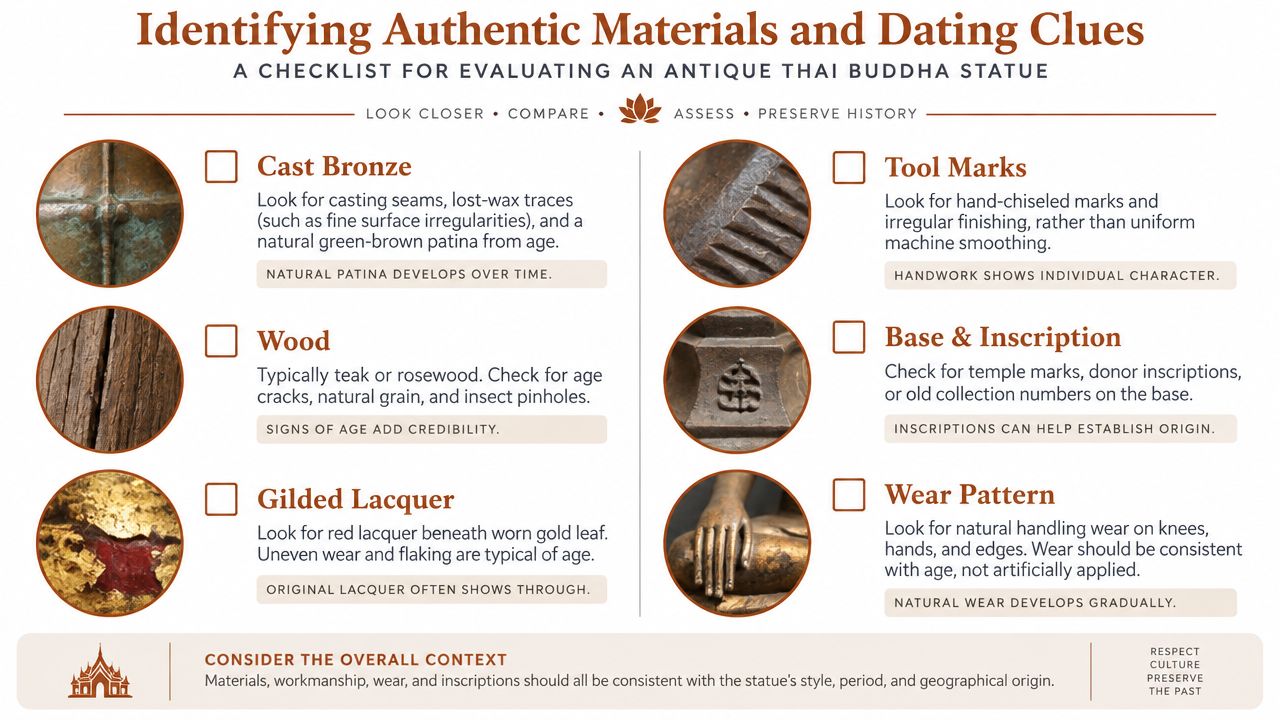
Thai Buddhist sculpture developed through successive regional traditions rather than a single uninterrupted national style. Early Dvaravati works, Khmer-influenced Lopburi sculpture, Sukhothai refinement, and Ayutthaya court production each offer different clues. Curators establish chronology by comparing those clues with securely documented museum objects.
Reading the regional sequence
Dvaravati sculpture belongs to the early foundations of Buddhist art in Thailand. Its forms can appear more substantial and direct than the later idealised Sukhothai image. Stone and bronze were both used, and the regional context matters as much as the religious subject. A standing Buddha identified only as “Thai” tells you very little until the facial structure, robe treatment, proportions, and material are examined together.
Lopburi sculpture presents a more specific diagnostic problem. The V&A records an 11th–12th-century Lopburi Buddha head in sandstone, as well as a 13th-century Lopburi sandstone head that reflects late Khmer influence from Angkor and the Bayon. That comparison is valuable because it demonstrates how attribution can depend on a narrow regional transition. Facial modelling, the crown-like ushnisha, and Khmer-derived features may point towards central Thailand during a period of strong Angkorian influence.
Sukhothai sculpture is often associated with elegant, elongated proportions and a highly controlled sense of movement. That reputation can tempt sellers and buyers into overusing the label. A slender face or flowing robe isn't enough by itself. The form must be considered alongside casting method, mudra, surface treatment, scale, and evidence of later alteration.
Ayutthaya works can be more ornate and formally elaborate, particularly in crowned and decorated bronzes. Yet transitional court workshops complicate tidy categories. A sculpture may combine Sukhothai and northern Thai characteristics without being a confused or inferior object. Mixed forms can reflect workshop practice, regional exchange, or changing court taste.
How museums anchor chronology
Museum records are useful because they separate description from certainty. The V&A identifies objects by century, region, and medium, including bronze, cast copper alloy, and sandstone. The British Museum's records similarly use dating systems tied to object study rather than relying solely on a dealer's stylistic phrase.
Use the Thai Buddha styles collector's guide as a starting point, not a substitute for examination. Compare the statue in front of you with documented examples. Look for a consistent relationship between head shape, shoulders, robe, hands, base, and material. If only one feature supports the proposed date, the attribution is weak.
Identifying Authentic Materials and Dating Clues
Material evidence often tells you more than surface colour. Begin by asking what the sculpture is made from, how it was formed, and whether the visible ageing is consistent with that process. A seller's description should identify these points clearly.
Bronze, sandstone, and surface evidence
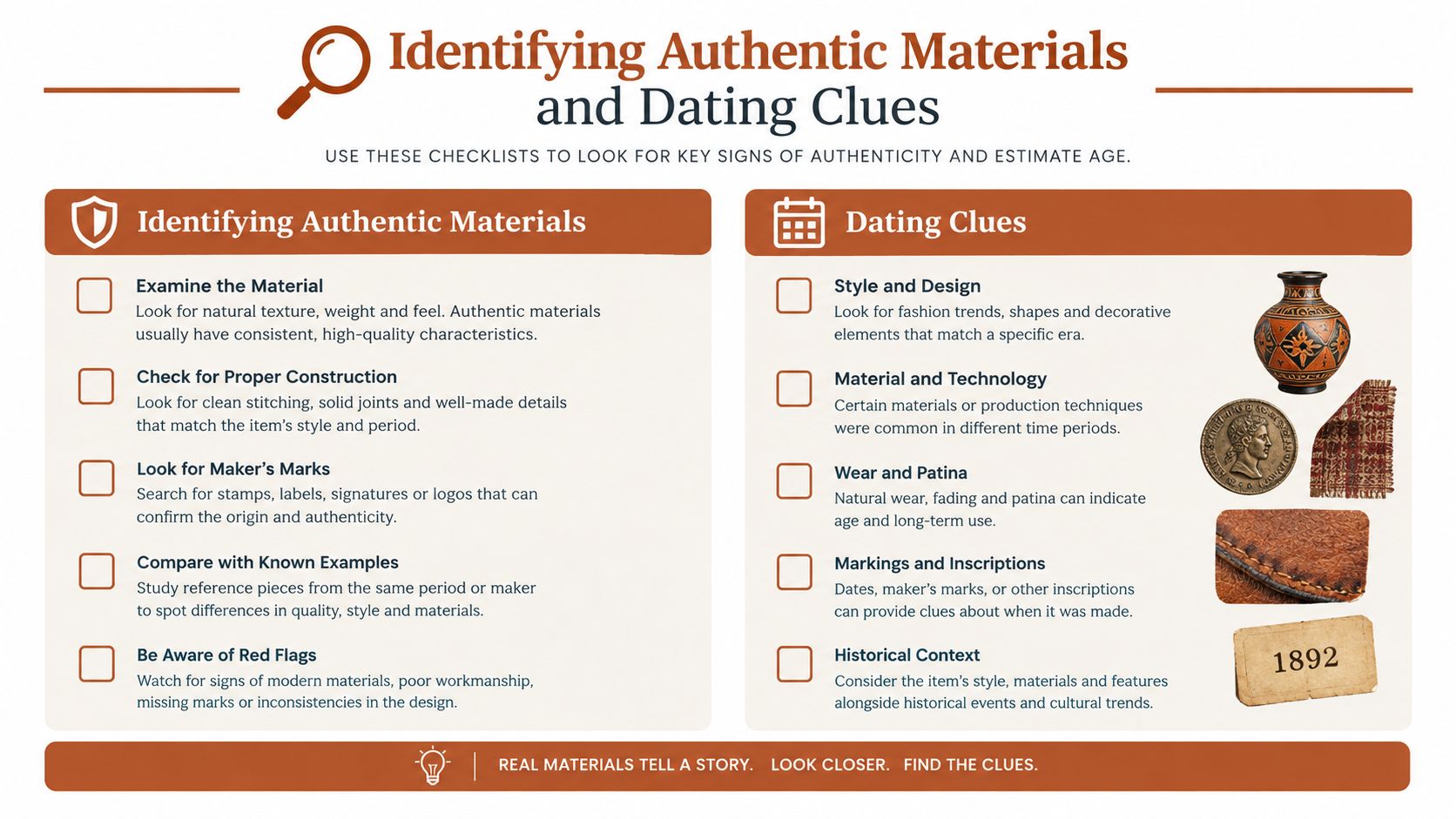
Bronze Thai Buddha figures are frequently cast rather than carved. Inspect photographs of the underside, back, joins, and difficult-to-reach recesses. Casting seams, lost-wax traces, areas of uneven wall thickness, and a natural green-brown patina can support a historic casting history, although none proves age on its own. Modern reproductions can imitate colour, and old objects can receive new surfaces, so the evidence must be read as a group.
The British Museum records a Thai bronze Buddha dated to 1540–1541 as cast bronze, crowned, ornamented, and making the earth-touching gesture. That combination is more useful than the word “antique” in a listing because it joins date, material, iconography, and form. The V&A also records a 16th-century gilt bronze Buddha from Ayutthaya wearing monastic robes and raising the right hand in abhaya mudra.
Sandstone demands a different examination. Check for natural variation in grain, tool marks, repaired fractures, and weathering in recesses. The V&A's Lopburi examples show why material and style must be connected. A sandstone head with late Khmer characteristics has a different evidential profile from a cast bronze Ayutthaya figure, even if both are marketed as Thai Buddha statues.
Mudra and construction
The hand gesture is not a decorative detail. It identifies an iconographic programme and can help establish whether the body, hands, and later additions belong together. Earth-touching, fearlessness, meditation, and teaching gestures each create different relationships between the arms, torso, robe, and base.
Look for these points before making an offer:
- Gesture and proportion: Check whether the hands fit the wrists and whether the arms follow the expected construction of the figure.
- Gilding: Worn gold over red lacquer can be meaningful evidence, but bright new gilding should be disclosed and separately assessed.
- Tool marks: Hand-chiselled finishing differs from uniform machine smoothing. Examine folds, hair, facial planes, and hidden areas.
- Base and inscriptions: Temple marks, collection numbers, labels, and old repairs may establish a history even when they don't identify the original workshop.
- Wear pattern: Natural handling wear often appears on knees, hands, and exposed edges. Abrasion that appears artificially concentrated should raise questions.
For a practical explanation of surface examination, consult this guide to patina and false ageing. Don't clean, polish, or scrape a suspected antique before a conservator has examined it. The original surface may contain the best evidence you have.
Navigating Provenance and UK Export Regulations
A statue with a flawed history is a liability, regardless of how persuasive its style may be. UK buyers should separate three questions: Is the object authentic? Is its ownership history lawful? Can it be moved across the relevant borders? A positive answer to one doesn't answer the others.
Request a written provenance statement, prior invoices where available, old collection labels, import records, export permits from the country of origin, and any conservation reports. If the seller can't provide every document, ask for a precise explanation of what exists and what doesn't. “From an old collection” is not provenance. It's a prompt for further questions.
The risk is not theoretical. UK guidance states that importing or exporting stolen artefacts is illegal, and a 2003 UK rule banned dealing in a tainted cultural object when the dealer knows or believes it is tainted. A dealer should be able to explain why the object was legally acquired and why its present sale is lawful. If the answer is evasive, walk away.
Export rules in practical terms
In Great Britain, objects of cultural interest generally need a UK export licence before leaving the UK for a destination outside the country. Arts Council England administers the licensing system, and its digital licence is issued by email. The licence must be attached to the export declaration sent to HMRC's National Clearance Hub through CDS, after which officials check the paperwork before Permission to Progress.
The Open General Export Licence covers many antiques, works of art, and collectors' items over 50 years old when the value per article, or matching set, is below £65,000. Above that threshold, an individual export licence is required when the object leaves the UK, although category thresholds can range from nil to £180,000.
| Object Age | Value Threshold | Licence Required |
|---|---|---|
| Over 50 years old | Below £65,000 per article or matching set | Open General Export Licence may apply |
| Over 50 years old | Above £65,000 | Individual export licence required when leaving the UK |
| Cultural goods in categories with different controls | Thresholds may range from nil to £180,000 | Check the applicable category and licensing route |
The figures and conditions in this table come from BADA's UK antiques export guidance. Age alone doesn't determine compliance. Value, category, destination, and the object's cultural status all matter.
A buying comparison
An undocumented statue may be cheaper and faster to buy, but you carry the burden of proving lawful history later. A documented piece may require more questions and a slower transaction, yet it gives insurers, customs officials, museums, and future buyers something defensible to work with.
Arts Council England states that applying for an export licence costs nothing and requires registration with Export Licensing Online. The portal requires a UK address, and applications are submitted through the digital system. Review the Arts Council England export licensing guidance before arranging international transport.
For broader ethical and legal context, see this guide to collecting Southeast Asian art. Don't ship first and investigate later. Compliance belongs in the purchase decision, not at the courier's collection point.
Assessing Condition and Institutional Value
Condition is not a simple scale from “excellent” to “poor”. It's a record of what happened to the object and how those changes affect its structure, appearance, authenticity, and future care. A worn surface may be entirely appropriate. A concealed replacement head is not.
Ask for high-resolution images of the front, back, sides, underside, hands, face, base, and all restored areas. For bronze, inspect joins, cracks, dents, unstable elements, and evidence of filled holes. For sandstone, look for flaking, powdering, structural fractures, old infill, and water damage. A professional report should distinguish original material from later additions.
What deserves attention
- Acceptable age-related wear: Surface abrasion, losses to gilding, and softened details can be consistent with long use or handling.
- Historical repair: An old repair may form part of the object's history, but it must be stable and clearly documented.
- Modern intervention: Re-gilding, aggressive polishing, replacement fingers, rebuilt bases, and filled cracks can alter both appearance and interpretation.
- Structural risk: Loose components, active corrosion, unstable stone, and poor previous mounting require conservator advice before display.
Institutional context helps because museums don't treat a statue as an isolated decorative object. The V&A's records identify Thai pieces by period, region, material, and form. The British Museum's documentation of a Thai golden Buddha included in “Ancient India: Living Traditions”, held from 22 May to 19 October 2025, shows how an image can be interpreted in relation to living religious practice. That Buddha was later installed at Buddhapadipa Temple in Wimbledon in 1982, demonstrating the movement between museum interpretation and community worship. See the British Museum record for the Thai Buddha.
Condition advice: A repair isn't automatically a defect. An undocumented repair is the defect.
Institutional value depends on more than rarity. A sculpture with a coherent regional attribution, stable condition, documented ownership, and a meaningful exhibition history is easier to study and conserve. It also gives a private collector a stronger basis for insurance, future sale, or possible institutional consultation.
Care, Placement and Respectful Display
An antique Thai Buddha statue needs a stable environment and a considerate setting. Bronze is durable, but its patina and gilding can be damaged by moisture, abrasive cleaning, unstable handling, and unsuitable mounting. Stone can suffer from impact, salts, vibration, and repeated changes in environmental conditions.
Build a safe display
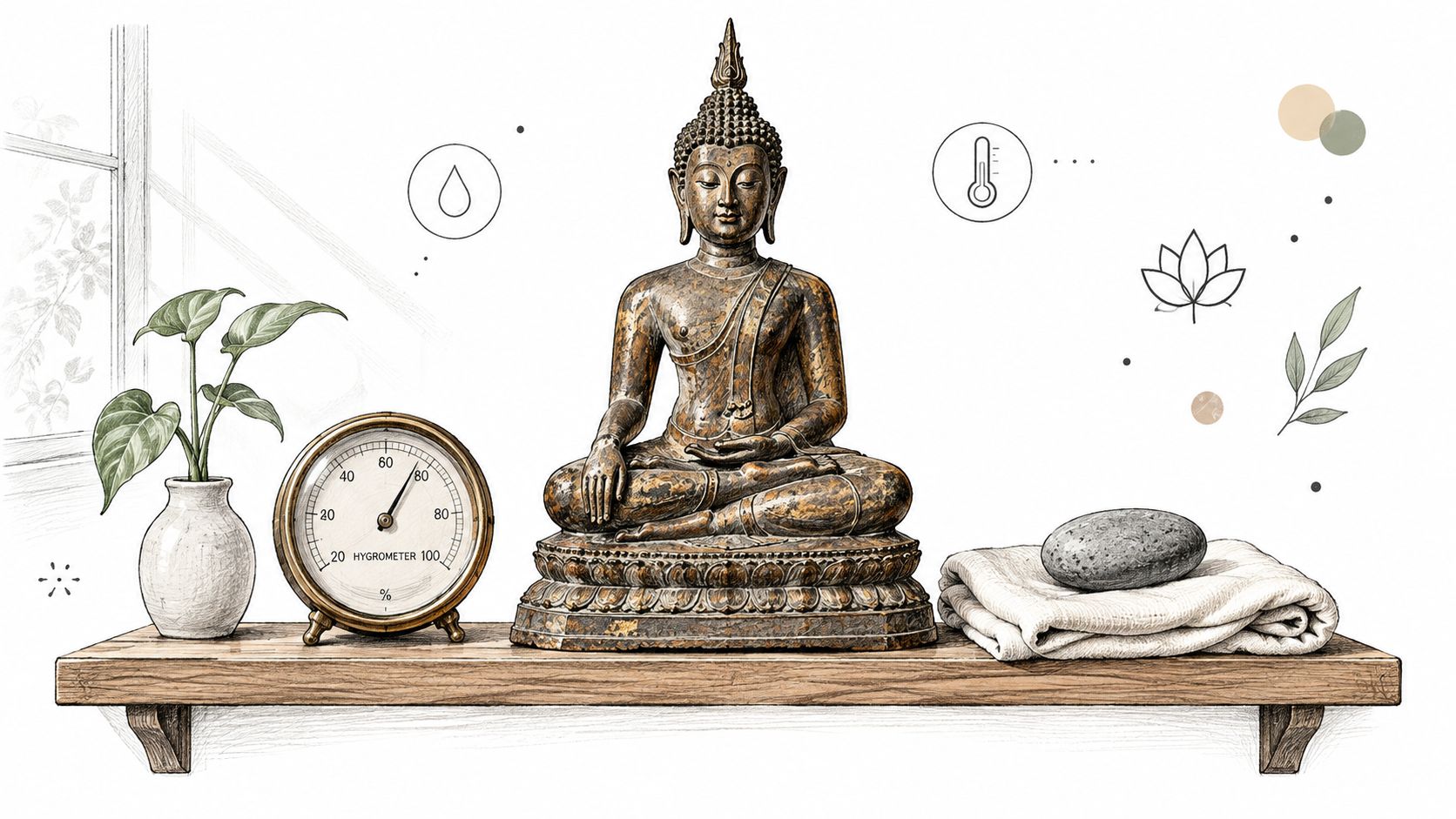
Place the statue on a stable, properly sized support that distributes weight evenly. Avoid narrow shelves, unstable plinths, radiators, fireplaces, damp walls, and areas exposed to repeated vibration. Keep it away from direct sunlight, which can fade lacquer and gilding and heat materials unevenly.
A hygrometer can help you observe changes in the room, but don't chase an arbitrary reading without professional advice. The priority is a steady, moderate indoor environment with no sudden swings. If the statue has flaking gilding, active corrosion, or fragile stone, ask a conservator to assess it before installation.
Clean only with restraint
Dust with a soft, dry brush or clean microfiber cloth, using minimal pressure. Never apply metal polish, wax, household cleaner, oil, water, or abrasive material to an aged surface. Don't remove residues from crevices, bases, or inscriptions. What looks like dirt may be old lacquer, pigment, ritual residue, or evidence of handling.
Display also carries cultural responsibility. Keep the figure raised, clean, and away from clutter, footwear, and casual storage. In a home altar or meditation room, choose a quiet location where the statue can be approached respectfully. Traditional Buddhist practice differs across communities, so consult a practitioner or cultural adviser if the image will be used devotionally rather than presented solely as art.
Choosing a Reputable Specialist Gallery
The seller's expertise matters because the buyer rarely has access to every test or archive. A specialist gallery should provide more than attractive photographs. It should identify the object's proposed period and region, describe the material and condition transparently, disclose restoration, and explain what it can and cannot establish about provenance.
A general marketplace often leaves you to interpret conflicting labels yourself. A museum-oriented specialist can at least create a disciplined starting point. Look for catalogues organised by region, material, and iconography; clear condition and returns policies; secure packing; and staff willing to discuss export documentation before payment.
Questions to ask before purchase
- What is the attribution based on? Ask which facial, bodily, material, and iconographic features support the proposed date.
- What is original? Request disclosure of replaced hands, bases, crowns, gilding, lacquer, and structural repairs.
- What documents accompany the object? Ask for provenance records, invoices, import details, and relevant export paperwork.
- How will it travel? Fragile sculpture needs appropriate packing, handling instructions, insurance, and accurate customs information.
- What happens if an expert disagrees? Read the returns and authenticity terms before committing funds.
HD Asian Art is one UK-based option that organises Southeast Asian sculpture by region and material, publishes contextual guidance, and offers worldwide shipping through its online storefront. Its Thai collection includes antique Thai-style bronzes associated with Sukhothai, Ayutthaya, and Chiang Saen, so the same questions about attribution, condition, and provenance should still be asked before purchase.
The right gallery acts as a curator and a logistics partner, but it doesn't remove your responsibility. Read the catalogue, request the documents, inspect the condition, and verify the export route. That process protects the object as much as it protects your money.
If you're assessing an antique Thai Buddha statue, browse the curated Thai collection at HD Asian Art, then contact the gallery for details on attribution, condition, provenance, and shipping documentation. Use that conversation to establish whether the piece suits your collection and whether its history can withstand serious scrutiny.
